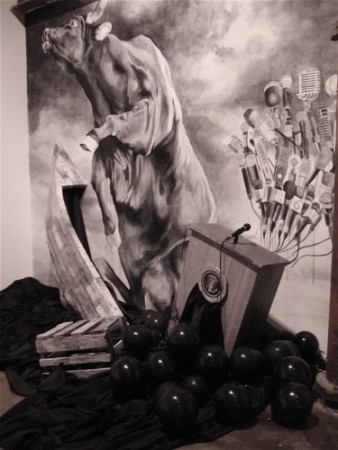
Esteban del Valle installation at Smack Mellon imagines a postapocalyptic political future (photo by twi-ny/mdr)
Smack Mellon
92 Plymouth St. at Washington St.
Opening reception: June 18, free, 5:00 – 8:00
Wednesday – Sunday through July 31, free, 12 noon – 6:00
718-834-8761
smackmellon.org
On June 17, Alicia Grullon kicked off the new political exhibit at Smack Mellon with a full reenactment of Bernie Sanders’s 2010 eight-and-a-half-hour Bush tax cuts filibuster, setting the stage for what will be happening at the Dumbo gallery over the next six weeks. Through July 31, Smack Mellon will be home to “Of the people,” a multidisciplinary show curated by Erin Donnelly that examines the current state of political discourse in America as presumptive presidential nominees Hillary Clinton and Donald J. Trump prepare to do battle, both under the threat of contested conventions. Sheryl Oring’s “I Wish to Say” consists of hundreds of index cards and Polaroids for which ordinary citizens have dictated brief personal letters to the presidential candidates. Daniel Bejar’s “Rec-elections (Let’s Make America Great Again, Isabel González)” are lenticular campaign buttons promoting the Puerto Rican activist. Ben Pinder IV’s small pamphlet “A Brief and Mythic History of Super PACs” turns the birth of the super PACs into comic-book legend. Leah Wolff’s “Political Buttons” declare “Don’t Do It” and are not for the taking.
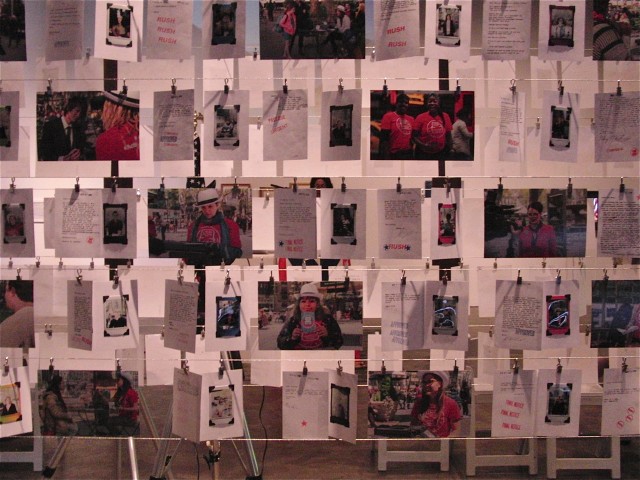
Sheryl Oring’s “I Wish to Say” gives voice to the people (photo by twi-ny/mdr)
Brittany M. Powell’s “Debt Portraits” detail the stories of four Americans, photographed in their homes, facing serious financial problems. Guy Ben-Ari’s “Oval Office Interior” painting imagines the White House room taken over by women. On Saturdays and Sundays (and July 7 evening), anyone can come to Smack Mellon and present their own case to be president in Jeremy D. Olson’s multimedia “Campaign Office.” Esteban del Valle’s untitled corner installation depicts a kind of postapocalyptic scenario with black balloons, a falling presidential podium, and a bull rising in the background. Peggy Diggs’s “Heirloom” includes a large-scale “Ideal Ballot” you can take home The show also features works by Isabella Cruz-Chong, Emily Greenberg, Brooklyn Hi-Art Machine (Mildred Beltre and Oasa DuVerney), Kate Sopko, and Lauren Frances Adams. On July 27 at 7:00, Hrag Vartanian, Miriam M. Basilio, and Bejar will participate in a panel discussion on propaganda; on July 28 at 5:30, Brooklyn Hi-Art Machine will present a silkscreen workshop in which attendees can make their own political posters; on July 30-31, t.Rutt will display Trump’s actual old campaign bus, which they bought late last year on Craiglist; and on July 31, Martha Wilson will be at Smack Mellon for “Martha Wilson as Donald Trump — Politics and Performance Art Are One and the Same,” followed by the panel discussion “Community Practices: Art and Intervention” with Cruz-Chong, Oring, and Sopko, moderated by Donnelly. The exhibition also has information on all of the registered political parties in New York State, useful websites, and voter registration forms, so you have no excuse not to get involved in this rather vitriolic and critically important election year.

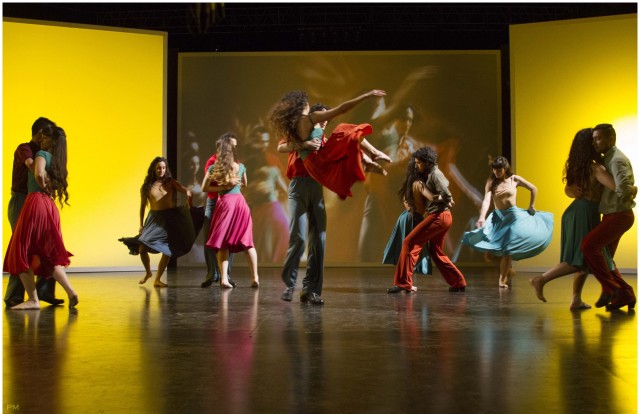
 Spanish writer-director Carlo Saura celebrates the history and tradition of Argentinian music and dance in the joyous documentary Argentina. The eighty-four-year-old Saura, whose previous films include Carmen, Tango, El amor brujo, and Flamenco, Flamenco, and production designer Pablo Maestre Galli built stages in a vast, empty barn in La Boca barrio of Buenos Aires City to honor such local and regional art forms as Zamba, Vidala, Chacarera, Malambo, Copla, and Chamamé. Using archival footage, silhouette-creating scrims, mirrors, and live projections, Saura and cinematographer Félix Chango Monti follow a series of set pieces with no narration or explanation, creating a simple and beautiful record of Argentinian music and dance. Among the lovely performances are pianist Horacio Lavandera playing Carlos Guastavino’s “Bailecito,” “Bagualas” featuring Mariana Carrizo, Melania Pérez, and Tomas Lipan, “La Felipe Varela” with Chaqueño Palavecino and Jimena Teruel, “Añoranzas” by Soledad Pastorutti, Metabombo’s “Ritmo de Malambo” with Carlos “Pajarín” Saavedra and Jorge “Koki” Saavedra, and “En el fondo del mal” by Gabo Ferro and Luciana Jury.


 First it took a long time for French-Vietnamese writer-director Tran Anh Hung (The Scent of Green Papaya) to convince Japanese novelist Haruki Murakami to let him adapt his 1987 novel, Norwegian Wood — Tran had been interested in turning the book into a movie ever since he first read it in 1994, but Murakami notoriously does not allow his novels to become films — and then, once the film was made and played at prestigious festivals in Venice, Toronto, and Dubai, still took more than a year to find a U.S. distributor. Norwegian Wood is a moving, faithful adaptation of Murakami’s elegiac novel about unrequited love, romantic communication, and death. After his best friend, Kizuki (Kengo Kora), commits suicide, Watanabe (Death Note’s Ken’ichi Matsuyama) and Kizuki’s girlfriend, Naoko (Babel’s Rinko Kikuchi), who previously were part of an inseparable trio with Kizuki, go their separate ways. After a short time, they meet up accidentally in Tokyo, where Watanabe is attending university and Naoko is trying to get over her loss. But an event on her twentieth birthday causes Naoko to take off again, this time seeking professional help at a sanitarium. Watanabe can’t stop thinking about Naoko, jeopardizing a possible relationship with the aggressive, sexually open Midori (Kiko Mizuhara), who already has a boyfriend but is extremely interested in Watanabe. Meanwhile, Watanabe disapproves of how his friend Nagasawa (Tetsuji Tamayama) continually cheats on his girlfriend, Hatsumi (Eriko Hatsune), who is devoted to him. With the student riots of the late 1960s swirling around them, Watanabe, Naoko, Midori, Nagasawa, Hatsumi, and Naoko’s roommate, Reiko (Reika Kirishima), take long, hard looks at what they want out of life and love, and they don’t always like what they find. Beautifully shot by Mark Lee Ping-Bing and featuring a subtle score by Radiohead’s Jonny Greenwood (There Will Be Blood), Norwegian Wood is a slow-paced, psychologically intense drama. Watanabe and Naoko are often shown walking amid vast natural landscapes of green forests and snow-covered mountains, but they are tied up tight within themselves, trapped in their own memories. The carefully composed sex scenes give depth and intelligence to the main characters without overplaying their emotions. The story itself might be relatively slight — it lacks the range of Murakami’s later books — but Tran has done a fine job bringing it to the screen. Norwegian Wood is screening at MoMA on June 17 and 29 at 7:30 in the series “Luminosity: The Art of Cinematographer Mark Lee Ping-Bing,” which runs June 16-30 and includes such other Lee-lensed treasures as Yang Chao’s Crosscurrent, Wang Tung’s Strawman, Tran’s The Vertical Ray of the Sun, and Hou Hsiao-hsien’s Flowers of Shanghai, Dust in the Wind, The Assassin, and The Puppetmaster. In addition, Lee will sit down with Department of Film associate curator La Frances Hui for