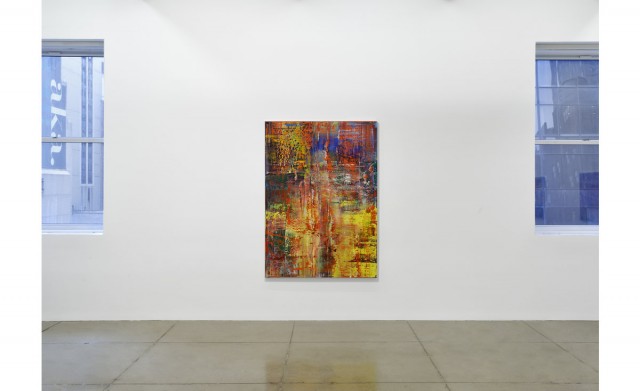
Installation view, Gerhard Richter, “941-1 Abstraktes Bild,” oil on canvas, 2015 (photo courtesy Marian Goodman Gallery)
Marian Goodman Gallery
24 West 57th St. between Fifth & Sixth Aves.
Tuesday – Saturday through June 25, free, 10:00 am – 6:00 pm
212-977-7160
www.mariangoodman.com
www.gerhard-richter.com
In 1985, Gerhard Richter wrote, “When I paint an abstract picture (the problem is very much the same in other cases), I neither know in advance what it is meant to look like nor, during the painting process, what I am aiming at and what to do about getting there. Painting is consequently an almost blind, desperate effort, like that of a person abandoned, helpless, in totally incomprehensible surroundings — like that of a person who possesses a given set of tools, materials and abilities and has the urgent desire to build something useful which is not allowed to be a house or a chair or anything else that has a name; who therefore hacks away in the vague hope that by working in a proper, professional way he will ultimately turn out something proper and meaningful.” Well, the German artist has turned out something proper and meaningful yet again, reinventing painting for the umpteenth time in his latest stirring cycle, 2014-15’s “Abstraktes Bild,” twenty spectacular examples of which are on view at Marian Goodman Gallery through June 25. Comprising ten large-scale oil-on-canvas works and ten smaller pieces (on canvas, wood, or aluminum mounted on wood), the series is utterly breathtaking, a deluge of color and abstract form that nearly jumps out of each work and envelops you with its physicality. Richter, who turned eighty-four earlier this year, built up layers of paint on each canvas, letting them dry and scratching and scraping at them until arriving at the finished work. Since 2010, Richter, who was profiled in the excellent 2011 documentary Gerhard Richter Painting, has been focusing on “initiatives directed towards recasting painting,” Dieter Schwarz explains in the catalog, “in various ways, in order to return to it in the end.” Don’t rush through these paintings; instead, take your time and inhale their supreme beauty. The exhibition also includes five of Richter’s lacquer-behind-glass Aladin pieces; fourteen photographs that Richter partially painted over, melding the real and the surreal, fact and fiction in primarily outdoor scenes; and forty pencil drawings lined up at eye level across the rear space, works that Schwarz writes are “not preparatory studies for paintings but rather a kind of finale, which can be understood in relation with the introduction, crescendo, development, and conclusion of the painting sequence.” And what a sequence it is.
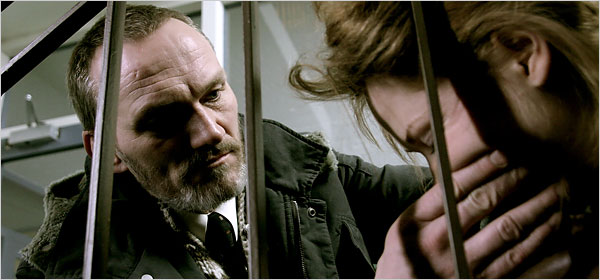
 Writer-director Baltasar Kormákur’s adaptation of Arnaldur Indriðason’s award-winning novel Jar City is a bleak but compelling police procedural that focuses on a fact-based controversial government initiative that is cataloging genetic research on all Icelandic families. When an aging man named Holberg (Thorsteinn Gunnarsson) is murdered in his home, brooding inspector Erlendur (Ingvar E. Sigurdsson) heads the investigation into the death, leading him to a thirty-year-old rape, a dirty cop, a trio of criminals (one of whom has been missing for a quarter century), a woman who killed herself shortly after her four-year-old daughter died, and a doctor who collects body parts. The divorced Erlendur also has to deal with his troubled daughter (Augusta Eva Erlendsdottir), a pregnant drug addict who hangs out with some very sketchy company. Meanwhile, a mysterious man (Atli Rafn Sigurdarson) is up to something following the traumatic death of his young daughter. Kormakur weaves together the story line of the two fathers side by side — in the book, the unidentified man appears only near the conclusion, although who he is still remains a mystery for most of the film — centering on the complex relationship between parents and children and what gets passed down from generation to generation, both on the outside and the inside. Sigurdsson plays Erlendur with a cautious seriousness, the only humor coming from the way he treats his goofy partner, Sigurdur Oli (Bjorn Hlynur Haraldsson). Iceland’s entry for the 2007 Best Foreign Language Film Oscar and winner of the Crystal Globe at the Karlovy Vary International Film Festival, Jar City is a dark, tense intellectual thriller. Indriðason has turned Erlendur into a continuing character in such follow-ups as Silence of the Grave and Voices; we were hoping Kormákur and Sigurdsson would do the same, but instead the director has gone on to make such Hollywood fare as Contraband, 2 Guns, and Everest. Jar City will be screening on June 22 and 23 in the IFC Center series “Cold Cases: The Department Q Trilogy and the New Nordic Noir,” which runs through June 23 and includes such other cool films as Daniel Espinosa’s Easy Money, Henrik Ruben Genz’s Terribly Happy, and Morten Tyldum’s Headhunters.