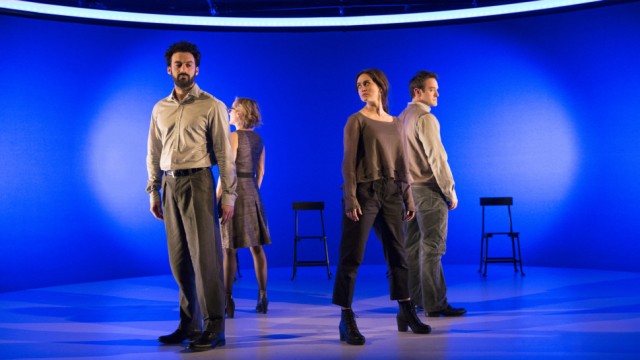
Morgan Spector, Geneva Carr, Heather Lind, and Charlie Cox play multiple roles in Nick Payne’s ingenious INCOGNITO (photo by Joan Marcus)
Manhattan Theatre Club
New York City Center Stage 1
Extended through July 10, $105
212-581-1212
incognitoplay.com
www.nycitycenter.org
Some entertainments let us check our brains at the door when we enter a theater, seeking mindless, feel-good entertainment to take us away from the drudgery and complications of modern life. However, thirty-two-year-old British playwright Nick Payne not only forces audiences to use their noggins but uses the human brain as the catalyst and centerpiece of his ingenious play Incognito, which has been extended at City Center through July 10. In such previous works as Constellations, If There Is I Haven’t Found It Yet, and Elegy, science plays a major role as Payne examines such topics as climate change, time, death, string theory, and the multiverse. Loosely inspired by several real stories, Incognito features four actors playing twenty parts built around three intertwining scenarios. Dr. Thomas Harvey (Spector) has performed the autopsy on Albert Einstein, cutting out his brain and bringing it home with him for further study. (Yes, this is based on fact.) “I got the professor in fronta me, I already opened him up and I’m looking at this . . . brain, and I’m thinking to myself: this could be the biggest moment of my life. So I took it,” the pathologist tells his incredulous wife, Elouise (Carr). Meanwhile, Dr. Victor Milner (Spector) is meeting with his patient, pianist Henry Maison (Cox), an epileptic who, following a brain operation to try to stop his seizures, now suffers from short-term memory loss, essentially restarting every forty-five seconds. His devoted wife, Margaret Thomson (Lind), is attempting to use musical therapy to help him, but Henry seems to have forgotten how to play the piano as well. In the third arc, Dr. Martha Murphy (Carr) is a divorced clinical neuropsychologist going on her first date with a woman, the free-spirited Patricia Thorn (Lind). Over the course of eighty-five breathless minutes, the stories overlap and intertwine either directly or conceptually as Payne explores love, grief, memory, identity, and time-and-space relativity.
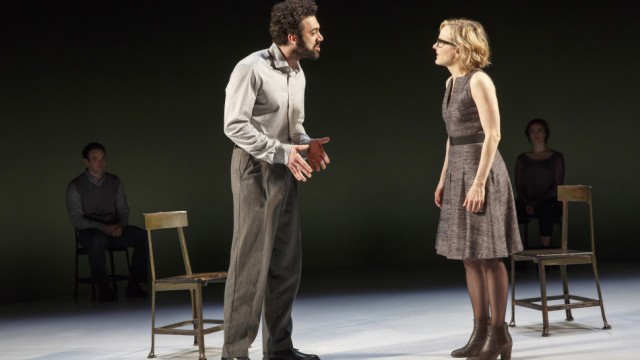
Morgan Spector and Geneva Carr face off while Charlie Cox and Heather Lind watch in dazzling play by Nick Payne (photo by Joan Marcus)
Divided into three sections — Encoding, Storing, and Retrieving — Incognito takes place on Scott Pask’s essentially simple set, a circular platform with four chairs. The characters and multiple plotlines change instantly, like the firing of neurons in the brain, often in the middle of a conversation or sentence, the actors, wearing the same clothes throughout, using different accents and manners of speaking to indicate the sudden shifts in time and place, along with lighting cues from Ben Stanton. In addition, there is occasional abstract movement set to music by David Van Tieghem. It’s all seamlessly directed by Tony winner Doug Hughes (Doubt, The Father) and expertly acted by Carr, Cox, Lind, and Spector, who effortlessly slide from one role to another as the stories weave together in this Manhattan Theatre Club production. “Our brains are constantly, exhaustively working overtime to deliver the illusion that we’re in control, but we’re not,” Martha tells Patricia. “The brain builds a narrative to steady us from moment to moment, but it’s ultimately an illusion. There is no me, there is no you, and there is certainly no self; we are divided and discontinuous and constantly being duped. The brain is a storytelling machine and it’s really, really good at fooling us.” The same can be said for Payne’s marvelously constructed play, which makes audiences’ brains work overtime, but it’s well worth it. “Imagination is more important than knowledge. Knowledge is limited. Imagination encircles the world,” one of Martha’s patients, Anthony (Spector), tells her, quoting Einstein. Incognito is riveting theater, with knowledge and imagination to spare.
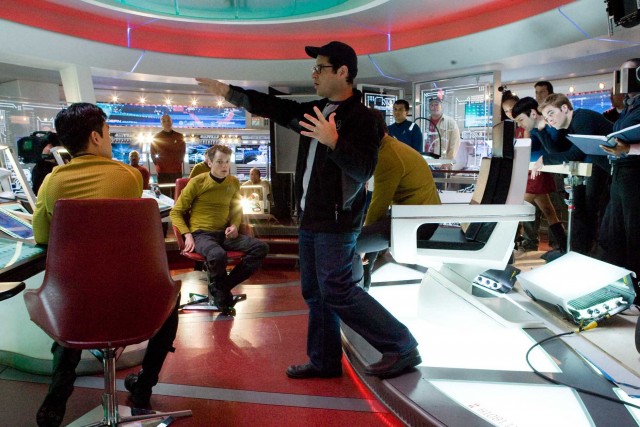
 The sudden, tragic death of Anton Yelchin, the twenty-seven-year-old Russian actor who was starring as Ensign Pavel Chekov in J. J. Abrams’s reboot of the Star Trek movie franchise, has cast a pall over the upcoming July 22 release of the third film in the series, Star Trek Beyond. But to prepare for the new flick, you can catch the first one for free on July 7 at the Intrepid Sea, Air & Space Museum. Just as Kirk has his Khan, Spock gets his Nero in Abrams’s immensely entertaining time-traveling Star Trek movie. Abrams (Lost, Cloverfield) goes back to the very beginning, with the tumultuous birth of one James Tiberius Kirk (Chris Pine), whose father was a legendary member of Star Fleet. Soon he winds up aboard the U.S.S. Enterprise, surrounded by a crew that includes a logical Vulcan named Spock (Zachary Quinto); Uhura (Zoe Saldana), a hot language specialist; Leonard “Bones” McCoy (Karl Urban), a goofy doctor; seventeen-year-old helmsman Pavel Chekov (Yelchin); engineer extraordinaire Montgomery Scott (Simon Pegg); and rookie pilot and swordsman Hikaru Sulu (John Cho). In this sort-of Star Trek Babies tale, the young cadets are suddenly thrust into action with Captain Pike (Bruce Greenwood), on a mission that involves evil villain Nero (Eric Bana), a rogue Romulan with an ax to grind. Star Trek fans will love all the little homages to the series and the previous films, with both obvious and obscure references every step of the way as we learn how this famous crew first met one another and developed their extremely familiar relationships. Star Trek is screening July 7 on board the flight deck of the Intrepid as part of the museum’s free summer movie series and is a great way to get ready for the new interactive exhibition


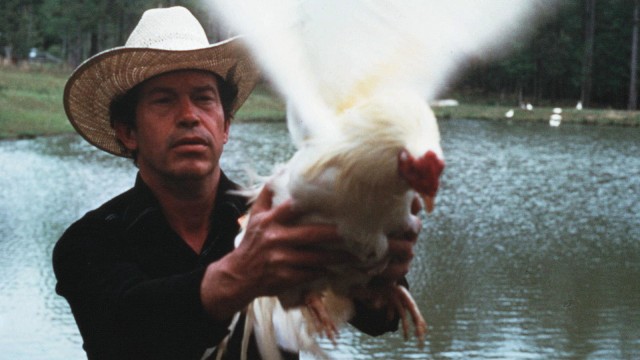
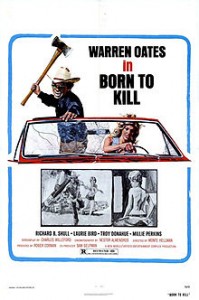
 Director Monte Hellman and star Warren Oates enter “the mystic realm of the great cock” in the 1974 cult film Cockfighter. Alternately known as Born to Kill and Gamblin’ Man, the film is set in the world of cockfighting, where Frank Mansfield (Oates) is trying to capture the Cockfighter of the Year award following a devastating loss that cost him his money, car, trailer, girlfriend, and voice — he took a vow of silence until he wins the coveted medal. Mansfield communicates with others via his own made-up sign language and by writing on a small pad; in addition, he delivers brief internal monologues in occasional voiceovers. He teams up with moneyman Omar Baradansky (Richard B. Shull) as he attempts to regain his footing in the illegal cockfighting world, taking on such challengers as Junior (Steve Railsback), Tom (Ed Begley Jr.), and archnemesis Jack Burke (Harry Dean Stanton); his drive for success is also fueled by his desire to finally marry his much-put-upon fiancée, Mary Elizabeth (Patricia Pearcy). The cast also includes Laurie Bird as Mansfield’s old girlfriend, Troy Donahue as his brother, Millie Perkins as his sister-in-law, Warren Finnerty as Sanders, Allman Brothers guitarist Dickey Betts as a masked robber, and Charles Willeford, who wrote the screenplay based on his novel, as Ed Middleton.