twi-ny recommended events

QUIETLY

QUIETLY

Ian (Declan Conlon), Robert (Robert Zawadzki), and Jimmy (Patrick O’Kane) do more than just watch the match in Owen McCafferty’s QUIETLY

Irish Repertory Theatre
132 West 22nd St. between Sixth & Seventh Aves.
Tuesday – Sunday through September 11, $50 – $70
212-727-2737
www.irishrep.org

Owen McCafferty’s searing, sharp-edged, fictional Quietly might be set in a Belfast pub in 2009, but its theme is so frighteningly universal that it could be describing real events in any part of the world today. Polish émigré and barman Robert (Robert Zawadzki) is watching a World Cup qualifier between Poland and Northern Ireland when everyday regular Jimmy (Patrick O’Kane) comes in for a few pints. A bitter, angry man with a massive chip on his shoulder, Jimmy claims not to care about the game, or the news about a pub that was smashed up by some Poles. He warns Robert that there is likely to be a different kind of trouble when a man he is waiting for arrives. “But it’s nothin for you to worry about,” Jimmy says. Robert: “No trouble — can’t afford for trouble — I get the blame.” Jimmy: All a meant was just in case there was a bit a shoutin — don’t panic.” Robert: “A bit of shouting.” Jimmy: “Yes, a bit a shoutin — nothin for you to get involved in — ya understan — stay out of it — nothin to do with you.” Robert: “A bit of shouting — everyone shouts here — it’s the national sport.” Jimmy: “We all need to be heard at the same time.” The soft-spoken Robert is in Northern Ireland trying to make a new life for himself but is stuck in the same rut. “I didn’t come over here to be a barman — Belfast isn’t barman mecca — not the fucking capital of the barman world — I came over to work and ended up a barman because I was one before,” he tells Jimmy, who is lost in his own drama. The situation explodes almost immediately when Ian (Declan Conlon) enters the pub. Although both Ian and Jimmy are fifty-two and well aware of each other’s existence, they have never met before, despite their involvement in an event thirty-six years earlier that profoundly altered both their lives. “I’m here because we’re the same age,” Ian says. “You’re not my fuckin age — my age has to do with the life I’ve led — you haven’t led my life,” Jimmy responds, to which Ian adds, “I led a life — my life.” As the facts slowly start coming out on what happened on that fateful day of July 3, 1974, the tension builds to a shattering conclusion.

The award-winning Abbey Theatre production, being staged at the Irish Rep in association with the Public Theater, is a sizzling drama zeroing in on how politics, religion, status, and birthplace can tear people apart, leading to senseless violence no matter what side you’re on. It’s also very much about forgiveness, specifically referencing the controversial truth and reconciliation process. Conlon (The House, Terminus) is rock solid as Ian, carefully balancing pride and regret, and Zawadzki (The Shoemakers, Who Is That Bloodied Man?) is calm as Robert, who is caught in the middle. But Quietly belongs to the Belfast-born O’Kane (The House, As the Beast Sleeps), who won several UK best actor awards for his compelling performance. O’Kane commands the stage, whether sitting with crossed arms on a barstool, drinking a pint of Harp, or confronting Ian face-to-face. (Catherine Fay’s set is based on a real pub that McCafferty used to live near and which was blown up by the Ulster Volunteer Force.) You can almost see the heat rising from O’Kane’s bald pate. It’s a memorable performance in a gripping play, tautly directed by Lyric Theatre executive producer Jimmy Fay (The Risen People, Here Comes the Night). And it ends with a final reminder that, in this increasingly polemic, xenophobic world, anyone could be next.

ISAAC MIZRAHI: AN UNRULY HISTORY

(photo by Will Ragozzino/SocialShutterbug.com)

Jewish Museum exhibition highlights Isaac Mizrahi’s fashion design sense and colorful personality (photo by Will Ragozzino/SocialShutterbug.com)

The Jewish Museum
1109 Fifth Ave. at 92nd St.
Daily through August 7, $15 (free admission Saturday, pay-what-you-wish Thursday 5:00 – 8:00)
212-423-3200
www.thejewishmuseum.org
www.isaacmizrahi.com

“I feel like a filmmaker/playwright trapped in the body of a fashion designer . . . seriously,” Isaac Mizrahi says on the audioguide accompanying the sensational exhibition “Isaac Mizrahi: An Unruly History,” continuing at the Jewish Museum through August 7. Exhibition organizers Chee Pearlman and Kelly Taxter have done a fabulous job of creating a compelling narrative arc to the show, brilliantly bathing visitors in Mizrahi’s intense love of color (“Color is the biggest luxury there is.”), wild sense of humor (“I think that the ability to laugh at myself sets me apart. I don’t understand people without humor, and I just don’t like certain things because they have no humor.”), and proud dedication to both high and low culture, from movies and television to opera, theater, and art, from Woody Allen, Fred Astaire, and Bette Davis to The Red Shoes, Lucille Ball, and Egyptian hieroglyphics. The show also explores the Brooklyn-born-and-raised Mizrahi’s creative expression in a number of different media. Splendid fashion drawings, which are works of art on their own, cover two walls; the designer works out ideas for potential outfits in these small sketches of tall, thin models, their bodies filling the paper from top to bottom. Another room is like a runway through his career as a costume designer for choreographers Mark Morris and Twyla Tharp and as designer and director for the Opera Theatre of St. Louis, for whom he created playful, fantastical costumes and a dazzling blue satin dress with one of the longest trains you’re ever likely to see, wrapping around a staircase and across the floor (for the Queen of the Night in The Magic Flute). Another section sits the audience down for a montage of his numerous television and movie appearances, including hosting several programs of his own, competing on Celebrity Jeopardy!, guest judging on Project Runway, starring in his own one-man show (Les MIZrahi), selling his clothes at Target and on QVC, and making cameos galore. “Isaac is a polymath of many talents and does not take himself too seriously in that he doesn’t see himself as a grand fashion figure. What he is . . . is what you see,” Pearlman says on the audioguide. “There is an instant, infectious warmth to him. He channels a light, happy, joyous spirit which he unleashes in his clothing.”

Dozens of mannequins are adorned with Mizrahi’s unique designs, which reveal his personality, style, and endless ingenuity, which was first brought to the general public’s attention in the innovative 1995 documentary Unzipped. “Baby Bjorn Ballgown” is a striking red dress with a place for an infant in the front (“The birth of a child should be integrated into a woman’s social life.”). “The Real Thing” is a pailette dress made from flattened Coke cans, a sly riff on consumerism. “Desert Storm” celebrates camouflage in a new way. “Extreme Kilt” reimagines the Scottish traditional garb in cashmere flannel (“There’s a million rules about kilts, and about plaids, and I thought it was hilarious and I liked knowing everything about it and then being able to absolutely destroy this knowledge.”) “Kitchen Sink Pink Dress” was influenced by neon-light artist Dan Flavin, “Exploded Tulip” was based on an Irving Penn photograph, and “Grand Pupa” takes its name from its cocoonlike shape and the name of the leader of Fred Flintsone’s lodge. The exhibition also includes a series of photographs Nick Waplington took of Mizrahi at work from 1989 to 1993, clips from dance and theater performances that Mizrahi designed, directed, and/or appeared in, and a room of such accessories as “Lobster Epaulet,” “Cardboard Boater,” “Fox Piece,” “Spring Heeled Heels,” and “Campaign Box Clutch.” At the center of it all, Mizrahi’s love of life and fashion shine through, highlighting a fascinating rebel who has always insisted on doing things his own way. “I’m just going to be myself,” he says. To give as many people as possible a chance to see this superb midcareer retrospective, the Jewish Museum will be open on Wednesday (when it’s usually closed) and has extended viewing hours to 8:00 on Saturday (when it’s free) and Sunday.

TICKET ALERT: BAM 2016 NEXT WAVE FESTIVAL

Mikhail Baryshnikov channels Nijinsky in Robert Wilsons LETTER TO A MAN (photo by Lucie Jansch)

Mikhail Baryshnikov channels Nijinsky in Robert Wilson’s LETTER TO A MAN (photo by Lucie Jansch)

Who: Performers and/or creators Mikhail Baryshnikov, Isabelle Huppert, Ivo van Hove, Robert Wilson, Peter Brook, John Jasperse, Godspeed You! Black Emperor, Alarm Will Sound, Howard Fishman, David Lang, Jonah Bokaer, Daniel Arsham, TR Warszawa, Cheek by Jowl, the Magnetic Fields, So Percussion, Wordless Music Orchestra, Shen Wei Dance Arts, Kyle Abraham / Abraham.In.Motion, Faye Driscoll, Mark Morris Dance Group, and many more
What: Annual fall interdisciplinary performance festival
Where: BAM Harvey Theater (651 Fulton St.), BAM Howard Gilman Opera House (30 Lafayette Ave.), BAM Fisher (321 Ashland Pl.)
When: September 7 – December 3
Why: Tickets for BAM’s 2016 Next Wave Festival have just gone on sale to the general public, but you better hurry if you want to see some of the hottest shows of what is always a great collection of innovative dance, music, film, theater, and hard-to-describe hybrid presentations from around the world. This year there are more than five dozen events, including performances, talks, and master classes. We don’t know about you, but we’ll be practically living at BAM this fall. Below are five of our don’t miss favorites.

Isabelle Huppert stars as a modern-day mythical queen in PHAEDRA(S) (photo by Pascal Victor/ArtComArt)

Isabelle Huppert stars as a modern-day mythical queen in PHAEDRA(S) (photo by Pascal Victor/ArtComArt)

PHAEDRA(S)
BAM Harvey Theater
September 13-18, $30-$95
Isabelle Huppert is back at BAM, following her stunning turns in Sarah Kane’s 4.48 Psychosis in 2005 and Robert Wilson’s Quartett in 2009. This time she stars as the mythological queen in Phaedra(s), in which director Krzysztof Warlikowski and Odéon-Théâtre de l’Europe incorporate texts by Kane, Wajdi Mouawad, and J. M. Coetzee to tell the three-and-a-half-hour story of love and tragedy. On September 18, BAM will host the related panel discussion “Phaedra Interpreted” at Borough Hall as part of the Brooklyn Book Festival.

REMAINS
BAM Harvey Theater
September 21-24, $20-$45
John Jasperse, who presented the exhilarating Canyon at BAM in 2011, now looks back at his thirty-year career as well as toward the future in Remains, featuring dancers Maggie Cloud, Marc Crousillat, Burr Johnson, Heather Lang, Stuart Singer, and Claire Westby and music by John King. On September 22 at 2:00 ($30), Jasperse will teach a master class for intermediate to professional dancers at the Mark Morris Dance Center, and on September 23 at 6:00 ($25) he will participate in a talk with Tere O’Connor at BAM Fisher.

LETTER TO A MAN
BAM Harvey Theater
October 15-30, $35-$120
BAM regular Robert Wilson reteams with Mikhail Baryshnikov in this multimedia staging of the diaries of Vaslav Nijinsky; the two collaborated at BAM in 2014 with The Old Woman. Baryshnikov recently paid tribute to his friend Joseph Brodsky in Brodsky/Baryshnikov, while Wilson has presented such aural and visual spectacles at BAM as Quartett, The Black Rider, and Woyzeck. On October 24 at 7:00 at NYU’s Center for Ballet and the Arts, “Inside Nijinsky’s Diaries” will consist of an actor reading from the diaries, followed by a discussion (free with advance RSVP).

Ivo van Hove merges multiple Shakespeare plays into KINGS OF WAR (photo by Jan Versweyveld)

Ivo van Hove merges multiple Shakespeare plays into KINGS OF WAR (photo by Jan Versweyveld)

KINGS OF WAR
BAM Howard Gilman Opera House
November 3-6, $24-$130
In-demand director Ivo van Hove and Toneelgroep Amsterdam return to BAM for a four-and-a-half-hour adaptation of Shakespeare’s Henry V, Henry VI Parts I, II & III, and Richard III. Van Hove has previously staged such works as Angels in America, Cries and Whispers, and Antigone (with Juliette Binoche) at BAM, in addition to the double shot of A View from the Bridge and The Crucible on Broadway.

THANK YOU FOR COMING: PLAY
BAM Fisher
Judith and Alan Fishman Space
November 16-19, $25
Choreographer Faye Driscoll follows up Thank You for Coming: Attendance with this new work, which we got a sneak peek at this past weekend on Governors Island. Driscoll’s presentations (There is so much mad in me, 837 Venice Blvd.) are always involving and unpredictable, and this piece is no exception. Driscoll will also be teaching a master class on November 18 at 2:00 ($30) for performers at all levels.

PRIVACY

Daniel Radcliffe and Reg Rogers in PRIVACY (photo by Joan Marcus)

A closed-down writer (Daniel Radcliffe) has trouble opening up to a psychiatrist (Reg Rogers) in PRIVACY at the Public (photo by Joan Marcus)

Newman Theater, the Public Theater
425 Lafayette St. at Astor P.
Tuesday through Sunday through August 14, $100
212-539-8500
www.publictheater.org

Tickets to James Graham and Josie Rourke’s Privacy come with a unique set of terms and conditions, advising “Privacy is a unique theatrical production that involves interactive moments with the audience, designed to explore how public many details of our lives have become. In order to better explore these issues, information that you provide when purchasing ticket(s) to the production of Privacy at the Public Theater will be used to inform some moments during your performance.” As far as “involving” theater goes, this coproduction with London’s Donmar Warehouse takes it to the next level, especially when, right before the show begins, the prerecorded voice of Public Theater artistic director Oskar Eustis asks audience members to leave their phone on, and then an address is given where they can send photos and texts to. Daniel Radcliffe stars as the Writer, a young man obsessing over his recent breakup with his boyfriend, who accused him of being too closed off. He is too scared to open up and share his innermost thoughts even with a psychiatrist (Reg Rogers), who guides him into situations in which he mentally faces his divorced parents (Rachel Dratch and Michael Countryman) and meets experts on information technology, cybersecurity, surveillance, social media, and personal privacy in the age of the iPhone. Among those he speaks with are Harvard professor Jill Lepore, journalists Ewen MacAskill and James Bamford, OKCupid cofounder Christian Rudder, MIT professor Sherry Turkle, former Facebook marketing director Randi Zuckerberg, FBI director James Comey, and U.S. senator Ron Wyden. These experts and family who enter the Writer’s mind are played by De’Adre Aziza, Raffi Barsoumian, an excellent Countryman, a terrific Dratch, and an outstanding Rogers and are identified by a projection of their faces and credentials on a large rear wall; all of their words are based on original interviews conducted by Graham and Rourke. As the Writer considers sharing more of his life with the psychiatrist as well as online, the audience is asked numerous times to text information or photos that are processed by onstage researcher Harry Davies and, within minutes, are incorporated into the show in clever ways. It’s almost like magic, but instead of pulling a rabbit out of a hat, Davies reveals surprisingly easy-to-access details about audience members. It’s both funny and frightening, but to say much more would give away too many of the show’s “tricks,” including a video appearance by a very special guest near the end.

Daniel Radcliffe and Reg Rogers in PRIVACY (photo by Joan Marcus)

Privacy concerns, with the onstage actors as well as audience members, are at the heart of James Graham and Josie Rourke’s participatory show (photo by Joan Marcus)

The casting of Radcliffe (The Cripple of Inishmaan, Equus) to play the shy, reserved Writer works on two major levels; first, he is excellent in the role, his unwillingness to talk about himself and his hesitant body movements beautifully capturing his character’s fears. In addition, Radcliffe became such an international star from the Harry Potter movies that he probably enjoys very little privacy in real life. He is particularly effective in a scene that may or may not be mostly improvised. When he is not the main subject of attention in the show, it drags significantly, but fortunately that is never for too long. Lucy Osborne’s uncomplicated set design allows Duncan McLean’s creative projections to often steal the audience’s attention, especially when — well, you’ll have to find that our for yourself, but don’t be surprised if you discover something rather personal about various people seated around you. Meanwhile, you won’t learn much about the cast in the Playbill, as numerous words and sentences have been redacted. And if you’re wondering who is providing the voiceovers, it’s British actors Simon Russell Beale and Harriet Walter. The first half of the show, which focuses on the Writer, is much stronger than the second half, which occasionally gets lost in the marvels of technology and the implications of sharing private information online. Also, if you already closely follow the ongoing controversies about government surveillance, drones, hacked email servers, smartphone protections, social media and online shopping algorithms, and other such privacy concerns, you might not learn much that is new. But writer Graham (This House, Finding Neverland) and director Rourke (Les Liaisons Dangereuses, City of Angels), who have also collaborated on The Vote at the Donmar Warehouse, maintain just enough drama to keep all of the data from overwhelming the story. (Radcliffe will be taking part in a TimesTalk with director Daniel Ragussis at the TimesCenter on August 8 at 7:00, discussing their upcoming film, Imperium; tickets are available here.)

EUDORA WELTY — MISSISSIPPI STORIES

Jenny Odle Madden and Alice Rainey Berry bring Eudora Welty and one of her most beloved stories to life in MISSISSIPPI STORIES (Fowler Photography)

Jenny Odle Madden and Alice Rainey Berry bring Eudora Welty and one of her most beloved tales to life in MISSISSIPPI STORIES (Fowler Photography)

The Studio Theatre at Theatre Row
410 West 42nd St. between Ninth & Tenth Aves.
Thursday – Sunday through August 7, $35
www.summonersensemble.org
www.theatrerow.org

Summoners Ensemble Theatre and Memphis-based Voices of the South pay tribute to Pulitzer Prize-winning southern writer Eudora Welty in Eudora Welty — Mississippi Stories, a pair of minimalist one-acts, adapted and directed by Gloria Baxter and starring Jenny Odle Madden and Alice Rainey Berry, running at the small gray box Studio Theatre at Theatre Row through August 7. The show begins with a delightful interpretation of one of Welty’s most beloved short stories, “Why I Live at the P.O.” Published in the 1941 collection A Curtain of Green, the tale is narrated by Sister (Berry) as her family (all played by Madden) gathers for a July 4 celebration. Sister’s younger sibling, Stella-Rondo, spends the day turning everyone against Sister in shameful ways. “Stella-Rondo is exactly twelve months to the day younger than I am and for that reason she’s spoiled,” Sister explains. “She’s always had anything in the world she wanted and then she’d throw it away. Papa-Daddy gave her this gorgeous Add-a-Pearl necklace when she was eight years old and she threw it away playing baseball when she was nine, with only two pearls.” Stella-Rondo has left her husband, Mr. Whitaker, and returned home with a two-year-old daughter whom she insists is adopted despite the child’s highly suspicious resemblance to both Stella-Rondo and the absent Mr. Whitaker. As the women’s long-simmering rivalry heats up, Sister’s standing in the family grows more and more dire. Berry is spectacular as Sister, delivering Welty’s slyly uproarious words with the poetry and grace they deserve, the lines just flowing off her tongue as she walks around the three chairs that form all the scenery on the stark stage and maintains nearly continual direct eye contact with the audience, making sure no one misses a single instant. Fluidly shifting among multiple eccentric characters, Madden overplays her roles with exaggerated gestures and cartoony facial movements, but Berry manages to bring it all back home every time.

In the second act, Berry and Madden both portray Welty in “Listening,” the first chapter from Welty’s 1984 memoir, One Writer’s Beginnings. The chairs are removed and replaced by a trunk and a long spread of fabric on the floor, which occasionally come into play as Welty recounts scenes from her childhood that put her on her career path. (Madden:) “In our house on North Congress Street in Jackson, Mississippi, where I was born, the oldest of three children, in 1909,” (Berry:) “we grew up to the striking of clocks.” (Madden:) “There was a mission-style oak grandfather clock standing in the hall,” (Berry:) “which sent its gong-like strokes through the living room, dining room, kitchen, and pantry, and up the sounding board of the stairwell. Through the night, it could find its way into our ears; sometimes, even on the sleeping porch, midnight could wake us up.” Welty remembers discovering the moon and sun and stars, listening to her mother tell stories to her friends, and hearing such expressions as “Well, I declare,” “You don’t say so,” and “Surely not.” Madden then adds, “Years later, beginning with my story ‘Why I Live at the P.O.,’ I wrote reasonably often in the form of a monologue that takes possession of the speaker,” to which Berry finishes, “How much more gets told besides!” The second work lacks the drama of the first, but it still tantalizes with Welty’s glorious language and observations about time. Once again Berry is excellent, displaying a natural acting ability that helps distract from Madden’s grander tendencies, which are calmer here than in “Why I Live at the P.O.” The theater world is often overloaded with Shakespeare, Williams, Albee, Shepard, Miller, etc.; Eudora Welty — Mississippi Stories offers a splendid literary alternative. (Note: Ten percent of all ticket sales goes to the Mississippi Center for Justice, which seeks is dedicated to advancing racial and economic justice.)

LAST CHANCE — HEY! HO! LET’S GO! RAMONES AND THE BIRTH OF PUNK / QUEENS INTERNATIONAL 2016

Danny Fields, Ramones in alley behind CBGB, 1977 (photo courtesy the artist)

Danny Fields, “Ramones in alley behind CBGB,” 1977 (photo courtesy the artist)

Queens Museum
New York City Building
Flushing Meadows Corona Park
Sunday, July 31, suggested admission $8, 11:00 am – 5:00 pm
718-592-9700
www.queensmuseum.org

“The Ramones all originate from Forest Hills and kids who grew up there either became musicians, degenerates or dentists. The Ramones are a little of each. Their sound is not unlike a fast drill on a rear molar,” Tommy Erdelyi, aka Tommy Ramone, wrote in in the Ramones’ first press release. That artifact serves as the perfect introduction to “Hey! Ho! Let’s Go: Ramones and the Birth of Punk,” which closes at the Queens Museum on Sunday, July 31, along with the Queens International 2016. The Ramones celebration is being held in conjunction with the fortieth anniversary of the band’s debut album, Ramones, which featured lead singer Joey (Jeffrey Hyman), guitarist Johnny (John Cummings), bassist Dee Dee (Douglas Colvin), and drummer Tommy pumping out fourteen songs in less than half an hour, a nonstop barrage that included “Blitzkrieg Bop,” “I Wanna Be Your Boyfriend,” “Now I Wanna Sniff Some Glue,” and “53rd & 3rd,” on their way to changing the shape of music and underground culture around the world. The exhibition consists of memorabilia galore, from photographs, videos, and artwork to handwritten lyrics, letters, T-shirts, and concert posters, as well as a few of their classic leather jackets and instruments (and the Schlitzie mask used during “Pinhead”). In a back room, the Ramones’ 1977 New Year’s Eve concert at the Rainbow in London plays continuously on the big screen. It’s the first of a two-part exhibition; the second iteration begins in September at the Grammy Museum in L.A. Gabba gabba hey!

Abby Dobson and Sam Vernon will perform in front of Vernon’s “Louis & Sam” collage at the Queens Museum on July 31 (photo by QM Curatorial Staff, courtesy the artists)

Abby Dobson and Sam Vernon will perform in front of Vernon’s “Louis & Sam” collage at the Queens Museum on July 31 (photo by QM Curatorial Staff)

Sunday is also your last chance to catch “Queens International 2016,” the museum’s biennial exhibition focusing on artists who live and/or work in the borough, this time looking at the concept of thresholds. We’re particularly fond of Kate Gilmore’s “Beat It” video (don’t read about it in advance and simply experience it), the Janks Archive’s “The Internal Insults,” a collection of razzes in multiple languages; Alan Ruiz’s “Western Standards,” a different kind of Mexican wall; Melanie McLain’s “Prepersonal” installation, which you are supposed to touch; Shadi Harouni’s “The Lightest of Stones,” a video in which she pulls down rocks in a pumice quarry in Iranian Kurdistan; and Brian Caverly’s “Studio Abandon,” a miniature re-creation of his Ridgewood studio. The closing festivities on Sunday start at 1:00 with “Las Reinas,” a performance by Jesus Benavente and Felipe Castelblanco involving the creation of a new song by two mariachi bands, one in Queens and one in Colombia. At 2:30, “When You’re Smiling . . . The Many Faces of the Mask” is a site-specific performance by singer Abby Dobson and guitarist Sam Vernon in response to the latter’s wall collage “Louis & Sam.” And at 3:00, there will be a screening of “A Frame Apart: Short Films Showcase,” followed by a Q&A with the filmmakers.

GENESIS BREYER P-ORRIDGE: TRY TO ALTAR EVERYTHING

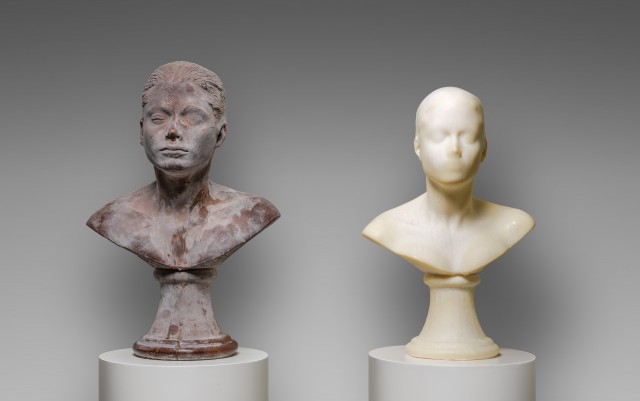
“Crucifom” is one of many unusual ritualistic artworks in Genesis Breyer P-Orridge exhibit at the Rubin Museum (courtesy Invisible-Exports)

“Cruciform” is one of many unusual ritualistic artworks in Genesis Breyer P-Orridge exhibit at the Rubin Museum (courtesy Invisible-Exports)

Rubin Museum of Art
150 West 17th St. at Seventh Ave.
Through August 1, $10-$15
212-620-5000
rubinmuseum.org

There are only three days left to see Genesis Breyer P-Orridge’s intriguing and captivating site-specific, interactive-exchange exhibition “Try to Altar Everything.” Born Neil Andrew Megson in 1950 in Manchester, England, Genesis cofounded the influential industrial bands Throbbing Gristle and Psychic TV as well as the art collective COUM Transmissions. Five years ago, Marie Losier’s documentary, The Ballad of Genesis and Lady Jaye: A Film of Transformation, detailed the love story between Genesis and Lady Jaye, both of whom went through various forms of plastic surgery to become one pandrogynous unit known as Breyer P-Orridge. (Pandrogeny stands for “positive androgeny.”) Lady Jaye passed away in 2007, and h/er death is evident throughout “Try to Altar Everything.” (The artist prefers such gender-neutral pronouns as “s/he,” “h/er,” or the plural “they” and “their.”) The exhibit explores occult ritual, faith and devotion, and the nature of objects; throughout the run of the show, visitors are encouraged to bring a small offering that will be placed in the circular containers in the walls on the sixth floor.

Genesis P-Orridge will take calls as part of Try to Altar Everything (photo courtesy Rubin Museum)

Genesis Breyer P-Orridge will take calls as part of “Try to Altar Everything” (photo courtesy Rubin Museum)

Genesis employs the cut-up method, popularized by Bryon Gysin and William S. Burroughs (whom she knew), to create sculptures and mixed-media collages that reference religion, from Christianity to Hindu and Tantric Buddhism. Each work is filled with strange and fascinating details that are worth investigating, including “Cruciform (Sigil Working),” in which a naked Lady Jaye adopts Christ’s pose on the cross; “Feeding the Fishes,” a shrine with fish, a mandala, and a sphere resting on a mold of gums and teeth; and “Reliquary,” a wooden box with sting ray skin, plastic eggs, a mirror, and photos. There are also illuminated standing coffins, a medicine chest, a bronze hand you’re supposed to touch, a stiletto shoe with bones and fur, and a cabinet of curiosities. And for “Listen Here,” Genesis will occasionally stop by the museum, take a seat in the regal red chair, and answer visitors’ phone calls. It’s a bold, wild, yet deeply personal exhibit that feels right at home at the Rubin. “Once you let go of all the different reasons to not do something, it leaves you with the freedom to do everything, and that was the path we chose,” Genesis says about taking risks in the Artist Extras section of the Rubin website. “Let’s go out and look for revelation, look for creation.” In addition, Genesis has curated a related Friday-night Cabaret Cinema series that continues through August 26 with Fellini Satyricon, Peter Collinson’s Up the Junction, John Schlesinger’s Billy Liar, and Liliana Cavani’s The Night Porter, introduced by Simon Critchley.