twi-ny recommended events

BILL’S 44th

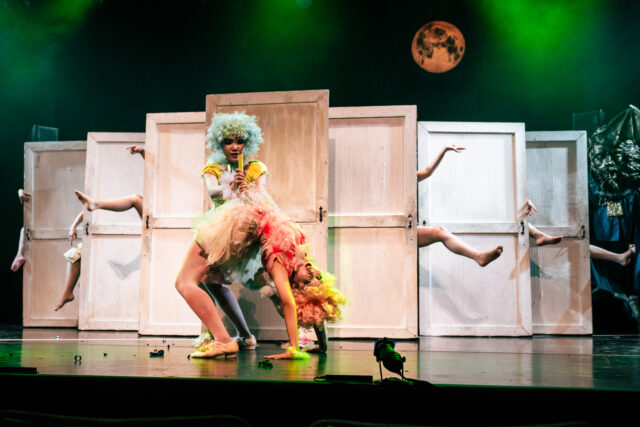
Bill, operated by Dorothy James and Andy Manjuck, hosts a party to remember at HERE Arts center (photo by Richard Termine)

BILL’S 44th
HERE Arts Center
145 Sixth Ave.
Tuesday – Sunday through July 28, $35-$100
here.org

Bill’s 44th is the must-attend party of the summer, and everyone is invited. Although it looks like his friends, relatives, and colleagues have something else to do, their loss is our gain.

Bill is all prepared for his forty-fourth birthday. He puts out the hors d’oeuvres, makes the punch, and gets out the party hats. The music is flowing — it starts with Burt Bacharach’s bright and buoyant theme song from the comic 1967 James Bond film Casino Royale, performed by Herb Alpert & the Tijuana Brass — and Bill is ready to celebrate.

He keeps checking the clock and the door, but as time passes, no one shows up.

There’s a knock at the front, but when he answers it, he sees only a small box on the floor all by itself, from his mother, who apparently has sent a package but will be skipping the festivities as well. Growing sadder by the second, Bill becomes even more dejected when his mother’s present breaks. Bill draws a happy face on a balloon, but, magically, the smile turns upside down into a frown.

Nothing is going right for poor Bill; we feel his pain, his loneliness, his disappointment. We’ve all been there at one point or another, desperate to make a connection with anyone, anything.

Oh, did I mention that Bill is a puppet?

The protagonist is a puppet with a bald head, empty eye sockets, bushy eyebrows, a thick black moustache, two long arms, and a paunchy stomach. He is operated by sound designer Andy Manjuck and puppet designer Dorothy James, who created the piece together; dressed all in black and wearing black masks over their mouths, James handles Bill’s right side, while Manjuck takes care of the left. They each have one arm in a sleeve of Bill’s sweater, using their other arm to move Bill’s head and torso. It takes only a few minutes to get used to the setup and believe that Bill is just another human being, trying to enjoy life and beat the ticking clock.

But with faith in people, trust in oneself, and a boundless imagination, even potential disasters can become moments to treasure.

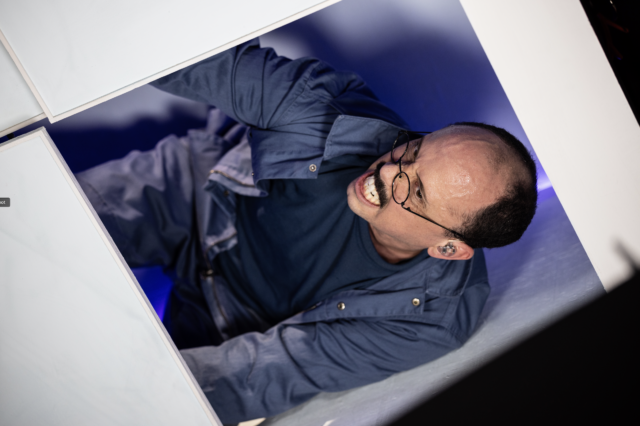
Bill is afraid that no one is coming to his party in the ingenious Bill’s 44th (photo by Ben Wright Smith)

Running at HERE through July 28 as part of the Dream Music Puppetry Program, Bill’s 44th is a fifty-five-minute rollercoaster of emotions that will both break your heart and lift your spirits. There is no dialogue, evoking the silent films of Charlie Chaplin and Buster Keaton in addition to Jacques Tati’s beloved 1950s and ’60s character Monsieur Hulot, who never speaks as he encounters unusual situations in the city, at the beach, and other places.

Eamon Fogarty’s playful score picks up where Bacharach left off, accompanied by M. Jordan Wiggins’s mood-enhancing lighting and Peter Russo, Joseph Silovsky, and Taryn Uhe’s props, which range from balloons and birthday cakes to an unforgettable carrot stick and a dazzling scene in miniature. Jon Riddleberger joins in by operating surprise puppets that are utterly delightful.

With Bill’s 44th — which next travels to the Edinburgh Fringe — Manjuck and James have delivered a marvelously inspired gift, an involving and infectious experience that explores the human condition in ingenious ways that, well, will turn that frown upside down.

This is one party you truly do not want to miss.

[Mark Rifkin is a Brooklyn-born, Manhattan-based writer and editor; you can follow him on Substack here.]

OPEN THROAT

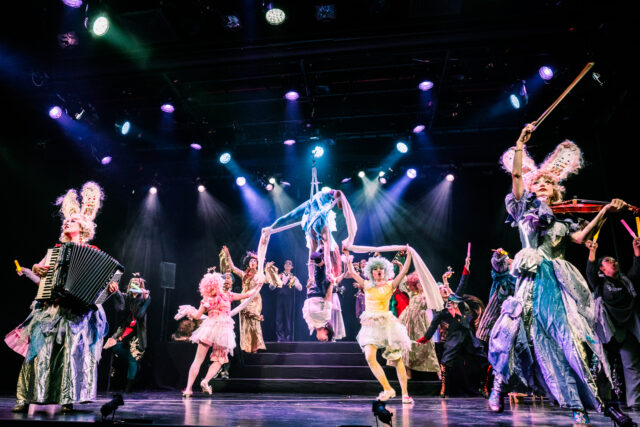
Chris Perfetti is one of three actors who portray a queer mountain lion in Open Throat on Little Island (photo by Julieta Cervantes)

OPEN THROAT
The Amph at Little Island
Pier 55, Hudson River Park at West Thirteenth St.
July 10-14, $25, 8:30
littleisland.org

In the theater, an actor is said to be “on book” if they are using the script onstage. Most often this occurs in previews because they are still working on their lines. A performer can also be on book if they are a last-minute replacement or, as in the case of the protagonist in Marin Ireland’s current Pre-Existing Condition, as a directorial choice relating to the character’s state of mind.

The full cast is on book — literally — in Henry Hoke’s expert adaptation of his highly acclaimed 2023 novel, Open Throat. Throughout the eighty-minute play, the actors read from either the hardcover or paperback edition as they walk across the spare set at the Amph on Little Island, the 687-seat open-air theater that borders the Hudson River. Because of rights issues, and probably also because there are only five performances of the piece, which was commissioned for the space, it had to be a staged reading with scripts in hand, but director Caitlin Ryan O’Connell uses that to her advantage, as the play becomes a celebration of the written word as well as clever stagecraft.

The story is narrated by a queer mountain lion (portrayed first by Chris Perfetti, then Calvin Leon Smith and Jo Lampert) living under the Hollywood sign in the Los Angeles hills, avoiding confrontations with humans, unwilling to be the hunter or the hunted, instead surviving on bats and small animals. “I’ve never eaten a person but today I might,” the lion says early on. The lion, who was inspired by P-22, a puma who lived for ten years in Griffith Park in LA, has no name; a young man in a homeless tent city calls the lion “fucker cat,” “shitfuck cat,” or “goddamn fuck cat.” His mother gave him a name he cannot share and people would be unable to pronounce, while his father gave him a name he won’t repeat. It’s all part of his search for his identity and his place in a foreign world he is trying to understand.

As the lion ventures closer to humans and vice versa, impeding on each other’s territory, the lion encounters a scary man who cracks a whip, a gay couple having sex in a cave, a woman yapping away on a phone, and various hikers and tourists. The lion listens as the people discuss capitalism, therapy, veganism, and dating. But the lion’s life changes dramatically when taken in by a young woman named slaughter who has domestication on her mind.

Henry Hoke’s Open Throat begins just as the sun sets over the Hudson River (photo by Julieta Cervantes)

Open Throat is a beguiling parable about personal identity, family, language, and being part of a community. It feels right at home in the Amph, surrounded by grassy hills, wind whipping through trees, and, on the west side, a beckoning river. At one point, just when the lion is describing how a young man in town refers to machines flying in the sky as “fucking helicopters,” a helicopter actually flew over the water. Unfortunately, many more did, creating loud distractions. The lion often refers to the “long death,” which is a busy street where many animals have met their end, being hit by cars; it’s hard not to compare that to the West Side Highway, which must be crossed in order to enter Little Island. And there are numerous mentions of “a deep forest on the edge of the water,” which is an apt description of the environment encircling the Amph.

Noah Mease’s set features a large, octagonal “O” on the floor; the missing center is represented twice as an object on which Steven Wendt makes shadow puppets with his hands, depicting moments from the lion’s past with his parents, including a poignant kill. Wendt also makes ingenious analog sound effects from atop a scaffold balcony. Perfetti, Smith, and Lampert each brings a different flavor to the lion, involving gender, color, and sexuality, as if any one of us could be the crafty animal. The rest of the characters are played by Marinda Anderson, Alex Hernandez, Layla Khoshnoudi, Ryan King, and Susannah Perkins, moving from the wings to the aisle steps to a balcony; rising star Perkins — she’s excelled in such plays as Grief Hotel, The Welkin, The Wolves, The Low Road, and The Good John Proctor — is particularly effective as the young slaughter, adding depth and nuance while having clearly memorized many of her lines.

Mease also designed the props and masks — each lion portrayer has a small costume element that identifies them as a cat — although they are kept to a minimum. Most of the props are imaginary, and cast members’ appearances do not change in order to match the text. The superb lighting, which emerges as the sun sets, is by 2024 special Drama Desk Award winner Isabella Byrd, with playful choreography by Lisa Fagan and immersive sound and music by Michael Costagliola. O’Connell (King Philip’s Head Is Still on That Pike Just Down the Road, Twin Size Beds) directs with a sure hand, whether depicting a tragic fire, an animal fight, an earthquake, or a road trip; a Disney dream sequence is the only scene that felt out of place. Even the actors using the script becomes organic to the tale.

Not only is the Amph itself a kind of character in the narrative but so is New York City. “they talk about new york a lot in ellay / in new york you don’t need a car,” the lion says. (The book contains no punctuation, and only the pronoun “I” is capitalized, furthering the idea of establishing one’s identity.)

“is new york where I have to go,” the lion asks. The answer is a resounding yes, as Open Throat could not have happened quite like this anywhere else.

[Mark Rifkin is a Brooklyn-born, Manhattan-based writer and editor; you can follow him on Substack here.]
WEST SIDE FEST 2024

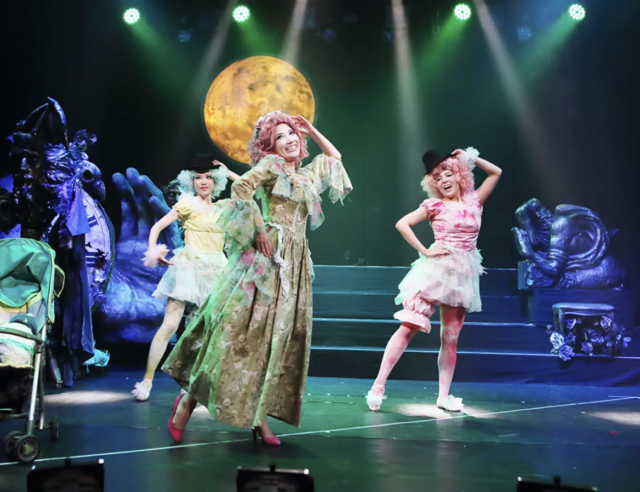
The High Line will host special programming at West Side Fest (photo by twi-ny/mdr)

WEST SIDE FEST
July 12-14, free
Multiple locations between Bank & West Thirtieth Sts.
www.westsidefest.nyc

Every June, the Upper East Side hosts the Museum Mile Festival, when seven or eight arts institutions, including the Met, the Guggenheim, the Cooper Hewitt, the Jewish Museum, and El Museo del Barrio, open its doors for free and turn Fifth Ave. into an arts-based street fair.

The West Side is getting in on the action with its own celebration with the weekend-long West Side Fest, running July 12-14, featuring live performances, guided tours, open studios, interactive workshops, special presentations, and free entry at many locations between Bank and Thirtieth Sts., including the Rubin, Poster House, the Whitney, Hudson Guild, Little Island, the Shed, Dia Chelsea, and the Joyce. Below is the full schedule; a map is available at the above website.

Friday, July 12
NYC Aids Memorial, 7:00 am – 11:00 pm

The Lesbian, Gay, Bisexual and Transgender Community Center, 8:00 am – 10:00 pm

Hudson Guild: Déflorée History Series, with panels by Valerie Hallier, 10:00 am – 5:00 pm

Hudson Guild: Triennial Children’s Art Show, 10:00 am – 6:00 pm

Poster House, free admission, 10:00 – 6:00

Little Island: Creative Break, art workshops, 11:00 am – 1:00 pm

Dia Chelsea, noon – 6:00

Whitney Museum of American Art: Open Studio for Teens, 1:00 – 3:00

IndieSpace/West Village Rehearsal Co-Op: Open Rehearsal by Divine Riot Company of Five Times in One Night, 2:00 – 5:00

Hill Art Foundation: Sound Bath, with musician Daren Ho, 5:00 – 7:00

The Joyce Theater at Chelsea Green Park: Pop-Up Dance Performances by Pilobolus and Dorrance Dance, 5:00 & 6:30

The Shed: Summer Sway, 5:00 – 8:00

White Columns: Exhibition Opening Reception, with works by Michaela Bathrick, Ali Bonfils, Joseph Brock, Eleanor Conover, and Donyel Ivy-Royal, 5:00 – 8:00

Whitney Museum of American Art: Free Friday Nights, advance RSVP required, 5:00 – 10:00

Print Center New York: Print Center After Hours, 6:00 – 8:00

Westbeth Artists Housing x the Kitchen Kickoff Celebration & Poster Sale, 6:00 – 8:00

Rubin Museum of Art: K2 Friday Night, 6:00 – 10:00

Little Island: Teen Night, 7:00 – 8:00

“Wonder City of the World: New York City Travel Posters” is on view at Poster House

Saturday, July 13
High Line: Family Art Moment: Dream Wilder with Us, ages 5–12, 10:00 am – noon

IndieSpace/West Village Rehearsal Co-Op: Open Rehearsal by Divine Riot Company of Five Times in One Night, 10:00 am – 1:00 pm

Poster House, free admission, 10:00 – 6:00

Hudson River Park: Explore & Play, 14th Street Park, 11:00 am – 1:00 pm

Little Island: Creative Break, 11:00 am – 1:00 pm

Westbeth Artists Housing: Penny’s Puppets, 11:00 am – 1:00 pm

Rubin Museum of Art, 11:00 am – 5:00 pm

Center for Art, Research, and Alliances, Javier Téllez: Amerika, 11:00 am – 6:00 pm

High Line: A Celebration of High Line Wellness, 11:30 am – 1:00 pm

The Kitchen: Tai Chi Workshop, 11:30 am – 1:00 pm

Hudson Guild: Triennial Children’s Art Show, noon – 3:00

Poster House Block Party, noon – 5:00

Dia Chelsea, noon – 6:00

Hudson Guild: Déflorée History Series, with panels by Valerie Hallier, 1:00 – 4:00

The Kitchen Poster Sale, 1:00 – 6:00

Westbeth Artists Housing: Art & Craft Market, 1:00 – 6:00

IndieSpace/West Village Rehearsal Co-Op: Open Rehearsal by Ali Keller, 2:00 – 5:00

Print Center New York: Print Activation with Demian DinéYazhi’, 2:00 – 5:00

Westbeth Artists Housing Open Studios, 2:00 – 5:00

Dia Chelsea Soil Sessions: Earth Sounds with Koyoltzintli, advance RSVP required, 2:30

Westbeth Artists Housing: You Are Never Too Old to Play, 7:00 – 9:00

The Rubin reimagines its collection in grand finale (photo byt twi-ny/mdr)

Sunday, July 14
The Lesbian, Gay, Bisexual and Transgender Community Center, 8:00 am – 8:00 pm

Poster House, free admission, 10:00 – 6:00

Whitney Museum of American Art: Free Second Sundays, 10:30 am – 6:00 pm

Hudson River Park Community Celebration, with Ajna Dance Company, henna, and community groups, Pier 63, 11:00 am – 1:00 pm

Center for Art, Research, and Alliances, Javier Téllez: Amerika, 11:00 am – 6:00 pm

Rubin Museum of Art: Family Sunday, 1:00 – 3:00

Westbeth Artists Housing Open Studios and Art & Craft Market, 1:00 – 5:00

Westbeth Artists Housing: Art Take-Over, curated by Valérie Hallier, Claire Felonis, and Noah Trapolino, 1:00 – 6:00

Whitney Museum of American Art: STAFF ONLY, Westbeth Gallery, 1:00 – 6:00

Chelsea Factory: Ladies of Hip-Hop’s Ladies Battle!, 1:00 – 10:00

IndieSpace/West Village Rehearsal Co-Op: Open Rehearsal by Felice Lesser Dance Theater of I AM A DANCER 2.0, 2:00 – 4:00

High Line: The Death Avenue Posse, by the Motor Company, 5:30 & 7:00

[Mark Rifkin is a Brooklyn-born, Manhattan-based writer and editor; you can follow him on Substack here.]
JAPAN CUTS — MOTION PICTURE: CHOKE / THE BOX MAN

Everyone becomes obsessed with the title character in Gen Nagao’s strange and unusual The Box Man

JAPAN CUTS: FESTIVAL OF NEW JAPANESE FILM
Japan Society
333 East 47th St. at First Ave.
July 10-21, $10-$25
212-715-1258
www.japansociety.org

“I never would have expected to be praised for my tentative steps as an actor at Japan Cuts, a film festival in New York!” eighty-two-year-old Chinese-born Japanese actor Tatsuya Fuji said about winning the Lifetime Achievement Award at this year’s fest at Japan Society. “The last time I visited New York was nearly half a century ago. Back then, Nagisa Oshima’s film, In the Realm of the Senses, was invited to the New York Film Festival, but unfortunately, it couldn’t be screened due to censorship. And now, in 2024, the film I participated in, Great Absence, is being screened in New York, and they’ve even given me an award! I am overwhelmed with emotion!”

It would be a shame for movie lovers to be absent at the seventeenth annual festival, which runs July 10-21 and celebrates new Japanese film with more than thirty features, documentaries, animation, shorts, and a few classics. The opening-night selection is Masanori Tominaga’s Between the White Key and the Black Key, which takes place over the course of one night in the life of jazz pianist Hiroshi Minami. The centerpiece is Shadow of Fire, which concludes Shinya Tsukamoto’s war trilogy that began with Fires on the Plain and Killing and stars Cut Above honoree Mirai Moriyama. The festival comes to an end with the international premiere of Hideaki Anno and Shinji Higuchi’s Shin Godzilla: ORTHOchromatic, a revised version of the 2016 original.

In between there are family-friendly works, romance stories, manga-based cartoons, searches for the meaning of existence, and a samurai tale from Takeshi Kitano. As is my preference every July, I’ve checked out two of the most unorthodox films, a pair that are unexpectedly similar in their use of black-and-white, dialogue, sex, violence, music, small casts, and investigations of loneliness.

A man (Daiki Hiba) and woman (Misa Wada) fear danger ahead in Gen Nagao’s Motion Picture: Choke

MOTION PICTURE: CHOKE (『映画 (窒息)』/ EIGA CHISSOKU) (Gen Nagao, 2023)
Friday, July 12, 9:00
japansociety.org

Nary a word is spoken in Gen Nagao’s black-and-white Motion Picture: Choke, which is set in a dystopian past/future that is either pre- or postverbal as it explores the inflexibility of the human condition in an unidentifiable time or place. The film begins in total darkness with Kiyoyuki Yoshikawa’s pulsating score, evoking the music of Bernard Herrmann in Alfred Hitchcock thrillers, followed by a frightening figure in black crawling up a woman’s body. The terrified woman (Misa Wada) awakes from the dream, panting, but then goes about her daily chores. Dressed in ragged, primitive clothing reminiscent of what Raquel Welch wore in One Million Years B.C., she scavenges for food, washes herself in a stream, collects water, and weaves by candlelight.

Living in an abandoned three-level concrete building with no outside walls or doors, she seems to enjoy her life. Every so often, a sweet-natured elderly peddler (Minori Terada) stops by to barter by playing a game. Everything is pleasant until a white-robed man (Takashi Nishina) and his two underlings (Yuri Tajima and Hiroshi Niki) brutally attack the woman, leaving her devastated and angry. She constructs a trap for protection that captures a shirtless young man (Daiki Hiba), who she ties to a wall like Jesus on a cross. They ultimately start a charming partnership, learning together how to survive this empty world, but when the evil bandits return, male toxicity rises up as a battle for power ensues — with the woman determined to not play the victim again.

In only his second full-length film, following 2019’s Someday in Love, Nagao is in complete command as he explores multiple genres; perhaps Motion Picture is part of the title to remind the viewer that this is about the cinematic experience as much as it is a history of how women have been treated by men since the beginning of time. Wada (Cape’s Brothers and Sisters, Kiku to Guillotine) is captivating as the woman, who is not about to get taken advantage of twice. She has an understanding of life that the men will never have, especially when she seeks revenge.

The lack of dialogue is no mere gimmick; instead, it harkens to how humans communicate with one another in the most basic of ways in any era, without language, like animals. The film is gorgeously photographed by Sota Takahashi, with stark lighting by Kohei Kajimoto; Yoshikawa’s music shifts genres as well, from ominous and threatening to innocent and playful.

From its opening moments to its startling, accusatory finale, Choke is precisely the kind of film that makes Japan Cuts one of the best festivals of the year.

A nurse (Koichi Sato) contemplates her future in Gakuryu Ishii’s strange and unusual The Box Man

THE BOX MAN (『箱 男 / HAKO OTOKO) (Gakuryu Ishii, 2024)
Saturday, July 13, 5:30
japansociety.org

“Those who obsess over the box man become the box man,” a man in a shabby box whispers early in Gakuryu Ishii’s creepy, bizarre adaptation of Kōbō Abe 1973 novel, The Box Man.

I can now firmly declare that I am obsessed with the box man. But aren’t we all?

The film takes place just as the prosperity of Japan’s Shōwa period is ending in 1973. The first few minutes are in black-and-white, featuring Abe’s street photography, before we meet the box man, aka Myself (Masatoshi Nagase), who declares in voice-over:

“I see right through everything. A fabricated box you put your faith in. It is you people who live inside it. I have abandoned all that is fake, to obtain the real thing. What is more, I can see. You people as you truly are. The hidden shape of this world. Together with this box, the world shall be completely reborn. I am the box man. I gaze at you unilaterally.”

As it turns to color, he continues, “I become identifiable. You may see me, but you pay no attention. You feign ignorance. And yet, just as I once did, if you become overly aware of the box man . . .”

The box man lives in a cardboard box that reaches down to his knees; it is from the Argon company, makers of medical supplies. There’s a rectangular slit on one side so he can see in front of him; the horizontal space resembles a letterboxed film, except in this case it works both ways, from the inside and the outside. He watches us as we watch him.

He moves stealthily through the streets, avoiding unnecessary contact, until he’s being tracked by a photographer with a rifle and threatened by a slingshot-wielding ex-military madman. But soon he finds himself in a small, private hospital run by an older gentleman called the General (Ayana Shiramoto), his assistant, a doctor (Tadanobu Asano), and their nurse (Koichi Sato), where an odd power dynamic unfolds involving self-identity, sex, control over one’s body and mind, who gets to tell their story, and reality itself.

Ishii’s film has been thirty years in the making, when he received Abe’s blessing to go forward with it. The book has previously been adapted into two short films, but this is the first full-length version, with screenwriters Kiyotaka Inagaki and Ishii (Crazy Thunder Road, Punksamurai Slash Down) making significant changes while staying true to Abe’s original vision.

Hideho Urata’s photography gives the film an immersive quality, as if we are all in our own box, which is sort of true whether we’re experiencing it at home on a TV or streaming device or in a theater. When the doctor is questioned by a detective (Yûko Nakamura) in a police interview room, another cop peers through a long slit in a wall, making him another kind of box man. Michiaki Katsumoto’s wide-ranging score guides us through 1940s detective noir, 1960s jangly pop, 1970s thriller, and a hilarious psychedelic scene with an enema.

The Box Man doesn’t always make sense; some plot twists are hard to decipher, and it is too long at two hours, but you won’t be able to look away for even a second. You’ll also wonder what life inside a box could be like, if you’re not already in one, psychologically or physically.

Like Motion Picture: Choke, The Box Man deals with loneliness, sex, violence, love, faith, misogyny, homelessness, and a dark future in which humanity builds cages for themselves and others, as well as how we tell stories — and who gets to tell them. At one point, the box man sees words appear on a wall, expressing, “Within this labyrinth, I shall seek an exit.” But getting out is not going to be easy, for any of us.

The Box Man is screening July 13 at 5:30 at Japan Society, with Ishii on hand for a Q&A. He will also participate in a Q&A following the July 14 showing of his 1995 rite-of-passage drama, August in the Water.

[Mark Rifkin is a Brooklyn-born, Manhattan-based writer and editor; you can follow him on Substack here.]
BARB MORRISON AND DAPHNE RUBIN-VEGA: BOTTOMING FOR GOD

Who: Barb Morrison, Daphne Rubin-Vega
What: Reading, conversation, and audience Q&A
Where: The Wild Project, 195 East Third St. between Aves. A & B
When: Thursday, July 11, $16, 7:00
Why: “the universe has a way of putting us in our place. a way of commanding what we pretend is destiny, what we like to call the journey and what we fool ourselves into believing is karma,” Barb Morrison writes at the beginning of her memoir, bottoming for god. “but the fact of the matter is we’ve already conspired with this entity, this force, this all knowing being, this GOD (or what EVER you wanna call it.) we already made a pact in the board room in between lives. we’ve already sat amongst our judges and jurors, our spirit guides, our guardian angels, our circle of souls and agreed to collaborate on whatever theater piece will take us to a higher consciousness. whatever decisions we THINK we’re making will move us up or down this mortal coil only because it was already agreed to. it was written before we zipped up these space suits. it was litigated at the table where our greatest enemies and best friends tried on costumes to see who will play which role this time around.”

My wife and I have known the Schenectady-born Morrison for many years, on a personal and professional level. A music producer, songwriter, film composer, football fan, multi-instrumentalist, former Gutterboy member, and mentor who has worked with Blondie, Rufus Wainwright, Franz Ferdinand, Asia Kate Dillon, Rachael Sage, Scissor Sisters, and many others, Morrison digs deep in the book, which is billed as “a story about gender euphoria, sobriety, old skool NYC, true love, past lives, and coming home,” in such chapters as “that fucking belt,” “fourteenth & third,” “the sound of a smile,” “shell shock,” and “hysterical and historical.”

Morrison’s summer book tour takes them July 11 to the Wild Project, where they will be joined by two-time Tony-nominated Panamanian American actress Daphne Rubin-Vega, who originated the roles of Mimi Marquez in Rent and Lucy in Jack Goes Boating and has appeared in such other shows as Anna in the Tropics, A Streetcar Named Desire, and Les Misérables as well as on such television series as Smash, Katy Keene, and Hazbin Hotel. The New Jersey–based Morrison will read excerpts from the book, then sit down for a conversation with Rubin-Vega, followed by an audience Q&A. Tickets are $16; signed books will be available for sale.

[Mark Rifkin is a Brooklyn-born, Manhattan-based writer and editor; you can follow him on Substack here.]
LITTLE ISLAND: OPEN THROAT

OPEN THROAT
The Amph at Little Island
Pier 55, Hudson River Park at West Thirteenth St.
July 10-14, $25, 8:30
littleisland.org

“I’ve never eaten a person but today I might,” the narrator states at the beginning of Henry Hoke’s award-winning 2023 novel, Open Throat. “I wake up in the thicket to the sound of whipcracks and look out and see a bulky man in a brown leather jacket and brown hat swinging the whip toward two other people a man and a woman / the woman holds a phone up and says you look just like him oh my god / the man with the whip smiles and cracks it again and I feel something in the bottom of my stomach that’s not hunger / I also feel hunger.”

The narrative unfolds in stream-of-consciousness verse in short paragraphs with no punctuation and only the pronoun I capitalized throughout.

Hoke, whose other books include The Groundhog Forever and The Book of Endless Sleepovers, has now adapted Open Throat into a play that will premiere July 10-14 at the Amph on Little Island. The story follows a queer mountain lion who must leave his home in the hills by the Hollywood sign and face what humanity is doing to the planet.

Directed by Caitlin Ryan O’Connell (King Philip’s Head Is Still on That Pike Just Down the Road, Twin Size Beds), the play features a promising cast; Marinda Anderson, Alex Hernandez, Layla Khoshnoudi, Ryan King, Jo Lampert, Chris Perfetti, Susannah Perkins, Calvin Leon Smith, and Steven Wendt, who also designed the shadow puppets.

The piece was commissioned for the outdoor Amph on Little Island, which rests on the edge of the Hudson River amid trees, so the location should fit right in. The choreography is by Lisa Fagan, with set, props, and masks by Noah Mease, lighting by 2024 special Drama Desk Award winner Isabella Byrd, and sound and music by Michael Costagliola. Tickets are only $25 and gain you access to specific sections.

[Mark Rifkin is a Brooklyn-born, Manhattan-based writer and editor; you can follow him on Substack here.]
SUMMER AT SEA

Be prepared to get swept away by summer film festival at Metrograph

SUMMER AT SEA
Metrograph
7 Ludlow St. between Canal & Hester Sts.
July 5 – September 2
212-660-0312
metrograph.com/film

It’s easy to get swept away by Metrograph’s “Summer at Sea,” a two-month festival of nineteen films set at the beach, on the ocean, and poolside. Among the wide-ranging works being shown are Agnès Varda’s La Pointe Courte, Christian Petzold’s Afire, Federico Fellini’s And the Ship Sails On, Chris Sanders and Dean DeBlois’s Lilo & Stitch, Luchino Visconti’s Death in Venice, Jacques Deray’s La Piscine, and Lina Wertmüller’s Swept Away . . . by an Unusual Destiny in the Blue Sea of August. Below is a closer look at several of the movies.

In addition, on July 20, Metrograph will be hosting its annual Summer Book Fair, this year honoring the late dance critic, literary editor, and publisher Robert Gottlieb, who passed away in June 2023 at the age of ninety-two. Gottlieb worked with such authors and celebrities as John Cheever, Doris Lessing, Chaim Potok, Salman Rushdie, John le Carré, Ray Bradbury, Michael Crichton, Toni Morrison, Bill Clinton, Nora Ephron, Katharine Hepburn, Lauren Bacall, Liv Ullmann, Paul Simon, Bob Dylan, and, most famously, Robert Caro; his longtime collaboration with Caro was documented in the terrific 2022 film Turn Every Page: The Adventures of Robert Caro and Robert Gottlieb. The fair will feature more than five hundred film books owned by Gottlieb, which will be availabie for sale, each one stamped with a seal certifying “From the Library of Robert Gottlieb.”

Father (David Niven) and daughter (Jean Seberg) have a little talk in lush Otto Preminger melodrama

BONJOUR TRISTESSE (Otto Preminger, 1958)
Metrograph
Friday July 5, 4:45
Sunday July 7, 12:20
Sunday July 14, 7:30
metrograph.com/film

Douglas Sirk would surely be proud of Otto Preminger’s wickedly obsessive 1958 melodrama, Bonjour Tristesse. Based on the 1954 novel by eighteen-year-old author Françoise Sagan, the film, whose titles translates as “Hello, Sadness,” stars Jean Seberg as Cécile, a seventeen-year-old girl on the cusp of womanhood, a child-adult living the good life while beginning to enjoy the pleasures of drinking, smoking, and sexual desire. She and her wealthy father, Raymond (a dapper David Niven), have moved into a posh villa on the French Riviera for the summer, where the widowed Raymond attempts to balance his time with serious fashion queen Anne Larsen (Deborah Kerr) and flighty young blonde Elsa (Mylène Demongeot). A selfish cad who considers only himself, Raymond is soon in deep water when the two women find out about each other. Meanwhile, Cécile tosses aside her studies in order to flirt with twenty-five-year-old neighbor Philippe (Geoffrey Horne) and other older men who quickly fall in love with her relatively carefree lifestyle, one that seemingly can only end in trouble.

Written by Arthur Laurents (Anastasia, The Way We Were), beautifully photographed in color (in Saint-Tropez) and black-and-white (in Paris) by Georges Périnal (Rembrandt, The Fallen Idol), and featuring costumes by Givenchy and jewelry by Cartier, Bonjour Tristesse examines love, lust, power, style, and jealousy, directed with an iron fist by Preminger, who often yelled at and embarrassed Seberg on-set in order to influence her performance. But at the heart of the film is the risqué relationship between Raymond and Cécile, one that more than hints at incest.

Sam Shakusky (Jared Gilman) and Suzy Bishop (Kara Hayward) are on the run in Wes Anderson’s delightful Moonrise Kingdom

MOONRISE KINGDOM (Wes Anderson, 2012)
Friday July 5, 5:00
Saturday July 6, 2:45
Wednesday July 10, 3:30
metrograph.com/film

In such unique films as Rushmore, The Royal Tenenbaums, and The Darjeeling Limited, black-comedy master Wes Anderson has created a bizarre collection of characters who seem to live in their own alternate realities. In Moonrise Kingdom, Anderson has once again assembled an oddball assortment of men, women, and children in a terrifically clever and entertaining fairy tale all its own. Tired of being abused by his fellow Khaki Scouts and dismissed by his foster parents, twelve-year-old orphan Sam Shakusky (Jared Gilman) runs away from Camp Ivanhoe on the island of New Penzance, much to the chagrin of dedicated scout master Randy Ward (Edward Norton). Meanwhile, twelve-year-old loner Suzy Bishop (Kara Hayward) is fed up with her life as well, which she mostly spends listening to Benjamin Britten, reading fairy tales (fictitious stories made up by Anderson), watching the world through a pair of ever-present binoculars, and despising her parents (Bill Murray and Frances McDormand). Afraid of what might have happened to the children, the local police officer, Captain Sharp (Bruce Willis), gets involved, as does a stern woman from social services (Tilda Swinton) and, eventually, a very different kind of scout, Cousin Ben (Jason Schwartzman).

The proceedings are overseen by a narrator (Bob Balaban) who ends up being more than just an omniscient presence. Moonrise Kingdom is an absolute gem of a film, an exciting, original tale about growing up told in a fabulously funny deadpan manner that combines slapstick humor with wildly ironic elements, filled with the endless wonders of childhood, although it is most definitely not for children. Newcomers Gilman and Hayward appear wise beyond their years in the lead roles, with outstanding support from an all-star cast, most prominently Norton as the by-the-book scout master on a mission. Written by Anderson with Roman Coppola, the film also features a lovely score by Alexandre Desplat.

Summer with Monika

Harry (Lars Ekborg) and Monika (Harriet Andersson) run away to start a new life in Summer with Monika

SUMMER WITH MONIKA (SOMMAREN MED MONIKA) (Ingmar Bergman, 1953)
Metrograph
Friday July 5, 7:10
Saturday July 6, 5:00
Thursday July 11, 4:15
metrograph.com/film

Swedish director Ingmar Bergman shocked the film world in 1953 with the controversial Summer with Monika, the tale of two young lovers who run away from their families and go on a brief but intense sexual adventure. The film featured full-frontal nudity by Harriet Andersson, with whom Bergman had a short relationship; the movie was actually edited down by distributor Kroger Babb to focus on the sex and nudity, renaming it Monika, the Story of a Bad Girl! and marketing it to US audiences as an exploitation picture. But Film Forum is screening the superb original version as part of its five-week centennial celebration of Bergman’s birth. Based on the 1951 novel by Per Anders Fogelström, Summer with Monika takes place in a working-class area of Stockholm, where Harry (Lars Ekborg) and Monika (Harriet Andersson) toil away in a glassware factory. Harry lives with his ailing father (Georg Skarstedt), while Monika sleeps in her family’s kitchen. Both teens are bored with their already dull and unfulfilling lives. So when they meet in a café, the bold, forward Monika lures the shy, fragile Harry into what begins as a summer of fun, as they steal Harry’s father’s boat and head out to their own private hideaway, but ends up as something very different. Bergman boils down an entire relationship — courtship, romance, children, breakup, in a way a precursor to his later epic, Scenes from a Marriage — into ninety-seven sharp, intuitive moments, turning clichéd plot twists into subtle statements on life and family. Cinematographer Gunnar Fischer shoots the film in a dark, gloomy black-and-white, with stark close-ups — Monika stares directly into the camera at one point, challenging the audience — and long shots of water and nature, while Erik Nordgren’s score is kept spare, with Bergman favoring natural sound and light.

Summer with Monika

Harriet Andersson stars as a fierce, independent spirit in Ingmar Bergman’s Summer with Monika

Andersson, who would go on to make many more films with Bergman, including Sawdust and Tinsel, Smiles of a Summer Night, Cries and Whispers, and Fanny and Alexander, is enticing as Monika, who doesn’t mind stepping on people’s souls while asserting herself as an independent woman, while Ekborg, who had a small part in Bergman’s The Magician, shows plenty of vulnerability as Harry, who wants to do the right thing and is ready to at least try to be a grown-up when things get complicated. The film is still shocking after all these years, and still rings true. “I want summer to go on just like this,” Monika says. But there are always other seasons, and more summers, to come.

David Hockney

David Hockney works on his masterpiece in Jack Hazan’s A Bigger Splash

A BIGGER SPLASH (Jack Hazan, 1974)
Metrograph
Monday, July 8, 4:00pm
metrograph.com

In June 2019, Metrograph premiered a 4K restoration of Jack Hazan’s pivotal 1974 A Bigger Splash, a fiction-nonfiction hybrid that was a breakthrough work for its depiction of gay culture as well as its inside look at the fashionable and chic Los Angeles art scene of the early 1970s. In November 2018, David Hockney’s Portrait of an Artist (Pool with Two Figures) sold at auction for $90.3 million, the most ever paid for a work by a living artist. A Bigger Splash, named after another of Hockney’s paintings — both are part of a series of canvases set around pools in ritzy Los Angeles — takes place over three years, as the British artist, based in California at the time, hangs out with friends, checks out a fashion show, prepares for a gallery exhibition, and works on Portrait of an Artist (Pool with Two Figures) in the wake of a painful breakup with his boyfriend, model, and muse, Peter Schlesinger, who is a key figure in the painting.

It’s often hard to know which scenes are pure documentary and which are staged for the camera as Hazan and his then-parter, David Mingay, who served as director of photography, tag along with Hockney, who rides around in his small, dirty BMW, meeting up with textile designer Celia Birtwell, fashion designer Ossie Clark, curator Henry Geldzahler, gallerist John Kasmin, artist Patrick Procktor, and others, who are identified only at the beginning, in black-and-white sketches during the opening credits. The film features copious amounts of male nudity, including a long sex scene between two men, a group of beautiful boys diving into a pool in a fantasy sequence, and Hockney disrobing and taking a shower. Hockney’s assistant, Mo McDermott, contributes occasional voice-overs; he also poses as the man standing on the deck in Portrait of an Artist (Pool with Two Figures), only to be replaced by Schlesinger later. There are several surreal moments involving Hockney’s work: He cuts up one painting; Geldzahler gazes long and hard at himself in the double portrait of him and Christopher Scott; and Hockney tries to light the cigarette Procktor is holding in a painting as Procktor watches, cigarette in hand, mimicking his pose on canvas. At one point Hockney is photographing Schlesinger in Kensington Gardens, reminiscent of Michelangelo Antonioni’s Blow-Up, which questions the very nature of capturing reality on film.

Hockney was so upset when he first saw A Bigger Splash, which Hazan made for about twenty thousand dollars, that he offered to buy it back from Hazan in order to destroy it; Hazan refused, and Hockney went into a deep depression. His friends ultimately convinced him that it was a worthwhile movie and he eventually accepted it. It’s a one-of-a-kind film, a wild journey that goes far beyond the creative process as an artist makes his masterpiece. Hockney, who will turn eighty-six on July 9, has been on quite a roll of late. He was the subject of a 2016 documentary by Randall Wright, was widely hailed for his 2018 Met retrospective, saw one of his paintings set an auction record, and had a major show at the Morgan Library in 2020-21, “David Hockney: Drawing from Life.” In addition, Catherine Cusset’s novel, Life of David Hockney, was published in 2019 in English, a fictionalized tale that conceptionally recalls A Bigger Splash.

BEFORE MIDNIGHT

Jesse (Ethan Hawke) and Celine (Julie Delpy) are back together again in Richard Linklater’s Before Midnight

BEFORE MIDNIGHT (Richard Linklater, 2013)
Metrograph
Friday July 12, 4:15
Saturday July 13, noon
metrograph.com/film

Unable to resist revisiting the characters who first fell in love in 1995’s Before Sunrise and again in 2004’s Before Sunset, Ethan Hawke and Julie Delpy reprise their roles as Jesse and Celine, respectively, in Richard Linklater’s absolutely wonderful Before Midnight. The couple first met on a train to Vienna in 1994, talking at length about their hopes and desires and planning on getting together in six months’ time, but they don’t reconnect for another nine years, when Celine comes to one of Jesse’s book signings in Paris. In real time, they walk around the City of Light, catching up on what has happened in their lives as Jesse prepares to take a plane back home to his wife and son. And now another nine years have passed, and Jesse and Celine are living together, the parents of twins (Charlotte and Jennifer Prior). As the film opens, the divorced Jesse is putting his teenage son, Hank (Seamus Davey-Fitzpatrick), on a plane after having spent the summer together in Greece. What follows is a marvelous fourteen-minute scene of Jesse driving down a mountain road as he and Celine essentially let the audience know what has occurred over the last nine years: They have twin girls (sleeping in the back), Celine has been offered an important environmental job, and Jesse is considering moving to Chicago to be closer to Hank. They return to a country estate owned by Patrick (award-winning cinematographer Walter Lassally, making his acting debut at the age of eighty-six), who is hosting an outdoor lunch with a group of friends (including French actress Ariane Labed, coproducer and filmmaker Athina Rachel Tsangari, and Xenia Kalogeropoulou, who came out of retirement to appear in her first picture since 1985). They all talk of life and love, with Celine being particularly charming. But when Jesse and Celine go off to a hotel room for what is supposed to be a romantic rendezvous, some things are said and truths revealed that complicate things.

Cowriters Julie Delpy and Ethan Hawke explore life and love in Greece in third film about Celine and Jesse

Cowriters Julie Delpy and Ethan Hawke explore life and love in Greece in third film about Celine and Jesse

As with the first two films, Before Midnight consists of long takes of Jesse and Celine discussing their past, present, and future as cowriters Linklater (Slacker, Dazed and Confused), Delpy, and Hawke, who were nominated for an Oscar for their script for Before Sunset, continue to explore these engaging characters; both the dialogue and the acting have matured with an intelligent grace and elegance that are captivating. The couple wanders around Messinia examining their lives as only fortysomethings can, trying to figure out whether what they have is what they want. The central focus, though, once again is time, whether it is the years Jesse and Celine have spent together, the time they have left, time as a concept in Jesse’s semiautobiographical novels, or Jesse making a joke about being a time traveler. It’s been eighteen years since we first met Jesse and Celine, and we’ve grown eighteen years older too, lending fascinating perspectives that can’t help but force us to take a look at our own lives as well. The trilogy is America’s version of François Truffaut’s Antoine Doinel series, filled with humor, lyricism, and an inherent understanding of twenty-first-century realities. Will there be a fourth film? As of now, the principals aren’t saying because they just don’t know, but Before Midnight ends on just about the perfect ambiguous note.

A SUMMER’S TALE

Margot (Amanda Langlet) and Gaspard (Melvil Poupaud) contemplate love and friendship in Éric Rohmer’s A Tale of Summer

A TALE OF SUMMER (CONTE D’ÉTÉ) (Éric Rohmer, 1996)
Friday, July 26, 2:00
Sunday, July 28, 11:30 am
metrograph.com

French New Wave auteur Éric Rohmer’s 1996 A Tale of Summer, the third of his seasonal 1990s stories following A Tale of Winter and A Tale of Springtime and preceding the finale, A Tale of Autumn, is a bittersweet romance about the follies of young love. In a seaside Breton resort town in the 1970s, musician and mathematician Gaspard (Melvil Poupaud) awaits the arrival of his girlfriend, Lena (Aurélia Nolin), who has not been answering his phone calls or returning his letters. He strikes up a perhaps platonic relationship with waitress-ethnologist Margot (Amanda Langlet), whose boyfriend is off in the Peace Corps. When Gaspard makes a move on Margot, she instead encourages him to go out with the free-spirited Solene (Gwenaëlle Simon). Soon Gaspard finds himself lost among three beautiful women, forced to make choices that he’s clearly not ready for.

Strikingly photographed by Rohmer favorite Diane Baratier in a subdued, ’70s-style palette, A Tale of Summer is a charmingly insightful and frustrating exploration of young love, desire, and commitment in which a group of attractive twentysomethings are caught between just wanting to have some fun and plotting out their future. It’s ironic that Gaspard is a mathematician, as he seems to have trouble as soon as he gets to the number three. Meanwhile, it’s appropriate that the ever-wise and knowing Margot (played with a captivating and alluring ease by Pauline at the Beach star Langlet) is an ethnologist, as she carefully studies Gaspard and others as she makes her way through life. Rohmer made A Summer’s Tale when he was seventy-five; the former editor of Cahiers du cinéma would go on to direct four more films before his death in 2010 at the age of eighty-nine. After eighteen years, A Tale of Summer, which premiered at Cannes in 1996, finally got its U.S. theatrical release in 2014 in a new HD restoration, and it is always a lovely way to continue the summer movie season.