twi-ny recommended events

LOWER EAST SIDE PICKLE DAY 2016

pickle-day

Orchard St. between Houston & Delancey Sts.
Sunday, September 25, free, 12 noon – 5:00 pm
pickleday.nyc

Speaking about Calvin Coolidge, Alice Roosevelt Longworth said, “He looks as though he’s been weaned on a pickle.” For many of us who were born and raised in New York, we’re not sure why that was an insult. And that’s why on Sunday you’re likely to find us at the annual Lower East Side Pickle Day, being held on Orchard St. between Houston and Delancey. Among those participating in the festivities, which include food, fashion, and family-friendly games and activities, are pickled purveyors Guss’ Pickles, Pioneer Cannery, Macdonald Farms, Pickle Me Pete, Backyard Brine, Grillo’s Pickles, Crisp & Co. Pickles, Fox Point Pickles, Messy Brine, the Pickle Guys, Rick’s Picks, Horman’s Pickles, Divine Brine, Adamah Farm, Rachel Mae Farmstand, Brooklyn Brine, Doctor Pickle, Pittsburgh Pickle Co., McClure’s Pickles, and Crooked Carrot Fermentory in addition to Melt Bakery, A Casa Fox, Osaka Grub, Saxelby Cheesemongers, sweet buttons desserts, Wassail, Ni Japanese Deli, the Meatball Shop, Puebla Mexican Food, the SKINny Bar & Lounge, Georgia’s BBQ, Cow & Clover, and Roni-Sue’s Chocolates. There will also be live music by Louie and Chan and a home pickling/dancing contest. Pickles have a long affiliation with the Lower East Side, and the annual Pickle Day only adds to that pickled history.

BAD REPUTATION — SPOTLIGHT ON KRISTEN STEWART: ADVENTURELAND

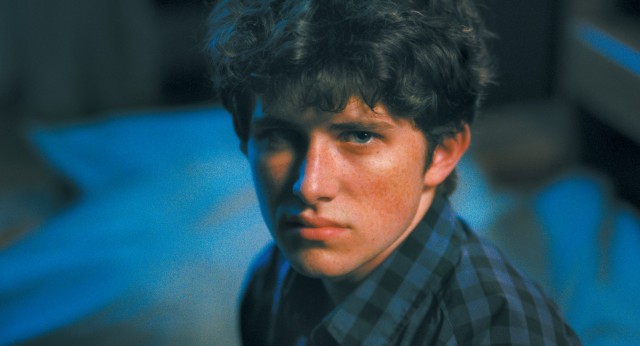
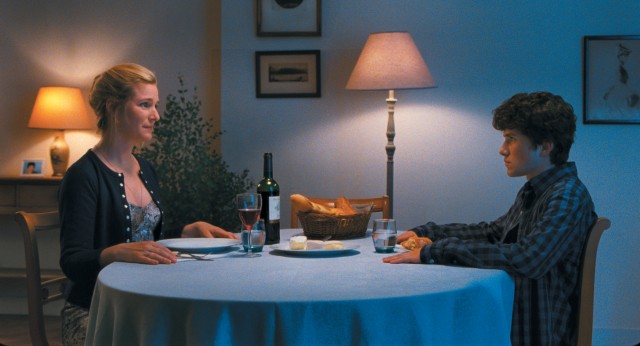
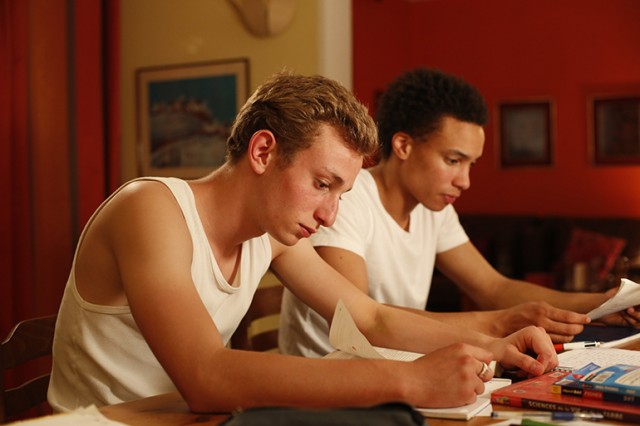
Jesse Eisenberg and Kristen Stewart are in the mood for some summer fun in ADVENTURELAND

Jesse Eisenberg and Kristen Stewart are in the mood for some summer fun in ADVENTURELAND

ADVENTURELAND (Greg Mottola, 2009)
BAMcinématek, BAM Rose Cinemas
30 Lafayette Ave. between Ashland Pl. & St. Felix St.
Saturday, September 24, 2:00 & 7:00, and Sunday, September 25, 4:40 & 9:40
Series runs September 23-27
718-636-4100
www.bam.org
adventurelandthefilm.com

When we were kids, it was always a treat when our parents packed us in the car and took us to Adventureland, a small amusement park in Farmingdale, Long Island. It wasn’t quite the same treat for writer-director Greg Mottola, who documents one summer he spent working as a carny there in the sweet coming-of-age comedy Adventureland, an underappreciated gem from last decade. Jesse Eisenberg stars as Mottola’s alter ego, James Brennan, a college grad in 1987 who is planning on traveling through Europe before starting grad school at Columbia — until his parents take a serious financial hit, forcing him to spend the summer working at the local amusement park in Pittsburgh called Adventureland. (Mottola had wanted to shoot the film in the actual Long Island location but found that the current state of Adventureland was too upscale compared to the one he remembers, so he found a more suitable cinematic park.) James is a hyperintellectual virgin who is waiting for true love, and he thinks he might have found it in fellow carny Em Lewin (Kristen Stewart). However, he doesn’t know that Em is also a booty call for the older Mike Connell (Ryan Reynolds), the hot maintenance man whose legendary claim to fame is that he once jammed with Lou Reed. Meanwhile, the amusement park’s hot-to-trot Lisa P. (Margarita Levieva) has returned, and she might be considering trying out a nice guy like James instead of her usual tough dudes.

Bill Hader and Kristen Wiig sort of run things at low-rent amusement park

Bill Hader and Kristen Wiig sort of run things at low-rent amusement park

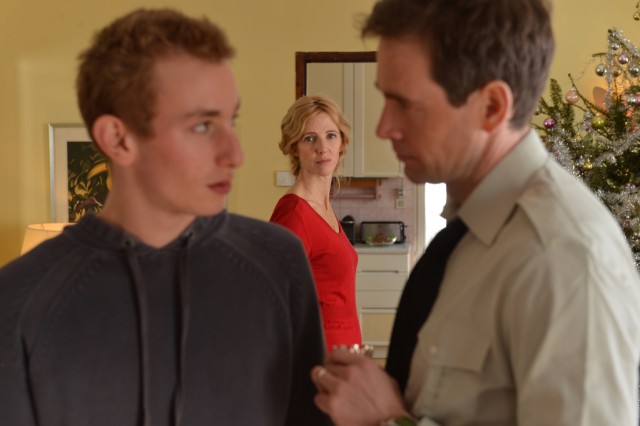
Adventureland is a very funny, emotionally honest look at growing up faster than one imagined, filled with believable characters and situations in a genre that is often wrought with hyperbole. (Mottola is another member of Judd Apatow’s inner circle, having directed episodes of the underrated Undeclared and directed and cowrote, with Seth Rogen, the overrated Superbad; prior to that, he wrote and directed the overrated 1999 indie hit The Daytrippers.) Eisenberg (The Squid and the Whale, The Social Network) and Stewart (Into the Wild, Twilight) are magnetic together, conveying their parts with heartfelt emotion; although Eisenberg is seven years older than Stewart in real life — she was born in 1990, after the film takes place — Stewart displays an intelligence beyond her years. The excellent supporting cast features SNLers Bill Hader and Kristen Wiig as the park’s crazy owners; Freaks & Geeks’ Martin Starr as James’s best friend, the Russian-lit-obsessed, pipe-smoking Joel; and Matt Bush as Frigo, who never misses a chance to punch James in the nuts. Mottola sets his compelling story to an awesome soundtrack that includes killer tunes by the Replacements, Husker Du, Big Star, the Cure, Judas Priest, and plenty of Lou Reed and the Velvet Underground (as well as a Foreigner tribute band and Falco’s “Rock Me Amadeus”). Adventureland is screening September 24 & 25 in the BAMcinématek series “Bad Reputation: Spotlight on Kristen Stewart,” a five-day, five-film tribute to the L.A.-born actress who, at the age of twenty-six, has already appeared in nearly three dozen films. The mini-festival also includes David Fincher’s Panic Room, Catherine Hardwicke’s Twilight, Floria Sigismondi’s The Runaways (in which Stewart plays Joan Jett!), and Olivier Assayas’s The Clouds of Sils Maria, for which she won a French César Award for Best Supporting Actress

THE LANGUAGE OF THINGS

(photo by twi-ny/mdr)

The seven sculptures that make up Claudia Comte’s “The Italian Bunnies” are named after Italian sculptors (photo by twi-ny/mdr)

City Hall Park
Broadway, Park Row, and Chambers St.
Through September 29, free
www.publicartfund.org
www.nycgovparks.org

If you find yourself walking through City Hall Park and a woman gazes into your eyes and starts singing to you and you alone, it might not be some weirdo but actually part of the Public Art Fund group exhibition “The Language of Things.” The show was inspired by Walter Benjamin’s 1916 essay “On Language as Such and on the Language of Man,” in which the German philosopher and critical theorist explores “the difference between human language and the language of things.” He writes, “Every expression of human mental life can be understood as a kind of language, and this understanding, in the manner of a true method, everywhere raises new questions. It is possible to talk about a language of music and of sculpture, about a language of justice . . . all communication of the contents of the mind is language, communication in words being only a particular case of human language and of the justice, poetry, or whatever underlying it or founded on it.” The multiple works in this exhibition vary wildly in conception and execution, but they all communicate. The only work that features spoken human language is the above-mentioned Tino Sehgal piece “This You,” the artist’s first outdoor work, in which one of a rotating cast of women singers approach strangers and warble something meant specifically for them. Chris Watson’s four-channel “Ring Angels” is named for the suspicious concentric patterns that appeared on British radar in the 1930s, which turned out to be roosting starlings; Watson’s audio piece plays the sounds of modern-day starlings moving in close formation while referencing the arrival of starlings to America in 1890–91, when Eugene Schieffelin released first sixty and then forty starlings into Central Park in an effort to introduce to North America all the avian species mentioned in Shakespeare.

(photo by twi-ny/mdr)

The Black Lives Matter movement brought its message to Adam Pendleton’s “Untitled (code poem)” in City Hall Park (photo by twi-ny/mdr)

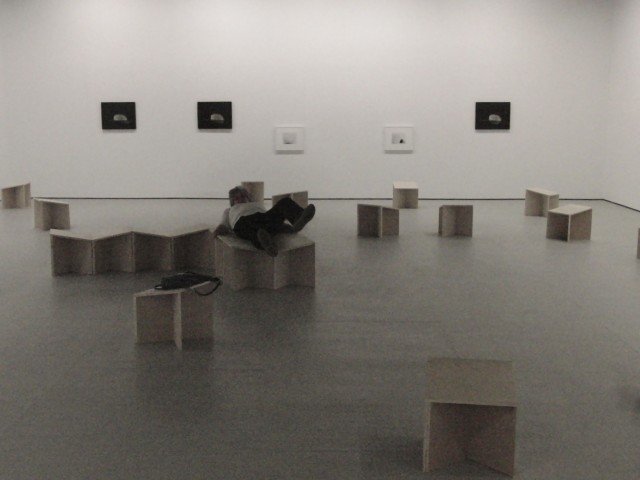
In Claudia Comte’s “The Italian Bunnies,” seven marble sculptures resembling bunny ears, and named for Italian artists (Guido, Pietro, Gian Lorenzo, Leonardo, Donatello, Michelangelo, and Properzia), appear to be in the midst of a silent conversation. Carol Bove’s “Lingam” refers to ancient Hindu phallic sculptures dedicated to Shiva and brings together petrified wood and steel as if they are engaged in some kind of symbolic ritual. Michael Dean’s reinforced concrete “4sho (Working Title)” developed from his own texts and typography. Don’t spend too much time trying to figure out how Hannah Weiner’s “Code Poems” work; in 1969, the poet and performance artist wrote, “i consider this code an exploration of linear communication, which has served the binary neurological function of the brain. the most useful thing for me here, in the code, is the understanding of the equivalents: one kind of signal may equally be substituted for another with the exact same meaning.” Directly influenced by Weiner’s work, Adam Pendleton’s “Untitled (code poem)” consists of eighteen concrete blocks in the shape of large-scale Morse code dots and dashes; for several days, people from the Black Lives Matter movement took over the space, using the blocks as seats as they spread their oft-misunderstood message, giving the piece an unexpected twist on the idea of communication. “The linguistic being of things is their language; this proposition, applied to man, means: the linguistic being of man is his language. Which signifies: man communicates his own mental being in his language,” Benjamin further explains. “It should not be accepted that we know of no languages other than that of man, for this is untrue.”

THE MASTER — PHILIP SEYMOUR HOFFMAN: CAPOTE / SYNECDOCHE, NEW YORK

Philip Seymour Hoffman won an Oscar for his portrayal of Truman Capote

Philip Seymour Hoffman won an Oscar for his intense portrayal of Truman Capote

CAPOTE (Bennett Miller, 2005)
Museum of the Moving Image
35th Ave. at 36th St., Astoria
Friday, September 23, $12, 7:00
Series continues through October 2
718-777-6800
www.movingimage.us
www.sonyclassics.com

In November 1959, Richard Hickock (Mark Pellegrino) and Perry Smith (Clifton Collins Jr.) brutally murdered a Kansas family. After reading a small piece about the killings in the New York Times, New Yorker writer Truman Capote (Philip Seymour Hoffman) sets out with his research assistant, Harper “Nell” Lee (Catherine Keener), to cover the story from a unique angle, which soon becomes the workings of the classic nonfiction novel In Cold Blood. Capote tells police chief Alvin Dewey (Chris Cooper) right off the bat that he cares only about the story, not what happens to the killers, which does not endear him to the local force. But when the murderers are captured, Capote begins a dangerous relationship with Smith, who comes to think of the writer as a true friend, while Capote gets caught up deeper than he ever thought possible. Based on the exhaustive biography by Gerald Clarke, Capote is a slow-moving character study featuring excellent acting and some interesting surprises, even for those who thought they knew a lot about the party-loving chronicler of high society and high living. Hoffman, who died from a drug overdose in 2014 at the age of forty-six, earned an Oscar for portraying the socialite author, who was played the following year by Toby Jones in Douglas McGrath’s Infamous, which was based on a book by George Plimpton. Capote, which was also nominated for Best Picture, Best Director (Bennett Miller), Best Supporting Actress (Keener), and Best Adapted Screenplay (Dan Futterman), is screening on September 23 in the Museum of the Moving Image series “Philip Seymour Hoffman: The Master,” a sixteen-film tribute to Hoffman, a native New Yorker who left us well before his time. The series continues through October 2 with such Hoffman films as John Patrick Shanley’s Doubt (introduced by Shanley), Todd Solondz’s Happiness, Paul Thomas Anderson’s Magnolia, and Anthony Minghella’s The Talented Mr. Ripley.

Philip Seymour Hoffman doesn’t quite understand what’s happening to him in SYNECDOCHE, NEW YORK

SYNECDOCHE, NEW YORK (Charlie Kaufman, 2008)
Museum of the Moving Image
35th Ave. at 36th St., Astoria
Sunday, September 25, $12, 4:00
718-777-6800
www.movingimage.us
www.sonyclassics.com

In films such as Being John Malkovich (Spike Jonze, 1999), Adaptation. (Spike Jonze, 2002), Confessions of a Dangerous Mind (George Clooney, 2002), and Eternal Sunshine of the Spotless Mind (Michel Gondry, 2004), writer Charlie Kaufman has created bizarre, compelling alternate views of reality that adventurous moviegoers have embraced, even if they didn’t understand everything they saw. Well, Kaufman has done it again, challenging audiences with his directorial debut, the very strange but mesmerizing Synecdoche, New York. Philip Seymour Hoffman stars as the bedraggled Caden Cotard, a local theater director in Schenectady mounting an inventive production of Death of a Salesman. Just as the show is opening, his wife, avant-garde artist Adele Lack (Catherine Keener), decides to take an extended break in Europe with their four-year-old daughter, Olive (Sadie Goldstein), and Adele’s kooky assistant, Maria (Jennifer Jason Leigh). As Caden starts coming down with a series of unexplainable health problems (his last name, by the way — Cotard — is linked with a neurological syndrome in which a person believes they are dead or dying or do not even exist), he wanders in and out of offbeat personal and professional relationships with box-office girl Hazel (a nearly unrecognizable Samantha Morton), his play’s lead actress, Claire Keen (Michelle Williams), his therapist, Madeleine Gravis (Hope Davis), and Sammy (Tom Noonan), a man who has been secretly following him for years. After winning a MacArthur Genius Grant, Caden begins his grandest production yet, a massive retelling of his life story, resulting in radical shifts between fantasy and reality that will have you laughing as you continually scratch your head, hoping to stimulate your brain in order to figure out just what the heck is happening on-screen. Evoking such films as Federico Fellini’s and City of Women, Woody Allen’s Stardust Memories, and Ingmar Bergman’s Wild Strawberries as well as the labyrinthine tales of Argentine writers Jorge Luis Borges and Julio Cortazar, Synecdoche, New York is the kind of work that is likely to become a cult classic over the years, requiring multiple viewings to help understand it all. The film is screening September 25 at the Museum of the Moving Image, with the elusive Charlie Kaufman on hand to talk about working with Hoffman. Four years after the film was released, Hoffman starred in Mike Nichols’s Broadway version of Death of a Salesman, the show his character is putting together in Synecdoche, New York.

THE GREAT BIG BACON PICNIC

great-big-bacon

The Old Pfizer Factory
630 Flushing Ave., Williamsburg
September 24-25, $79-$249 (twenty-one and older only)
greatbigbacon.com

Mmm, bacon. . . . The second annual Great Big Bacon Picnic is set for September 24-25 at the Old Pfizer Factory in Williamsburg, where more than one hundred purveyors of food and drink will join together for an extravaganza of all things bacon. Chefs from all over New York City will show just how diverse the sizzling meat can be with a bevy of bite-sized delights that can be washed down with specially selected beer, wine, and spirits. Among the many participants are BaconFB4, Traif, Williamsburg Pizza, Antony “Tony Bacon” Nassif of Mile End Deli, Tres Carnes, Roni-Sue’s Chocolates, BarBacon, Veselka, Walter Momente and Jon Streep of Alidoro, Big Papa Smokem Gourmet Smoked Meats, Brooklyn Baked and Fried, Chef’s Cut Real Jerky, Feast, Off the Hook Raw Bar & Grill, Potatopia, Dirty Burger, and 2015 GBBP champ Arthur Saks. Potent potables will be available from Shiner Beer, New Belgium Brewing Co., Van Brunt Stillhouse, Two Roads Brewing Co., Iron Smoke Whiskey, Doc Herson’s Natural Spirits, Domaine des Haute Glace “Les Moisson” French Single Malt, Domaine d’Esperance Armagnac, Derrumbes Mezcal, and many more. There are three ticket packages for the three sessions, which take place on Saturday from 12 noon to 2:30 for brunch, Saturday from 5:30 to 8:00 for happy hour, and Sunday from 1:00 to 3:30 for brunch. Brunch and happy hour are currently being discounted to $79, with half-hour early entry $114 and VIP $189 (including one-hour early entry and access to private lounges and gift bag). Ten percent of the proceeds go to such local charities as City Harvest and No Kid Hungry. The High & Mighty Brass Band will provide live music, and first-time Lyft users can get a $50 credit here. Everyone gets unlimited bacon — and no turkey bacon, soy bacon, or other substitutes. And don’t forget to belly up to the Bacon Bar.

CROSSING THE LINE 2016

THE SHOW MUST GO ON

Jérôme Bel’s THE SHOW MUST GO ON will go on at the Joyce as part of FIAF’s tenth annual Crossing the Line festival

French Institute Alliance Française and other locations
Florence Gould Hall, 55 East 59th St. between Madison & Park Aves.
FIAF Gallery, 22 East 60th St. between Madison & Park Aves.
September 22 – November 3, free – $55
212-355-6160
crossingthelinefestival.org
www.fiaf.org

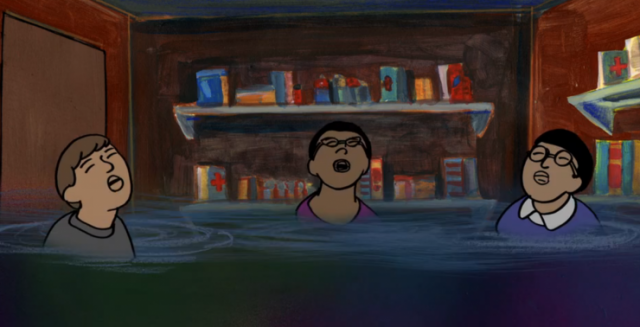
We can’t help but get excited for FIAF’s annual multidisciplinary fall festival, Crossing the Line, now celebrating its tenth anniversary. Every summer, we eagerly await the advance announcement of what they’ll be presenting, then scour the lineup for the most unusual events to make sure we see them. This year is another stellar collection of cutting-edge international dance and theater, beginning September 22 and 24 with screenings of concluding episodes seven, eight, and nine of Nature Theater of Oklahoma’s epic Life and Times at Anthology Film Archives ($11), along with a Thursday night party in FIAF’s Florence Gould Hall ($10) that begins with a screening of the eighth chapter of Kristin Worrall’s rather ordinary life, with the artists themselves serving up PB&Js. The festival features a special focus on French choreographer Jérôme Bel, who will be involved in four programs, beginning October 17 (free with RSVP) with a screening of his short biographical film on Paris Opera dancer Véronique Doisneau, followed by a discussion with Bel and Ana Janevski. Bel’s award-winning The Show Must Go On will go on at the Joyce October 20-22 ($36-$46), with Bel hanging around for a Curtain Chat after the 2:00 show on October 22. Bel will present the New York premiere of his controversial eponymous 1995 signature work at the Kitchen October 27-29 ($20) while also moving over to the Museum of Modern Art October 27-31 (free with museum admission) for Artist’s Choice: MoMA Dance Company, a site-specific piece for MoMA’s Marron Atrium that will be performed by members of the MoMA staff.

Tenth annual Crossing the Line festival features special focus on breakdance world champion Anne Nguyen, including AUTARCIE (….): A SEARCH FOR SELF-SUFFICIENCY

Tenth annual Crossing the Line festival features special focus on breakdance world champion Anne Nguyen, including U.S. premiere of AUTARCIE (….): A SEARCH FOR SELF-SUFFICIENCY

Breakdance world champion Anne Nguyen is making her U.S. debut with a pair of works: the free Graphic Cyphers will take place September 23 at Roberto Clemente Plaza in the Bronx at 2:00 and in Times Square September 25 at 2:30 and 4:30, while Autarcie (….): a search for self-sufficiency has its American debut September 29 to October 1 ($20) at Gibney Dance. “I seek to reconcile the peculiarities of hip-hop with demanding theatrical performance to question the place of human beings in the modern-day world,” Nguyen says; you can hear more from her at the October 1 artist talk “Towards Cultural Equity: The Artist’s Perspective” (free with RSVP) with fellow panelists David Thomson, Mohamed El Khatib, and Rokafella, moderated by George Emilio Sanchez. The UK’s Forced Entertainment, which is “interested in confusion as well as laughter,” will likely dish out a healthy portion of both at the New York premiere of Tomorrow’s Parties in Florence Gould Hall September 28 and 30 and October 1 ($20). From September 30 to October 2 ($35-$55), Venice Biennale lifetime achievement award winner Romeo Castellucci will deliver the one-man show Julius Caesar. Spared Parts, making the most of Federal Hall’s marble columns. This past June, dancer-choreographer Maria Hassabi gave an informal preview of her latest work, Staged, on the High Line; she will now bring the final piece down to the Kitchen, below the High Line, where it will be performed by Simon Courchel, Jessie Gold, Hristoula Harakas, and Oisín Monaghan October 4-8 ($20).

Romeo Castellucci

Romeo Castellucci will make his New York City debut channeling Julius Caesar at Federal Hall

On October 6-8 and 13-15 ($35), drag fabulist Dickie Beau will conjure up Marilyn Monroe, Judy Garland, and Richard Meryman at Abrons Arts Center for Blackouts. [Ed. note: All performances of Blackouts have been canceled because of unexpected travel circumstances.] Also on October 13-15 ($20), Lora Juodkaite and Annie Hanaeur will perform the U.S. premiere of Rachid Ouramdane’s Tordre (Wrought) at Baryshnikov Arts Center; CTL veteran Ouramdane will take part in the October 15 artist talk “Towards Cultural Equity: The Institutional Perspective” (free with RSVP) with keynote speaker Patrick Weil, panelists Firoz Ladak and Zeyba Rahman, and moderator Thomas Lax. On October 25 (free with RSVP), Aaron Landsman will host Perfect City, in which a group of young people from the Lower East Side will gather at Abrons Arts Center and discuss what the future holds in store for them, particularly in their neighborhood. The festival ends on November 3 with My Barbarian’s Post-Party Dream State Caucus at the New Museum (free with RSVP), held in conjunction with the exhibition “The Audience Is Always Right.” Throughout the festival, you can check out Mathieu Bernard-Reymond’s “Transform” art exhibit in the FIAF Gallery, and Tim Etchells’s multichannel video installation “Eyes Looking” will be projected at 11:59 each night in Times Square as October’s Midnight Moment.

THE KEEPER

(photo by Maris Hutchinson / EPW Studio)

Ydessa Hendeles’s “Partners (The Teddy Bear Project)” dominates one floor of “Keeper” exhibit at New Museum (photo by Maris Hutchinson / EPW Studio)

New Museum of Contemporary Art
235 Bowery at Prince St.
Wednesday through Sunday through September 25, $10-$16
212-219-1222
www.newmuseum.org

Just about everyone collects something. From baseball cards to Wedgwood, coins to stamps, rocks to dolls, and so much else, most people have something they like to stockpile, many to the point of hoarding. The New Museum explores that natural instinct in “The Keeper,” a four-floor extravaganza of unique items that continues through September 25. “‘The Keeper’ is an unusual exhibition in that it multiplies the function of the museum by presenting, within one show, an array of imaginary museums and personal collections — what one might consider to be museums of the individual. Organized as a series of case studies or portraits, ‘The Keeper’ tells the stories of various figures through the objects they chose to protect and preserve — some extraordinarily precious and others apparently trivial or valueless,” museum director Lisa Phillips writes in the catalog foreword. “‘The Keeper,’ of course, is not simply a treatise on collections or on objects and their relative value. Rather, it points beyond these objects to the acts of those who have given themselves the task of safeguarding them, tracing the passions and impulses that inspire their intrepid undertakings, subjective quests, and chronicles of experience.” Spread across three floors plus the glassed-in lobby gallery, “The Keeper” is often reminiscent of the kind of exhibits the old American Folk Art Museum used to mount, particularly Arthur Bispo do Rosário’s tapestries and constructions using cans, dolls, beaded necklaces, bicycle wheels, clothing, and other odd items, created during fifty years in a Rio psychiatric hospital, and Hilma af Klint’s occult paintings, which she did not allow to be seen in public until twenty years after her death in 1944.

Vanda Vieira-Schmidt Weltrettungsprojekt [World Rescue Project] consists of more than thirty thousand drawings (photo by Maris Hutchinson / EPW Studio)

Vanda Vieira-Schmidt’s “Weltrettungsprojekt (World Rescue Project)” consists of more than thirty thousand drawings (photo by Maris Hutchinson / EPW Studio)

Perhaps the most obsessive collection is Ydessa Hendeles’s “Partners (The Teddy Bear Project),” an enormous two-story installation of three thousand vintage family-album photographs in which children pose with a teddy bear, along with related ephemera, spiral staircases, and classic teddy bears in vitrines, a kind of museum exhibition unto itself. Tony Bingxue has preserved sixty-two photographic studio portraits of Ye Jinglu taken in 1901 and then from 1907 to 1968, which reveal a changing culture while calling into questions of authorship. After her family escaped Germany following Kristallnacht, Hannelore Baron started making assemblages using found objects and personal mementos. Novelist Vladimir Nabokov collected butterflies, discovering nearly twenty species and naming them after family members. Yuji Agematsu picks up detritus from New York City streets and displays them in clear plastic wrappers. One of the most fascinating works is Ed Atkins’s The Trick Brain, a sixteen-minute video of found footage that scans André Breton’s personal collection of rare books and tribal artifacts, made after the poet’s death. For The Last Silent Movie, former anthropologist Susan Hiller recorded dozens of endangered or extinct languages, played over a black screen that identifies in white text what language it is and translates what is being said into English. “Today you will get to know me through my tongue,” the last known speaker of K’ora says. It’s a haunting film in an exhibition that ranges from the ridiculous to the sublime while exploring the basic human need to collect, revealing that what we are collecting and preserving is, of course, ourselves, our irreproducible minds with their endless capacity for order and choice. (On Friday, September 23, at 12:30, there will be a New Perspectives tour of the exhibit, “Keeping to Change,” led by New Museum Teaching Fellow Maggie Mustard.)