Rashid Johnson’s “Antoine’s Organ” features AudioBlk playing piano inside massive grid construction (photo by twi-ny/mdr)
Hauser & Wirth
511 West 18th St. between Tenth & Eleventh Aves.
Tuesday – Saturday through October 22, 10:00 am – 6:00 pm
212-790-3900
www.hauserwirth.com
Rashid Johnson continues his exploration of black selfhood and identity — for both himself and the viewer — in the extraordinary and subtly powerful four-part multimedia exhibition “Fly Away,” continuing at Hauser & Wirth through October 22. The Brooklyn-based artist first came to prominence when photographs he took for a Columbia College Chicago class were included in Thelma Golden’s seminal 2001 “Freestyle” group show at the Studio Museum in Harlem; he later created such provocative series and installations as “The New Negro Escapist Social and Athletic Club,” “Souls of Black Folk,” and “New Growth.” Johnson, who was raised in and around Chicago in an Afro-centric household — his mother is a poet and a professor of African history, his father is a painter and sculptor who works in electronics, and his stepfather is from Nigeria — delves into the black experience in America and across the African diaspora in the new show, which takes its title from the gospel favorite “I’ll Fly Away,” while “Cosmic Slop,” which Johnson also employs in describing his work, references the 1973 album by George Clinton and Funkadelic. In the first room, visitors are greeted by “Untitled Anxious Audience,” a half-dozen large-scale works that consist of dozens of faces scratched into black wax and black soap on grids of white bathroom tiles, an expansion of last year’s “Anxious Men” at the Drawing Center. Johnson’s process begins when he puts the tiles together on the floor of his studio, then pours hot black wax and soap over them, giving him a limited amount of time to shape and scratch in the faces as the mixture dries. He does not make the faces in any specific order; blank spaces are merely areas he didn’t get to, although they also have a distinct feel of absence, particularly in an era when black men are being shot and killed by police at an alarming rate. The pieces also reference feces, black substances in bathrooms, as well as bathhouses, which are often used as business meeting places for men. Each face looks out at the viewer, evoking a mirror, as if we are really looking at ourselves, while also serving as witnesses to violence, poverty, and racism. In the next room, three of Johnson’s “Falling Man” sculptures surround a long, rectangular walnut table with mounds of yellow shea butter on a Persian rug; shea butter is another of Johnson’s favorite materials and one that is also deeply connected to African and Afro-American culture. Each “Falling Man” is centered by an upside-down figure on white tiles, recalling a video-game character, 9/11 victim, or chalk outline of a body; the works also include broken mirrors, splotches of dripping black soap and wax, star-shaped cutouts of his father, oak flooring as if from a suburban basement, spray paint, a book (Harry Haywood’s Black Bolshevik), and plants, examining life and death from numerous angles.

Rashid Johnson, “Falling Man,” burned red oak flooring, spray enamel, mirror, black soap, wax, shea butter, book, plant, 2015 (photo by twi-ny/mdr)
In a third room, three of Johnson’s “Untitled Escape Collages” hang on the walls, grids of white and color tiles on which Johnson has added vinyl stickers of scenes with palm trees and other plants, flowery wallpaper, drips of black soap and wax, spray paint, and another cutout of his father (standing in front of a CB radio — his father is a CB aficionado — and showing off his green belt in martial arts), all coming together to represent the dreams Johnson had of escaping to another world. “As a kid I remember thinking that if you could actually live in a place with palm trees, if you could get away from the city and the cold, that meant you’d definitely made it,” he has said. The pièce de résistance is “Antoine’s Organ,” a massive latticework construction that is filled with living plants in colorful decorative pots handmade by Johnson, books about the black experience (Ta-Nehisi Coates’s Between the World and Me, Paul Beatty’s The Sellout, Randall Kennedy’s Sellout: The Politics of Racial Betrayal, a twelve-steps book that references Johnson’s two years of sobriety), CBs, skulls made out of “traditional handcrafted sheabutter” from Ghana, and small, old-fashioned monitors looping four of Johnson’s short films, two of which he appears in. On Tuesdays and Wednesdays from 3:00 to 5:00 and Saturdays from 1:00 to 4:00, Antoine “AudioBlk” Baldwin sits inside the three-dimensional grid, performing original jazz compositions that lend a gorgeous elegance to the proceedings. Splendidly curated by Hauser & Wirth senior director Cristopher Canizares, “Fly Away” is a deeply personal work with a distinctly DIY feel by an artist taking stock of his life as he approaches forty, exploring institutional systemic racism and his own place in an ever-more-complicated America, an intellectually and emotionally stimulating installation in which every detail is some kind of signifier that can be read differently by each visitor. “Just a few more weary days and then / I’ll fly away / To a land where joy shall never end / I’ll fly away,” musicians as diverse as George Jones, Kanye West, the Blind Boys of Alabama, Andy Griffith, Aretha Franklin, and Johnny Cash have sung. In “Fly Away,” Johnson reimagines the popular song in the context of a divisive contemporary America.
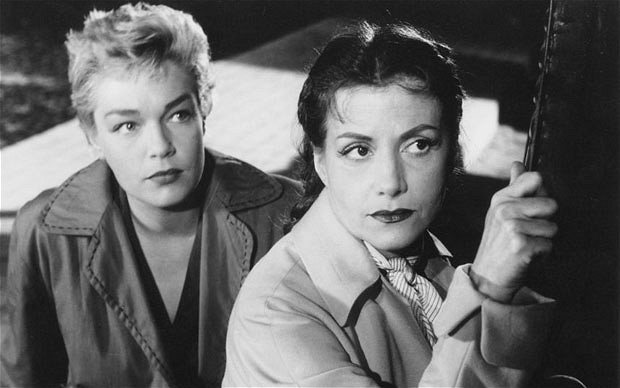
 Henri-Georges Clouzot’s Les Diaboliques is a masterpiece of suspense, a psychological thriller that never lets up. This intense noir stars Véra Clouzot as Christina Delassalle, the mousy owner of a private school for boys run by her nasty, sadistic husband, Michel (Paul Meurisse), who is having an affair with teacher Nicole Horner (Simone Signoret). Nicole conspires with Vera to murder Michel and dump his body in a pool, and the plan works, if not exactly perfectly. Shortly after that, a young student claims to have seen the headmaster alive, frightening Christina and forcing Nicole to — well, we’ve already said too much. As the end credits say, “Don’t be devils. Don’t ruin the interest your friends could take in this film. Don’t tell them what you saw.” Les Diaboliques is based on the novel Celle qui n’était pas (The Woman Who Was No More) by Pierre Boileau and Thomas Narcejac, who also wrote D’entre les morts (The Living and the Dead), which was turned into the Alfred Hitchcock classic Vertigo. Sadly, Véra Clouzot, wife of director Henri-Georges, died five years after Les Diaboliques came out, at the age of forty-six, of a heart condition. Les Diaboliques is screening October 14-15 at the diabolically early time of 11:30 am at the Nitehawk Cinema as part of its “Brunch Screenings,” “Crime,” and “Halloween at Nitehawk” series. The Halloween series continues through October 29 with such horror favorites as Takashi Miike’s awesome Audition, John Carpenter’s classic original Halloween, Tod Browning’s Dracula, Charles Laughton’s Night of the Hunter, and Charles Barton’s Abbott and Costello Meet Frankenstein.

 For the last four decades, Baldwin-born writer-director Jonathan Demme has alternated between fiction films and documentaries, releasing such features as Something Wild, The Silence of the Lambs, and Philadelphia as well as such real-life tales as Haiti: Dreams of Democracy, Cousin Bobby, and Neil Young Trunk Show. IFC Center is dedicating its complete fall Stranger Than Fiction season to the latter, screening six Demme documentaries on successive Tuesday nights, each followed by a Q&A with the Oscar-winning director. The series began with Stop Making Sense, Swimming to Cambodia, and The Agronomist; on October 18, STF will present one of Demme’s very best, Neil Young: Heart of Gold. In March 2005, less than a week before a scheduled operation for a brain aneurysm, Canadian country-folk-rock legend Neil Young headed to Nashville, assembled friends and family, and in four days recorded one of the best — and most personal — albums of his storied career, Prairie Wind. On August 18, he had recovered enough to put on a poignant show at the Ryman Auditorium in Nashville, captured on film by Jonathan Demme (whose previous music-related works included Talking Heads in Stop Making Sense, Robyn Hitchcock in Storefront Hitchcock, and videos by the Pretenders and Bruce Springsteen).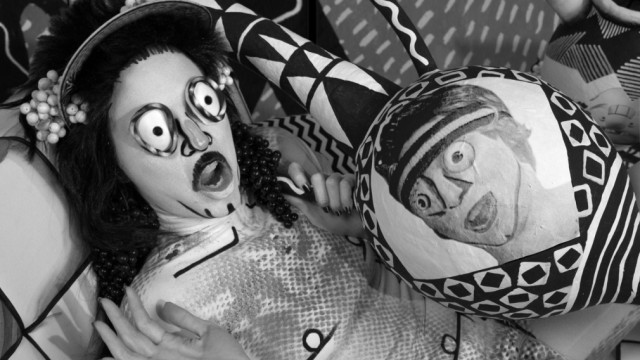
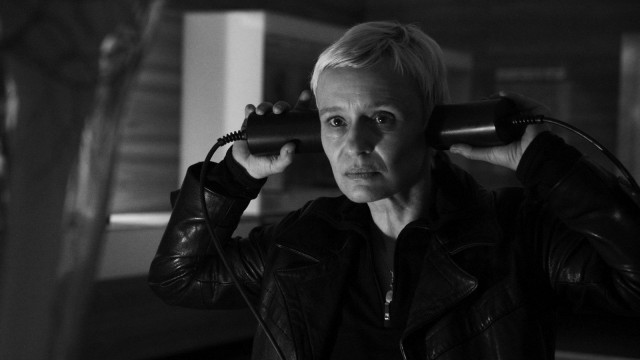
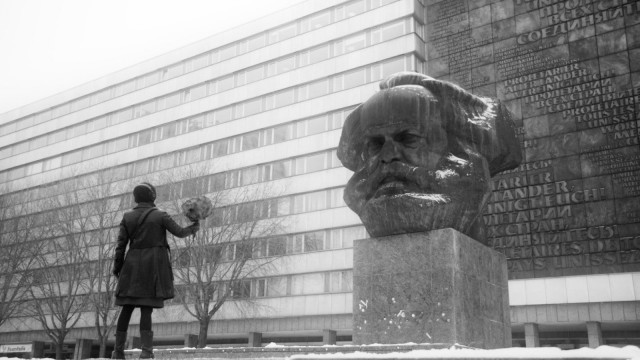
 In 1999, filmmaker Petra Epperlein’s fifty-seven-year-old father, Wolfgang, thoroughly washed his company car, burned all of his personal papers and photographs, and then hanged himself from a tree in the family garden in their home in Chemnitz, which was known as Karl Marx City in what was formerly communist East Germany from shortly after the end of WWII to the fall of the Berlin Wall. “Much like Karl Marx City, her father set out to erase himself,” narrator Matilda Tucker, Epperlein’s daughter, says near the beginning of the intricately plotted and gripping documentary Karl Marx City. “All that he left behind were questions.” Fifteen years later, Epperlein, who has made such sociopolitical films with her husband, Michael Tucker, as Gunner Palace, The Prisoner Or: How I Planned to Kill Tony Blair, and Bulletproof Salesman — the duo call themselves Pepper & Bones — returned to Chemnitz to try to answer some of those questions and find out whether her father had killed himself because, as was rumored, he had collaborated with the Stasi, the much-feared East German secret police. Between 1950 and 1990, the German Democratic Republic employed 92,000 officers and 200,000 informants to spy on their own friends, neighbors, and family, using audio and video to track their every move in order to identify supposed enemies of the state. Written, directed, edited, and produced by Epperlein and Tucker — Petra also did the audio recording and Michael served as cinematographer and sound designer — Karl Marx City features declassified surveillance tapes, broadcast intercepts, and propaganda films from the Ministry for State Security (the Stasi, or Staatssicherheit) along with striking new black-and-white footage of Epperlein’s quest as she poignantly retraces her father’s steps. She meets with such current and former employees of the Stasi Archive as Lothar Raschker, Dr. Juliane Schütterle, and Dagmar Hovestadt, Cold War and GDR expert Dr. Douglas Selvage, and Berlin-Hohenschönhausen Memorial director Dr. Hubertus Knabe to examine the history of the Stasi and detail the effects it had on the psyche of the German people.