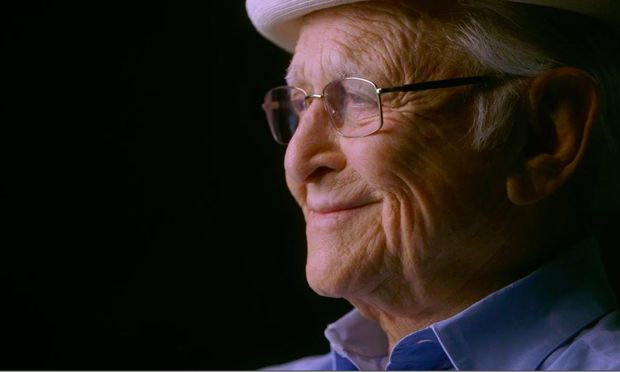
Norman Lear, seen above in documentary NORMAN LEAR: ANOTHER VERSION OF YOU, will be at the Greene Space on December 17 to discuss his life and career
Who:Norman Lear,Susan Fales-Hill,Heidi Ewing, Rachel Grady What: Conversation with Norman Lear When: Saturday, December 17, $25, 6:00 Where:The Greene Space at WNYC, 44 Charlton St. at Varick St. Why: “In my ninety-plus years I’ve lived a multitude of lives,” Norman Lear writes in his new memoir, Even This I Get to Experience. “I had a front-row seat at the birth of television; wrote, produced, created, or developed more than a hundred shows; had nine on the air at the same time; finished one season with three of the top four and another with five of the top nine; hosted Saturday Night Live; wrote, directed, produced, executive-produced, or financed more than a dozen major films; before normalization, led an entourage of Hollywood writers and producers on a three-week tour of China; founded several cause-oriented national organizations, including the 300,000-member liberal advocacy group People for the American Way; was told by the New York Times that I changed the face of television; was labeled the ‘No. 1 enemy of the American family’ by Jerry Falwell; was warned by Pat Robertson that my arms were ‘too short to box with God’; made it onto Richard Nixon’s ‘Enemies List’; was presented with the National Medal of the Arts by President Clinton; purchased an original copy of the Declaration of Independence and toured it for ten years in all fifty states; was ranked by Entertainment Weekly fortieth among the ‘100 Greatest Entertainers of the Century’ (twenty-nine places ahead of the Sex Pistols); ran the Olympic torch in the 2002 Winter Olympics; blew a fortune in a series of bad investments in failing businesses; and reached a point where I was informed we might even have to sell our home.” That’s quite a legacy for the ninety-four-year-old New Haven native, built around such innovative television programs as All in the Family, Good Times, The Jeffersons, Sanford and Son, Maude, Fernwood 2Night, One Day at a Time, and Marry Hartman, Mary Hartman but one that goes much further than that. On December 17, Lear will sit down with author and television writer Susan Fales-Hill (Always Wear Joy, A Different World) for the next installment of her “Icons & Innovators” series at the Greene Space for a conversation exploring Lear’s extensive life and career. They will be joined by filmmakers Heidi Ewing and Rachel Grady (Jesus Camp, 12th & Delaware), directors of the recently released documentary Norman Lear: Another Version of You, which opened the 2016 Sundance Film Festival. It should be a fascinating, wide-ranging talk, especially given the political situation in the country today.
On December 13, the Met moves slightly northeast as museum curator and educator Kathryn Calley Galitz discusses her new book, The Metropolitan Museum of Art: Masterpiece Paintings (Skira Rizzoli, September 2016, $75), at the Barnes & Noble on Eighty-Sixth St. and Lexington Ave. The deluxe book examines five hundred classic works, divided into four chronological sections, “Before 1450,” “1450-1750,” “1750-1900,” and “After 1900,” from the ca. 3800-3700 BCE Central Iran “Storage Jar with Mountain Goats” to Kerry James Marshall’s 2014 “Untitled (Studio).” In addition to full-color photos of each piece, the book includes a bibliography and artist-based index. “Every painting has a story to tell. It should come as no surprise, then, that The Metropolitan Museum of Art: Masterpiece Paintings reveals so many intriguing stories,” Met director Thomas P. Campbell writes in the foreword, opposite Georges Braque’s “Still Life with Metronome (Still Life with Mandola and Metronome).” In her essay “Painting through the Ages,” Galitz explains, “As for the qualifier ‘masterpiece,’ it is indeed a loaded term whose inherent subjectivity goes without saying. We each have our own idea of what constitutes greatness, just as, over time, the canon of acknowledged masterpieces has been subject to the vagaries of taste — both scholarly and popular. . . . That a painting completed in 2015 is included in the same volume as works that have enjoyed masterpiece status for centuries may come as a surprise, but its presence forces us to question the imposition of an arbitrary time frame on the notion of a masterpiece.” Many of the reproductions are full pages, allowing readers to delve into the details of some of what makes these works so special. (Getting the prestigious front cover, by the way, is Jean Auguste Dominique Ingres’s “Joséphine-Éléonore-Marie-Pauline de Galard de Brassac de Béarn, Princesse de Broglie,” while Ogata Kōrin’s “Irises at Yatsuhashi [Eight Bridges]” occupies the back.) I started to list some of my personal favorites here, but that would have just gone on . . . and on . . . and on. The Metropolitan Museum of Art: Masterpiece Paintings is a beautifully designed book that will make you gasp again and again, much like a trip through the Met’s spectacular galleries does.
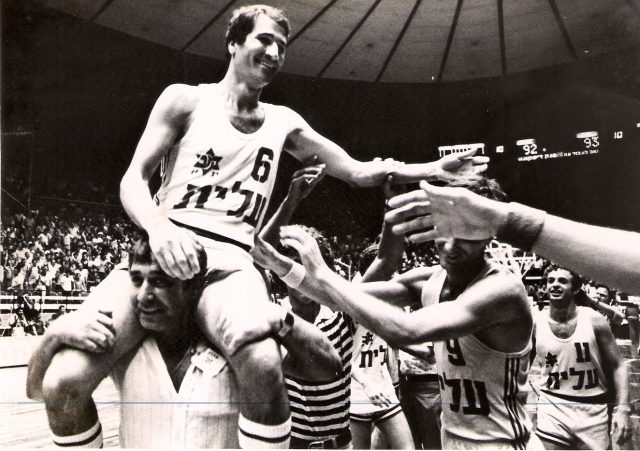
Jersey’s Tal Brody gave up potential NBA career to help lift Israeli team to glory in 1977
ON THE MAP (Dani Menkin, 2016)
Cinema Village
22 East 12th St. between University Pl. & Fifth Ave.
Opens Friday, December 9
212-529-6799 www.cinemavillage.com www.onthemapfilm.com
In the 1970s and 1980s, sports and politics began to mix in unsavory ways, from the horrific massacre of the Israeli Olympic team in Munich in 1972 to boycotts of the 1980 and 1984 Summer Games. But sports can also lift nations and their place in the world in remarkable ways. Three years before the “Miracle on Ice,” when the U.S. Olympic hockey team won the Gold Medal in Lake Placid, a previously unsuccessful Israeli basketball team was attempting to pull off a miracle of its own at the 1976-77 European Cup Championship. Writer-director Dani Menkin tells the improbable story of Maccabi Tel Aviv in On the Map, an exciting, superbly made documentary about a group of dedicated men whose on-court efforts were about more than going after the cup. “It’s not just basketball,” point guard Bob Griffin explains. Menkin mixes contemporary and archival footage for maximum impact; seeing the surviving members of the team donning their jerseys again and watching themselves in the biggest international game an Israeli team has ever participated in is tremendously moving. “It was something so unbelievable, so wishful, a great, golden place in sports history,” says sportscaster Alex Giladi, who took much of the amazing footage shown in the film. Fascinating insights emerge as Menkin speaks with Griffin, power forward Eric Minkin, forward Lou Silver, guard Miki Berkovich, center Aulcie Perry, superstar point guard and captain Tal Brody, and Jennifer Boatwright, the widow of small forward Jim Boatwright, in addition to former Notre Dame coach Digger Phelps, Hall of Famer Bill Walton, who played with Brody on the U.S. National Team, former NBA commissioner David Stern, NBA commentator Simmy Reguer, and broadcaster Gideon Hod. Among those putting Maccabi’s battles against Italy’s Mobilgirgi Varèse, Spain’s Real Madrid, and Russia’s CSKA Moscow Red Army into political perspective are former finance minister Yair Lapid, former Israeli ambassador to the U.S. Michael Oren, Maccabi president Shimon Mizrahi, and longtime Soviet prisoner and activist Natan Sharansky.
On the Map is a terrific documentary, particularly because Menkin (39 Pounds of Love, Dolphin Boy) was able to acquire so much outstanding black-and-white and color footage of the events discussed in the film, from Israeli defense minister Moshe Dayan greeting the team on court before games to Brody practicing by himself, from players sharing a prophetic cake to head coach Ralph Klein giving inspirational locker-room speeches. There is also archival footage of the 1972 Olympic massacre, the 1973 Yom Kippur War, Prime Minister Yitzhak Rabin preparing to resign, Egyptian president Anwar Sadat meeting with U.S. president Jimmy Carter, and the 1976 Air France hijacking that led to Operation Entebbe. In the middle of it all is Brody, a kid from Jersey who helped change Israel and its position on the world stage. “There are some things that are more important than sport,” Stern says. “The excitement was just too much. I wanted more,” Perry asserts with a big smile. On the Map expertly delivers big-time on both accounts. The film opens December 9 at Cinema Village, with Menkin participating in Q&As following the 3:00, 5:00, and 7:00 screenings December 9-11.
Proud mass murderers envision themselves as movie stars in Joshua Oppenheimer’s THE ACT OF KILLING
THE ACT OF KILLING (Joshua Oppenheimer, 2012)
Museum of the Moving Image
35th Ave. at 36th St., Astoria
Sunday, December 11, $12 (can be applied to museum admission), 3:00
Series runs through December 23
718-777-6800 www.movingimage.us www.theactofkilling.com
Joshua Oppenheimer’s Oscar-nominated The Act of Killing is one of the most disturbing, and unusual, films ever made about genocide, and you can see even more of it on December 11 when the Museum of the Moving Image screens the director’s cut, containing thirty-seven minutes of additional material, as part of the nonfiction series “Pushing the Envelope: A Decade of Documentary at the Cinema Eye Honors.” In 1965–66, as many as a million supposed communists and enemies of the state were killed in the aftermath of a military coup in Indonesia. Nearly fifty years later, many of the murderers are still living in the very neighborhoods where they committed the atrocities, openly boasting about what they did, being celebrated on television talk shows, and even being asked to run for public office. While making The Globalization Tapes in Indonesia in 2004, the Texas-born Oppenheimer met some of these self-described gangsters and, struck by their brash, bold attitudes, decided to create a different kind of documentary. In addition to following them around as they go bowling, play golf, sing, and dance, proudly showing off how happy their lives are, Oppenheimer offered them the opportunity to tell their story as if it were a Hollywood movie. The men, whose love of American noir and Westerns heavily influenced the stylized killings they perpetrated, loved the idea and began to restage torture and murder scenes in great detail for the camera, getting in period costumes, putting on makeup, going over script details, reviewing the dailies, and playing both the violent criminals and their victims.
The leader is master executioner Anwar Congo, who is perhaps the only one haunted by his deeds; although on the surface he is proud of what he did, he is tormented by constant nightmares. Such is not the case for the others, who laugh as they go over the gory details, especially paramilitary leader Herman Koto, Congo’s protégé and a man seemingly without a conscience. Meanwhile, fellow executioner Adi Zulkadry wonders whether telling the truth will actually negatively impact their legendary status. “Human rights! All this talk about ‘human rights’ pisses me off,” Congo says in one scene. “Back then there was no human rights.” Oppenheimer also depicts how frighteningly powerful the three-million-strong, government-connected Pancasila Youth is, ready to fight for the very same things that led to the genocide in the first place. It’s hard to comprehend how these men continue to walk free, and one can argue whether Oppenheimer should indeed be giving them the platform that he does. Watching these gangsters — or “free men,” as they like to call themselves, since the Indonesian word for gangster is “preman,” derived from the Dutch “vrijman” — artistically re-create scenes of horrific violence is both illuminating and infuriating on multiple levels that will leave viewers angry and incredulous.
A family searches for answers in THE LOOK OF SILENCE
THE LOOK OF SILENCE (Joshua Oppenheimer, 2014)
Museum of the Moving Image
35th Ave. at 36th St., Astoria
Sunday, December 11, $12, 6:30
Series runs through December 23
718-777-6800 www.movingimage.us thelookofsilence.com
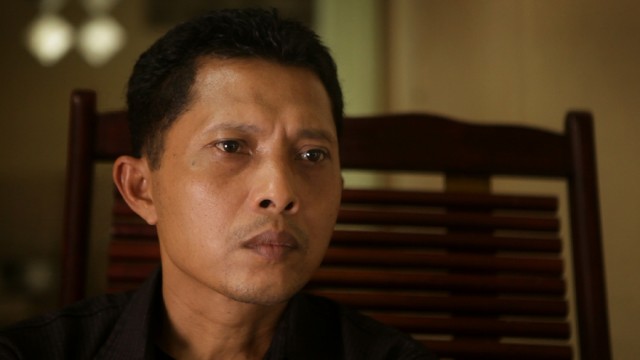
Oppenheimer’s Oscar-nominated The Look of Silence opens with an old man, wearing a pair man, wearing a pair of red optic trial lens frames, gazing into and around the camera for twelve uncomfortable seconds, in complete silence, showing no emotion. It is a striking metaphor for the rest of the film, a shocking documentary about the 1965–66 Indonesian genocide and a bold man determined to confront the men who brutally murdered his brother then, along with a million other supposed communists. In 2012, Oppenheimer made the Oscar-nominated The Act of Killing, in which the leaders of the genocide, who are still in power today, restaged their killings as if they were Hollywood movie scenes. Created as a companion piece to that documentary, The Look of Silence follows forty-four-year-old optometrist Adi as he learns the details of what happened to his brother, Ramli, who was butchered two years before Adi was born. Adi has decided to do what no one else in his country will: break his culture’s silence and denial and face the perpetrators to make them take responsibility for what they did. If they are willing to show remorse, he is willing to forgive. But he has set out on what appears to be an impossible mission; the men he meets with still run Indonesia, and they are more than comfortable threatening the well-being of Adi and his family. Meanwhile, Adi’s parents and patients don’t want to talk about what occurred back in 1965–66, or what is still going on today, as they live in fear of these same men. “No, nothing happened,” one woman says when asked about the killings in her town of Aceh. “You ask too many questions,” she adds. Kemat, a survivor of the Snake River massacres, says, “The past is the past. I’ve accepted it. I don’t want to remember. It’s just asking for trouble.” Adi learns horrifying details as he meets with village death squad leader Inong (the old man shown at the beginning of the film), Snake River death squad commander Amir Siahaan, and regional legislature speaker M. Y. Basrun, all of whom defend their actions, and their power and wealth, while more than hinting that Adi should end his quest. But Adi isn’t about to back down.
Adi faces a group of mass murders, including his brother’s killers, in powerful documentary
Adi is often shown in front of a television, mystified as Oppenheimer shows him footage taken for The Act of Killing; Adi stares ahead in disbelief and silence, much like we did when watching the final film, amazed at what we were seeing. It is a fascinating coincidence that Adi is an optometrist, going around his community fitting people for glasses, helping them see better, even if they don’t always want to look at certain things. He is appalled that his children’s school still teaches that the evil communists deserved to die; it’s particularly telling when his young daughter playfully puts on two pairs of glasses, as if perhaps the next generation will not look away — and to emphasize that, Oppenheimer cuts directly to Adi’s aging, decrepit father, Rukun (whom his wife, Adi’s mother, Rohani, claims is 140), his eyes closed, as he can barely see or hear anymore and needs to be taken care of like a baby. Adi has become a folk hero in Indonesia, where some regions have banned the film and screenings had to be canceled because of threats of violence from the police and military. But the film itself depicts Adi as an everyman; he could be any one of us, saying the things that need to be said. “Making any film about survivors of genocide is to walk into a minefield of clichés, most of which serve to create a heroic (if saintly) protagonist with whom we can identify, thereby offering the false reassurance that, in the moral catastrophe of atrocity, we are nothing like the perpetrators,” Oppenheimer (The Globalisation Tapes) writes in his extensive, must-read notes on the film’s official website. “But presenting survivors as saintly in order to reassure ourselves that we are good is to use survivors to deceive ourselves. It is an insult to survivors’ experience, and does nothing to help us understand what it means to survive atrocity, what it means to live a life shattered by mass violence, and to be silenced by terror. To navigate this minefield of clichés, we have had to explore silence itself.” In that way, to use a cliché, The Look of Silence speaks volumes. And although it’s specifically about the Indonesian genocide, it could just as easily be made about many other mass murders that have occurred, and are still going on, around the world. Adi might be receiving long standing ovations at screenings where he appears, but it’s telling that the film’s closing credits include more than two dozen people listed as “Anonymous,” from the codirector and a coproducer to a camera operator and production managers. Clearly, fear still rules in Indonesia.
An unforgettable film that needs to be widely seen, The Look of Silence, which was executive produced by Werner Herzog, Errol Morris, and André Singer, is being shown at 6:30 on December 11 at the Museum of the Moving Image, shortly after the director’s cut of The Act of Killing. “Pushing the Envelope: A Decade of Documentary at the Cinema Eye Honors,” which celebrates the upcoming tenth annual Cinema Eye Honors awards, continues through December 23 with such other past Cinema Eye nominees and winners as Michael Palmieri and Donal Mosher’s October Country, Bill Ross IV and Turner Ross’s 45365, and Jennifer Venditti’s Billy the Kid, with the directors on hand for Q&As. Both The Act of Killing and The Look of Silence won Cinema Eye Honors for Outstanding Achievement in Nonfiction Feature Filmmaking and Outstanding Achievement in Production; Oppenheimer also won for Outstanding Achievement in Direction. The nominees for Outstanding Achievement in Nonfiction Feature Filmmaking for the 2017 Cinema Eye Honors are Cameraperson, Fire at Sea, I Am Not Your Negro, OJ: Made in America, and Weiner; the winners will be announced at the Museum of the Moving Image on January 11.
Another superstar lineup is set for the biannual Rainforest Fund benefit at Carnegie Hall
Who: Chris Botti, Vittorio Grigolo, Darlene Love, Idina Menzel, Ronnie Spector, Bruce Springsteen, Sting, James Taylor, more What: Biannual benefit for the Rainforest Fund Where: Stern Auditorium / Perelman Stage, Carnegie Hall, When: Wednesday, December 14, $150 – $600, 7:00 Why: Founded in 1989 by Trudie Styler and Sting, the Rainforest Fund “supports programs that cover a range of issues from protection of civil and political rights of indigenous and tribal peoples, to the promotion and defense of their social, economic and cultural rights, including the protection of rights to their land and against the destructiveness of resource exploitation.” Every other year the man also known as Gordon Sumner leads a rousing benefit at Carnegie Hall to raise money and awareness for the organization, which must be cheering the recent news about the potential move of the Dakota Access Pipeline. The stellar lineup for the December 14 show, “Baby It’s Cold Outside”: The Revlon Concert for the Rainforest Fund, features jazz trumpeter Chris Botti, Italian tenor Vittorio Grigolo, legendary vocalists Darlene Love and Ronnie Spector, Broadway superstar Idina Menzel, bestselling author Bruce Springsteen, singer-songwriter James Taylor, and Sting, in addition to surprise guests. Previous shows, which used to be known as Rock for the Rainforest, have included performances by Paul Simon, Whitney Houston, Stephen Stills, Dionne Warwick, Billy Joel, Renée Fleming, Elton John, Natalie Cole, George Michael, Gladys Knight, Tom Jones, Macy Gray, Ravi Shankar, Sheryl Crow, and Stevie Wonder, mixing multiple genres and resulting in fab finales with everyone onstage joining in on classic tunes.
Girls soccer team prepares for next game in Sarah DeLappe’s winning debut, THE WOLVES (photo by Daniel J. Vasquez)
The Playwrights Realm
The Duke on 42nd St.
Wednesday – Monday through December 24, $65-$85 www.playwrightsrealm.org
Sarah DeLappe’s sharply incisive debut play about a girls soccer team, The Wolves, is back for an encore engagement at the Duke on 42nd St., making a playoff run after a superb regular season in September. The Playwrights Realm production is set in the present in an unnamed middle America town, where the team is making a championship run of its own. The action takes place on Laura Jellinek’s rectangular AstroTurf set, with the audience seated bleacher-style on the two longer sides of the central green field. Over the course of ninety minutes and a handful of Saturday game warm-ups, the nine girls discuss menstruation, their perpetually hung-over coach, social media, religion, exercise, parents, abortion, political correctness, and making a difference in the world while stretching, jogging in formation, and kicking the ball around in predetermined practice routines (including the awesome spider). The sixteen- and seventeen-year-old students are more than a bit fascinated with aging and death; the play opens with a debate about whether ninety-year-old former Khmer Rouge leader Nuon Chea should be imprisoned or executed for horrific crimes he committed in the 1970s. When a few of the girls admit they don’t know anything about the Khmer Rouge, one says, “We don’t do genocide till senior year.” When they argue about the success of various types of feminine hygiene products, the same girl declares, “Score on me with my own baby blood? I think not!” The Wolves regularly passes the Bechdel test, as very few of the discussions have anything to do with boys. In addition, nearly everyone involved with the play is female; the only male listed in the program is one of the sound designers.
Sarah DeLappe’s award-winning play is back for an encore run at the Duke on 42nd St. (photo by Daniel J. Vasquez)
The Realm’s Page One Playwright, DeLappe, and director Lila Neugebauer (Signature Plays: The Sandbox,The Wayside Motor Inn) — both of whom played soccer and made playing the sport with the actors part of the audition process — serve up rapid-fire dialogue like a ball being passed around during a game, with multiple conversations going on at the same time, the audience swerving their heads back and forth to keep up with the fast pace and flow. After a victory, many an athlete has attributed success to that mundane sports cliché, Total Team Effort, but that is exactly what makes The Wolves such a winner; the nine young actors are individually excellent and even better as a unit, although they are later joined by a soccer mom (Kate Arrington) in a heartfelt but unnecessary coda. DeLappe’s clever writing prevents the girls from turning into stereotypes; in fact, for most of the play they are referred to by their numbers, not their names. (We don’t even learn everyone’s given appellation.) They all wear Ásta Bennie Hostetter’s blue uniform costumes except for the goalie, #00 (Lizzy Jutila), who dresses in yellow and purposely mismatched sneakers; she barely speaks but pays close attention to what the rest of the girls are saying. The team is led by #25 (Lauren Patten), the captain, who has learned various motivation techniques from her father. The rest of the cast, each of whom deserves kudos, features Sarah Mezzanotte as the skinny #2; Brenna Coates as the bold and brash striker, #7; Midori Francis as the childlike and innocent #8; Susannah Perkins as the elitist and morbid #11; Jenna Dioguardi as the wacky, filter-less #13; Samia Finnerty as the serious #14, who is best friends with #7; and Tedra Millan as the mysterious #46, an odd new girl who, according to #13, lives with her mother in a “yogurt.” (It’s actually a yurt.) All of their interactions feel honest and genuine, fully immersing the audience in their very believable private and public dramas. The play, which shared the inaugural Relentless Award (with Clare Barron’s Dance Nation), presented by the American Playwriting Foundation in honor of Philip Seymour Hoffman, makes us eager to see more from DeLappe. A wonderful and unique theatrical experience, The Wolves continues at the Duke through December 24, but it deserves a whole lot more extra time before that final whistle blows.
Japan Society
333 East 47th St. at First Ave.
Saturday, December 10, 7:30, and Sunday, December 11, 2:30, $28
212-715-1258 www.japansociety.org
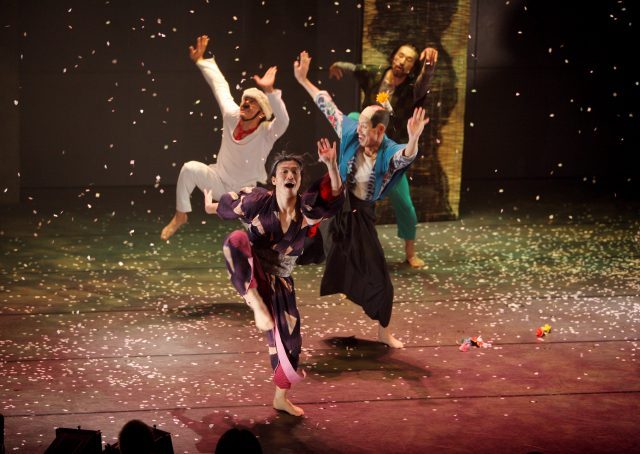
Japan Society is hosting the North American premiere this weekend of a rather unique retelling of the favorite mukashi banashi folktale Hanasaka Jiisan (The Old Man Who Made Flowers Bloom), a wild and wacky version by Ryohei Kondo and his all-male Condors dance company. In the story, a childless couple’s dog finds treasure in their backyard, but things go awry when a greedy neighbor then borrows the pooch so it can dig up treasure on his land as well. Currently celebrating its twentieth anniversary, the twelve-member Condors troupe has previously performed such shows as Nezumi no Sumo (Rats’ Sumo),Apollo,Conquest of the Galaxy: Mars, and 2012 Angry Men, an adaptation of 12 Angry Men. The Tokyo-born, South America-raised Kondo, who brought Goats Block the Road, Part III: Goat Stampede to Japan Society in January 2011, has a talent for creating works that combine silliness and unpredictability with a strong social conscience, sharing Japanese culture while avoiding preaching. (He has also choreographed Takashi Miike’s crazy The Happiness of the Katakuris and Yatterman.) Performed by Michihiko Kamakura, Yoshihiro Fujita, Kojiro Yamamoto, and Kondo, Hanasaka Jiisan features playful props and costumes (by Hiroko Takamatsu) on Hanako Murayama’s ever-changing set. It will be preceded by Tokyo-born, Brooklyn-based Maiko Kikuchi’s Pink Bunny, a parade consisting of puppets and unusual objects marching across the stage in short vignettes. In November 2015, the Pratt graduate’s No Need for a Night Light on a Light Night Like Tonight had its world premiere at La MaMa; Pink Bunny premiered in 2014 as part of St. Ann’s Labapalooza! Answering the question “What do you want to be?,” the piece will be performed by Maiko Kikuchi, Shun Kikuchi, Monica Lerch, David Commander, and Zac Pless.

 In the 1970s and 1980s, sports and politics began to mix in unsavory ways, from the horrific massacre of the Israeli Olympic team in Munich in 1972 to boycotts of the 1980 and 1984 Summer Games. But sports can also lift nations and their place in the world in remarkable ways. Three years before the “Miracle on Ice,” when the U.S. Olympic hockey team won the Gold Medal in Lake Placid, a previously unsuccessful Israeli basketball team was attempting to pull off a miracle of its own at the 1976-77 European Cup Championship. Writer-director Dani Menkin tells the improbable story of Maccabi Tel Aviv in On the Map, an exciting, superbly made documentary about a group of dedicated men whose on-court efforts were about more than going after the cup. “It’s not just basketball,” point guard Bob Griffin explains. Menkin mixes contemporary and archival footage for maximum impact; seeing the surviving members of the team donning their jerseys again and watching themselves in the biggest international game an Israeli team has ever participated in is tremendously moving. “It was something so unbelievable, so wishful, a great, golden place in sports history,” says sportscaster Alex Giladi, who took much of the amazing footage shown in the film. Fascinating insights emerge as Menkin speaks with Griffin, power forward Eric Minkin, forward Lou Silver, guard Miki Berkovich, center Aulcie Perry, superstar point guard and captain Tal Brody, and Jennifer Boatwright, the widow of small forward Jim Boatwright, in addition to former Notre Dame coach Digger Phelps, Hall of Famer Bill Walton, who played with Brody on the U.S. National Team, former NBA commissioner David Stern, NBA commentator Simmy Reguer, and broadcaster Gideon Hod. Among those putting Maccabi’s battles against Italy’s Mobilgirgi Varèse, Spain’s Real Madrid, and Russia’s CSKA Moscow Red Army into political perspective are former finance minister Yair Lapid, former Israeli ambassador to the U.S. Michael Oren, Maccabi president Shimon Mizrahi, and longtime Soviet prisoner and activist Natan Sharansky.