twi-ny recommended events

AI WEIWEI — 2016: ROOTS AND BRANCHES / LAUNDROMAT

A tree grows in Chelsea at the Lisson Gallery (photo by twi-ny/mdr)

A tree grows in Chelsea at the Lisson Gallery (photo by twi-ny/mdr)

2016: ROOTS AND BRANCHES
Lisson Gallery
504 West 24th St. between Tenth & Eleventh Aves.
Mary Boone Gallery
541 West 24th St., 745 Fifth Ave. between 57th & 58th Sts.
AI WEIWEI: LAUNDROMAT
Deitch Projects, 18 Wooster St.
Through December 23, free
aiweiwei.com

This past October, Chinese dissident artist and activist Ai Weiwei swept into New York City, giving a talk at the Brooklyn Museum and opening four gallery exhibitions. He had been banned from international travel for four years since his March 2011 arrest and disappearance, and didn’t receive his passport back until July 2015. So it should not be surprising that the works deal with issues of home and planting roots, particularly in relation to the current refugee crisis around the world. At Lisson Gallery, one of three parts of “Ai Weiwei 2016: Roots and Branches” features giant, rusting cast-iron tree trunks and roots, creating a kind of dying forest, surrounded by black-and-white wallpaper depicting friezes of armed soldiers, explicitly referencing warriors on Ancient Greek black-figure vases; the same archaizing style is applied to modern military vehicles hovering around tent cities and rounding up men, women, and children; storms raging above dangerously overcrowded boats; people being carried away on stretchers; and signs on barbed-wire fences proclaiming, “No One Is Illegal,” “Open the Border,” and “#SafePassage.”

(photo by twi-ny/mdr)

Ai Weiwei’s “Tree” rises up at Mary Boone in Chelsea (photo by twi-ny/mdr)

At Mary Boone in Chelsea, Ai has planted “Tree,” a twenty-five-foot-high twisting tree composed of parts of dead trees bolted together to form something new, a totem that evokes how every person is made of DNA from different cultures and traditions (as well as, of course, much of the same DNA). It’s an imposing structure standing in front of gold-and-white wallpaper showing elegant, circular patterns of surveillance cameras. Also on view are a Warhol-like self-portrait and a triptych of Ai’s famous “Dropping a Han Dynasty Urn,” both made using LEGO pieces like pixels, in addition to “Treasure Box,” a large, wooden box resembling a Chinese puzzle.

(photo by twi-ny/mdr)

Ai Weiwei’s “Spouts Installation” gives the finger to China’s past (photo by twi-ny/mdr)

At Mary Boone’s Midtown location, “Spouts Installation” consists of forty thousand ceramic spouts broken off from teapots dating from the Song to Qing dynasties, fracturing China’s past. Kaleidoscopic gray-and-white wallpaper features arms giving the finger, referencing Ai’s “Fuck Off” series, in which he takes photographs of himself flipping the bird in front of historical landmarks around the globe. The juxtaposition also makes the spouts, arranged in a circle around a central pole that is like a tree, look like a shadowy graveyard of broken middle fingers that have been silenced while also recalling Ai’s “Sunflower Seeds” installations at the Tate and Mary Boone in Chelsea. In the back room are the wooden box “Garbage Container,” the porcelain doormat “Blossom,” a glass-encased “Set of Spouts,” and the porcelain “Free Speech Puzzle.”

Ai Weiwei explores the refugee crisis in “Laundromat” at Deitch Projects (photo by twi-ny/mdr)

Ai Weiwei explores the refugee crisis in “Laundromat” at Deitch Projects (photo by twi-ny/mdr)

Finally, at Deitch Projects in Soho, “Ai Weiwei: Laundromat” is a large room filled with racks of clothing, rows of shoes, stills from new films lining the walls, social media posts on the floor, a documentary video, and Allen Ginsberg’s poem “September on Jessore Road.” (“Millions of fathers in rain / Millions of mothers in pain / Millions of brothers in woe / Millions of sisters nowhere to go.” Inspired by the conditions at the Idomeni refugee camp on the Greek-FYROM border, the Shariya refugee camp in Iraq, and the Moria refugee camp in Lesbos, Ai has sought to give voice back to these refugees, who are suffering through war and extreme poverty; there is a deeply personal aspect to the work, as Ai’s family was sent to a labor camp when he was a child because his father was a poet and political dissident. The clothing and shoes are the real items worn by Syrian refugees at Idomeni — it’s particularly haunting seeing the racks of children’s clothing and rows of kids’ shoes — now properly cleaned instead of caked with mud and filth, each one individually tagged, as if offering each man, woman, and child a clean, new start, with renewed dignity.

IN TRANSIT

IN TRANSIT

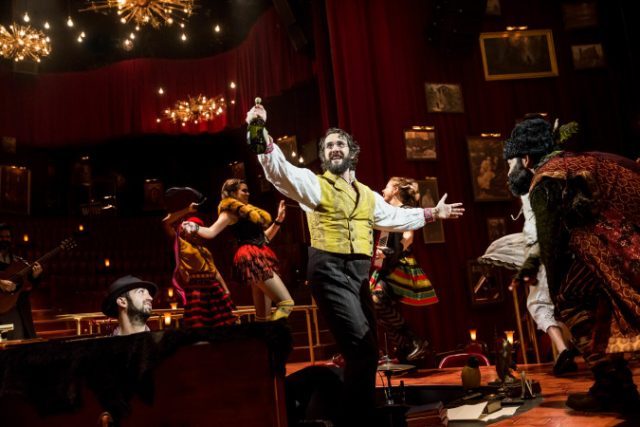
A cappella musical IN TRANSIT has pulled into Circle in the Square for its Broadway bow (photo by Joan Marcus)

Circle in the Square Theatre
1633 Broadway at 50th St.
Tuesday – Sunday through June 25, $89-$159
www.intransitbroadway.com

In the fall of 2010, Primary Stages premiered the a cappella In Transit at 59E59, nabbing a special Drama Desk Award for Outstanding Ensemble and earning a nomination for Outstanding Musical, losing out to a little show called The Book of Mormon. A new production of In Transit has now pulled into the Circle in the Square, where it has its ups and downs, stops and starts, just like the New York City subway system. The show is set in an imaginary train station watched over by Boxman (Chesney Snow and Steven “HeaveN” Cantor alternate in the role), a subway beatboxer with a speaker and a microphone who serves as a kind of Greek chorus / narrator, dishing out advice as well as beats. “Really, how you gonna get where you’re going if you don’t know how to be where you are?” he asks. Over the course of ninety-five minutes and sixteen a cappella songs — there are no instruments used; every sound is made by the human voice — various straphangers take stock of their lives while in transit or at their destinations, their stories rooted in genre clichés that seem tailored more for tourists than New Yorkers yet delivered with energetic charm by a very likable cast. Jane (Margo Seibert) is working as a temp while going on auditions, looking for her big acting break. At a bar, she hits it off with Nate (James Snyder), who recently lost his job because of a major “reply all” faux pas. Nate’s sister, Ali (Erin Mackey), has just taken up running to deal with her breakup with Dave (David Abeles), the doctor she moved cross-country to join in New York. Trent (Justin Guarini) and Steven (usually played by Telly Leung, but we saw understudy Arbender Robinson), are planning their wedding, but Steven insists that Trent must stop hiding his sexual orientation from his Bible-thumping mother (Moya Angela) in Texas. The excellent cast also includes Gerianne Pérez, Mariand Torres, and Nicholas Ward; all of the actors except for Snow play multiple roles.

IN TRANSIT

Characters share their hopes and dreams, trials and tribulations on the subway in IN TRANSIT (photo by Joan Marcus)

Directed and choreographed by three-time Tony winner Kathleen Marshall (The Pajama Game, Anything Goes), In Transit works best when it is taking place in the subway, on Donyale Werle’s set, which features familiar train seats and platform and a clever conveyer belt that suggests subway car movement while the characters share classic subway thoughts: “I should’ve hailed a cab.” “This aroma’s unique.” “Is that lady pregnant or fat?” “Crap, why is the seat all wet where I just sat?” “Did I just miss my stop?” When the location moves to Texas, to a bar, and to Jane’s office, it’s like someone pulled the emergency cord on the train and we did indeed get off on the wrong stop. The cast displays an endearing chemistry not only in the major storylines but in the playful subplot involving Trent and angry token clerk Althea (Angela). Overseeing it all like a mythological god is Snow, the only actor from the original 2010 production; the sounds that come out of his mouth are hard to believe, like a full band accompanying the rest of the cast’s lovely, soaring voices. The problem, however, is in the writing, which does not feel adult enough, unwilling to take any real risks, so it is not surprising that the book, music, and lyrics were written by a quartet — Kristen Anderson-Lopez, James-Allen Ford, Russ Kaplan, and Sara Wordsworth — whose resumes include Frozen, Finding Nemo: The Musical, If You Give a Mouse a Cookie & Other Story Books, and the NYC Children’s Theatre’s Dear Albert Einstein. It could have been a much-loved express train, but instead it’s merely a likable local.

ANDREAS GURSKY: NOT ABSTRACT II / EDWARD BURTYNSKY: ESSENTIAL ELEMENTS

Andreas Gursky Amazon, 2016 C-print 81 1/2 × 160 1/4 × 2 7/16 inches, framed (207 × 407 × 6.2 cm) © Andreas Gursky/Artist Rights Society (ARS), New York/VG Bild-Kunst, Bonn

Andreas Gursky, “Amazon,” C-print, 2016 (© Andreas Gursky/Artist Rights Society (ARS), New York/VG Bild-Kunst, Bonn)

Gagosian Gallery
522 West 21st St. between Tenth & Eleventh Aves.
Through Friday, December 23, free, 10:00 am – 6:00 pm
212-741-1717
www.gagosian.com

A pair of stirring, unrelated photography exhibits in Chelsea close this week, both featuring awe-inspiring large-scale prints that turn manufactured landscapes into gargantuan, thought-provoking spectacle. “My photographs are ‘not abstract.’ Ultimately they are always identifiable. Photography in general simply cannot disengage from the object,” German artist Andreas Gursky says about his latest show, “Not Abstract II,” an extension of his recent survey exhibition “nicht abstract” at Kunstsammlung Nordrhein-Westfalen. Continuing at Gagosian’s vast Twenty-First St. space through December 23, the exhibit consists of twenty-one C-prints and inkjet prints accompanied by a specially commissioned subtle soundscape designed by Canadian electronica DJ Richie Hawtin. The majority of the photographs, some stretching more than eleven feet high and more than sixteen feet wide, were taken between 2008 and 2016, highlighted by a trio of recent untitled vertical works that look like Agnes Martin melded with Mark Rothko, C-prints with horizontal lines of bold colors that are impossible to identify as aerial views of tulip fields without additional information. In “Review,” the backs of the heads of current and former German chancellors Gerhard Schröder, Helmut Schmidt, Angela Merkel, and Helmut Kohl are in the foreground, Barnett Newman’s “Vir Heroicus Sublimis” in front of them. “Amazon” takes visitors inside a vast warehouse of endless packages, the scope of the company’s reach instantly evident and overwhelming, while another exploration of consumerism, “Mediamarkt,” gets its own room. “Les Meés” depicts a rolling landscape covered in rows of solar panels. Meanwhile, the shining gold room in “Qatar” practically glows throughout the gallery. Two examples from Gursky’s superhero series, one depicting Batman against a coming ship, the other Spider-Man dwarfed by a building, are too gimmicky alongside these other breathtaking works that, essentially, take humans but not humanity out of the picture.

Rice Terraces #5  Western Yunnan Province, CH, 2008  Chromogenic Color Print

Edward Burtynsky, “Rice Terraces #5, Western Yunnan Province, CH,” chromogenic color print, 2008 (photo courtesy Bryce_Wolkowitz_Gallery_)

Bryce_Wolkowitz_Gallery_
505 West 24th St. between Tenth & Eleventh Aves.
Through Friday, December 23, free, 10:00 am – 6:00 pm
212-243-8830
brycewolkowitz.com

The abstract, or “not abstract,” nature of reality and humankind’s intervention is also on view a few blocks west at Bryce_Wolkowitz_, where Canadian native Edward Burtynsky’s mini-retrospective, “Essential Elements,” also runs through December 23. The show comprises nineteen chromogenic color prints ranging from 1981’s “Grasses, Bruce Peninsula, Ontario” to a pair of Salt Pan photos taken earlier this year in Gujarat, India. Like Gursky, Burtynsky takes large-scale photographs of vast interiors and exteriors, with Burtynsky concentrating more on the impact technology and resource extraction has had on the environment, as evidenced in such series as “Water,” “Oil,” “Pivot Irrigation,” and “Dryland Farming.” In “Essential Elements,” the branching “Colorado River Delta #12” resembles the L.A. traffic patterns in “Highway #2, Intersection 105 & 110.” “Rice Terraces #5” looks like shimmering mirrored waves. “Oil Refineries #8” is brethren to Gursky’s later “Storage.” It’s a real treat seeing “Third Floor Gallery, Art Gallery of Alberta,” a shadowy, deep photo that has never been shown before in the United States. A photograph of Robert Smithson’s “Spiral Jetty” is too obvious, and the kaleidoscopic 1999 “Borromini #21, Vault, San Ivo della Sapienze, Rome,” feels too gimmicky in an otherwise small but solid round-up.

MANIFESTO

Cate Blanchett

Cate Blanchett plays multiple characters in Julian Rosefeldt’s MANIFESTO

Park Ave. Armory, Wade Thompson Drill Hall
643 Park Ave. at 67th St.
Daily through January 8, $20
212-933-5812
www.armoryonpark.org

As visitors go from screen to screen in Julian Rosefeldt’s thirteen-channel installation, Manifesto, at the Park Ave. Armory, they’re bombarded with declarations from cultural missives by artists and philosophers dating back more than 150 years. Various words and phrases stick out, hanging in the air like bees buzzing around flowers: “originality,” “conflict,” “infinite and shapeless variation,” “decay,” “revolution,” “recklessness,” “absolute reality,” “glorious isolation,” “obsession,” freedom,” “everlasting change,” “the unconsciousness of humanity.”

I am against action; I am for continuous contradiction: for affirmation, too. I am neither for nor against and I do not explain because I hate common sense. I am writing a manifesto because I have nothing to say.

Art requires truth, not sincerity.

Logic is a complication. Logic is always wrong.

The words are all spoken by Oscar-winning actress Cate Blanchett (Notes on a Scandal, Blue Jasmine), who plays thirteen characters in twelve of the films, which each runs ten and a half minutes and are looped concurrently. She does not appear in the shorter prologue but does provide the narration. Among the characters she portrays are a homeless man, a grade school teacher, a factory worker, a punk rocker, a scientist, a news anchor, a choreographer, and a puppeteer.

Our art is the art of a revolutionary period, simultaneously the reaction of a world going under and the herald of a new era.

Originality is nonexistent.

Purge the world of intellectual, professional, and commercialized culture!

Rosefeldt (Trilogy of Failure, Deep Gold, The Ship of Fools), a photographer and filmmaker who was born in Munich and lives and works in Berlin, has an MA in architecture, so location plays a key role in the films, many of which take place in spectacular surroundings, interiors and exteriors, that would make Andreas Gursky drool, including an abandoned Olympic village, the Klingenberg CHP Plant, the Palasseum housing project, a former fertilizer factory, the ZDF Hauptstadtstudio, and the Humboldt Universität Department of Engineering Acoustics (in which a 2001-like monolith floats in the air). Each film begins and ends with Christoph Krauss’s camera lingering on the often jaw-dropping visuals.

We must create. That’s the sign of our times.

Fluxus is a pain in art’s ass.

Existence is elsewhere.

Julian Rosefeldt, Manifesto, 2015 © Julian Rosefeldt and VG Bild-Kunst, Bonn

A homeless man screams out his thoughts on art in Julian Rosefeldt’s MANIFESTO (© 2015 Julian Rosefeldt and VG Bild-Kunst, Bonn)

The statements are delivered in unique and inventive ways, with Blanchett, looking vastly different in each scene courtesy of Bina Daigeler’s costumes, Morag Ross’s makeup, and Massimo Gattabrusi’s hairstyling, playing a mourner giving a eulogy, a mother saying grace, a teacher presenting a lesson, a choreographer yelling at her troupe, a financial analyst spouting data, a crane operator incinerating garbage, and a CEO offering a new concept at a private board meeting in a seaside villa.

I am for art that is put on and taken off, like pants; which develops holes, like socks; which is eaten, like a piece of pie, or abandoned with great contempt, like a piece of shit.

No to the heroic. No to the anti-heroic.

Temporal and geographical alienation are forbidden.

Each section is dedicated to a separate artistic theory, discussing Pop Art, Conceptual Art / Minimalism, Fluxus, Surrealism / Spatialism, Dadaism, Suprematism / Constructivism, Stridentism / Creationism, Abstract Expressionism, Architecture, Futurism, Situationism, and Film. Heard today in this context, the statements range from the very funny to the extremely dry and boring, from the downright elitist to the realistic and relevant, from the sublime to the ridiculous.

Farewell to absurd choices.

Nothing is original.

In this period of change, the role of the artist can only be that of the revolutionary: it is his duty to destroy the last remnants of an empty, irksome aesthetic, arousing the creative instincts still slumbering unconscious in the human mind.

MANIFESTO (photo by James Ewing)

Close-ups of Cate Blanchett appear simultaneously in thirteen-screen installation at Park Ave. Armory (photo by James Ewing)

The quotations come from a wide variety of sources, from little-known essays to major influential texts. They include Karl Marx and Friedrich Engels’s Manifesto of the Communist Party, Kazimir Malevich’s Suprematist Manifesto, Dziga Vertov’s WE: Variant of a Manifesto, André Breton’s Manifesto of Surrealism, Lucio Fontana’s White Manifesto, Stan Brakhage’s Metaphors on Vision, Elaine Sturtevant’s Man Is Double Man Is Copy Man Is Clone, Lars von Trier and Thomas Vinterberg’s Dogma 95, and Claes Oldenburg’s I am for an art . . . , in addition to writings by Francis Picabia, Barnett Newman, Yvonne Rainer, Kurt Schwitters, Tristan Tzara, Sol LeWitt, Paul Eluard, Wassily Kandinsky and Franz Marc, Guillaume Apollinaire, and Werner Herzog.

The past we are leaving behind us as carrion. The future we leave to the fortune-tellers. We take the present day.

All of man is fake. All of man is false.

I believe in the pure joy of the man who sets off from whatever point he chooses, along any other path save a reasonable one, and arrives wherever he can.

About two-thirds of the way through each film, all of the characters portrayed by Blanchett, seen in extreme close-up, suddenly speak their lines in monotone unison, a kind of choral cacophony of chanting and singing that echoes throughout the massive Wade Thompson Drill Hall, an exhilarating moment that makes up for some of the pompous diatribe and intellectual masturbation that preceded it. It also is a grand statement for the critical importance of art, especially during tough times when countries face cultural and sociopolitical battles that threaten personal freedoms and liberties. But the best reason to experience Manifesto, which continues through January 8, is to watch a remarkable actress in a marvelous and memorable tour de force; Blanchett fans will also want to catch her in Anton Chekhov’s The Present, which is running on Broadway through March 19.

CHRISTMAS AT METROGRAPH: SILENT NIGHT, DEADLY NIGHT

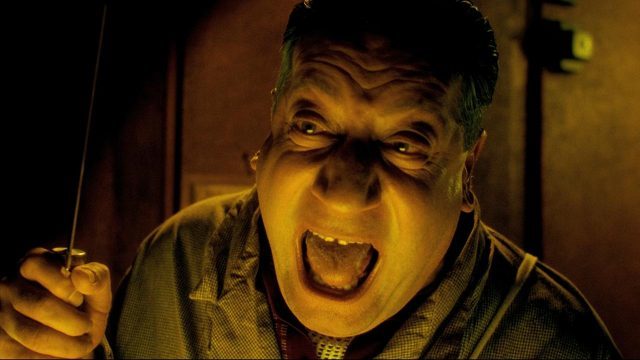
Santa goes a little psycho on holiday flasher flick, SILENT NIGHT, DEADLY NIGHT

Santa goes a little psycho on holiday flasher flick, SILENT NIGHT, DEADLY NIGHT

SILENT NIGHT, DEADLY NIGHT (Charles E. Sellier Jr., 1984)
Metrograph
7 Ludlow St. between Canal & Hester Sts.
Tuesday, December 20, 9:30
Series runs through January 1
212-660-0312
metrograph.com

“Punishment is good,” Mother Superior (Lilyan Chauvin) tells eight-year-old Billy (Danny Wagner) in Charles E. Sellier Jr.’s Silent Night, Deadly Night. Some might think that watching this 1984 slasher flick is pretty severe punishment itself, while others will revel in its tongue-in-cheek campiness; you can decide for yourself when it screens December 20 at 9:30 as part of the “Christmas at Metrograph” series at the Lower East Side theater, which features such other nontraditional seasonal faves as Die Hard, Eyes Wide Shut, and the Gee Whiz It’s Christmas compilation of various shorts, including Christ Mass Sex Dance and Holidaze. Not exactly a holiday classic, Silent Night, Deadly Night, the working title of which was Slayride, was mired in controversy upon its initial release, with critics and such groups as the PTA, the Catholic Conference, and Citizens Against Movie Madness attacking the film for setting a killer Santa Claus loose on an unsuspecting public. The movie begins in 1971, when five-year-old Billy (Jonathan Best) looks on in horror as his parents (Tara Buckman and Geoff Hansen) are brutally murdered by an insane criminal Kris Kringle (veteran character actor Charles Dierkop). Haunted by nightmares, Billy is mistreated by Mother Superior at St. Mary’s Home for Orphaned Children while being befriended by Sister Margaret (Gilmer McCormick), who wants to take a more sensitive approach with the boy. When Billy (Robert Brian Wilson) turns eighteen — blossoming into quite a handsome hunk — Sister Margaret gets him a job at a local toy store run by Mr. Sims (veteran character actor Britt Leach), but when Christmas comes around, well, everyone better watch out.

Silent Night, Deadly Night has its moments, particularly when it is dealing with Billy’s tortured mind, but then it gets bogged down in genre cliches and loses its psychological focus. But it’s still subversive fun, with a crazy soundtrack that combines Perry Botkin’s synth score with original songs by Morgan Ames that you are unlikely to ever hear performed by neighborhood carolers, among them “Slayrider,” “Christmas Flu,” and the indescribable “Warm Side of the Door.” The film was followed by four sequels, but the less said about them, the better. And yes, that’s scream queen Linnea Quigley getting into some trouble on the pool table. We chose not to give Silent Night, Deadly Night a star (token) rating because our advice is essentially to avoid it at all costs if you have any sense of common decency. (Meanwhile, we’ve watched it several times, especially to see what Santa does to that poor snowman….)

MARTIN SCORSESE IN THE 21st CENTURY: THE DEPARTED

Leonardo DiCaprio gets ready for battle in Martin Scorsese's Oscar-winning THE DEPARTED

THE DEPARTED is part of 21st-century Martin Scorsese retrospective at the Museum of the Moving Image

THE DEPARTED (Martin Scorsese, 2006)
Museum of the Moving Image
35th Ave. at 36th St., Astoria
Saturday, December 17, $15, 7:00
Series runs December 16-30
718-777-6800
www.movingimage.us

Queens-born auteur Martin Scorsese changed the face of independent film in the 1970s with such hard-hitting dramas as Mean Streets, Alice Doesn’t Live Here Anymore, and Taxi Driver, then proceeded to expand the notion of cinema as art with such 1980s and 1990s pictures as The King of Comedy, Goodfellas, and After Hours. His more recent output, however, has been vastly overrated, as evidenced by the first part of the Queens-based Museum of the Moving Image retrospective “Martin Scorsese in the 21st Century,” being held December 16-30 in conjunction with the release of the director’s latest film, Silence, which stars Andrew Garfield, Adam Driver, and Liam Neeson. (The series accompanies the exhibition “Martin Scorsese,” a look at Scorsese’s career divided into Family, Brothers, Men and Women, Lonely Heroes, New York, Cinephile, Cinematography, Editing, and Music.) Scorsese’s best film of the new century just might be 2006’s The Departed, based on Andrew Lau and Alan Mak’s awesome 2000 hit, Infernal Affairs. The relatively faithful remake moves the relentless action and intrigue from Hong Kong to the mean streets of Boston, where it is hard to tell cop from criminal. Just out of the academy, Colin Sullivan (Matt Damon) rises quickly to detective in the Special Investigations Unit, but he’s actually in cahoots with master crime lord Frank Costello (Jack Nicholson). Meanwhile, Billy Costigan (an excellent Leonardo DiCaprio), training to become a cop, is sent deep undercover (including a prison stint) to infiltrate Costello’s gang, with only Captain Queenan (Martin Sheen) and Sergeant Dignam (a very funny and foul-mouthed Mark Wahlberg) aware of the secret mission.

Sullivan and Costigan are like opposite sides of the same persona; in between them stands Costello — and Madolyn (Vera Farmiga), a psychiatrist who is in a relationship with one and is doctor to the other. As both the cops and the criminals search desperately for their respective rats, no one can trust each other, leading to lots of blood and a spectacular finale. Nicholson has a field day as the aging gangster, chewing up mounds of scenery in his first film with Scorsese, who returned to peak form with his best work since 1990’s Goodfellas. The film was nominated for five Oscars, winning four, for Best Director, Best Film Editing (Thelma Schoonmaker), Best Adapted Screenplay (William Monahan), and Best Picture, while Wahlberg was nominated for Best Supporting Actor. The Departed is screening December 17 at 7:00 in the museum’s Redstone Theater. The series opens December 16 with the bombastic Gangs of New York and continues through December 30 with Shutter Island, the disappointing Howard Hughes flick The Aviator, and the good but overrated films The Wolf of Wall Street and Hugo in 3-D.

ERNESTO NETO: THE SERPENT’S ENERGY GAVE BIRTH TO HUMANITY

Ernesto Neto’s “The Serpent’s Energy Gave Birth to Humanity” welcomes visitors into its soothing passageways (photo by twi-ny/mdr)

Ernesto Neto’s “The Serpent’s Energy Gave Birth to Humanity” welcomes visitors into its soothing passageways (photo by twi-ny/mdr)

Tanya Bonakdar Gallery
521 West 21st St. between Tenth & Eleventh Aves.
Through December 16, free, 10:00 am – 6:00 pm
212-414-4144
www.tanyabonakdargallery.com

For his first gallery exhibition in four years, Brazilian artist Ernesto Neto has created another happy-making installation grounded in ritual, tradition, and custom. Inspired by his recent collaborations with the indigenous, shamanistic Huni Kuin (Kaxinawá) of South America, “The Serpent’s Energy Gave Birth to Humanity” contains several living sculptures that welcome visitors into their inviting warmth. Neto’s trademark hand-dyed, crocheted work can be found throughout the two floors of Chelsea’s Tanya Bonakdar Gallery, dangling from the ceiling, hanging on the walls, and spread across the floor. The centerpiece is “Adam Boa Eve Apple Egg,” a large-scale, snakelike passage that leads to a communal womblike area where people can relax, lie down, play a bongo or guitar, and even put on a hat. “The spirit of the boa is an energy . . . It’s a vibration that is inside all the matter, and in all life,” Neto says of the work. That positivity, and Neto’s belief in humanity’s connectivity with nature, is evident in the titles of several of the wall pieces, including “Cosmic roots of the earth,” “Sprouting life,” “Life is love, love energy, from dark earth to light sky D L D L D L,” and, simply, “Joy.” Upstairs, visitors are greeted by a twisting helix ladder titled “e twin serpents, the stairway to life a”; in a small room, you can get comfy on “I am, yo soy, mantra light,” which evokes an umbrella at a beach resort. And in the bigger upstairs room, you can breathe in “Flying fern, cater-boa-pillar, cleaning air, cleaning earth,” a collection of potted plants and stones hanging from the ceiling, and and then stick your arm deep in the far wall piece for a special surprise. With “The Serpent’s Energy Gave Birth to Humanity,” Neto — who dazzled crowds with his giant, immersive “Anthropodino” at the Park Ave. Armory in 2009 — once again melds mind and body, earth and spirit in an energetic treat for the senses.