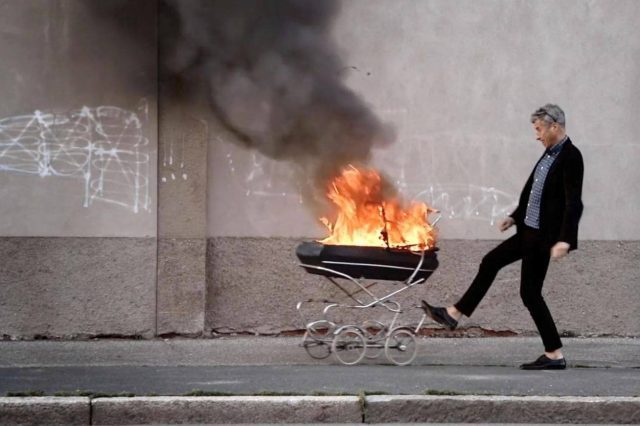
MAURIZIO CATTELAN: BE RIGHT BACK explores career of controversial Italian artist and provocateur
MAURIZIO CATTELAN: BE RIGHT BACK (Maura Axelrod, 2016)
Quad Cinema
34 West 13th St. between Fifth & Sixth Aves.
Opens Friday, April 14
212-255-2243
www.quadcinema.com
www.mauriziocattelanfilm.com
 Italian artist and prankster extraordinaire Maurizio Cattelan has built his wildly successful career out of controversy, provocation, and mystery, taking on the very art world that has made him a superstar. Documentarian Maura Axelrod includes the same elements in her vastly entertaining film, Maurizio Cattelan: Be Right Back. The title refers to both the beginning of Cattelan’s career, a Milan solo show in which he locked the gallery door and hung a sign on it that said “Torno Subito” (Be Right Back) as well as what might or might not be the end, as he announced his retirement following the brilliant 2011 retrospective at the Guggenheim, “All,” in which he hung all of his works from the Guggenheim ceiling, as if signaling their death. “His career is based on anecdotes and lies and imaginary stories,” Milan gallerist Massimo De Carlo says in the film. “Some people are suspicious that Maurizio is pulling the wool over their eyes and he is some kind of flamboyant artistic con man,” adds art historian Sarah Thornton. “I think he’s probably one of the greatest artists that we have today, but he could also be the worst. It’s gonna be one or the other; it’s not gonna fall in the middle,” cracks one of his collectors. Axelrod also speaks with former Guggenheim artistic director Nancy Spector, former Public Art Fund director Tom Eccles, Cattelan archive director Victoria Armutt, Guggenheim curator Katherine Brinson, gallerists Marian Goodman and Emmanuel Perrotin, art critics Calvin Tomkins and Dodie Kazanjian, and Cattelan’s sister, Giada, former fiancée Victoria Cabello, and current girlfriend Victoria Yee Howe. They share stories about Cattelan’s working methods and proclivities, delving into such pieces as “Daddy Daddy,” a facedown Pinocchio in a pool of water that was inspired by Cattelan’s childhood; “La Nona Ora” (The Ninth Hour), a lifelike sculpture of the pope knocked down by a meteorite; “Another Fucking Readymade,” in which he stole the inventory of another artist’s show and claimed them as his own; “Him,” a rendering of a kneeling child who turns out to be Adolf Hitler; and “L.O.V.E.” (Libertà, Odio, Vendetta, Eternità), a marble sculpture of a giant middle finger in Milan’s financial district. He even staged his own pseudo–Caribbean Biennial, featuring such artists as Wolfgang Tillmans, Elizabeth Peyton, Gabriel Orozco, Pipilotti Rist, Chris Ofili, and Mariko Mori gathered together on the island of St. Kitts. (The critics were not amused.)
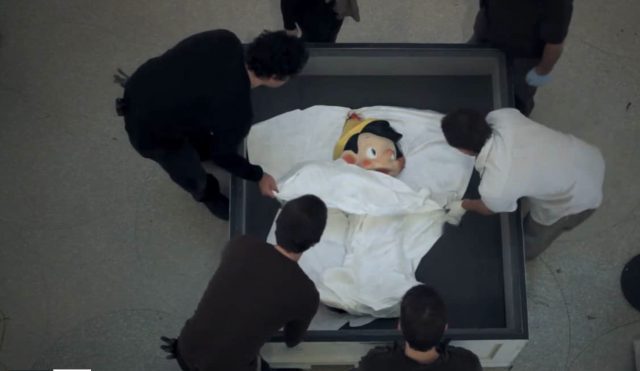
“Daddy Daddy” holds one of the keys to the mystery that is Maurizio Cattelan
Meanwhile, the artist speaks profusely on camera, sharing such insights as “I knew what was expected of me and I decided I was going to be something else” and “I’ve always been very good at faking things.” Indeed, about two-thirds of the way through the film, there is a fabulous twist that only art-world insiders are likely to have guessed, as Axelrod takes a page from Orson Welles’s magical F for Fake. Writer, producer, and director Axelrod incorporates home movies, family photographs, playful animation, and new and old footage to try to figure out just what makes Cattelan tick, what he’s really like, but she lets viewers in only so far, like his tiny elevator installation in which no one can fit. Among the many words used to describe the iconoclastic artist and his oeuvre are “tasteless,” “profound,” “funny,” “tragic,” “disrespectful,” “vulnerable,” and “uncanny beauty,” as people also point out that he is anxious, very demanding to live and work with, and, while seeing art as commodity, uses the vanity of collectors against themselves. Of course, all of those are true, in one way or another. His art can be as thrilling as it is offensive, as silly as it is prescient as he explores such themes as failure, alienation, mortality, and personal identity. “You need to go pretty far, otherwise the piece doesn’t exist,” he says. “You need to push your friends and enemies and collaborators further, and you have to be uncomfortable about it. The further you go, the more satisfaction is created by the level of discomfort in which all the participants were put.” The last section of the film details “All,” which a clearly uncomfortable Spector had her doubts about but insisted that “the risk had to be real,” worrying that it would cause the Guggenheim to collapse within itself but they had to proceed. And as far as Cattelan’s retirement is concerned, this past September he installed “America” at the Guggenheim, an eighteen-karat-gold fully functional toilet, the first new piece he has exhibited since “All.” Maurizio Cattelan: Be Right Back opens April 14 at the newly renovated Quad Cinema, with Axelrod participating in Q&As on April 14 (with Spector and New Museum artistic director Massimiliano Gioni) and April 15 at 7:45 and April 16 at 5:30.
 Daria and Scooby-Doo meet The Poseidon Adventure and Titanic in graphic novelist