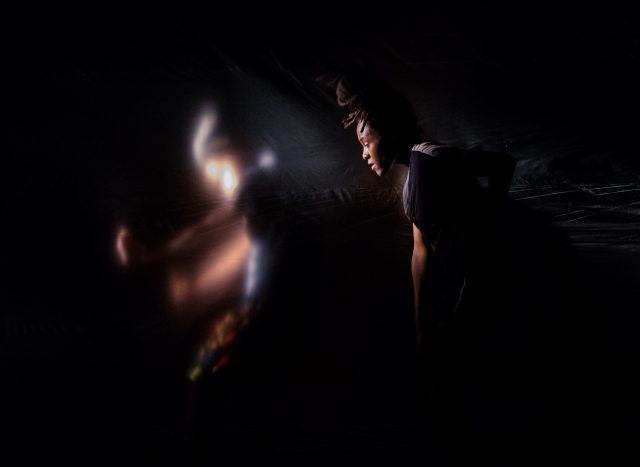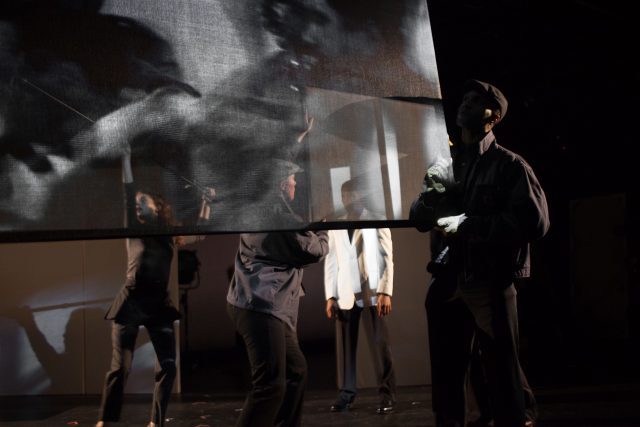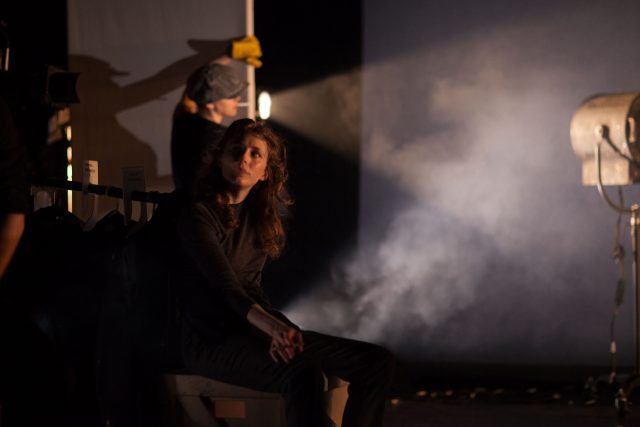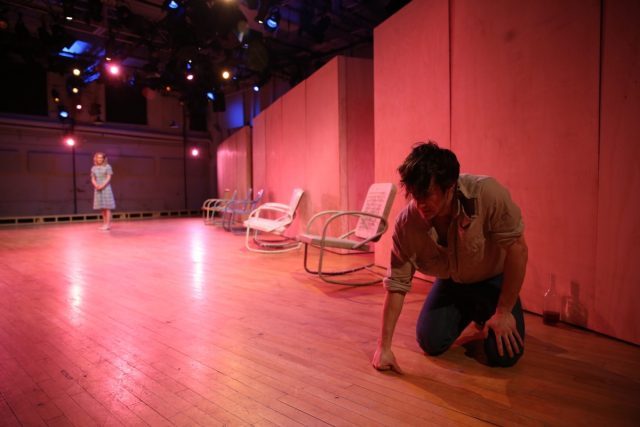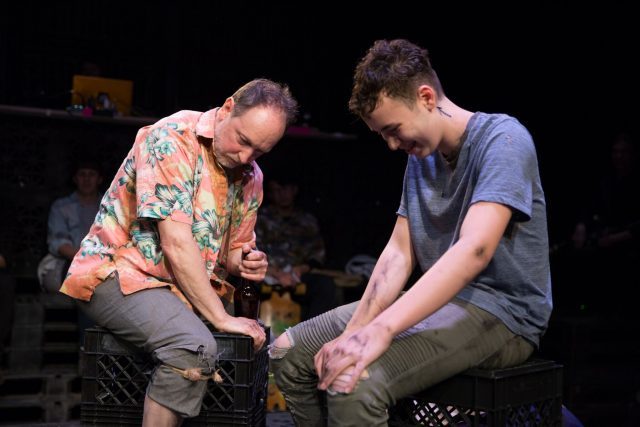
The Drunk (Paul Lazar) and the Messenger (Jasper Newell) take a break at a mysterious outpost in SAMARA (photo by Julieta Cervantes)
Soho Rep.
The Mezzanine Theatre at the A.R.T./New York Theatres
502 West 53rd St. between Tenth & Eleventh Aves.
Tuesday – Sunday through May 14, $35-$65
sohorep.org/samara
Richard Maxwell’s Samara is an eloquent and poetic existential Western that takes audiences on a soul-searching journey across a dark, mysterious frontier. Perhaps inspired by John O’Hara’s 1934 novel The Appointment in Samarra, ancient parables, and the Central Asian city of Samarkand, known as the Crossroads of Cultures, the play opened last night at Soho Rep.’s temporary home at the Mezzanine Theatre on West Fifty-Third St., where an intimate black box space has been constructed out of palettes of grayish-black plastic milk-crate-like blocks, evoking the muqarnas of Samarkand, formed into walls, benches, and the spare set itself. The show consists of sixteen short scenes totaling seventy-five minutes, with folk-country rocker Steve Earle reading the stage directions in front of a music stand off to one side; in opposite corners, Ivan Goff plays uilleann pipes and an Irish concert flute and Anna Wray contributes atmospheric percussion on a prepared piano. The play begins with the Messenger (fourteen-year-old Jasper Newell) demanding payment from the Supervisor (Roy Faudree) for work rendered; the Supervisor claims he can’t pay him and instead offers the Messenger an IOU for a larger debt that he can collect himself. With nowhere else to turn, the Messenger takes the paper and sets out on a treacherous sojourn to an outpost in the middle of nowhere, where he finds the Manan (Becca Blackwell), whose father owes the debt, and the Drunk (Big Dance Theater cofounder Paul Lazar). They don’t all get along, and soon the Manan is traveling back to Samara, encountering the sage Agnes (ninety-two-year-old Vinie Burrows) and her two sons, Cowboy (Modesto Flako Jiménez) and Beast (Matthew Korahais).
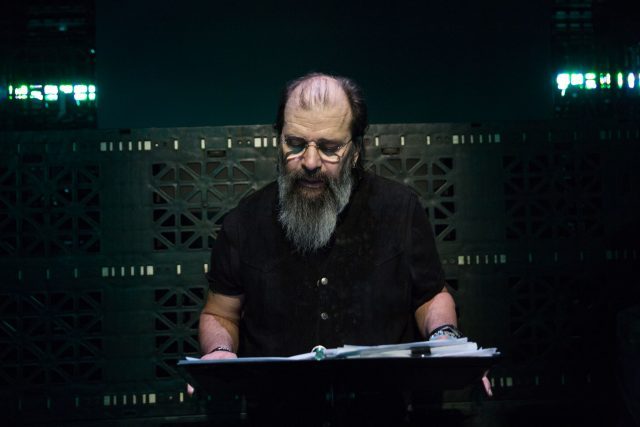
Steve Earle serves as narrator and composer of new Richard Maxwell play (photo by Julieta Cervantes)
North Dakota native Maxwell, who usually directs his own avant-garde and experimental works (which include Good Samaritans, Neutral Hero, Isolde, and the Obie-winning House), primarily with his New York City Players company, has entrusted Samara to Obie-winning director Sarah Benson, the Soho Rep. artistic director who has helmed such plays as Branden Jacobs-Jenkins An Octoroon and Sarah Kane’s Blasted. (Maxwell was last at Soho Rep. in 1999 with another Western of sorts, Cowboys and Indians, about real-life Oregon Trail historian Francis Parkman.) Just as there are no standard rules in Maxwell’s plays, there are nonstandard narrative guidelines in Samara. “Back home, we knew what the rules were. Right? It was clear,” the Messenger tells the Manan. “Oh, those were some times, weren’t they! Do you even remember? I would say those were some times, and Samara was a good place. And, who knows, maybe it will be good again.” When the Drunk talks about power, the Messenger explains, “True power? Is that what you’re asking? True power, is in the mind.” Much of Samara takes place in the mind, with a kind of Buddhist/Sufi ethos in a postapocalyptic future. The play is also about debts of all kinds, real and imagined, monetary and psychological. “Oh, I wish I knew . . . I owe something, and I have to pay it back,” says the Manan, whose monicker means “thoughtfulness” in Sanskrit. Even the name Samara evokes the Sanskrit word “samsara,” which refers to the cyclic nature of life and the world itself. Maxwell and Benson provide just the right mix of abstraction and exposition, packing a whole lot into a small amount of time, following unique characters that serve as unpredictable archetypes of the Old West, men and women who would feel at home in a Coen brothers film. Gone is the trademark stilted delivery of Maxwell’s actors in past shows, although it’s hard to call the performances naturalistic, but Maxwell still provokes the audience with his penchant for revealing the staged theatricality of his presentations.
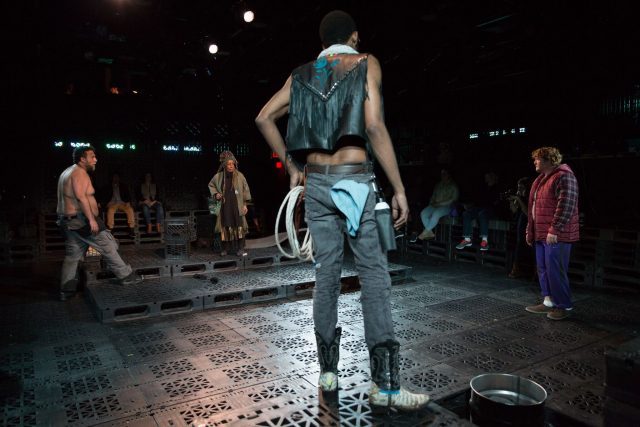
Richard Maxwell’s SAMARA is running at Soho Rep. through May 7 (photo by Julieta Cervantes)
Samara also explores such concepts as responsibility, fear of death, and karma. “Damn! After fifty years, a man has got to realize that he is living on top of a fence,” the Drunk says. “He begins by thinking he knows what it all means, and what he should do. Then, he becomes sure what it all means and what he should do, and apologizes for what he thought it meant and all the things that he did do. Later on, he puts what he should do against the things he really wants to do. And now . . . It is pure fear. Fear and sound, can’t bring them together. What’s going to happen to him? What is the fence dividing? Old and new? Pleasure and duty? Life, death? Good bad? Known unknown? . . . COME DOWN OFF THE FENCE!!” he declares. Earle, who has appeared as an actor in such popular cable series as The Wire and Treme, eventually steps out from behind the stand to deliver a strangely beautiful soliloquy. Louisa Thompson’s set is sometimes slightly rearranged, as characters move around pieces of the palettes, and Annie-B Parson’s choreography and Matt Frey’s lighting form quite a one-two punch as the end nears and your discomfort rises, even if you’re sitting on one of the cushions provided to the audience. What does it all mean? What does anything mean? Samara is another superb foray into the known and the unknown by Maxwell, who perhaps is primarily telling us all to “come down off the fence.”
[There will be three special FEED events ($10) following select shows; on April 20, Blackwell will tell stories about an out-of-work Pussy Clown and take part in a Q&A; on May 4, Jiménez will perform his poetry, Oye Para mi Querido Brooklyn (Listen for My Dear Brooklyn); and on May 5, Lazar will present Cage Shuffle, consisting of one-minute stories by John Cage, choreographed by Parsons.]