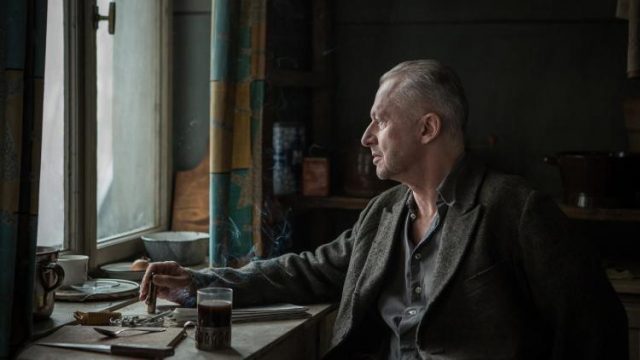
Władysław Strzemiński (Bogusław Linda) looks out on a changing Poland in Andrzej Wajda’s film film, Afterimage
OPENING NIGHT GALA: AFTERIMAGE (POWIDOKI) (Andrzej Wajda, 2016)
Directors Guild of America
110 West 57th St. between Fifth & Sixth Aves.
Tuesday, May 2, $50, 7:00
Series continues May 4-7 at Anthology Film Archives, 32 Second Ave. at Second St., $16-$20, 212-505-5181
www.nypff.com
 In his final film, Polish master Andrzej Wajda makes a grand statement about the importance of art and its place in society. Afterimage, which will be introduced by Martin Scorsese at the gala opening-night celebration of the thirteenth New York Polish Film Festival on May 2 at the Directors Guild of America, is based on a true story while also serving as a stern warning. Bogusław Linda, who has previously appeared in Wajda’s Man of Iron and Danton, gives a towering performance as real-life Polish avant-garde artist Władysław Strzemiński, a one-armed, one-legged painter considered one of the greatest Polish artists and theoreticians of the twentieth century but whose legacy was destroyed during the rise of Stalinism and social realism. The film begins with a bright, gleeful scene in which Professor Strzemiński and his students roll around a lush green field, smiling and laughing and loving life. Hanna (Zofia Wichłacz) arrives, wanting to study with the professor as well. “The image has to be what you absorb from this,” he tells her, pointing at the beautiful landscape while his students listen with rapt attention. “When we gaze at an object, we get its reflection in our eye. When we stop looking at it and move our gaze elsewhere, an afterimage of the object remains in the eye — a trace of the object with the same shape but the opposite color. An afterimage. Afterimages are the colors, the inside of the eye which looks at an object. Because a person really only sees what he is aware of.” He then gazes out with a big grin and closes his eyes — and Wajda cuts to him in his apartment in 1948, with the Polish United Workers’ Party now in charge; cinematographer Paweł Edelman switches to a very different color scheme, primarily dank grays save for the pervasive red of the Communist party. Virtually day by day, Strzemiński has his ability to make art and to teach stripped away a little at a time as the party enforces a strict code of what is permitted and what is not under its regime. “The purpose of art is to improve its truth on reality,” Strzemiński explains, and he has to face a series of disturbing new truths himself, especially when his young daughter, Nika (Bronislawa Zamachowska), whose mother is famous sculptor Katarzyna Kobro (Aleksandra Justa), starts falling in line with Communist ideals.
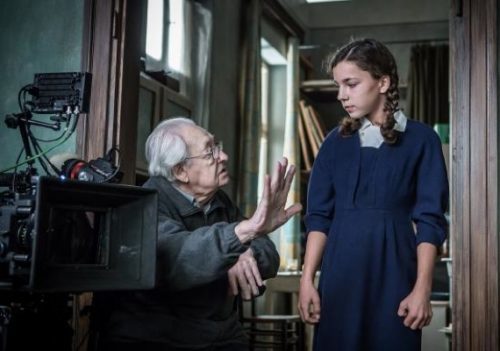
Andrzej Wajda directs Bronislawa Zamachowska on the set of Afterimage (photo © Akson Studio/Anna Włoch)
The film, written by Andrzej Mularczyk based on an idea by Wajda (The Maids of Wilko, The Promised Land), is a fitting finale for the Polish auteur, who won such prestigious prizes as the Palme d’Or, an honorary Golden Bear, and an honorary Academy Award before passing away in October at the age of ninety, following a sixty-five-year career. (In addition, four of his works were nominated for Best Foreign Language Film Oscars.) Afterimage might take place between 1948 and 1952, but it is frighteningly relevant today with so many countries around the world under dictatorships and the value of art and arts education in schools facing scrutiny even here in the United States. Much of the film has an elegiac tone, including the score, which features the music of the late Polish composer Andrzej Panufnik. Linda is brilliant as Strzemiński, who is almost always deep in thought, finding it hard to believe the lengths the party will go to in order to silence artists, including his eager students and his good friend, poet Julian Przyboś. The disheartened stares he makes while watching Nika become part of the problem instead of the solution are intensely moving. Rising Polish star Wichłacz (Warsaw 44) gives a touching performance as Hania, the new student who wants to fight the authorities and is determined to help Professor Strzemiński finish his master opus, The Theory of Vision, before everything is taken away from him. Even though the film shows Wajda at the top of his game, it might not be a stretch to suggest that the aging director identified with Strzemiński, a man who didn’t let the loss of two limbs prevent him from creating art, just as Wajda, approaching ninety at the time, didn’t let anything stop him as well; he joined up with the Polish resistance in 1942, trained to be a painter and then a filmmaker after the war, and was a major supporter of Lech Wałęsa’s Solidarity movement in the 1980s, ultimately making the film Wałęsa: Man of Hope. In the end, both Wajda and Strzemiński are inspiring figures whose works seal their legacies, from the former’s many films to the latter’s paintings and theories as well as his revolutionary Neoplastic Room, which was reconstructed in 1960 at the Muzeum Sztuki w Łodzi.
“Everyone sees differently,” Professor Strzemiński says in the film, which is likely to leave a long-lasting afterimage on those who watch it. The thirteenth New York Polish Film Festival, which is dedicated to Wajda, moves to Anthology Film Archives after opening night, with screenings of some of the best new films from Poland, including Jan P. Matuszyński’s The Last Family, Tomasz Wasilewski’s United States of Love, Agnieszka Smoczynska’s The Lure, and Mitja Okorn’s Singles Planet in addition to Wajda’s 1958 masterpiece, Ashes and Diamonds; Andrzej Wajda: Robmy Zdjecie!, in which Wajda meets with four of his former students while making Katyń; and short films made by students from the Wajda Film School in Warsaw.





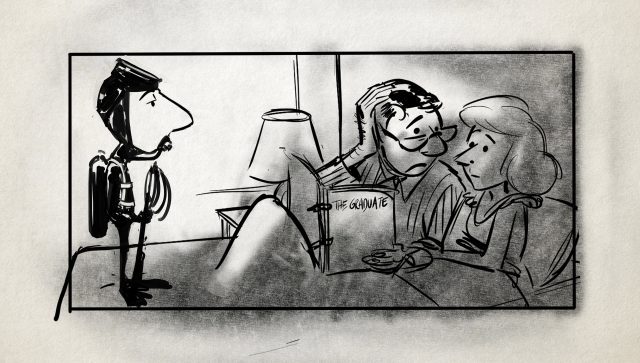
 Burton and Taylor. Bogie and Bacall. Gable and Lombard. Michelson and Michelson? In Harold and Lillian: A Hollywood Love Story, documentarian Daniel Raim traces the sixty-year relationship between storyboard artist and production designer Harold Michelson and his wife, film researcher extraordinaire Lillian, and their roles in Hollywood’s Golden Age and beyond. New York City native Harold was a bombardier navigator in WWII who developed a talent for illustration. Lillian lived in a series of orphanages, seeking to be part of a family. She accepted Harold’s offer to move to Los Angeles to be with him mainly because she had no better plan for her life — and his mother didn’t approve. But soon their love blossomed, as did their impact on the movie industry. Harold had a natural ability for creating storyboards that incorporated camera angles and other technical elements that was a boon for directors; meanwhile, Lillian did extensive research for a myriad of films, doing whatever it took in order to make sure every possible detail was correct, from major plot points to clothing and household objects in backgrounds. Among those paying tribute to the happy couple, whose work was often uncredited, are Danny DeVito, Francis Ford Coppola, Mel Brooks, and such production designers as Gene Allen, James D. Bissell, Rick Carter, Richard Sylbert, and Tom Walsh. Raim, who wrote, directed, produced (with his wife, Jennifer Raim), and shot (with Battiste Fenwick) the documentary, includes clips from many of the films Harold and/or Lillian worked on, including The Ten Commandments, Full Metal Jacket, Rosemary’s Baby, Spaceballs, The Birds, Scarface, and Winter Kills, in which Harold discusses how his storyboards were turned into a gripping scene.