twi-ny recommended events

AFTER THE STORM

AFTER THE STORM

Father (Hiroshi Abe) and son (Taiyo Yoshizawa) face challenges in Hirokazu Kore-eda’s AFTER THE STORM

AFTER THE STORM (UMI YORI MO MADA FUKAKU?) (海よりもまだ深) (Hirokazu Kore-eda, 2016)
IFC Center, 323 Sixth Ave. at Third St., 212-924-7771
Lincoln Plaza Cinema, 1886 Broadway between 62nd & 63rd Sts., 212-757-2280
Opens Friday, March 17
afterthestorm-film.com

“This isn’t how it was supposed to turn out,” Ryota Shinoda (Hiroshi Abe) says in Hirokazu Kore-eda’s latest masterful family drama and most personal yet, After the Storm. With the twenty-third typhoon of the year on its way, struggling writer Ryota decides to visit his mother, Yoshiko (Kilin Kiki), at the Asahigaoka Housing Complex in Kiyose, Tokyo (where Kore-eda lived for nearly twenty years, until he was twenty-eight). The broke Ryota is hoping to find some hidden treasures left behind by his father, who has recently passed away, to get him out of the financial hole he has dug for himself through a gambling addiction. His ex-wife, Kyoko (Yoko Maki), is threatening to take away his visitation rights with their young son, Shingo (Taiyo Yoshizawa), unless Ryota pays his back child support. To make some quick cash, Ryota has taken a job with a detective agency, where he is not exactly ethical; he claims he took the job as research for his next novel, but he even spies on Kyoko, who has a new boyfriend. As the storm approaches, the characters try to reconnect, and disconnect, forced to face what their lives have become. Written, directed, and edited by Kore-eda, After the Storm is a gentle, eloquent tale, where the smallest of gestures and details are packed with emotional resonance, from Yoshiko attending a class on Beethoven to Ryota purposely scuffing cleats he is buying for Shingo in order to get a discount, from Ryota and Yoshiko trying to eat frozen-solid ices to Ryota finding out something new about his father from a local pawnbroker (Isao Hashizume).

AFTER THE STORM

Divorced couple Kyoko (Yoko Maki) and Ryota (Hiroshi Abe) wonder what went wrong in AFTER THE STORM

Ryota is stuck in a rut of his own making, and he doesn’t know how to get out of it, or at least is unwilling to take certain risks despite his need to gamble (and lose). He wants only the best for his son, but Shingo is becoming more and more like him; playing baseball, the boy keeps his bat on his shoulder, striking out looking, trying to work out a walk instead of taking action and swinging away. None of the main adult characters, including Ryota, Kyoko, Yoshiko, and Ryota’s sister, Chinatsu (Satomi Kabayashi), are particularly happy and satisfied with how their lives turned out. The film is sharply photographed by Yutaka Yamazaki and features a soundtrack by singer-songwriter Hanaregumi that just manages to avoid being treacly. Kore-eda, who has made several documentaries as well as such poignant dramas as Our Little Sister, Still Walking, and Like Father, Like Son, fills After the Storm with a tender believability and beautifully drawn, realistic characters portrayed by an outstanding cast of familiar faces who have worked with him before. In his fourth Kore-eda film, the ruggedly handsome and tall Abe (Thermae Romae, Snow on the Blades) gives a profound performance as Ryota, a man who can’t avoid failure even though he knows better. Kore-eda’s visual storytelling style is often compared to Yasujirō Ozu’s, but he has said that After the Storm is more like a film by Mikio Naruse, tinged with sadness and melancholy. In his director’s notes for After the Storm, he also emphasizes how personal the film is to him, explaining, “Incorporating the changes that occurred within me after my mother and father died, it’s the film that is most colored by what I am. After I die, if I’m taken in front of God or the Judge of the Afterlife and asked, ‘What did you do down on Earth?’ I think I would first show them After the Storm.” That’s not such a bad choice.

SAM AND DEDE, OR MY DINNER WITH ANDRE THE GIANT

(photo by Jay Yamada)

A young Andre the Giant (Brendan Averett) is driven to school by Samuel Beckett (Dave Sikula) in absurdist bromance (photo by Jay Yamada)

59E59 Theaters
59 East 59th St. between Park & Madison Aves.
Tuesday – Sunday through April 1, $25
212-279-4200
www.59e59.org

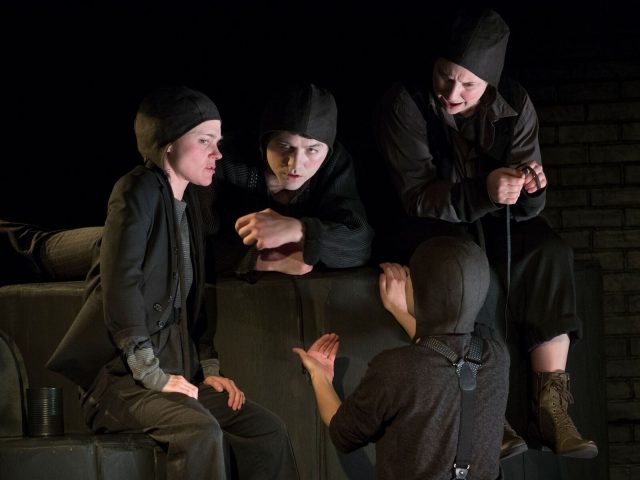
In 1958, in a small town in France, fifty-two-year-old Samuel Beckett drove twelve-year-old André René Roussimoff to school in a truck as a favor for the boy’s father. It’s one of the most bizarre confluences of all time: The playwright who had already written such groundbreaking works asEndgame, Waiting for Godot, and Act without Words I & II meeting the rather large adolescent who would later become known as wrestling icon and Princess Bride star Andre the Giant. Gino DiIorio re-creates that fact-based scene and imagines several others in the delightfully odd Sam and Dede, or My Dinner with Andre the Giant, which opened last night at 59E59. “I don’t fit anywhere,” Andre (Brendan Averett), who asks to be called Dede (pronounced “day-day”), says to Sam (Dave Sikula), referring not only to his size — he’s already over six feet tall and nearly 250 pounds — but to his place in the world. The man and the boy discuss farming, teaching, cricket, bullying, and playwriting. Curious about one of Sam’s plays, Dede asks, “What’s it about?” Sam responds, “I’m not certain.” Dede: “You wrote the play and you don’t know what it’s about?” Sam: “Well, it’s hard to say.” Dede: “It has to be about something.” Sam: “No. A play isn’t about something. A play is something.” Five years later, Dede, who calls Sam “Boss,” attends a performance of Endgame in Paris, where Dede talks about the play and his new career in professional wrestling. “The trouble is, we don’t always finish the way we want to finish,” he says. “And we don’t know where the finish is!” Meanwhile, Sam self-effacingly admits, “I don’t know what I’m doing.” The men next meet in 1975, when Sam comes to see Dede in a wrestling match. They are drinking in Dede’s hotel room, Sam as elusive as ever, but Dede has grown into an intelligent adult with a lust for life, reevaluating his place in the world and offering to show Sam what a pile driver is. It’s a wonderful scene, as the two men realize they are not as different as they once were, both entertainers in their own way.

(photo by Jay Yamada)

Sam (Dave Sikula) and Dede (Brendan Averett) meet as adults in entertaining play by Gino DiIorio (photo by Jay Yamada)

Erik Ladue’s somewhat claustrophobic set consists of stonelike blocks that Sam rearranges for each scene, creating car seats, chairs, a table, and carefully thought out abstract shapes. Occasionally he wistfully points up at one wall and a projection of the moon appears, an awkward reference to Waiting for Godot (“It’s about a tree and the moon,” Sam says) and a poem Dede makes up later in the play. Director Leah S. Abrams, cofounder and executive director of Custom Made Theatre Co., has helmed numerous Beckett shorts, and she brings that understanding of Beckett and his work to Sam and Dede, adding humor and occasional sweet moments of uncomfortability, along with an inspiringly staged conclusion. Shakespeare veteran Averett (The Killer, Massacre: Sing to Your Children) and Sikula (Grey Gardens, Superior Donuts) have an infectious camaraderie; neither actor attempts to do an impression of their characters — Sikula completely foregoes an Irish accent, and Averett speaks more clearly than Andre did in real life — but they lovingly capture the essence of each unique individual. Plays that imagine scenarios that never happened are often problematic and untrustworthy, but Abrams and DiIorio (Crib, The Jag) manage to avoid that dilemma, creating an entertaining and thoughtful absurdist bromance that one can only wish were really true.

LARGE AND IN CHARGE: CLOVERFIELD

A monster is on the loose in the big city in CLOVERFIELD

NITEHAWK MIDNITE SCREENINGS: CLOVERFIELD (Matt Reeves, 2008)
Nitehawk Cinema
136 Metropolitan Ave. between Berry St. & Wythe Ave.
Friday, March 17, and Saturday, March 18, 12:20 am
718-384-3980
www.nitehawkcinema.com
www.cloverfieldmovie.com

A surprise going-away party turns into a nightmare in Matt Reeves’s highly anticipated Cloverfield. Michael Stahl-David stars as Rob, a young man who has accepted a promotion that will send him to Japan. Although he is in love with his best friend, Beth (Odette Yustman), he is unable to tell her. But everything changes when the ground starts to shake, buildings begin to collapse, and people are on the run, attempting to escape from an enormous monster on the loose in post-9/11 Manhattan. And when Rob discovers that Beth, who had left the party early, might still be alive, he decides to risk his life and head uptown to save her. He is joined on the dangerous journey by his brother, Jason (Mike Vogel); Jason’s girlfriend, Lily (Jessica Lucas); Lily’s friend Marlena (Lizzy Caplan); and Hud (T. J. Miller), who serves as the comic relief. The entire film is seen through the lens of a video camera that Hud was entrusted with at the party, giving the film the feel of The Blair Witch Project, mixed with such Gotham horror stories as King Kong, The Day After Tomorrow, and the ridiculous 1998 Godzilla remake. Cloverfield, which has an ever-widening back story growing online (similar to that of Lost, which is also the creation of J. J. Abrams), doesn’t try to be anything more than it is — a monster movie set in New York City. The creature is kept hidden for most of the film, which doesn’t make any grand statements about science, humanity, or, really, anything except true love — and brutal death. And yes, there is a secret message hidden in the brief sound clip at the end of the credits. Cloverfield, which was followed by the conceptual sequel 10 Cloverfield Lane, is screening on March 17 and 18 in the Nitehawk Cinema “Midnite Screenings” and “Large and in Charge” series; the latter continues weekends in March with Pacific Rim and the 1958 and 1988 versions of The Blob.

CULTUREMART 2017

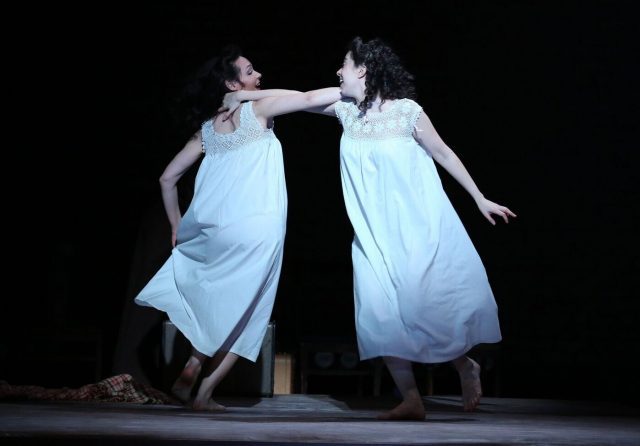
Purva Bedi and Mariana Newhard perform a duet in ASSEMBLED IDENTITY (photo by Benjamin Heller)

Mariana Newhard and Purva Bedi perform a duet in ASSEMBLED IDENTITY at HERE (photo by Benjamin Heller)

HERE
145 Sixth Ave. at Dominick St.
March 15-25, $15
212-647-0202
here.org

HERE’s annual multidisciplinary festival, CultureMart, starts tonight, featuring workshop performances that often defy easy categorization. Things kick off March 15-16 with Purva Bedi, Kristin Marting, and Mariana Newhard’s Assembled Identity, a multimedia duet between Bedi and Newhard that explores just what makes us human, on a shared bill with Trey Lyford’s kinetic solo show The Accountant, about how we can lose our humanity at the office. On March 18-19, Gisela Cardenas + Milica Paranosic and InTandem Lab’s Hybrid Suite No. 2: The Carmen Variations tells the story of fictional archaeologist Elizabeth Sherman, paired with Leah Coloff’s autobiographical song cycle ThisTree. The double bill for March 21-22 consists of Rob Roth’s cinematic hybrid Soundstage, linking the screen goddess with the adoring gay male fan, and Chris Green’s American Weather, an interactive piece performed by Quince Marcum, Katie Melby, and Yasmin Reshamwala. On March 25-26, Zoey Martinson and Smoke & Mirrors Collaborative lead audiences into The Black History Museum . . . According to the United States of America, examining the criminal justice system, while a birthday party turns into much more in Jeremy Bloom and Brian Rady’s Ding Dong It’s the Ocean. CultureMart concludes March 26 with a reading of HERE playwright in residence and downtown legend Taylor Mac’s The Bourgeois Oligarch, the third section of his four-part Dionysia Festival, this one involving a ballet and a philanthropist. With tickets only $15, CultureMart is always a great way to check out new and up-and-coming talent presenting works in progress at one of our favorite spaces.

AUTOCRATIC FOR THE PEOPLE — AN UNPRESIDENTED SERIES OF STAR-SPANGLED SATIRES: THEY LIVE

THEY LIVE

Rowdy Roddy Piper tries to save the planet from an alien conspiracy in John Carpenter’s THEY LIVE

WEEKEND CLASSICS: THEY LIVE (John Carpenter, 1988)
IFC Center
323 Sixth Ave. at West Third St.
March 17-19, 11:00 am
Series continues weekends through April 2
212-924-7771
www.ifccenter.com
www.theofficialjohncarpenter.com

How can you possibly not love a movie in which wrestling legend Rowdy Roddy Piper, brandishing a shotgun and standing next to an American flag, declares, “I have come here to chew bubblegum and kick ass . . . and I’m all out of bubblegum.” IFC Center’s Trump-inspired “Autocratic for the People: An Unpresidented Series of Star-Spangled Satires” continues March 17-19 with John Carpenter’s tongue-in-cheek Reagan-era cult favorite, They Live. In the goofy 1988 political sci-fi thriller, Piper, who passed away in 2015 at the age of sixty-one, stars as John Nada, a drifter who arrives in L.A. and gets a job working construction, where he is befriended by Frank Armitage (Keith David), who is otherwise trying to keep to himself and away from trouble as he makes money to send back to his family. Frank invites John to stay at a tent city for homeless people, across the street from a church where John soon finds some disturbing things happening involving a blind preacher (Raymond St. Jacques), a well-groomed man named Gilbert (Peter Jason), and a bearded weirdo (John Lawrence) taking over television broadcasts and making dire predictions about the future. John then discovers that by using a pair of special sunglasses, he can see, in black-and-white, what is really going on beneath the surface: Alien life-forms disguised as humans have infiltrated Los Angeles, gaining positions of power and placing subliminal messages in signs and billboards, spreading such words and phrases as Obey, Consume, Submit, Conform, Buy, Stay Asleep, and No Independent Thought. John seeks help from Frank and cable channel employee Holly Thompson (Meg Foster), determined to reveal the hidden conspiracy and save the planet.

THEY LIVE

Aliens use television and billboards to send subliminal messages to humanity in prescient sci-fi satire

Loosely based on Ray Nelson’s 1963 short story and 1986 comic-book adaptation “Eight O’Clock in the Morning,” They Live is a fun, if seriously flawed, film that takes on Reaganomics, consumerism, the media, and capitalism and doesn’t much care about its huge, gaping plot holes. Carpenter, an iconoclastic independent auteur who had previously made such other paranoid thrillers as Assault on Precinct 13, Halloween, Escape from New York, and a remake of The Thing, wrote They Live under the pseudonym Frank Armitage (the name of David’s character as well as a reference to H. P. Lovecraft’s Henry Armitage from “The Dunwich Horror”) and composed the ultracool synth score with Alan Howarth. The movie is famous not only for Piper’s not exactly brilliant performance but for one of the longest fight scenes ever, as John and Frank go at each other for five and a half nearly interminable minutes, as well as the influence They Live had on activist artist Shepard Fairey, who admitted in 2003 that it “was a major source of inspiration and the basis for my use of the word ‘obey.’” The film is all over the place, a jumble of political commentary and B-movie nonsense, but it’s also eerily prescient, especially with what is going on in America today. Keep a watch out for such recognizable character actors as Sy Richardson, George Buck Flower, Susan Blanchard, Norman Alden, Lucille Meredith, and Robert Grasmere, whose names you don’t know but whose faces are oh-so-familiar. They Live is screening in a DCP projection March 17-19 at 11:00 am at IFC; the Weekend Classics series continues through April 2 with Andrew Fleming’s Dick and Trey Parker’s South Park: Bigger, Longer & Uncut.

WAKEY, WAKEY

(photo by Joan Marcus)

Two-time Emmy winner Michael Emerson returns to the New York stage in WAKEY, WAKEY (photo by Joan Marcus)

The Pershing Square Signature Center
The Alice Griffin Jewel Box Theatre
480 West 42nd St. between Tenth & Eleventh Aves.
Tuesday – Sunday through April 2, $30-$75
212-244-7529
www.signaturetheatre.org

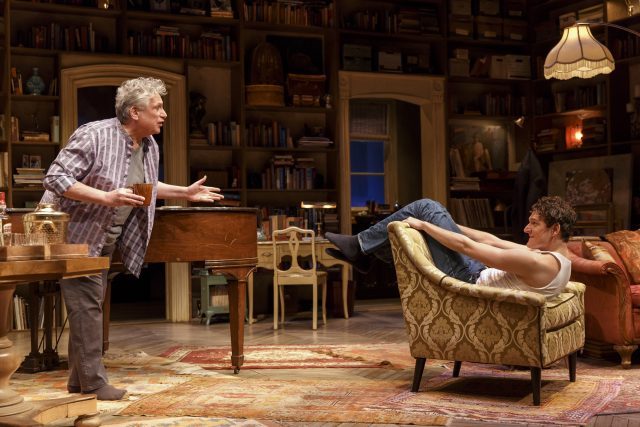
Will Eno completes his three-play Residency Five program at the Signature Theatre with Wakey, Wakey, a very funny, deeply touching, and unique exploration of humanity and the life cycle. Partially inspired by his friendship with Signature founder James Houghton, who passed away in August 2016 at the age of fifty-seven from stomach cancer, Wakey, Wakey is about all the little pieces of basic daily existence that make us who we are, from birth to death. Michael Emerson returns to the stage as a character referred to in the script only as Guy, who as the play opens is lying on the floor, facedown. “Is it now?” he asks. “I thought I had more time.” For the next seventy minutes, Guy shares details from his life, plays word games, philosophizes about the world, shows home movies and YouTube videos, and is cared for by home health worker Lisa (a gentle and sweet January LaVoy). He also self-reflexively critiques what is happening in the theater. “Sorry, I don’t know exactly what to say to you,” he admits. “I wonder how you hear that, how that strikes you? What do you make of the fact that this event, painstakingly scripted, rehearsed, designed, and directed, features someone saying, ‘I don’t know exactly what to say to you.’ I hope you’ll receive that in the humble and hopeful spirit it was offered in.” Writer-director Eno, whose previous Signature works were Title and Deed and The Open House and who was represented on Broadway by The Realistic Joneses in 2014, has fun with the very clever staging; for example, noises that initially seem to be coming from the street or the audience are actually part of the sound design, and he uses physical objects in creative ways as well.

(photo by Joan Marcus)

Lisa (January LaVoy) arrives to help Guy (Michael Emerson) in Will Eno world premiere at Signature (photo by Joan Marcus)

Following a video of screaming wildlife, Guy delves into the nature of pleasure and enjoyment, questioning where such feelings go once the moment is past. He also discusses how one’s life can be divided into two parts, one before watching the video, and one after it ends, in much the same way the play itself can serve as a dividing line, especially as it deals so intimately with life and death and how things don’t always go quite as planned. Christine Jones’s set consists of a free-standing door, a large wall with a calendar on it, and packing boxes, as if someone is moving in — or moving out. David Lander’s lighting, Nevin Steinberg’s sound, and Peter Nigrini’s projections all contribute to the play’s inventive originality. Two-time Emmy winner Emerson (Lost, Person of Interest), whose previous stage credits include playing Oscar Wilde in 1997–98’s Gross Indecency at the Minetta Lane as well as three Broadway roles, gives a rousing performance, tender and humane, mostly from a wheelchair, making the most of his expressive puppy-dog eyes and small body movements, the slightest pause or glance filled with charm and humble mischief, then pain as Guy takes a turn for the worse. The play certainly has a message, but it’s not quite as syrupy and sentimental as it could have been. “Yes, we’re here to say good-bye and maybe hopefully also get better at saying hello,” Guy explains. “To celebrate Life, if that doesn’t sound too passive-aggressive.” But even when you think it’s over, Eno has yet more surprises in store, both inside the theater and outside in the lobby, as you kick off the next phase of your life.

PERCEPTION: her

HER

Super-nerd Theodore Twombly (Joaquin Phoenix) falls in love with an AI operating system in dazzling Spike Jonze romance

CABARET CINEMA: her (Spike Jonze, 2013)
Rubin Museum of Art
150 West 17th St. at Seventh Ave.
Friday, March 17, 9:30
212-620-5000
rubinmuseum.org
www.herthemovie.com

The brilliant mind of Spike Jonze dazzles again with the spectacularly original romance her. In the very near future, geeky nerd Theodore Twombly (a radiant Joaquin Phoenix) makes his living writing personally commissioned letters for Handwritten Greeting Cards, developing relationships with the people he writes for, considering them family. Meanwhile, he and his wife, Catherine (Rooney Mara), are divorcing, although he is hesitant to sign the final papers. His life takes an unexpected turn when he buys the world’s first AI operating system and slowly falls in love with her during an extremely romantic twenty-first-century-style courtship. The talking OS (the sexy, gravelly voice of Scarlett Johansson), who names herself Samantha, wants to experience the world, so she and Theodore go everywhere together, including on a double date that is pure genius. When he shares his news with his best friend, Amy (Amy Adams), she doesn’t act the slightest bit concerned for his sanity, instead showing true happiness for his blossoming relationship. But as his and Samantha’s love grows, so does their need for something more from each other, which doesn’t always work out as planned.

Stunning apartment is one of many beautiful sets in Oscar-nominated film

Stunning apartment is one of many beautiful sets in Oscar-nominated film

Jonze’s fourth film as director and first solo screenplay (he cowrote Where the Wild Things Are with Dave Eggers, while Charlie Kaufman wrote Being John Malkovich and Adaptation.), her is a beautifully rendered love story filled with humor and heart. Phoenix shows a whole new, freer, playful side of himself as Theodore, particularly during a rousing scene in which he spins Samantha through a carnival. Wearing his pants way up high, as all men seem to do in Jonze’s vision of the future L.A., Theodore — who must make quite a lot of money at his job, considering his extremely large apartment with its amazing views of the city — serves both as an endearing protagonist and a warning about the importance of human connection. “Are you social or antisocial?” the new program asks him before initiating Samantha. As unique as the film is, it does echo themes found in a pair of Twilight Zone episodes; in “From Agnes — with Love,” a supercomputer falls in love with her creator (played by Wally Cox), while in Ray Bradbury’s “I Sing the Body Electric,” a robot grandmother (Josephine Hutchinson) has the ability to grow emotionally with the family she takes care of. Watching her is like falling in love all over again, not only with the story but with the movies themselves. Nominated for five Academy Awards, the film is screening March 17 in the Rubin Museum Cabaret Cinema series “Perception,” part of the institution’s latest Brainwave series of special programs, and will be introduced by cognitive research scientist Dr. Eran Agmon. “Perception” continues Friday nights through April 28 with such other mind-bending films as Eternal Sunshine of the Spotless Mind, The Matrix, and Ghost in the Shell; meanwhile, Brainwave takes on such topics as “Why Magicians Are Master Manipulators” with Asi Wind and Tony Ro on March 22, “Keeping Your Eye on the Ball” with Patrick Vieira and John Krakauer on April 17, and “What Makes a True Work of Art?” with Tobias Meyer and Frank Moore on April 26.