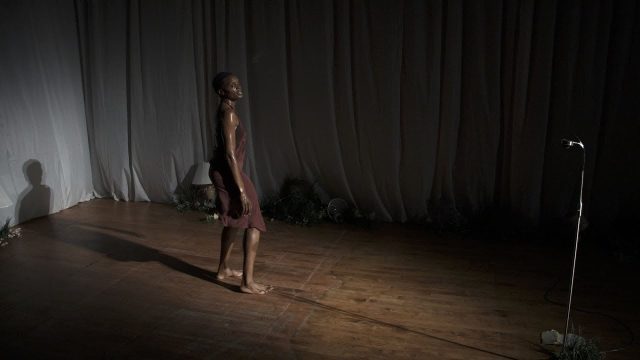
Okwui Okpokwasili takes viewers behind the scenes of her one-woman show in Bronx Gothic (photo courtesy of Grasshopper Film)
BRONX GOTHIC (Andrew Rossi, 2017)
Film Forum
209 West Houston St.
July 12-25
212-727-8110
www.filmforum.org
grasshopperfilm.com
 “Okwui’s job is to scare people, just to scare them to get them to kind of wake up,” dancer, choreographer, and conceptualist Ralph Lemon says of his frequent collaborator and protégée Okwui Okpokwasili in the powerful new documentary Bronx Gothic. Directed by Okpokwasili’s longtime friend Andrew Rossi, the film follows Okpokwasili during the last three months of her tour for her semiautobiographical one-woman show, Bronx Gothic, a fierce, confrontational, yet heart-wrenching production that hits audiences right in the gut. Rossi cuts between scenes from the show — he attached an extra microphone to Okpokwasili’s body to create a stronger, more immediate effect on film — to Parkchester native Okpokwasili giving backstage insight, visiting her Nigerian-born, Bronx-based parents, and spending time with her husband, Peter Born, who directed and designed the show, and their young daughter, Umechi. The performance itself begins with Okpokwasili already moving at the rear of the stage, shaking and vibrating relentlessly, facing away from people as they filter in and take their seats. She continues those unnerving movements for nearly a half hour (onstage but not in the film) before finally turning around and approaching a mic stand, where she portrays a pair of eleven-year-old girls exchanging deeply personal notes, talking about dreams, sexuality, violence, and abuse as they seek their own identity. “Bronx Gothic is about two girls sharing secrets. . . . It is about the adolescent body going into a new body, inhabiting the body of a brown girl in a world that privileges whiteness,” Okpokwasili, whose other works include Poor People’s TV Room and the Bessie-winning Pent-Up: A Revenge Dance, explains in the film. National Medal of Arts recipient Lemon adds, “It’s about racism, gender politics — it’s not just about these two little black girls in the Bronx.” Rossi includes clips of Okpokwasili performing at MoMA in Lemon’s “On Line” in 2011, developing Bronx Gothic at residencies at Baryshnikov Arts Center and New York Live Arts, and participating in talkbacks at Alverno College in Milwaukee and the Bronx Academy of Arts and Dance, where the tour concluded, right next to her childhood church, which brings memories surging back to her.
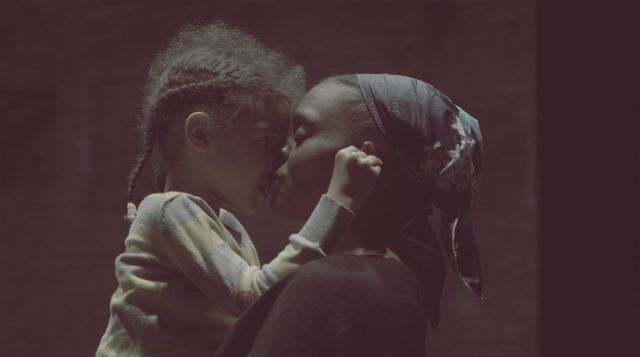
Okwui Okpokwasili nuzzles her daughter, Umechi, in poignant and timely documentary (photo courtesy of Grasshopper Film)
Rossi is keenly aware of the potentially controversial territory he has entered. “As a white man, I was conscious of the complexity and implications of embarking on a project that revolves around the experience of African American females,” he points out in his director’s statement. “But fundamentally, I believe in an artist’s creative ability to explore topics that are foreign to the artist’s own background. I think this takes on even more resonance when the work itself has an explicit objective to ‘grow our empathic capacity,’ as Okwui says of Bronx Gothic, [seeking] an audience that is composed of ‘black women, black men, Asian women, Asian men, white women, white men, Latina women, Latina men….’” Cinematographers Bryan Sarkinen and Rossi (Page One: Inside the New York Times, The First Monday in May) can’t get enough of Okpokwasili’s mesmerizing face, which commands attention, whether she’s smiling, singing, or crying, as well as her body, which is drenched with sweat in the show. “We have been acculturated to watching brown bodies in pain. I’m asking you to see the brown body. I’m going to be falling, hitting a hardwood floor, and hopefully there is a flood of feeling for a brown body in pain,” Okpokwasili says. Meanwhile, shots of the audience reveal some individuals aghast, some hypnotized, and others looking away. Editor Andrew Coffman and coeditors Thomas Rivera Montes and Rossi shift from Okpokwasili performing to just being herself, but the film has occasional bumpy transitions; also, Okpokwasili, who wrote the show when she was pregnant, does the vast majority of the talking, echoing her one-woman show but also at times bordering on becoming self-indulgent. (Okpokwasili produced the film with Rossi, while Born serves as one of the executive producers.) But the documentary is a fine introduction to this unique and fearless creative force and a fascinating examination of the development of a timely, brave work. Bronx Gothic opens July 12 at Film Forum, with Okpokwasili and Rossi taking part in Q&As at the 7:00 screenings on July 12, 14, and 15.

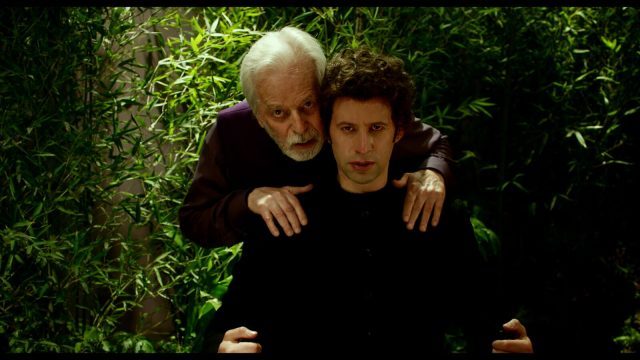
 Eccentric auteur Alejandro Jodorowsky, the mastermind behind such midnight-movie classics as 1971’s El Topo and 1973’s The Holy Mountain, once again turns his magical realist eye on his own life as a young poet in Chile in the 1940s in Endless Poetry, picking up where he left off in the autobiographical saga he began in 2013’s