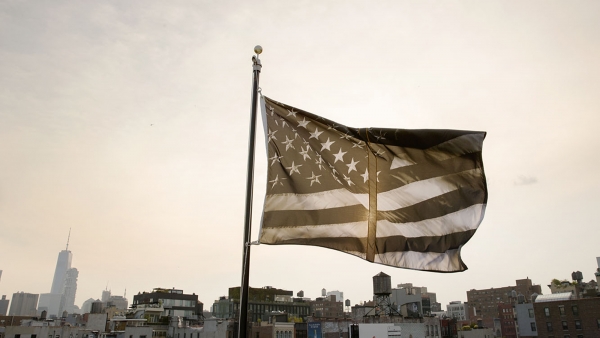
Robert Longo, “Untitled (Dividing Time),” nylon and polyester poplin, hand appliqué, 2017 (courtesy of Creative Time’s “Pledges of Allegiance”)
Brooklyn Museum
200 Eastern Parkway at Washington St.
Saturday, October 7, free, 5:00 – 11:00
212-864-5400 www.brooklynmuseum.org
The Brooklyn Museum’s monthly free First Saturday program returns after its annual September Labor Day weekend break with “Beyond Borders,” an exploration of the immigrant crisis. There will be live performances by Locos por Juana, Batalá New York, and DJ Geko Jones with La Chiquita Brujita and DJ Big Nito; poetry with Cave Canem’s Darrel Alejandro Holnes and Jessica Lanay Moore; an immersive screening of Alejandro Jodorowsky’s mind-bending The Holy Mountain with live performances; a salsa party with lessons by Balmir Latin Dance Company; a hands-on workshop in which participants can make clay vessels; pop-up gallery talks with teen apprentices focusing on works that honor Latinx history; a curator tour of “Proof: Francisco Goya, Sergei Eisenstein, Robert Longo” led by Sara Softness; and a community talk with Movimiento Cosecha about immigrant rights. In addition, the galleries will be open late so you can check out “Arts of Korea,” “The Legacy of Lynching: Confronting Racial Terror in America,” “Infinite Blue,” “A Woman’s Afterlife: Gender Transformation in Ancient Egypt,” “The Dinner Party by Judy Chicago,” and more.
Brooklyn Museum, Beaux-Arts Court
200 Eastern Parkway at Washington St.
Saturday, September 30, 12 noon & 4:00, and Sunday, October 1, 3:00, free with museum admission of $6 to $20
212-864-5400 www.brooklynmuseum.org crossingthelinefestival.org
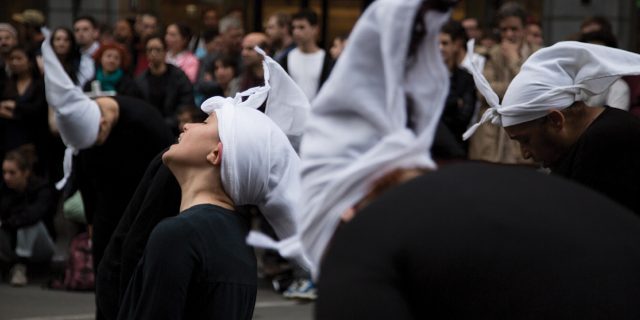
Moroccan dancer and choreographer Bouchra Ouizguen returns to FIAF’s Crossing the Line Festival this weekend with the New York premiere of the site-specific Corbeaux (Crows), reconfigured for the Brooklyn Museum’s Beaux-Arts Court. Ouizguen, who previously presented Madame Plaza at CTL 2010 and HA! at CTL 2013, made the piece for her Compagnie O as a one-time-only performance at the Marrakech train station for the 2014 Biennale of Contemporary Art, but it proved so popular that it has since made its way across the globe and finally comes to Brooklyn. “Corbeaux is one of the shows that enchants me the most because everything remains to be done. That is, even if it has been created, I have the impression each time that there are still things beyond my control. I wanted to give the sensation that it was taking place here in front of you and that it had not been prepared,” Ouizguen said in an October 2016 interview with Fondation d’entreprise Hermès. The work will feature an all-women ensemble in tight-fitting black costumes and white cloths knotted around their heads, weaving through the columns of the grand court, initially in silence, as human conceptions of time and space disappear. A kind of living sculpture, Corbeaux (Crows) is being staged September 30 at 12 noon and 4:00 and on October 1 at 3:00, free with museum admission.
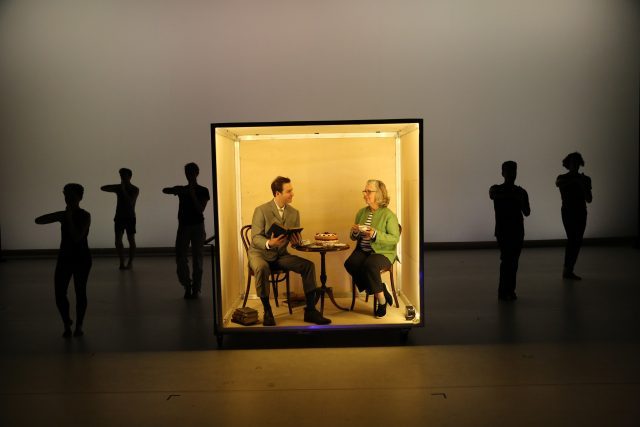
John Heginbotham and Maira Kalman collaborate on the multimedia The Principles of Uncertainty at BAM this week (photo by Adrienne Bryant)
BAM NEXT WAVE FESTIVAL
BAM Fisher, Fishman Space
321 Ashland Pl.
September 27-30, $25
718-636-4100 www.bam.org
“How can I tell you everything that is in my heart. Impossible to begin. Enough. No. Begin. With the hapless dodo,” Maira Kalman writes at the start of her 2006-7 online graphic diary, The Principles of Uncertainty, which ran on the New York Times website. The diary was later published in book form, with such chapters as “Sorry, the Rest Unkown,” “Celestial Harmony,” “Ich Habe Genug,” and “Completely.” Kalman, the author and/or illustrator of such other books as My Favorite Things, Looking at Lincoln, and Beloved Dog has also designed sets and costumes for the Mark Morris Dance Group, delivered a popular TED talk in 2007, and was the subject of a major retrospective at the Jewish Museum in 2011. The New York City–based Tel Aviv native will take the stage at BAM this week for the sixty-minute dance-theater piece The Principles of Uncertainty, a live staging of her blog in collaboration with choreographer John Heginbotham in which she will perform with Dance Heginbotham, which is celebrating its fifth anniversary this year. While Kalman sits in a box reflecting on her memories, dancers will move around the stage as members of the chamber ensemble the Knights play live music composed, curated, and arranged by Colin Jacobsen. The piece is directed and choreographed by Heginbotham, with illustrations, costumes, and set design by Kalman. In the catalog of the Jewish Museum exhibition, “Various Illuminations (of a Crazy World),” Kalman explains, “There is a strong personal narrative aspect of what I do. What happens in my life is interpreted in my work. There is very little separation. My work is my journal of my life.” This multidisciplinary collaboration at the BAM Fisher, which runs September 27-30, is merely the latest chapter of her intimate story, engaging with the public in yet another new way. (The September 28 performance will be followed by a Champagne toast and dessert reception on the Fisher Rooftop Terrace for those who purchase a $200 Celebration Ticket in conjunction with Dance Heginbotham’s fifth anniversary.)
New York Live Arts
219 West 19th St. between Seventh & Eighth Aves.
September 27-30, 7:30
212-924-0077 newyorklivearts.org www.rosas.be/en
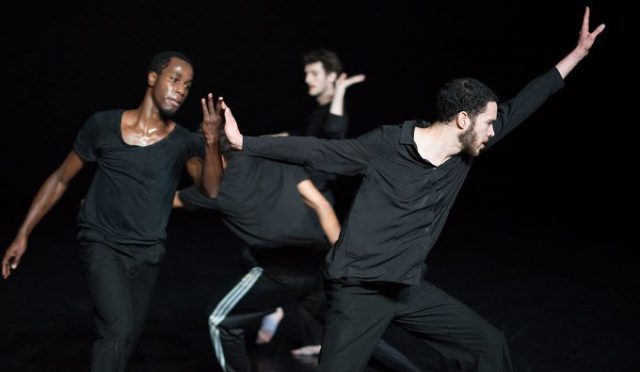
In December 1964, saxophonist John Coltrane made one of the greatest jazz records of all time, A Love Supreme, a four-part suite consisting of “Acknowledgement,” “Resolution,” “Pursuance,” and “Psalm,” featuring Coltrane on tenor and soprano sax, Jimmy Garrison on double bass, Elvin Jones on drums and percussion, and McCoy Tyner on piano. In 2005, Belgian choreographer Anne Teresa De Keersmaeker and Spanish dancer and choreographer Salva Sanchis created the four-part dance suite A Love Supreme, set to Coltrane’s legendary music; they have now revisited the piece, rewriting it for four male dancers from De Keersmaeker’s Rosas company. The fifty-five-minute dance work, which will be performed by José Paulo dos Santos, Bilal El Had / Robin Haghi, Jason Respilieux, and Thomas Vantuycom, investigates the desire for happiness through mysticism and spirituality, incorporating jazzlike improvisation into the movement, with each dancer interpreting one of the musicians on the record: Vantuycom is Coltrane, Respilieux is Garrison, El Had / Haghi is Tyner, and dos Santos is Jones. When the musicians improvise, so will the dancers.
“Taking on A Love Supreme fits with the idea of revisiting and rewriting Rosas’s repertoire for a new generation of dancers,” De Keersmaeker said in a statement. “What is interesting about the piece, in addition to its intrinsic connection with this milestone of twentieth-century music, is the way it combines improvised and written choreography.” Sanchis, who was part of the original cast in 2005, added, “On the whole, A Love Supreme is more suitable for a dance performance than a simple collection of songs. The music poses a structure with a beginning and an end, offering a kind of dramaturgical accessibility.” The New York City premiere of A Love Supreme runs at New York Live Arts September 27-30 at 7:30, with saxophonist Tony Jarvis performing a tribute to the seminal album at seven o’clock each night. The September 28 show will be followed by a Stay Late Conversation moderated by NYU associate professor and associate chair André Lepecki; there will be a Shared Practice workshop September 30 at 2:00 ($20) with Rosas rehearsal director Bryana Fritz and Respillieux; and on September 30 at 5:00 ($10), NYLA artistic director Bill T. Jones will be joined by music historian Ashley Kahn and bassist and composer Reggie Workman for the special Coltrane program “Bill Chats — The Man and His Music.” Tickets are sold out for all four shows, but there will be a standby line each evening to see what De Keersmaeker calls “essentially a piece about defying gravity. It is a piece about the relationship between mankind and the planet, between the vertical and the horizontal.”
Hundreds of original works on paper will be available at the Hole for thirty bucks apiece
The Hole
312 Bowery
Monday, September 25, free admission, $30 per artwork, 5:00 – 9:00 pm
212-466-1100 www.theholenyc.com
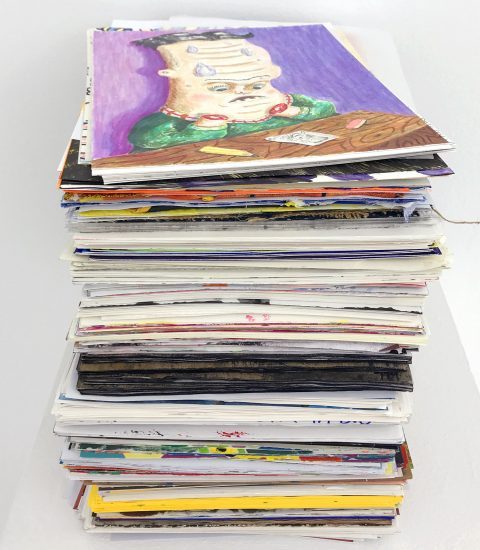
Looking to add to your art collection? It will be hard to go wrong at “GIFC: Got It for Cheap” at the Hole on September 25 from 5:00 to 9:00. Original 8.5″ x 11″ works on paper by more than seven hundred artists will be available for a mere thirty bucks each. The event has been making its way around the world, with stops in Greece, Canada, and Denmark, and will continue to Norway, Los Angeles, and Hawaii, among other locations. There are no discounts, previews, or reserves, and it’s first come, first served. Among the participating artists are Kembra Pfahler, Jeanette Hayes, Morgan Blair, Julie Curtiss, Josh Reames, Peter Demos, Andrew Jeffrey Wright, Kate Klingbiel, Juni Figueroa, Eric Shaw, Graham Wilson, Johnny Abrahams, Alison Blickle, Royal Jarmon, and many more.
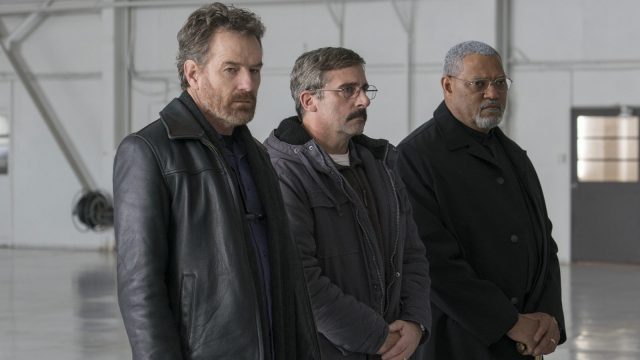
Richard Linklater’s Last Flag Flying opens the fifty-fifth New York Film Festival this week
Film Society of Lincoln Center, Walter Reade Theater, Elinor Bunin Munroe Film Center, Bruno Walter Auditorium, Alice Tully Hall
West 65th St. between Broadway & Amsterdam Ave.
September 28 – October 14
212-875-5601 www.filmlinc.org/nyff2017
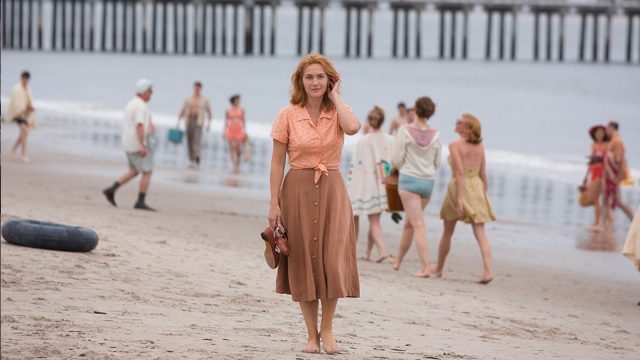
The New York Film Festival turns fifty-five this year, with another powerful lineup of shorts, features, documentaries, animation, and more from around the world, with Richard Linklater’s road movie, Last Flag Flying, kicking it all off on September 28. The centerpiece selection is Todd Haynes’s Wonderstruck, based on a YA novel by Brian Selznick, with Woody Allen’s Coney Island-set Wonder Wheel closing things out on October 14. Divided into Main Slate, Convergence, Projections, Talks, Retrospectives, Revivals, Shorts, and Spotlight on Documentary, this year’s lineup also features works by Kiyoshi Kurosawa, Arnaud Desplechin, Agnès Varda and JR, Greta Gerwig, Claire Denis, Noah Baumbach, Aki Kaurismäki, Agnieszka Holland, Claude Lanzmann, Rebecca Miller, Griffin Dunne, Abel Ferrara, and Hong Sang-soo, most of whom will be on hand for Q&As following select screenings. There’s also a twenty-four-film salute to Robert Mitchum celebrating the centennial of his birth; revivals of works by Jean Vigo, Jean-Luc Godard, Hou Hsiao-hsien, James Whale, Philippe Garrel, Jean Renoir, Jean-Pierre Melville, and others; experimental films by Xu Bing, Luke Fowler, Kevin Jerome Everson, Barbara Hammer, and more; immersive and interactive experiences; and panel discussions and dialogues. Below is a list of at least one highlight per day for which tickets are still available or the event is free; keep checking twi-ny for reviews and further information.
Thursday, September 28 Last Flag Flying (Richard Linklater, 2017), introduced by Richard Linklater, Bryan Cranston, Laurence Fishburne, J. Quinton Johnson, and Darryl Ponicsan, Alice Tully Hall, $100, 6:00
Friday, September 29
Convergence, Elinor Bunin Munroe Film Center, free, 3:00 – 6:00 (also 9/30 and 10/1, 12 noon – 6:00)
Saturday, September 30
On Cinema: With Richard Linklater, moderated by Kent Jones, Walter Reade Theater, $25, 6:00
Spoor (Agnieszka Holland, in cooperation with Kasia Adamik, 2017), followed by a Q&A with Agnieszka Holland and Kasia Adamik, Alice Tully Hall, $25, 9:00
Sunday, October 1
HBO Directors Dialogues: Lucrecia Martel, Howard Gilman Theater, free, 3:00
Film Comment Live: The Cinema of Experience, amphitheater, free, 7:00
Woody Allen’s Wonder Wheel closes the fifty-fifth New York Film Festival
Zama (Lucrecia Martel, 2017), followed by a Q&A with Lucrecia Martel, Alice Tully Hall, $25, 6:00
Tuesday, October 3 L’Atalante (Jean Vigo, 1934), Howard Gilman Theater, $15, 3:45
Wednesday, October 4 Film Comment Presents: A Gentle Creature (Sergei Loznitsa, 2017), Walter Reade Theater, $25, 6:00
Thursday, October 5 A Story from Chikamatsu (Kenji Mizoguchi, 1954), Francesca Beale Theater, $15, 3:30
Friday, October 6 Spielberg (Susan Lacy, 2017), introduced by Jessica Levin and Emma Pildes, Walter Reade Theater, $25, 8:45
Saturday, October 7 Claude Lanzmann’s Four Sisters: The Hippocratic Oath (Claude Lanzmann, 2017), introduced by Claude Lanzmann, Alice Tully Hall, $25, 1:00
Good Luck (Ben Russell, 2017), followed by a Q&A with Ben Russell, Francesca Beale Theater, $15, 6:15
Sunday, October 8
Projections Program 5: Urban Rhapsodies, followed by a Q&A with Ayo Akingbade, Fern Silva, Ephraim Asili, and Michael Robinson, Francesca Beale Theater, $15, 12 noon
Let the Sun Shine In (Claire Denis, 2017), followed by a Q&A with Claire Denis, Alice Tully Hall, $25, 3:30
Monday, October 9
HBO Directors Dialogues: Hong Sang-soo, amphitheater, free, 7:00
Tuesday, October 10
HBO Directors Dialogues: Philippe Garrel, amphitheater, free, 8:00
Wednesday, October 11
Master Class: Vittorio Storaro and Ed Lachman, moderated by Kent Jones, Walter Reade Theater, $25, 6:15
Thursday, October 12 Hallelujah the Hills (Adolfas Mekas, 1963), introduced by Jonas Mekas, Howard Gilman Theater, $15, 6:00
Lucía (Humberto Solás 1968), Howard Gilman Theater, $15, 8:00
Friday, October 13 Ismael’s Ghosts (Arnaud Desplechin, 2017), Director’s Cut, followed by a Q&A with Arnaud Desplechin, Alice Tully Hall, $25, 6:00
Saturday, October 14 Farewell, My Lovely (Dick Richards, 1975), introduced by Robert Mitchum’s daughter, Petrine Mitchum, Howard Gilman Theater, $15, 1:30
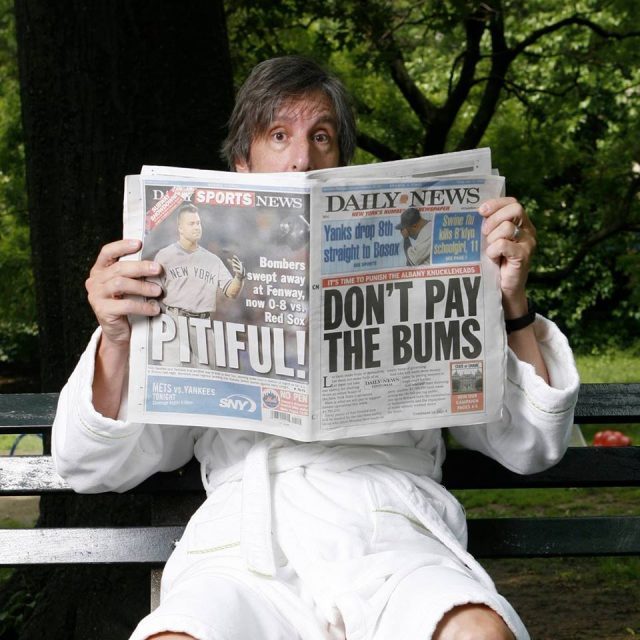
Andy Borowitz will behave badly at literary Selected Shorts show at Symphony Space on November 15
Symphony Space, Peter Jay Sharpe Theatre
2537 Broadway at 95th St.
October 4 – June 6, $31, 7:30
212-864-5400 www.symphonyspace.org
Tickets are now on sale for the upcoming season of Symphony Space’s popular trademark series, “Selected Shorts,” in which actors and literary figures read from a thematic collection of stories by major writers. The series kicks off October 4 with The Best American Short Stories 2017 with Meg Wolitzer, featuring readings by Suzzy Roche, Bhavesh Patel, and others, and concludes June 6 with “A Surprising Night of Shorts,” which, unsurprisingly, consists of surprise guests reading surprise writing. More performers will be added as the show dates approach, and there are specially priced packages available if you purchase tickets to three or more presentations.
Wednesday, October 4
Selected Shorts: The Best American Short Stories 2017, with Meg Wolitzer, Suzzy Roche, and Bhavesh Patel
Wednesday, November 1
Selected Shorts: Henry Louis Gates Jr., with Gates presenting classic and contemporary stories inspired by The Portable Nineteenth-Century African American Women Writers, with readings by Danielle Brooks and Crystal Dickinson
Wednesday, November 15
Selected Shorts: Behaving Badly, with Andy Borowitz and Judith Ivey
Wednesday, December 6
Selected Shorts: A Celebration of Agatha Christie, with special guest Fran Lebowitz and host Megan Abbott
Wednesday, January 24
Selected Shorts: Love, Laughter, and Vodka with Anton Chekhov, with Rainn Wilson
Wednesday, February 7
Selected Shorts: Fiction in the Kitchen with Food52, with hosts Amanda Hesser and Merrill Stubbs
Wednesday, April 11
Selected Shorts: Crybabies, cohosted by Susan Orlean and Sarah Thyre
Wednesday, May 2
Selected Shorts: A Night with The Paris Review, hosted by Lorin Stein
Wednesday, May 23
Selected Shorts: A Surprising Night of Shorts
Wednesday, June 6
Selected Shorts: A Surprising Night of Shorts