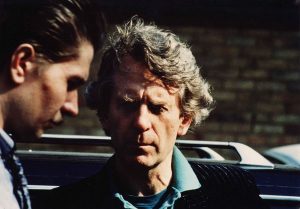
Anthology Film Archives is hosting a mostly free retrospective of the work of British director Alan Clarke
Anthology Film Archives
32 Second Ave. at Second St.
August 4–20, free (except for two screenings)
212-505-5181
anthologyfilmarchives.org
Working-class British theater, television, and film director Alan Clarke wrote and directed socially conscious, provocative works that challenged the status quo. “As a director, it seems to me that Clarke had it all — he had range, he had vision, he put energy on the screen, he could tell a story, he discovered fantastic actors and got great performances from them, and he could use a camera like a dream. He remains, in my eyes, quite simply the greatest British director of my lifetime,” Paul Greengrass said in the Guardian in 2005 on the occasion of the fifteenth anniversary of Clarke’s passing. The BBC is remastering nearly two dozen films he made for the channel, which has spurred Anthology Film Archives to host the retrospective “The Elephant in the Room: The Films of Alan Clarke,” which runs August 4-20. And just as most of Clarke’s films were shown on free television, most of the screenings in the retrospective will be free as well. The series begins August 4 with 1987’s Christine and 1989’s Elephant and continues with such other films as 1985’s Contact, 1970’s Sovereign’s Company, 1974’s Penda’s Fen, 1970’s The Hallelujah Handshake, and 1972’s To Encourage the Others. The only screenings that require paid admission are 1986’s Rita, Sue and Bob Too and the 1979 version of Scum, both of which were released in cinemas. (The 1977 theatrical version of Scum is free.) Don’t worry if the titles of most of the films are unfamiliar to you; among the stars are David Bowie, Tim Roth, Ray Winstone, Jane Horrocks, Gary Oldman, and others. In his book Alan Clarke, Dave Rolinson wrote, “Clarke was, as W. Stephen Gilbert argued upon the director’s untimely death from cancer at the age of fifty-four, ‘an unswerving champion of the individual voice and the noncomformist vision.’ He gave voice to those on the margins of society. . . . Individuals often come into contact with institutions, and are either initiated into them or broken, rehabilitated or cut adrift, rendered compliant or silenced. They face a struggle to articulate themselves in their own language.” Anthology is doing a great service by bringing back Clarke’s unswerving voice, and especially primarily for free.