twi-ny recommended events

FOOTBALL AS AMERICA: MATTHEW BARNEY AT METROGRAPH

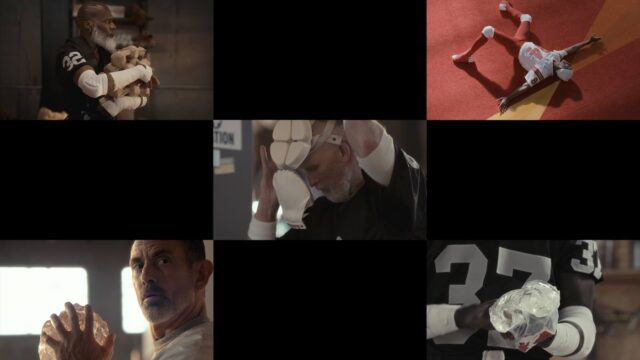
Matthew Barney’s multichannel Secondary will be shown on a single screen at Metrograph (image © Matthew Barney, courtesy of the artist, Gladstone Gallery, Sadie Coles HQ, Regen Projects, and Galerie Max Hetzler)

SECONDARY
Metrograph
7 Ludlow St. between Canal & Hester Sts.
Saturday, May 3, 5:00
metrograph.com
secondary.matthewbarney.net
online slideshow

It was the hit heard round the world.

On August 12, 1978, the New England Patriots were playing a preseason game against the Oakland Raiders at Oakland-Alameda County Coliseum. Late in the second quarter, the Pats have a third and eight at the Raiders twenty-four-yard line. QB Steve Grogan calls the 94 Slant, and wide receiver Darryl Stingley heads downfield. At the ten-yard line, Stingley reaches for the overthrown pass and is crushed in midair by two-time Raiders All-Pro safety Jack Tatum, known as the Assassin for his punishing style of play. Stingley immediately crumples to the ground. Four Oakland defenders look down at Stingley and walk away; Patriots wide receiver Russ Francis stands over his fallen teammate, knowing something is wrong. The twenty-six-year-old Stingley is wheeled off the field on a stretcher, a quadriplegic for the rest of his life; he died in 2007 at the age of fifty-five. Tatum wasn’t penalized on the play and never apologized to Stingley, claiming it was a legal hit and that he had done nothing wrong. Tatum, who died in 2010 at the age of sixty-one, was also involved in the Immaculate Reception on December 23, 1972, in a playoff game against the Steelers; with twenty-two seconds left and Pittsburgh down by one, future Hall of Famer Terry Bradshaw was facing a fourth and ten from his own forty. He ran to his right and threw a pass down the middle. Tatum smashed into Steelers running back Frenchy Fuqua, the ball popped up into the air, and future Hall of Famer Franco Harris picked it up by his shoestrings and ran forty yards into the end zone for the winning score.

Filmmaker and installation artist Matthew Barney was eleven years old when Tatum pummeled Stingley. Seeing the collision over and over again on replay did not prevent Barney from becoming a star quarterback in high school in Idaho. But at Yale, he switched from sports to art, beginning his “Drawing Restraint” series in 1987 and making his Jim Otto Suite in 1991–92, about orifices, bodily fluids, energy, Harry Houdini, and Raiders Hall of Fame center Jim Otto, who wore the number double zero, mimicking the letters at the beginning and end of his palindromic last name.
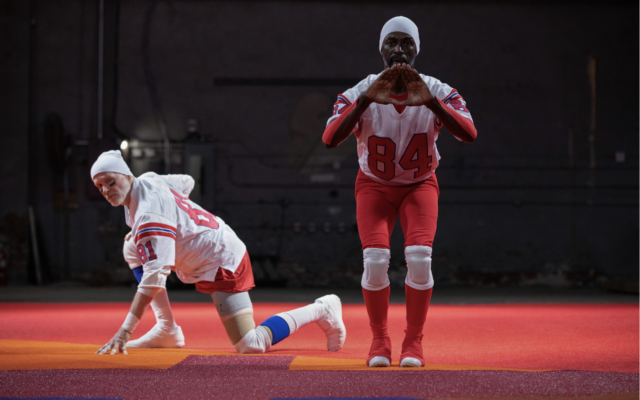
Violence in football takes center stage as a metaphor for America in Matthew Barney’s Secondary (image courtesy Matthew Barney Studio, © Matthew Barney / photo by Julieta Cervantes)

In 2023, Barney said farewell to his longtime Long Island City studio with Secondary, a five-channel video installation that used the Tatum-Stingley play to explore violence in athletic competition. Barney transformed the studio, which was right on the East River, into a football stadium, with a long, artificial turf surface divided into geometric patterns of different colors, centered by his “Field Emblem,” his Cremaster logo, an ellipse with a line going through it, evoking –0-. There were monitors in all four corners of the field, along with a three-sided mini-jumbotron hanging from the ceiling. Visitors could sit on the field or a bench; there was also a painting on the wall, an owners booth filled with football paraphernalia, and a ditch with broken piping and mud dug into the concrete. Outside, on the facade facing the water, there was a digital countdown clock next to graffiti that said, “Saboroso,” which means “delicious.”

Written and directed by Barney, photographed by Soren Nielsen, and edited by Kate Williams, the film — which lasts sixty minutes, the length of a football game — has now been reimagined on a single screen, where it will be shown at Metrograph on May 3 at 5:00, in conjunction with the publication of a two-volume companion book (Rizzoli, April 2025, $115), featuring contributions from Eric Banks, Jonathan Bepler, Raven Chacon, Mark Godfrey, Juliette Lecorne, Helen Marten, Maggie Nelson, and David Thomson; Barney will be at Metrograph for a postscreening discussion with book editor Louise Neri and Banks, followed by a reception with signed books available for purchase.

The multichannel version kicks off with indigenous rights activist Jacquelyn Deshchidn, a Two-Spirit Chiricahua Apache and Isleta Pueblo soprano, composer, poet, and public speaker, performing an alternate national anthem, a none-too-subtle jab at a league that still has teams using offensive Native American names and imagery. The cast, primarily consisting of dancers and choreographers, features movement director David Thomson as Stingley; Raphael Xavier as Tatum; Shamar Watt as Raiders safety Lester “the Molester” Hayes; Wally Cardona as Grogan; Ted Johnson as Francis; Isabel Crespo Pardo, Kyoko Kitamura, and Jeffrey Gavett as the line judges and referees; Barney as Raiders Hall of Fame QB Ken “the Snake” Stabler, who died of colon cancer but was discovered to have had high Stage 3 chronic traumatic encephalopathy (CTE), the disease that affects so many football players, brought on by getting hit so much in the head; and Thomas Kopache as Raiders owner Al Davis, whose motto was “Just win, baby,” no matter the cost. (Football fans will also notice cameos by actors portraying such Raiders favorites as wide receiver Fred Biletnikoff and defensive end John “the Tooz” Matuszak, who became an actor and died in 1989 at the age of thirty-eight from an opioid overdose.) The actors are generally much older than the people they represent, several of whom never made it to the age the performers are today.

The experimental film does not have a traditional chronological narrative; instead, Barney focuses on Tatum, Hayes, and Stingley training in slow motion in equipment rooms as if preparing for a ballet, Grogan making a football out of a gooey substance and then practicing with it, members of Raiders Nation shouting and cheering in fierce black-and-silver Halloween-like costumes, and players venturing into the muddy ditch, the broken pipe echoing Stingley’s shattered body. The music, by sound designer Jonathan Bepler, envelops the audience in a parade of noises, from hums and breathing to clangs and screams. Shots of the Manhattan skyline and the East River beckon to another life outside. The screens sometimes display the same footage, while other times they are different; it is like the viewer is at a football game, with the choice whether to watch the quarterback, the defensive alignment, or other fans in the stands. There is no actual pigskin in the film.
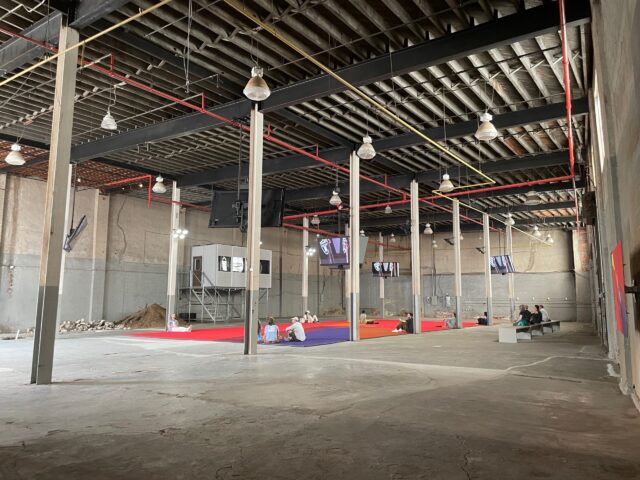
Matthew Barney turned his LIC studio into a multimedia installation (photo by twi-ny/mdr)

The game of football has always been lionized for its violence. Even as the league changes rules to try to protect the quarterback, kick returners, and receivers, the sports networks repeatedly show brutal hits like the one on Dolphins quarterback Tua Tagovailoa against the Cincinnati Bengals that resulted in severe head and neck injuries. When we think of Washington Redskins quarterback Joe Theismann, the first thing we remember is the career-ending injury he suffered on Monday Night Football in 1985 at the hands of New York Giants linebackers Lawrence Taylor and Harry Carson, brutally shattering his leg, and not his 1982–83 MVP season when he led his team to a Super Bowl victory over the Dolphins.

But Barney (River of Fundament, “Subliming Vessel”) is not merely commenting on football. Secondary is about America itself, its rituals and celebrations, its embracing of violence on and off the field. It’s about our lack of respect for the human body and one another, about a country torn apart into blue and red states like opposing teams, ready to do whatever is necessary to just win, baby.

[Mark Rifkin is a Brooklyn-born, Manhattan-based writer and editor; you can follow him on Substack here.]

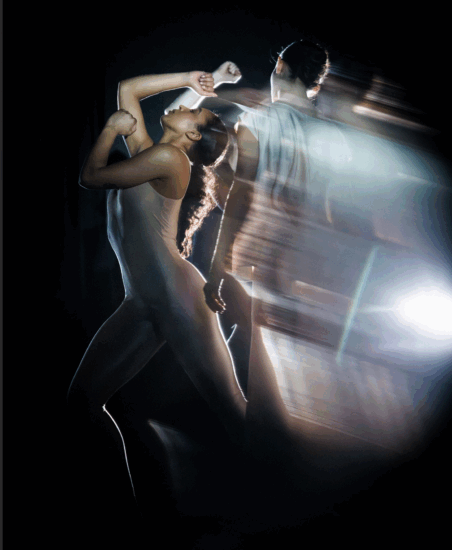
ANANSI’S GOLD: YEPOKA YEEBO AT THE AFRICA CENTER

Who: Yepoka Yeebo, Stuart A. Reid
What: Anansi’s Gold: In Conversation with Yepoka Yeebo and Stuart Reid
Where: The Africa Center, 1280 Fifth Ave. between 109th & 110th Sts., and online
When: Wednesday, April 30, free with advance RSVP, 6:30
Why: “In a castle by the sea in Accra, our man was telling his story. Outside, the sky was so bright it was almost white. In the shallows next to the castle, the waves were pale gray with white caps. Farther out to sea, they turned a shimmering blue. Huge fishing canoes rocked gently, close to shore. On the horizon, container ships lined up, waiting to dock. The air smelled of salt and smoke and brine. The castle — Osu Castle — was cut off from the rest of Accra by palm trees and checkpoints. It was a maze of archways and staircases and parapets, patched together over four centuries. Some of its walls were brightly whitewashed. Others were gray concrete, slick with algae. Ancient cannons and soldiers with assault rifles lined the castle’s walls. Even without stepping into its underground dungeons, you could tell that unspeakable things had happened here. In a heavily guarded room at the heart of the castle, a haze hung in the air as our man began. The history of Ghana, he said, had a secret chapter. Kwame Nkrumah, the country’s first president, had revealed it on his deathbed in 1972.”

So begins British-Ghanaian journalist Yepoka Yeebo’s true-crime bestseller, Anansi’s Gold: The Man Who Swindled the World (Bloomsbury, April 2025, $19.99), which tells the story of con artist supreme John Ackah Blay-Miezah, who perpetrated a long, complicated financial fraud that involved a CIA-funded military junta, Ghanaian statesman Ako Adjei, former Nixon attorney general John N. Mitchell, and several of Kwame Nkrumah’s cabinet ministers, among others, stretching from Ghana to Philadelphia.

In conjunction with the release of the paperback edition of the book, which won the Jhalak Prize and the Plutarch Award for Biography, Yeebo will be at the Africa Center on April 30 at 6:30, speaking with writer and editor Stuart A. Reid, author of The Lumumba Plot: The Secret History of the CIA and a Cold War Assassin.

Admission is free with advance RSVP; the event will also be livestreamed on YouTube and Facebook.

[Mark Rifkin is a Brooklyn-born, Manhattan-based writer and editor; you can follow him on Substack here.]
TIME AND “TIME AGAIN”: TRISHA BROWN AT THE JOYCE

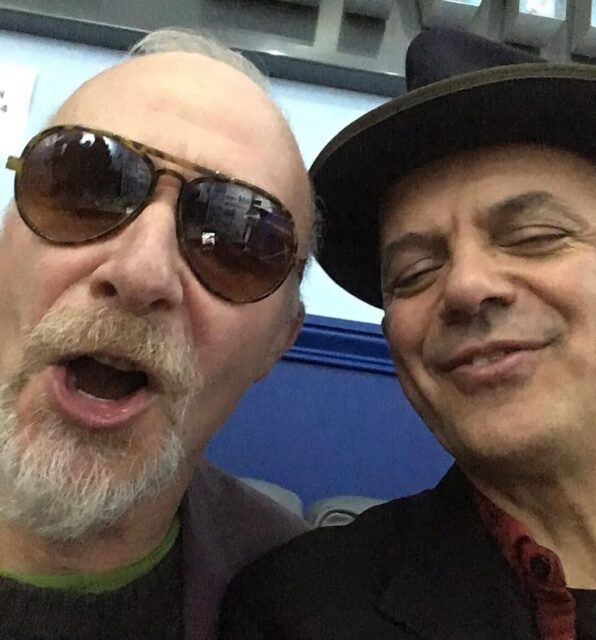
Opal Loop / Cloud Installation #722503 is part of Trisha Brown season at the Joyce (photo by Maria Baranova)

TRISHA BROWN DANCE COMPANY
The Joyce Theater
175 Eighth Ave. at Nineteenth St.
April 29 – May 4, $52-$72
www.joyce.org

For its 2025 season at the Joyce, Trisha Brown Dance Company looks back at its seminal Unstable Molecular Structure Cycle while also forging ahead into the future.

Running April 29 through May 4, the program features three dances, beginning with the world premiere of Time again, which explores the concept of change, repetition, chance, and familiarity. Choreographed by Lee Serle, who was mentored by Brown in 2010 through the Rolex Mentor and Protégé Initiative, the work features set and visual design by Mateo López, who was mentored by William Kentridge in 2012–13 in the Rolex program, lighting by Jennifer Tipton, and music by Australian sound artist Alisdair Macindoe. It will be performed by TBDC members Savannah Gaillard, Rochelle Jamila, Burr Johnson, Ashley Merker, Patrick Needham, Jennifer Payán, and Spencer James Weidie.

Following intermission, the company returns with two pieces from the Unstable Molecular Structure Cycle, which executive director Kirstin Kapustik calls “a series of works that embrace fluidity, unpredictability, and the beauty of constant change.” First up is 1980’s Opal Loop / Cloud Installation #722503, a collaboration with Japanese fog artist Fujiko Nakaya that invites the audience “to bring together images within themselves.” Merker, Needham, Payán, and Weidie perform to the sounds of water passing through high-pressure nozzles, with costumes by Judith Shea and lighting by Beverly Emmons.

The evening concludes with 1981’s Son of Gone Fishin’, which Brown called “a doozey. In it I reached the apogee of complexity in my work.” The full ensemble randomly selects sections of Robert Ashley’s score from his three-opera opus Atalanta, with costumes by Shea and lighting by Emmons evoking the original set design by Donald Judd.

To dive deeper, there will be a Curtain Chat following the April 30 performance.

[Mark Rifkin is a Brooklyn-born, Manhattan-based writer and editor; you can follow him on Substack here.]
NOT JUST PASSING THE TIME: GRAHAM PARKER AND JAMES MASTRO SOLO AT CITY WINERY

Graham Parker and James Mastro will be playing solo gigs at City Winery on April 28 (photo courtesy James Mastro)

GRAHAM PARKER ‘SOLO’ WITH JAMES MASTRO
City Winery New York
25 Eleventh Ave. at Fifteenth St.
Monday, April 28, $38-$58 (plus $25 per person minimum), 8:00
citywinery.com
www.grahamparker.net
www.jamesmastro.net

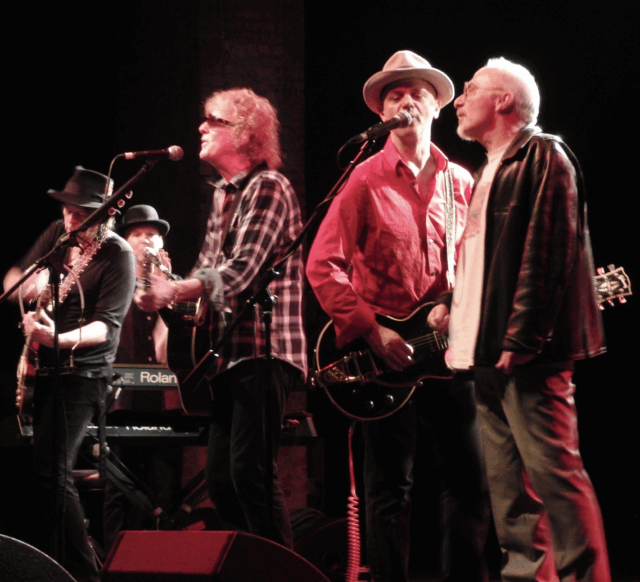
On December 2, 2012, the Paramount in Huntington hosted a memorable show by a pair of British ex-pats. First up was the reunited Graham Parker and the Rumour, followed by Ian Hunter and the Rant Band, the latter featuring James Mastro on guitar, sax, and mandolin.

On April 28, Parker and Mastro will be at City Winery, with Parker playing songs from throughout his illustrious fifty-year-career, during which he has been backed by the Rumour, the Shot, the Figgs, the Small Clubs, and the Goldtops. His most recent album, 2023’s Last Chance to Learn the Twist, is classic GP, a phenomenal package of incisive tunes, from the bluesy rocker “The Music of the Devil” to the throwbacks “Grand Scheme of Things” and “Wicked Wit” to a love song to weed, “Cannabis.”

An expert raconteur, Parker came out of the gate with a remarkable string of records between 1976 and 1979 — Howlin’ Wind, Heat Treatment, Stick to Me, and Squeezing Out Sparks — and he has never stopped releasing terrific new music while also writing the short story collection Carp Fishing on Valium and the backstage novel The Thylacine’s Lair and acting in Judd Apatow’s This Is 40. I’ve seen him numerous times over the decades and he has never failed to work wonders; one of my favorite evenings was a house concert in New Jersey in which Parker performed one deep cut from each of his albums, in chronological order, introducing each song by talking about what was going on in the world when he wrote it.

In an interview on his website, he explains, “I can’t say I ever think I’m doing anything more with each song or each album other than throwing another pebble into the stream where it swirls around for a bit until it eventually gets picked up by the current and flows off downstream. Bye bye, thanks for helping pass the time.”

Graham Parker joins James Mastro, Ian Hunter, and the Rant Band at the Paramount in 2012 (photo by twi-ny/mdr)

I’ve also had the good fortune to see Mastro play in numerous configurations over the years, with the legendary Hoboken band the Bongos, the underappreciated Health & Happiness Show, Patti Smith, Richard Hell, Syd Straw, Megan Reilly, Amy Speace, and others. But last year the consummate sideman released his highly praised debut solo album, Dawn of a New Error, with Mastro taking on faith and religion in “My God,” death and loss in “Never Die,” true love in “Gangster Baby” and “Three Words,” and fake news in “Right Words, Wrong Song.”

In a February 2024 twi-ny talk, Mastro, who also runs the the Hoboken art gallery and live event space 503 Social Club, explained, “I’ve really enjoyed being a side guy all these years, and especially when you’re working with someone like Ian Hunter, or Patti or John [Cale], anyone I’ve worked with, Megan. So it’s been nice to go in and try to contribute and watch how other people work. It takes a lot of pressure off. Running a band is a pain in the ass; you gotta make sure the drummer doesn’t get arrested.”

Parker and Mastro will be more than passing the time at City Winery, and there will be no drummers needing protection from the law.

[Mark Rifkin is a Brooklyn-born, Manhattan-based writer and editor; you can follow him on Substack here.]
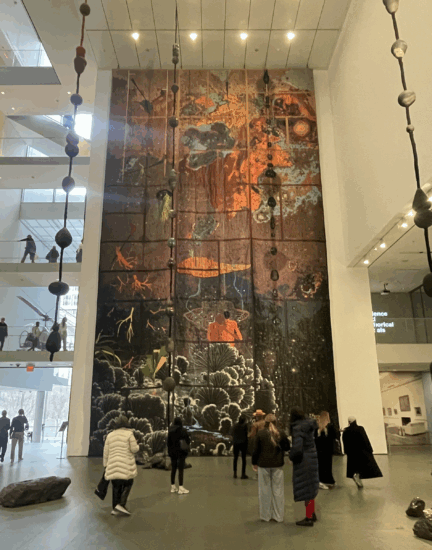
THE VOICE OF A TEARDROP: ACTIVATING OTOBONG NKANGA’S CADENCE AT MoMA

Artist Otobong Nkanga will be joined by six performers to activate Cadence installation on April 27 (photo by twi-ny/mdr)

Who: Otobong Nkanga and others
What: Installation activation
Where: Marron Family Atrium, MoMA, 11 West Fifty-Third St. between Fifth & Sixth Aves.
When: Sunday, April 27, free with museum admission, 10:30 am – 5:30 pm
Why: Describing her MoMA atrium commission Cadence, Nigeria-born, Belgium-based artist Otobong Nkanga notes, “Once I’d visited MoMA, I was interested in creating a tapestry work for the highest wall in the atrium, which would allow for a way of looking into the world from a different perspective. I wanted to create the notion of falling: a fall of things, a certain shift, a certain rhythm. The tapestry opens up to a more three-dimensional space, with sculptural pieces made of clay, smoked raku, and glass hanging from ropes and sitting on anthracite rocks, and a sound piece integrated in the sculpture that relates to the notion of teardrops, which is another kind of fall. . . . I wanted to make something that explores different rhythms of life. You might also feel that it’s a world that is beyond this one, like the universe somehow. It’s a mix of different worlds — from the underworld and the mining of minerals, to the surface and the soil, to the atmosphere and the heat of the sun, into outer space — all collapsing together in one place. That’s what creates the cadence of life. That’s what creates, actually, a world, because you cannot separate what is happening in the universe from what is happening underneath the soil in the core of the earth.”

On April 27 from 10:30 to 5:30, Nkanga and six other performers — Holland Andrews, Keishera, Muyassar Kurdi, Anaïs Maviel, Miss Olithea, and Samita Sinha, in costumes by Christian Joy — will activate the installation, incorporating sound and movement to interact with the piece. “What if a teardrop actually had a voice? What would it say? How would it say it? The work is really looking at that teardrop, and the emotions that go with it,” Nkanga says of the live performance, which is free with museum admission. Cadence is on view through July 27.

[Mark Rifkin is a Brooklyn-born, Manhattan-based writer and editor; you can follow him on Substack here.]
DEMOCRACY IN ACTION: EMERGENT CITY, INNOVATION, AND THE BROOKLYN WATERFONT

Documentary traces community battle against rezoning of Industry City in Brooklyn

EMERGENT CITY (Jay Arthur Sterrenberg & Kelly Anderson, 2024)
DCTV Firehouse Cinema
87 Lafayette St.
Opens Friday, April 25
www.dctvny.org
www.emergentcitydoc.com

“Everybody wants to live, work, shop, spend money in Brooklyn,” real estate journalist Michael Stoler said in a July 2012 episode of The Stoler Report. “Why’s everybody want Brooklyn?”

Carlos Scissura of the Brooklyn Chamber of Commerce responded, “Look, there’s no other place in America that anyone should be, period.”

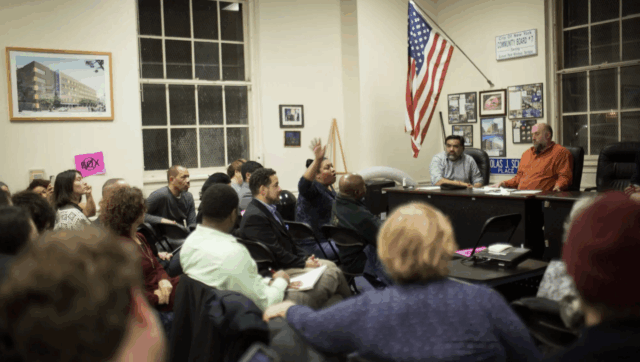
That exchange kicks off Emergent City, Jay Arthur Sterrenberg and Kelly Anderson’s documentary tracking the rezoning battle of Industry City, comprising sixteen buildings on the Brooklyn waterfront, from the time that developers started buying up property there after the devastation of Hurricane Sandy in the fall of 2012 through the end of 2022, when a decision was ultimately reached.

Sterrenberg and Anderson are flies on the wall during a seemingly endless series of meetings, town halls, protests, hearings, and other gatherings over the course of ten years, during which Industry City CEO Andrew Kimball and attorney Jesse Masyr, backed by such billion-dollar companies as Jamestown and Belvedere Capital and real estate investor Angela Gordon, defend their plan to rezone the Sunset Park industrial waterfront for commercial and retail use and luxury hotels.

The fight against the project, as it goes through the six-stage approval process — Scoping, Certification, Community Board, Borough President, Planning Commission, and City Council — is led by tenant organizer Marcela Mitaynes, later the Community Board 7 house chair; Antoinette Martinez of the Protect Our Working Waterfront Alliance; Southwest Brooklyn Industrial Development Corporation executive director Ben Margolis; UPROSE Climate Justice Center executive director Elizabeth Yeampierre; Community Board 7 land use chair John Fontillas and chair César Zuñiga; city council director of land use and planning Renae Widdison; and others.

Caught in the middle is city councilmember Carlos Menchaca, who is trying to negotiate a community benefits agreement that will make both sides happy, which appears to be an impossible task.

“How do you retain the working-class character of the community, how do you keep it a walk-to-work community and keep it industrial, but not at the expense of our lives?” Yeampierre asks, noting that “catastrophic events are heading our way.”

Trying to find perspective, Margolis says, “It’s not that this is the ideal scenario. The ideal scenario is that the waterfront is owned by the city, and everybody can choose how to make it work. That’s just not the reality.”

Kimball refers to the area as an “innovation district,” talking to several local small business owners who have decided to lease space in Industry City, seeing it as a boon for the community, while others argue that it will invariably lead to higher rents, gentrification, and displacement.

Finally, after a decade of contentious and volatile discussion, a surprising resolution settles the matter.

A vivid portrait of democracy in action, with all its flaws and inherent prominence of power, money, and politics, Emergent City opens April 25 at DCTV Firehouse Cinema, with eight postscreening Q&As through May 1 featuring Sterrenberg and Anderson and such guests as Menchaca, Widdison, Mitaynes, Martinez, cinematographer Alex Mallis, executive producer Stephen Maing, field producer Betty Yu, city councilmember Alexa Avilés, and moderators Max Rivlin-Nadler, Oscar Perry Abello, Siddhant Adlakha, Alyssa Katz, and Firehouse Cinema director of programming Dara Messinger

[Mark Rifkin is a Brooklyn-born, Manhattan-based writer and editor; you can follow him on Substack here.]
HERE I AM: A TRANS RABBI SHARES HER STORY IN BECOMING EVE

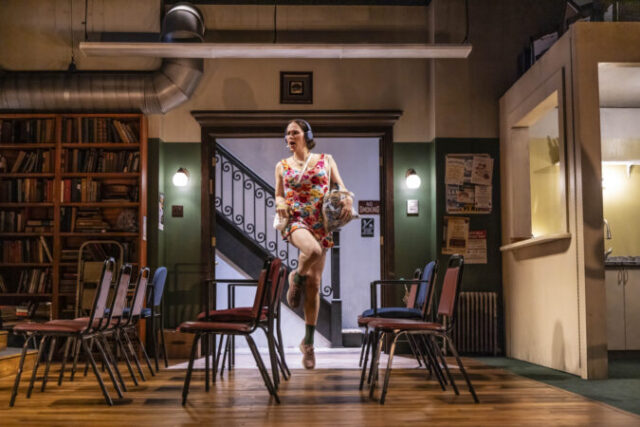
Tommy Dorfman stars as a trans rabbi trying to come out to her father in Becoming Eve (photo by Matthew Murphy)

BECOMING EVE
Abrons Arts Center Playhouse Theater
466 Grand St. at Pitt St.
Through April 27, $29.88-$130
212-598-0400
www.nytw.org
www.abronsartscenter.org

On the second day of Rosh Hashanah, the Jewish New Year, synagogues around the world read and discuss Genesis 22:1–24, the story of Abraham’s binding of his son Isaac on Mount Sinai, preparing him as a human sacrifice until an angel of G-d intervenes, replacing Isaac with a ram at the last moment. Known as the Akedah, the passage has been hotly debated for millennia by religious leaders, scholars, and laypeople, exploring issues of faith, obedience, familial responsibility, and the value of human life.

One line of thought considers whether Abraham, and perhaps Isaac as well, is aware that it is a test and that Abraham believed that G-d never planned on having him go ahead with the slaughter of the son who was born to him and his wife Sarah in their old age.

In Emil Weinstein’s debut play, the searing Becoming Eve, another interpretation comes to the fore: whether what happened on Mount Sinai was actually a transformation of Isaac’s soul from female to male, as argued by Rabbi Yechiel Michel of Zloczow in the seventeenth century.

Based on Abby Chava Stein’s 2019 memoir, Becoming Eve: My Journey from Ultra-Orthodox Rabbi to Transgender Woman, the lightly fictionalized play, continuing at Abrons Arts Center through April 27, focuses on Chava (Tommy Dorfman), a trans rabbi who has not come out yet to her deeply religious family, whose ancestors include the Baal Shem Tov, the eighteenth-century founder of Hasidism.

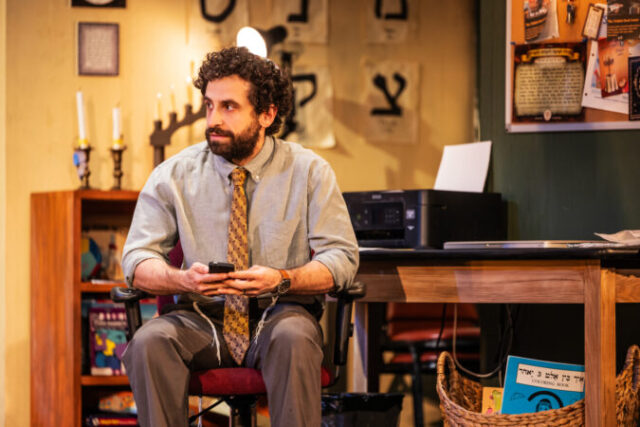
Chava has been spotted wearing a dress in midtown Manhattan by a member of her parents’ tight-knit Williamsburg community, and, fearing that the observer will reveal her secret, she decides to tell her father, Tati (Richard Schiff), and mother, Mami (Judy Kuhn), enlisting the support of Jonah (Brandon Uranowitz), a rabbi who has recently started a progressive shul on the Upper West Side.

Chava is afraid her parents won’t understand, explaining to Jonah, “They live in a hermetically sealed nineteenth-century village that happens to be in Brooklyn. They don’t know the Internet. They don’t know Superman.”

Jonah is excited to learn of Reb. Michela’s interpretation, proclaiming, “That story has always confounded me. This essential paradox, at the very start of our religion, G-d telling Abraham to sacrifice Isaac, his beloved son, when G-d has just promised Abraham that Isaac will father generations! How can both be true? But the whole story is about both-ness, right? This essential both-ness that Abraham has to contend with. But it makes so much sense with the Michela commentary. It cracks the whole thing open. The sacrifice is actually a transformation, which is so essentially Jewish. We’re the people of transition. Of exodus, of leaving and starting over, of walking through doorways. And doorways are fundamentally about liminality, right? The in-between space between two extremes! Between borders and genders and sexualities and — This may have cracked open my Rosh Hashanah speech.”

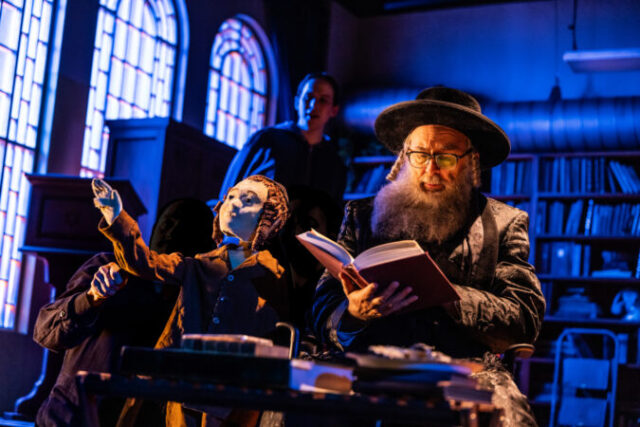
Tati (Richard Schiff) reads Scripture next to a puppet of his son in powerful new play (photo by Matthew Murphy)

Chava is disappointed when only Tati shows up, and she hesitates in sharing her truth. As she delays, the narrative shifts back and forth between the present and the past, depicted in poignant memory scenes from Chava’s childhood in which she is portrayed by a series of Bunraku-style puppets that get bigger and older as Chava does; they’re operated by Justin Perkins and Emma Wiseman, dressed in all black, with Dorfman standing with them, speaking the dialogue in darkness.

The vignettes begin with Chava at the age of two and a half, when Tati, thrilled to finally have a son after five daughters, wants to bring his boy to shul for the first time and Mami disagrees. At six, Chava is asking Tati whether doctors will someday be able to perform full-body transplants. At thirteen, Chava is taught by Tati how to put on tefillin; he explains, “The tefillin binds us, father and son, together to the end of time,” recalling the Akedah. At sixteen, Chava grows close with a curious schoolmate, Chesky (Rad Pereira). And at nineteen, Chava is introduced to Fraidy (Tedra Millan), who has been chosen to be his bride.

Meanwhile, in the present day, Chava, Jonah, and Tati have intriguing conversations about family and the Torah. Tati is confused when Jonah offers, “I left Judaism completely for a few years, actually, and then I found my way back, through transdenominational Renewal Judaism, which takes a lot of inspiration from the Hasidic masters.” Tati doesn’t understand why Chava is refusing to attend her brother’s upcoming wedding. When Jonah mentions that Steven Spielberg helped fund the local Yiddish Book Center, Tati claims to have never heard of him. Chava reminds her father that, as a teenager, he had snuck out of his house to see Jaws, an event that he is ashamed of. “You looked America in the teeth and it scared you back to Williamsburg,” Chava says. Tati replies, “I wasn’t scared. It was clearly a machine.” Jonah adds, “Machines can be scary,” to which Tati concludes, “Only if you let them run your life,” a clever reference to biblical fundamentalists like Tati.

Presented by New York Theatre Workshop, Becoming Eve was initially scheduled for the Connelly Theater but had to be moved after the New York Archdiocese, which runs the venue, canceled the show because of its content. Archdiocese director of communications Joseph Zwilling wrote in a statement, “It is the standard practice of the archdiocese that nothing should take place on Church-owned property that is contrary to the teaching of the Church. That applies to plays, television shows, or movies being shot, music videos being recorded, or other performances.” The Connelly is part of the Cornelia Connelly Center, a nonprofit whose mission is “to champion girls, empowering them to realize their full potential from middle school through college and beyond.”

Tony winner Brandon Uranowitz plays an Upper West Side rabbi in Becoming Eve (photo by Matthew Murphy)

The play, which is in English but the characters are actually speaking in Yiddish and Hebrew, feels much more at home at Abrons Arts Center on the Lower East Side, where immigrant Jewish communities have thrived for more than a century. Abrons is part of the Henry Street Settlement, which was established in the late-nineteenth century and whose mission is “to open doors of opportunity for Lower East Side residents and other New Yorkers through social service, arts, and health care programs.”

To signal time shifts, Ben Stanton’s lighting goes dark and UptownWorks’ (Daniela Hart, Noel Nichols, Bailey Trieweiler) sound explodes before Daniel Kluger’s music calms things down. The convincing puppets are by Amanda Villalobos, who has previously worked on such shows as Is This a Room, Wolf Play, and The Old Country.

Becoming Eve unfolds on Arnulfo Maldonado’s exquisitely detailed set, an upstairs office with overstuffed bookcases, a small kitchen, a flyer for a production of The Hamantaschen Monologues, exposed air ducts, Jonah’s cluttered desk, a cabinet with two Torah scrolls, a bemah, and three arched windows. Enver Chakartash’s costumes range from Chava’s sexy dress to Jonah’s casual clothing to Tati’s traditional Hasidic garb.

Weinstein, a trans man who, as a teenager, attended the synagogue that Stein had left, writes incisive dialogue that avoids becoming, well, preachy and didactic, with unexpected twists and turns that are guided with expert precision by director Tyne Rafaeli (Epiphany, The Coast Starlight). Dorfman (Romeo + Juliet, “Daddy”) is heartbreaking as Chava, who is desperate to be accepted by her family; it is wrenching when she changes from her revealing dress to a zipped-up hoodie, terrified at how her father might react. Unrecognizable Emmy winner Schiff (Glengarry Glen Ross, The West Wing) is sensational as the long-bearded Tati, a respectable man stuck in the past, unwilling to face the realities of the modern era.

Tony winner Uranowitz (Falsettos, An American in Paris) is eminently likable as Jonah, a rabbi who understands just how to bridge the gap between Chava and Tati. Three-time Tony nominee Kuhn (Fun Home, Les Misérables) and Millan (On the Shore of the Wide World, The Wolves) excel as the key women in Chava’s life, while Pereira (Take Care, Madonna col Bambino) is touching as Chesky.

One of the best plays of the year, Becoming Eve begins with Chava singing Ariana Grande’s “Break Free,” which includes the lyrics “If you want it, take it / I should have said it before / Tried to hide it, fake it / I can’t pretend anymore,” and ends with SOPHIE’s “Immaterial” (“Im-ma-ma-material, immaterial / Immaterial boys, immaterial girls / Im-ma-ma-material, immaterial / We’re just, im-ma-ma-material [I could be anything I want] / Immaterial, immaterial boys [anyhow, anywhere] / Immaterial girls [any place, anyone that I want] / Im-ma-ma-material, immaterial”).

In Genesis 22:1, G-d calls out to Abraham, who answers, “Hineni” — “Here I am” — which is also the name of one of the most beautiful Rosh Hashanah and Yom Kippur prayers, sung in the shul by the cantor, who is representing the congregation despite their own personal faults and transgressions. The final word of Weinstein’s play is also “hineni,” a defiant conclusion to a complex, thought-provoking work about who we are, how we are seen by others, and everything in between.

[Mark Rifkin is a Brooklyn-born, Manhattan-based writer and editor; you can follow him on Substack here.]