twi-ny recommended events

CABARET CINEMA — SOUNDTRACK: THE YOUNG GIRLS OF ROCHEFORT

The Young Girls of Rochefort

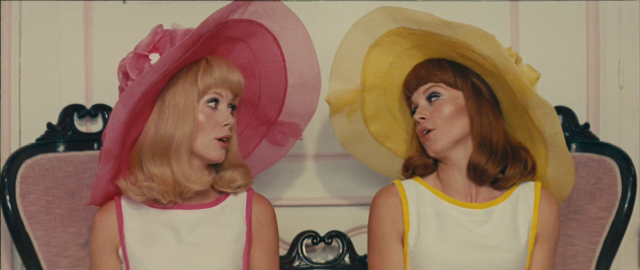
Real-life sisters Catherine Deneuve and Françoise Dorléac play Gemini twins in Jacques Demy’s The Young Girls of Rochefort

THE YOUNG GIRLS OF ROCHEFORT (LES DEMOISELLES DE ROCHEFORT) (Jacques Demy, 1967)
Rubin Museum of Art
150 West 17th St. at Seventh Ave.
Friday, October 27, $10, 9:30
Series continues Friday nights through April 28
212-620-5000
rubinmuseum.org

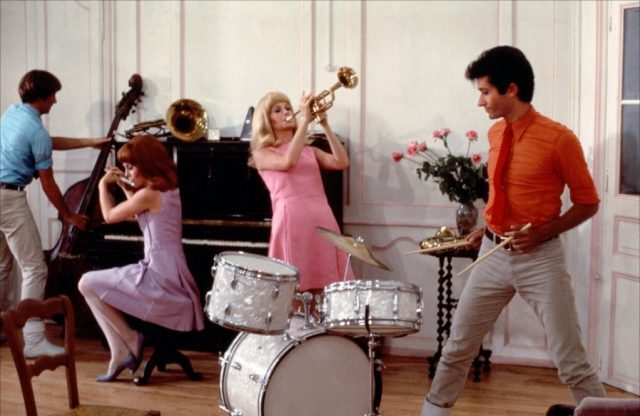
When asked why he chose The Young Girls of Rochefort for the Rubin Museum Cabaret Cinema series “Soundtrack,” being held in conjunction with the exhibition “The World Is Sound,” movie executive Jack Lechner explained, “In addition to being the single biggest influence on Damien Chazelle’s La La Land, Jacques Demy’s The Young Girls of Rochefort is the sheerest expression of pure joy in the history of movies — a nonstop celebration of song, dance, and romantic idealism.” Demy’s 1967 pastel-colored romp is all that and more, a swirling, twirling two-hour-plus party of music, missed connections, and murder. In the port town of Rochefort, a fair has come to town, including hot-to-trot carnies Etienne (George Chakiris, with songs overdubbed by Romuald) and Bill (Grover Dale, José Bartel), who spend a lot of time hanging out at a café right next to the town square, owned by Yvonne Garnier (Danielle Darrieux, the only one who does her own singing), who has grown twin girls, dance instructor Delphine (Catherine Deneuve, Anne Germain) and piano teacher Solange (Françoise Dorléac, Claude Parent), as well as a young son, Booboo (Patrick Jeantet, Olivier Bonnet). Local gallery owner Guillaume Lancien (Jacques Riberolles, Jean Stout) is in love with Delphine, but she wants nothing to do with him. Music store owner Simon Dame (Michel Piccoli, Georges Blaness) is trying to arrange a meeting between Solange, who has written a symphony, with his very successful conservatory friend, Andy Miller (Gene Kelly, Donald Burke). Meanwhile, blond sailor and painter Maxence (Jacques Perrin, Jacques Revaux) has drawn a picture of his ideal woman — a dead ringer for Delphine — but circumstances keep preventing them from bumping into each other. Meanwhile, the perky Josette (Geneviève Thénier, Alice Gerald) serves such regulars as Dutrouz (Henri Crémieux) and Pépé (René Bazart) in the café. Over the course of one rather long weekend, characters fall in and out of love, uncover family secrets, and keep missing one another as they sing and dance as if it’s the most natural thing in the world. And who’s to argue with them.
The Young Girls of Rochefort

Sound is a key element in multiple ways in one of the grandest musicals ever made

Recently restored with the participation of Demy’s widow, fellow Nouvelle Vague master Agnès Varda, The Young Girls of Rochefort is a genuine treat for the eyes and ears. Deneuve and Dorléac are utterly delightful as the Gemini twins, wearing candy-colored dresses and dramatic hats (the glorious costumes are by Jacqueline Moreau and Marie-Claude Fouquet), everything gorgeously photographed by Ghislain Cloquet. (Sadly, Dorléac, Deneuve’s older sister in real life) died in a car accident a few months before the film was released; she was only twenty-five.) Demy wrote and directed the film, including penning the lyrics for Michel Legrand’s wide-ranging score, even giving an inside nod to the composer. While his previous film, 1964’s The Umbrellas of Cherbourg, featured every piece of dialogue being sung, The Young Girls of Rochefort mixes it up, much like the dancing, choreographed by Norman Maen; at any moment, some characters are dancing and others just sitting or walking, sometimes noticing each other with quick moves, and sometimes not, almost as if the worlds of fantasy and reality are side-by-side. Of course, this being Demy (Model Shop, Une chambre en ville), it’s not all sweetness and light. There’s a violent murderer on the loose, the military is marching through town, and Guillaume seems to be rather handy with a gun. “Trouble is everywhere,” Yvonne says. Several times Maxence notes that his return to Nantes, Demy’s own hometown, is “immi-Nantes,” and that goofy joke is one of the many sly elements that keeps the film sharp and edgy; the plot is built around everything being imminent to the point of intoxicating ridiculousness. In addition to also kvelling over abstract art (“Braque, Picasso, Klee, Miró, Matisse — that’s life!” Maxence declares), the film is surprisingly feminist. Delphine and Solange regularly add little quips, almost under their breath, refusing to be taken for floozies no matter how sexist and misogynist some of their suitors might be. And then, at the end, Demy literally and figuratively opens and closes one last door. The Young Girls of Rochefort is screening at the Rubin at 9:30 on October 27 and will be introduced by Lechner; “Soundtrack” continues Friday nights through December 15 with such other sound-specific films as Michael Powell and Emeric Pressburger’s I Know Where I’m Going, Gus Van Sant’s Elephant, and Lars von Trier’s Dancer in the Dark.
HANK AND JIM: 12 ANGRY MEN / MR. SMITH GOES TO WASHINGTON

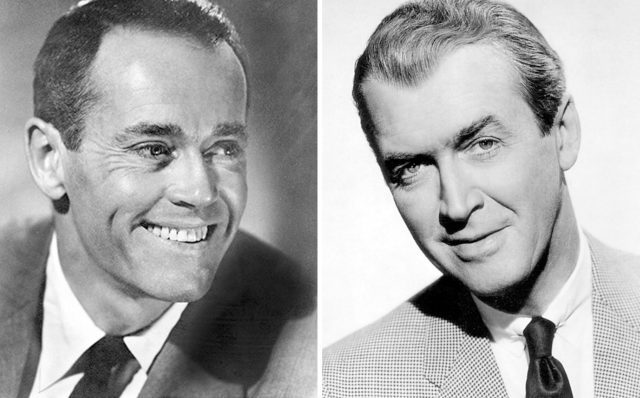
Henry Fonda and Jimmy Stewart

The long friendship Henry Fonda and Jimmy Stewart is the focus of terrific three-week series at Film Forum

Film Forum
209 West Houston St.
October 27 – November 16
212-727-8110
filmforum.org

If only America were more like the long relationship between Nebraska-born Oscar winner Henry Jaynes Fonda and Pennsylvania-born Oscar winner James Maitland Stewart. Fonda, who served in the Navy during WWII and passed away in 1982 at the age of seventy-seven, was a liberal Democrat who was married five times; Stewart, who served in the Army during WWII and passed away in 1997 at the age of eighty-nine, was married to the same woman for forty-four years. Not only did Hank and Jim disagree on politics, which they early on decided never to talk about in each other’s company, but they also went head-to-head for the Best Actor Oscar in 1941, when Stewart (The Philadelphia Story) beat Fonda (The Grapes of Wrath). Still, they remained best buddies, which is documented in Scott Eyman’s new book, Hank and Jim: the Fifty-Year Friendship of Henry Fonda and James Stewart (October 24, Simon & Schuster, $29), a tome that serves as the inspiration behind the fab Film Forum series “Hank and Jim,” running October 27 through November 16, consisting of more than three dozen movies made by the two actors, who both experienced success on Broadway as well as in Hollywood. (The onetime roommates met while trying to establish their careers in New York City.) Eyman will be at Film Forum to introduce several screenings and sign copies of his book.

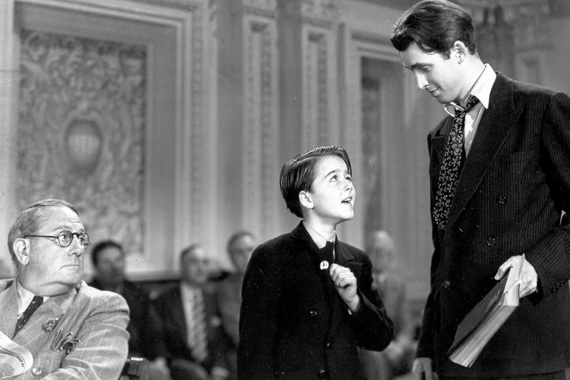
The series begins October 27 with an Alfred Hitchcock double feature, The Wrong Man, starring Fonda as a jazz musician accused of murder, and Rope, in which Stewart plays a professor invited to a dinner party with an unexpected guest. That is followed October 28 with Sidney Lumet’s 12 Angry Men and Frank Capra’s Mr. Smith Goes to Washington, in which Fonda and Stewart both portray men with consciences who care about fairness and the truth. Other double features with films made by each man include The Ox-Bow Incident and Broken Arrow, Call Northside 777 and The Boston Strangler, The Moon’s Our Home and Next Time We Love, and Destry Rides Again and Daisy Kenyon, in addition to double features with just one of them and individual screenings of some of their greatest solo films. Fonda and Stewart made only three movies in which they appeared together, On Our Merry Way, Vincent McEveety’s Firecreek, and Gene Kelly’s The Cheyenne Social Club, but, oddly, none of them is part of this festival, nor is How the West Was Won, which stars both of them but they are never in the same scene.

12 ANGRY MEN

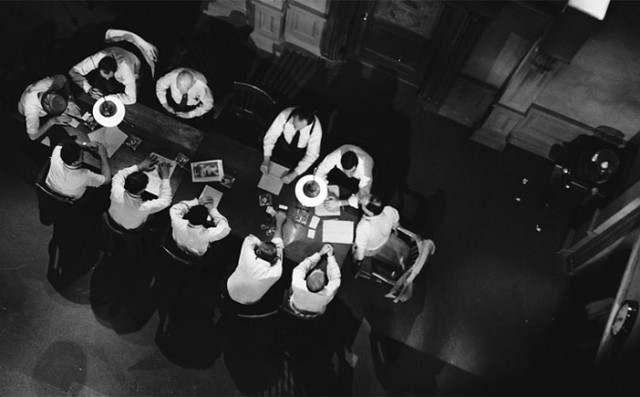
Sidney Lumet’s 12 Angry Men explores the consciences and more of a dozen jurors deciding a murder case

12 ANGRY MEN (Sidney Lumet, 1957)
Film Forum
Saturday, October 28, 3:00, 7:30
www.filmforum.org

The fate of an eighteen-year-old boy charged with the murder of his father is at stake in Sidney Lumet’s first film, the gripping, genre-defining 12 Angry Men. After a series of establishing shots, a judge sends a dozen New Yorkers into the jurors room, where they need to come to a unanimous verdict that could lead to the execution of the teen. Over the course of about ninety minutes, an all-star cast examines and reexamines the case — and their own personal biases — as the heat increases, both literally and figuratively. At first, the nameless dozen men make small talk, trying to be friendly, but it’s not long before some of them are at others’ throats, primarily the gruff Lee J. Cobb, who has it in for the calm and thoughtful Henry Fonda, who is ready to stand alone if necessary for what he believes in. The other uniformly excellent actors playing a very specific cross-section of white, male America are John Fiedler, Martin Balsam, Robert Webber, E. G. Marshall, Jack Klugman, Edward Binns, Jack Warden, Ed Begley, Joseph Sweeney, and George Voskovec. “I tell you, we were lucky to get a murder case,” Webber tells Fonda, but he won’t feel the same as the tension reaches near-violent proportions. 12 Angry Men is a searing examination of the criminal justice system as well as basic human instincts, behavior, and common decency. The Philadelphia-born Lumet, whose parents were both in the Yiddish theater, is able to tell the story in cinematic ways despite its taking place mostly in one small, sweaty room, letting the intense acting drive the narrative; the director, who was nominated for an Oscar for the film, would go on to make such other classic New York City dramas as The Pawnbroker, The Anderson Tapes, Serpico, Dog Day Afternoon, and Prince of the City. Nominated for a Best Picture Oscar and winner of the Golden Bear at Berlin, 12 Angry Men, based on an original teleplay by Reginald Rose, is screening October 28 as part of a double feature with Frank Capra’s Mr. Smith Goes to Washington in the Film Forum series “Hank and Jim”; the 7:30 show will be introduced by Scott Eyman, author of Hank and Jim: the Fifty-Year Friendship of Henry Fonda and James Stewart, and followed by a book signing.

Jimmy Stewart takes filibustering to a whole new level in Mr. Smith Goes to Washington

MR. SMITH GOES TO WASHINGTON (Frank Capra, 1939)
Film Forum
Saturday, October 28, 12:30, 4:55
www.filmforum.org

We love Jimmy Stewart; we really do. Who doesn’t? But a few years ago we had the audacity to claim that Jim Parsons’s performance as Elwood P. Dowd in the 2012 Broadway revival of Harvey outshined that of Stewart in the treacly 1950 film, and now we’re here to tell you that another of his iconic films is nowhere near as great as you might remember, although it still has its place in the Hollywood canon. Nominated for eleven Academy Awards, Frank Capra’s Mr. Smith Goes to Washington caused quite a scandal in America’s capital when it was released in 1939, depicting a corrupt democracy that just might be saved by a filibustering junior senator from a small state whose most relevant experience is being head of the Boy Rangers. (The Boy Scouts would not allow their name to be used in the film.) Stewart plays the aptly named Jefferson Smith, a dreamer who believes in truth, justice, and the American way. “I wouldn’t give you two cents for all your fancy rules,” Smith says of the Senate, “if, behind them, they didn’t have a little bit of plain, ordinary, everyday kindness and a little looking out for the other fella, too.” He’s shocked — shocked! — to discover that his mentor, the immensely respected Sen. Joseph Harrison Paine (played by Claude Rains, who was similarly shocked that there was gambling at Rick’s in Casablanca), is not nearly as squeaky clean as he thought, involved in high-level corruption, manipulation, and pay-offs that nearly drains Smith of his dreams. Having recently celebrated its seventy-fifth anniversary, Mr. Smith Goes to Washington is still, unfortunately, rather relevant, as things haven’t changed all that much, but Capra’s dependence on over-the-top melodrama has worn thin. It’s a good film, but it’s no longer a great one. Just in time for election day, Mr. Smith Goes to Washington is screening October 28 as part of a double feature with Sidney Lumet’s 12 Angry Men in the Film Forum series “Hank and Jim”; the 4:55 show will be introduced by Scott Eyman, author of Hank and Jim: the Fifty-Year Friendship of Henry Fonda and James Stewart, and followed by a book signing.
THE PORTUGUESE KID

(photo by Richard Termine 2017)

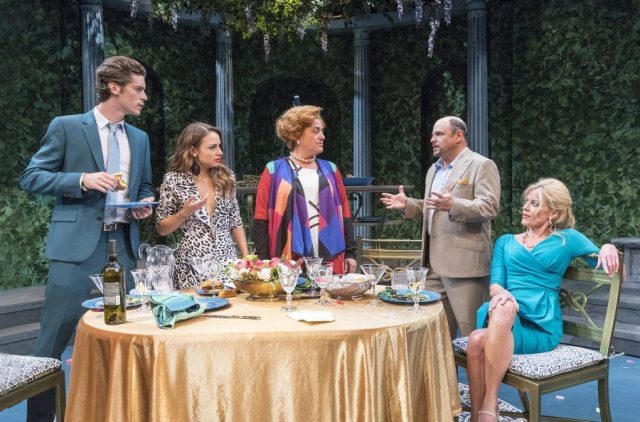
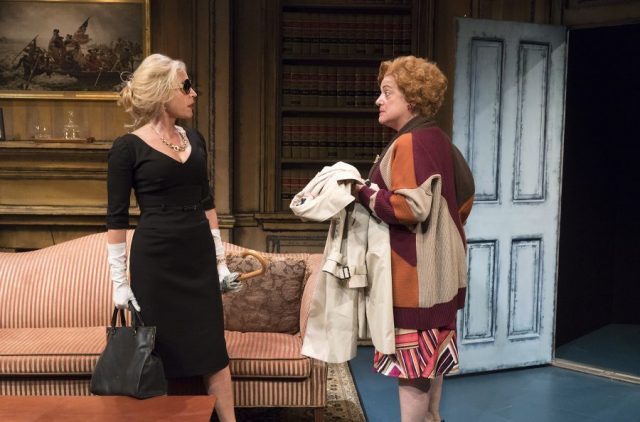
Atalanta Lagana (Sherie Rene Scott) and Mrs. Dragonetti (Mary Testa) are at odds throughout John Patrick Shanley’s The Portuguese Kid (photo by Richard Termine 2017)

Manhattan Theatre Club
MTC at New York City Center – Stage I
Tuesday – Sunday through December 3, $95-$112.50
212-581-1212
theportuguesekid.com

Tony, Oscar, and Pulitzer Prize winner John Patrick Shanley was feeling down in the dumps about the state of the world, so he decided it was time for an old-fashioned Neil Simon-style romantic farce; the result is the hilarious, if bumpy, comedy The Portuguese Kid, which opened last night at Manhattan Theatre Club’s Stage I at City Center. Grieving widow Atalanta Lagana (Sherie Rene Scott) is in the Providence, Rhode Island, home office of her lawyer and childhood friend, Barry Dragonetti (Jason Alexander), reviewing the estate of her recently deceased second husband, Vinny, “a passive aggressive fascist” foot surgeon who voted for Donald J. Trump. ESP-obsessed Atalanta is wearing a sexy black mourning dress and sunglasses, pummeling Barry, who seems to have forced himself into a too-tight, too-blue business suit, with a barrage of brutal one-liners. They’ve been at odds for forty years, ever since ten-year-old Atalanta saved fifteen-year-old Barry when he was mugged by a Portuguese kid, leading to his lifelong horror of anything Portuguese. Atalanta slyly reveals that she’s now seeing Freddy Imbrossi (Pico Alexander), a twenty-nine-year-old carefree would-be poet and real estate agent — and the former passionate lover of Patty (Aimee Carrero), Barry’s hot, sexy, and sensitive young Puerto Rican wife. “What is it? You got a problem with Freddy?” Atalanta says to a disgruntled Barry, who responds, “You got a problem. Freddy Imbrossi? You’d be better off with Lyme disease!” Atalanta then explains that she’s been calling out Barry’s name during sex for years (with both her deceased husbands), which confuses Barry but infuriates his nine-toed mother (Mary Testa), who has been listening in by the door. Barry recuses himself from Atalanta’s case, which fills Mrs. Dragonetti with glee. “I pray to God I never have to violate these eyes with the sight of you again,” she says to the two-time widow.

Clever, witty, and, sometimes a little roughly, the next three scenes in this intermissionless one-act move from Atalanta’s corny but lush bedroom to Barry’s well-appointed backyard, where Patty and Mrs. Dragonetti go at it next, no holds barred, leaving Barry torn between his fiery young wife, who remembers fondly how they met and fell in love, and his hotheaded, nasty mother, who thinks no one is good enough for her baby. The final scene takes place in Atalanta’s garden, where all of the characters gather for a lunch they’ll never forget.

Everyone gathers for a frenetic feast in Manhattan Theatre Club world premiere (photo by Richard Termine 2017)

Everyone gathers for a frenetic feast in Manhattan Theatre Club world premiere (photo by Richard Termine 2017)

The Bronx-born Shanley (Doubt, Moonstruck, Prodigal Son,) wrote and directed The Portuguese Kid, making changes to the second and fourth scenes up to the very last minute during previews, and it unfortunately shows; those scenes are more chaotic and unformed than the fabulous first and third scenes, in which the characters are well developed, the actors get to strut their stuff, and the plot thickens in wonderfully acerbic ways. Alexander (Seinfeld, Merrily We Roll Along) excels in a role written with him in mind, all pent-up anger waiting to explode, while three-time Tony nominee Scott (Everyday Rapture, Dirty Rotten Scoundrels) is simply fab as the unpredictable, tough-talking Atalanta (loosely inspired by the virgin huntress in Greek mythology), who regularly admits to having “a darkness.” And there’s little left of the scenery after Drama Desk Award winner Testa (First Daughter Suite, Queen of the Mist) gets through with it; her physical presence is the center of gravity around which her galactic verbal barrages fly. Alexander (Punk Rock, What I Did Last Summer) and Carrero (Young & Hungry, What Rhymes with America) have their moments, but their roles are not as fully fleshed out as Jason Alexander’s and Scott’s; in some ways, the quartet evokes Edward Albee’s Who’s Afraid of Virginia Woolf? The snazzy production features a movable set by John Lee Beatty, fun, colorful costumes by William Ivey Long (Scott’s dresses are too die for), and original music and sound by MTC stalwart Obadiah Eaves. “You underestimate women,” Atalanta tells Barry, who answers, “I’m glad you think so.” In The Portuguese Kid, Shanley most certainly does not underestimate women — or his audience.

SHAUN IRONS & LAUREN PETTY: WHY WHY ALWAYS

(photo by Paula Court)

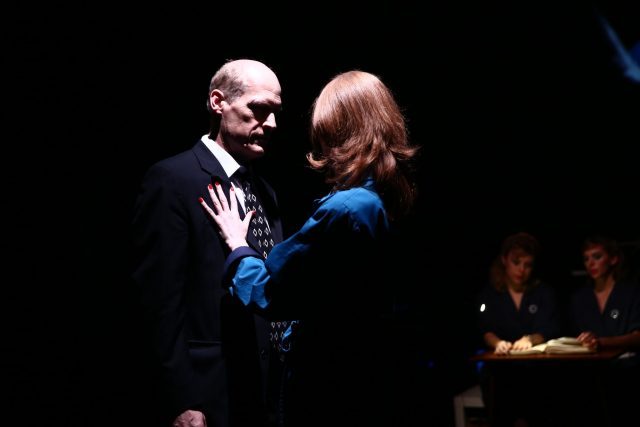
Lemmy Caution (Jim Fletcher) and Natacha Von Braun (Elizabeth Carena) get caught up in mysterious intrigue in Why Why Always (photo by Paula Court)

Abrons Arts Center, Underground Theater
466 Grand St. at Pitt St.
Wednesday – Sunday through October 29, $25
212-352-3101
www.abronsartscenter.org
whywhyalways.automaticrelease.org

Jean-Luc Godard’s Alphaville meets the ASMR phenomenon in Shaun Irons and Lauren Petty’s multimedia futuristic sci-fi noir, Why Why Always, continuing at Abrons Arts Center’s Underground Theater through October 29. The prescient 1965 man vs. machine film starred Eddie Constantine as secret agent Lemmy Caution, who leaves the Outerlands and enters Alphaville posing as reporter Ivan Johnson in order to find out what happened to fellow agent Henry Dickson and to track down mysterious scientist Professor Von Braun. Irons and Petty reimagine the story using multiple monitors and cameras, live feeds and prerecorded scenes, overlapping dialogue, disembodied voices, mirrors and scrims, and more, in black-and-white and color. Longtime New York City Players member Jim Fletcher (Isolde, The Evening) stars as Caution, driving through darkness and moving through Alphaville in his trench coat, gun at the ready. Natacha (Elizabeth Carena), the professor’s daughter, is assigned to accompany him, making sure he doesn’t break any of Alpha 60’s rules, while a pair of seductresses (Laura Bartczak and Marion Spencer) hover around to take care of his more private needs. Wooster Group and Elevator Repair Service veteran Scott Shepherd (who currently can be seen in Measure for Measure at the Public) appears with Madeline Best on video, and Irons and Petty (Keep Your Electric Eye on Me, Standing By: Gatz Backstage) handle the technological aspects and live processing, including going onstage to reposition the cameras as necessary.

Meanwhile, Carena, Bartczak, and Spencer occasionally break out of character and engage in ASMR (Autonomous Sensory Meridian Response), slow, repetitive movements that have little to do with the plot but create both calm and stimulating atmospheres. Christina Campanella does the narration, with voiceovers by Olivier Conan and Irons, additional music by the Chocolate Factory’s Brian Rogers, costumes and props by Amy Mascena (clothing changes are made at front stage right, visible to some of the audience), complex sound design by Irons and Petty and implemented by Ian Douglas-Moore, and moody lighting courtesy of Jon Harper, referencing Raoul Coutard’s cinematography from the film. The production style of Why Why Always evokes such works as Reid and Sara Farrington’s Casablancabox and Big Dance Theater’s Comme Toujours Here I Stand, tech-heavy, complicated re-creations of Casablanca and Cléo from 5 to 7, respectively. What does it all mean? “That’s always how it is,” Caution says. “You never understand anything. And in the end, it kills you.” It won’t kill you, but it will keep you calmly stimulated and entertained throughout its ninety-minute running time.

THE ROOF GARDEN COMMISSION: THE THEATER OF DISAPPEARANCE BY ADRIÁN VILLAR ROJAS

(photo by twi-ny/mdr)

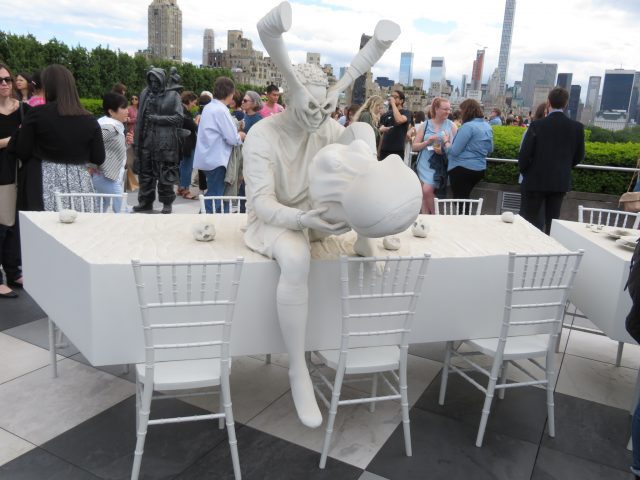
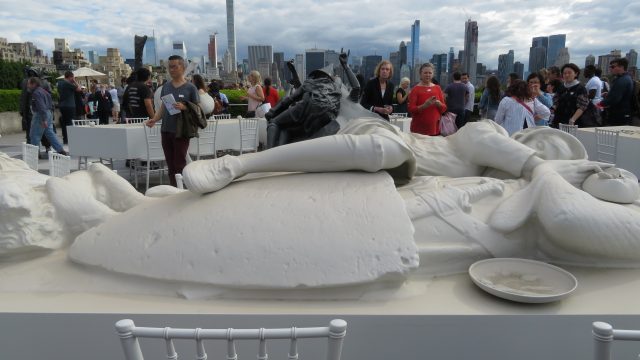
A man examines a hippo head in a unique way on the Met roof (photo by twi-ny/mdr)

Metropolitan Museum of Art, Met Fifth Avenue
The Iris and B. Gerald Cantor Roof Garden
1000 Fifth Ave. at 82nd St.
Daily through October 29 (weather permitting)
Recommended admission: $25 adults, children under twelve free
212-535-7710
www.metmuseum.org
theater of disappearance slide show

In 2014, Argentine artist Adrián Villar Rojas installed “The Evolution of God” on the High Line, cement and clay blocks that deteriorated over time, revealing such artifacts as clothing and sneakers while grass and plants grew in the cracks. The previous year, Villar Rojas’s “La inocencia de los animales” served as a decaying amphitheater where lectures and performances were held as part of MoMA PS1’s “Expo 1: New York.” He has now created the ultimate dinner party on the Met roof, “The Theater of Disappearance,” tables and chairs occupied by an amalgamation of characters based on sculptures in the Met collection.

(photo by twi-ny/mdr)

There’s much to see in Adrián Villar Rojas’s “The Theater of Disappearance” (photo by twi-ny/mdr)

Some of the men, women, children, and animals are haunting in a ghostly white, while others are in an ominous black. Villar Rojas handpicked each item he re-created, milled or using a 3D printer and made in urethane foam coated with matte industrial paint to protect it all from the weather. Villar Rojas has mixed the ancient with the modern, the classical with the contemporary, including elements from Tomb Effigy of Elizabeth Boott Duveneck, a boy resting with a horse on a fourteenth-century fragment of a queen’s face, a French knight from the Cloisters, a sixth-century Egyptian otter, fourth-century BCE Persian plates, a mid-twentieth-century Côte d’Ivoire bird, Edvard Munch’s “The Kiss” with the man and woman turned into horses, a boy general wearing business shoes, and a man sitting on a table, two disembodied arms forming binoculars over his eyes as he stares at the head of a New Kingdom hippo in his hands. There are also babies, cats, tiny lions, crabs, musical instruments, a hand holding a cigarette, coins, and abstract shapes. (Villar Rojas even designed the bar and the typography.) It’s as if Villar Rojas collected hundreds of works from the Met collection (he has referred to it as a scavenger hunt), tossed them like a salad, then put the pieces back together however he wanted, letting his imagination go wild.

(photo by twi-ny/mdr)

Figures nap on a table that is part of the 2017 Met Roof Garden Commission (photo by twi-ny/mdr)

There’s a decidedly playful feel to “The Theater of Disappearance” in addition to an endearing hope for the future; Villar Rojas has constructed a surreal fantasy world where art from cultures around the globe, including China, Japan, Europe, Africa, the Middle East, and America, have gathered for a Bacchanalian feast by way of Judy Chicago, their parts having been rearranged so that they cannot be easily identified by nationality, religion, or even gender, instead a melting pot devoid of time and place, built with the glee of a child playing with his or her toys. Oh, and look out for the hand in the symbol of devil horns; it’s a cast of Villar Rojas’s own, and it just happens to mean “I love you” in sign language.

GALLIM: STONE SKIPPING

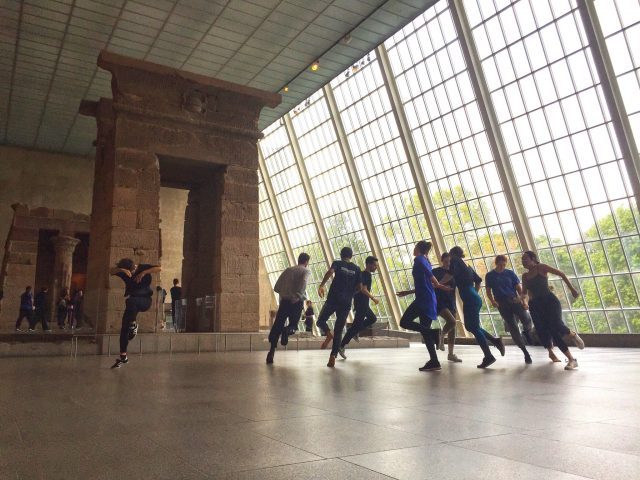
Gallim Dance will engage in a performance conversation with the Temple of Dendur at the Met this weekend (photo by Nikki Theroux)

Gallim Dance will engage in a performance conversation with the Temple of Dendur at the Met this weekend (photo by Nikki Theroux)

MetLiveArts
Metropolitan Museum of Art
Gallery 131, the Temple of Dendur in the Sackler Wing
1000 Fifth Ave. at 82nd St.
October 28-29, $65 (includes same-day museum admission), 2:00
212-570-3949
www.metmuseum.org
www.gallimdance.com

The Metropolitan Museum of Art’s first-ever artist-in-residence choreographer, Andrea Miller of Gallim Dance, will debut her site-specific project, Stone Skipping, on October 28 and 29 at 2:00 at the Met Fifth Avenue, at the Temple of Dendur in the Sackler Wing. The Salt Lake City-born, New York City-based choreographer, a 2014 Guggenheim Fellow who formed Gallim in 2007, created the piece as a conversation with the popular historical artifact, a Roman Period Egyptian temple completed in 10 BCE, during the reign of Augustus Caesar, who is depicted on one of the outer walls as a pharaoh. “I am curious to understand the capacity of the body, its anatomy, its power, and its instinct to connect with the space and events around us. In my work, I look for texture, a quality of energy, or a psychological pitch that surfaces in the doing of things,” Miller, whose previous pieces include W H A L E, Fold Here, Wonderland, and Blush, has said. That mission should resonate beautifully with the Temple of Dendur, a favorite of Met visitors. Stone Skipping features ten members of the Gallim company, joined by six guest dancers from Juilliard, with an original composition by Phil Kline (Unsilent Night, John the Revelator), performed live by the viola quartet Firewood, consisting of Ralph Farris, Stephanie Griffin, Jessica Meyer, and Lev Zhurbin; the costumes are by fashion designer Jose Solis. Stone Skipping will also touch upon the journey the Aeolian sandstone structure made from Egypt, which, in conjunction with the White House, awarded the institution the temple in 1967. “I am convinced that the Metropolitan’s plans for the temple will protect it and make it available to millions of Americans in a setting appropriate to its character,” President Lyndon B. Johnson wrote to museum director Thomas Hoving in April 1967. Exploring such universal themes as loss, preservation, and survival, Miller’s Stone Skipping should only add to the special nature of this extraordinary artifact. Tickets are $65 and include museum admission; for an addition dollar, you can bring a child between the ages of seven and sixteen to the performance, up to three kids per adult. Back in 2011, we saw Shen Wei give a gorgeous presentation in the Met’s Charles Engelhard Court, so we can’t wait to see what Gallim has in store for us.

JESUS HOPPED THE ‘A’ TRAIN

(photo © 2017 Joan Marcus)

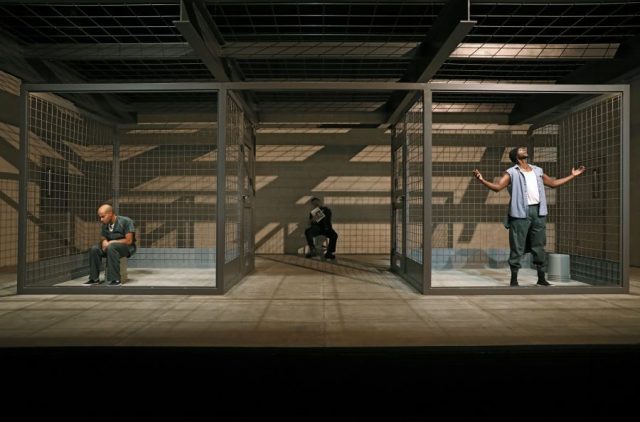
Prison guard Valdez (Ricardo Chavira, center) calmly reads as Angel Cruz (Sean Carvajal, left) and Lucius Jenkins (Edi Gathegi, right) consider their fate in Stephen Adly Guirgis’s Jesus Hopped the ‘A’ Train (photo © 2017 Joan Marcus)

The Pershing Square Signature Center
The Irene Diamond Stage
480 West 42nd St. between Tenth & Eleventh Aves.
Tuesday – Sunday through November 19, $30 through November 12, $45 after
212-244-7529
www.signaturetheatre.org

With the U.S. incarceration system under increasing scrutiny and as talk of closing down the infamous Rikers Island jail grows, the time is ripe for the first New York City revival of Stephen Adly Guirgis’s 2000 play, Jesus Hopped the ‘A’ Train, and a blistering version opened last night at the Irene Diamond Stage at the Signature Theatre. The play is not an activist exposé of the penal system as much as a searing journey into the battle for the soul of humanity, set in Rikers, pitting good vs. evil, light vs. dark, God vs. the Devil, and guard vs. inmate. Edi Gathegi is electrifying as Lucius Jenkins, a serial killer whom we see only during his one outdoor hour a day, caged in the prison yard, where the sun beats down on him as he madly exercises and spouts off like a man in heat, with an opinion about everything, from television to cookies to the surgeon general. But soon friendly, sympathetic guard Charlie D’Amico (Erick Betancourt) is replaced by the more vicious and condescending Valdez (Ricardo Chavira), and Lucius gets a new neighbor.

“People think everything is replaceable. Everything is not replaceable,” Valdez explains. “People believe they go through life accumulating things. That is incorrect. People go through life discarding things, tangible and intangible, replaceable and priceless. What people do not understand is that once they have discarded an irreplaceable item, it is lost forever.” Joining Lucius for the daily sixty minutes away from their twenty-three-hour lockdown is Angel Cruz (Sean Carvajal), a thirty-year-old man arrested for shooting the Reverend Kim in the butt; he believes the minister is a cult leader who kidnapped and brainwashed his best friend. Angel is not initially cool with his court-appointed public defender, Mary Jane Hanrahan (Stephanie DiMaggio), but she takes an interest in his case even after he admits to her that he did it, setting up a potential serious ethical violation. With Angel’s trial and Lucius’s extradition to execution-happy Florida looming, the characters discuss faith, the existence of God, the law, and time, which is running out on both of them.

(photo © 2017 Joan Marcus)

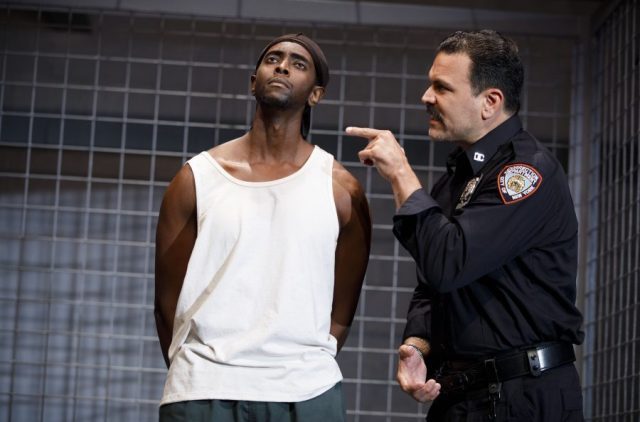
Lucius Jenkins (Edi Gathegi) gets an earful from prison guard Valdez (Ricardo Chavira) in Stephen Adly Guirgis revival at the Signature (photo © 2017 Joan Marcus)

Without getting pedantic or simplistic, Pulitzer Prize winner Guirgis (Between Riverside and Crazy, The Little Flower of East Orange) explores many basic dichotomies in Jesus Hopped the ‘A’ Train, from the names of the two men in prison, Angel (a celestial being) and Lucius (the son of the devil), to a brief discussion of two kinds of Oreos, chocolate fudge and vanilla fudge. (Also, while Lucius worships the sun, Angel shot a man based on the Reverend Sun Myung Moon where the sun don’t shine.) Obie winner Mark Brokaw (Heisenberg, The Lyons) directs with a strong but understanding hand, giving room for the actors to intersect with Guirgis’s sharp language. Riccardo Hernandez’s set, boldly lit by Scott Zielinski, features a pair of cells a few feet apart, surrounded by concrete blocks, the cages open at the front not only to give the audience a clearer view inside but to imply that anyone can end up there. In his off-Broadway debut, Gathegi (Two Trains Running, Superior Donuts), stepping in for the originally announced Reg E. Cathey, is a whirlwind of energy as Lucius, constantly on the move, exercising, climbing up the cage, lifting his arms defiantly, and throwing matches and cigarettes over to Angel; he doesn’t just speak his lines but he lives every word. Carvajal (Seven Spots on the Sun, Tell Hector I Miss Him), who took over for Victor Rasuk just before previews began, still needs to find his sea legs as Angel, who spends much of his time sitting in a chair or on a bucket or kneeling in prayer; his emotional shifts from scared to brazen jump around too much, as if he is playing two different characters, but when he hits the right stride, he nails it.

Chavira (A Streetcar Named Desire, Guirgis’s The Motherf**ker with the Hat) portrays Valdez with just the right amount of high-minded privilege because he’s not the one behind bars. When Lucius starts talking about the vibe of these daily workout sessions, Valdez responds, “Oh . . . well, let me, if I may, tell you now about my vibe, my feel. My ‘vibe’ is: Step away from that cage before I come in there and club you to death.” Chavira delivers the lines in a way that makes everyone in the audience lean back in their seat and take notice. DiMaggio (A Free Man of Color, Exile) and Betancourt (Julius Caesar, Guirgis’s The Last Days of Judas Iscariot) each gets to deliver a soliloquy at opposite sides off the stage, their characters the only ones not tied down to Rikers. Jesus Hopped the ‘A’ Train, which was originally directed by Philip Seymour Hoffman in 2000 with a cast consisting of Elizabeth Canavan, Salvatore Inzerillo, Ron Cephas Jones, John Ortiz, and David Zayas, is an exciting beginning to Guirgis’s Signature Residency, which continues next May with his 2002 play, Our Lady of 121st Street, directed by Anne Kauffman, followed in 2018-19 by a new work.