Amos Gitai’s West of the Jordan River makes its U.S. premiere as the closing selection of the New York Jewish Film Festival on January 23
WEST OF THE JORDAN RIVER (Amos Gitai, 2017)
Film Society of Lincoln Center, Walter Reade Theater
165 West 65th St. at Amsterdam Ave.
Tuesday, January 23, 12:30 & 6:00 pm
212-875-5601
www.filmlinc.org
Quad Cinema
34 West 13th St. between Fifth & Sixth Aves.
Opens Friday, January 26
212-255-2243
quadcinema.com
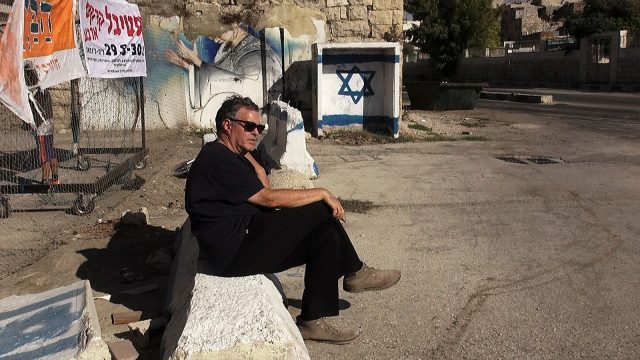
 The New York Jewish Film Festival, presented by the Film Society of Lincoln Center and the Jewish Museum, concludes January 23 with the U.S. premiere of Israeli filmmaker Amos Gitai’s West of the Jordan River, screening at 12:30 and 6:00 at the Walter Reade Theater. Both are followed by a Q&A with Gitai; the first will be moderated by New York Film Festival director emeritus Richard Peña. The eighty-seven-minute documentary revisits a familiar theme for Gitai, the continuing crisis between Jews and Palestinians, which he previously explored in such nonfiction works as 1982’s Field Diary, 2016’s Rabin, the Last Day, and last year’s Shalom Rabin. The camera follows Gitai from the Erez checkpoint at the Gaza Border in 1994 to Hebron in the West Bank in 2016, from a conference room where he interviews Prime Minister Yitzhak Rabin in 1994 to a backgammon tournament in Jerusalem in 2016. “I’m making a film which will have entries like a travel diary and it will chronicle the negotiations between Israelis and Palestinians,” he explains at the beginning. “I decided that my role in this visual diary should be like an archeologist. I want to scratch layer after layer to get to the substance of the matter to understand how we could possibly reach some reconciliation in the region.” Gitai, who likens himself to an architect (he has a PhD in architecture), speaks with groups of angry Palestinians in the street, demanding fair treatment; Israeli soldiers explaining how complicated it can be dealing with Arab children throwing rocks; the Parents Circle in Beit Jala in the West Bank, where Israeli and Palestinian women who have lost children in the conflict get together to promote peace; the NGO B’tselem, an Israeli organization that teaches women to document human rights violations in the occupied territories safely using their cell phones; Khan Al-Ahmar, who runs a Bedouin school in the West Bank that is threatened with demolition; and terrorist victim Michal Froman and her sister, Lia Raz Twito Froman, who live in the Israeli settlement of Teqoa and offer a surprising reaction to Michal’s stabbing by a fifteen-year-old Arab boy when she was pregnant.
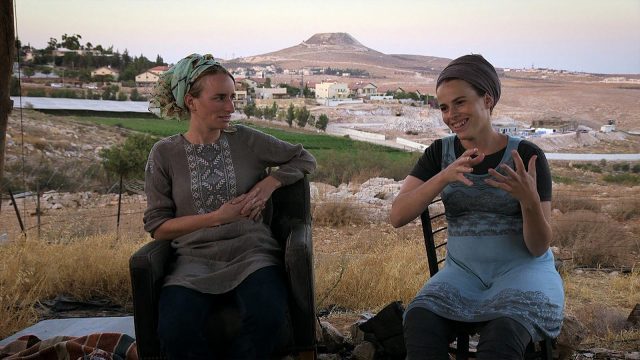
Israeli filmmaker Amos Gitai meets with groups of Jews and Palestinians to get to the bottom of the Arab-Israeli conflict in West of the Jordan River
Gitai also interviews Deputy Minister of Foreign Affairs Tzipi Hotovely, Knesset member and former minister of foreign affairs Tzipi Livni, Knesset member Tamar Zandberg, Haaretz journalists Ari Shavit and Gideon Levy, Yediot Aharonot journalist Ben-Dror Yemini, and Haaretz editor in chief Aluf Benn, who offer their intriguingly different views of the Israel-Palestine dilemma, discussing humanization and dehumanization on both sides. But Gitai, who has made such well-regarded sociopolitical fictional trilogies as Devarim, Yom Yom, and Kadosh and Kippur, Eden, and Kedma in addition to the play Yitzhak Rabin: Chronicle of an Assassination, does not take the passive role of documentary filmmaker; instead, he often puts himself front and center, sharing his own opinions and challenging those of some of his subjects. (The project was a commission by France Télévisions, which wanted Gitai’s personal point of view.) “Nothing is more solid than the coalition of those who oppose peace,” he tells a group of Arabs mourning the killing of a fifteen-year-old boy. Gitai is shown traveling in cars and on planes, setting up for interviews, and walking through various areas to talk to regular citizens, revealing significant parts of his creative process. “I want to look at the little moments in life and the general political discussions,” he says. He sees the Middle East conflict as a TV series in which “the roles of heroes and villains can be interchangeable,” and that’s how West of the Jordan River, which opens theatrically at the Quad on January 26, unfolds. Perhaps one of the most important lines in the film is one of the first. As Gitai sits down with Prime Minister Rabin in 1994, the thirty-five-year-old director says, “I understand we don’t have much time.” The next year, Rabin was assassinated, and the Israeli-Palestinian conflict continues, with no end in sight.