twi-ny recommended events

NOH-NOW: HANJO

SITI Company presents a new adaptation of Yukio Mishimas Hanjo at Japan Society

SITI Company presents a new adaptation of Yukio Mishima’s Hanjo at Japan Society

Japan Society
333 East 47th St. at First Ave.
December 7-9, $35, 7:30
212-715-1258
www.japansociety.org
siti.org

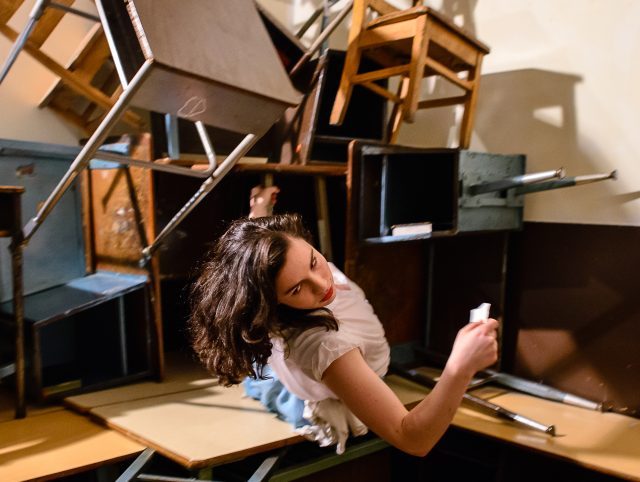
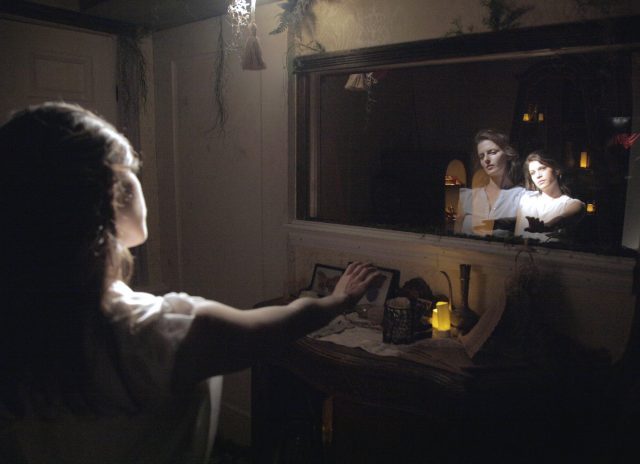
Japan Society’s four-part “NOH-NOW” series, which began with Luca Veggetti’s Left-Right-Left and Hiroshi Sugimoto’s Rikyu-Enoura, continues with SITI Company’s adaptation of Yukio Mishima’s Hanjo, running December 7-9. (SITI presented a staged reading of Hanjo at Japan Society in May 2007.) Freely adapted by Japanese author, poet, and filmmaker Mishima (The Sailor Who Fell from Grace with the Sea, Madame de Sade) from Seami Motokiyo’s fourteenth-century noh play about love and betrayal, the work features three characters, the mad girl Hanako, the spinster Jitsuko, and a young man, Yoshio, performed in rotation through three iterations by Akiko Aizawa (who just appeared in Ripe Time’s adaptation of Haruki Murakami’s Sleep at BAM), Gian-Murray Gianino, and Stephen Duff Webber. Leon Ingulsrud directs the bilingual production from his translation, with live music composed and played by violist Christian Frederickson, sets and lighting by Brian H Scott, costumes by Mariko Ohigashi, and choreography by Wendell Beavers. Founded by Anne Bogart and Tadashi Suzuki in 1992, the company has previously staged such inventive works as Chess Match No. 5, bobrauschenbergamerica, Steel Hammer, and Bob and, in its early years, were regulars at the Toga Festival in Japan. The December 7 show at Japan Society will be followed by a reception with members of the company, while the December 8 performance will be followed by a Q&A with the artists. “NOH-NOW” concludes January 11-14 with Satoshi Miyagi’s Mugen Noh Othello as part of the Public Theater’s Under the Radar Festival.

THE NON-ACTOR: PUTTY HILL

Matt Porterfield directs the cast in a scene from PUTTY HILL

Matt Porterfield directs a cast of mostly nonprofessional actors in a scene from Putty Hill

PUTTY HILL (Matt Porterfield, 2010)
Film Society of Lincoln Center
Francesca Beale Theater
144 West 65th St. at Amsterdam Ave.
Thursday, December 7, 6:30
Series runs November 24 – December 10
212-875-5601
www.filmlinc.org

The city of Baltimore has not exactly been depicted kindly in film and on television, with such series as Homicide: Life on the Street, The Wire, and The Corner: A Year in the Life of an Inner-City Neighborhood focusing on the rash of drugs and violence that have devastated the community, while native son John Waters has shown its wackier side in such films as Polyester and Hairspray. Born and raised in a suburb just inside the Baltimore city line, writer-director Matt Porterfield (Hamilton, I Used to Be Darker) has taken a different view in his second feature film, Putty Hill. When financing for his coming-of-age drama Metal Gods fell through, he decided to keep the cast and crew together and instead shoot a cinéma verité story about the after-effects of a young man’s drug overdose on a tight-knit community inspired by the one he grew up in. Not much is revealed about Cory as his funeral nears and life goes on, with his younger brother, Cody (Cody Ray), playing paintball with Cory’s friends; his uncle, Spike (Charles Sauers), tattooing customers in his apartment; and Spike’s daughter, Jenny (Sky Ferreira), returning to her hometown for the first time in several years and hanging out with her old friends like nothing much has changed. Working off a five-page treatment with only one line of scripted dialogue, Porterfield and cinematographer Jeremy Saulnier capture people just going on living, taking Cory’s death in stride; Porterfield interviews much of the cast, who share their thoughts and feelings in relatively unemotional ways. Shot on a minuscule budget in only twelve days, Putty Hill uses natural sound and light, nonprofessional actors, and real locations, enhancing its documentary-like feel, maintaining its understated narrative and avoiding any bombastic or sudden, big revelations. It’s a softly moving film, a tender tale about daily life in a contemporary American working-class neighborhood. Putty Hill is screening December 7 at 6:30 in the Film Society of Lincoln Center series “The Non-Actor”; it will be introduced by Porterfield and preceded by Laida Lertxundi’s Cry When It Happens. The series continues through December 10 with such other films as Shirley Clarke’s The Cool World, Susumu Hani’s Furyo shonen, Spencer Williams’s The Blood of Jesus, and Peter Watkins’s Punishment Park.

DoublePlus: DR. MIQUE’L DANGELI & MIKE DANGELI + MARIA HUPFIELD

Photos: Dr. Mique’l Dangeli & Mike Dangeli by Thosh Collins

Dr. Mique’l Dangeli & Mike Dangeli will present new work curated by Emily Johnson for Gibney Dance DoublePlus series (photo by Thosh Collins)

Gibney Dance Performing Arts Center, Studio H
280 Broadway between Chambers & Reade Sts.
December 7-9, $15, 8:00
Series continues through December 16
gibneydance.org

Gibney Dance’s annual DoublePlus program, in which established artists mentor pairs of emerging choreographers, continues this week with one of New York City’s most original and innovative creators, Emily Johnson, curating pieces by Dr. Mique’l Dangeli & Mike Dangeli and Maria Hupfield. “I am thrilled to present three artists working a futurity embedded within relationships of language, land, and present action,” Johnson (Niicugni, Shore, The Thank-You Bar) explains in a statement. “Maria Hupfield is Anishinaabe and a member of Wasauksing First Nation, Ontario. Hupfield works with performance and sculpture. Her hand-sewn creations function as tools carried on the body—tracking rhythms, identifying areas (within body, within culture, within life) that warrant open communication, protection, or both. She works the reflection of sight, sound, and object to generate the unexpected — to shift meaning. Dr. Mique’l Dangeli is of the Tsimshian Nation of Metlakatla, Alaska. Mike Dangeli is of the Nisga’a, Tlingit, Tsetsaut, and Tsimshian Nations. Since 1999, Mique’l Dangeli and Mike Dangeli have led Git Hayetsk, an internationally renowned dance group specializing in ancient and newly created songs and mask dances. Through their work they have focused on Northwest Coast First Nations and Alaska Native visual and performing arts, protocol, politics, sovereignty, language revitalization, and decolonization.” Dr. Mique’l Dangeli & Mike Dangeli will present Where do you speak from? Locating languages in the body, land, and waterways, while Hupfield will present Electric Prop and Hum Freestyle Variations. This past summer, Johnson, who always pushes the limits of performance and interactivity, curated Then a Cunning Voice and a Night We Spent Gazing at Stars, a unique, wide-ranging, participatory overnight program on Randall’s Island, so it should be fascinating to see what she has come up with for this DoublePlus show. DoublePlus concludes December 14-16 with Dean Moss curating works by Wesley Chavis + Cori Olinghouse.

A ROOM IN INDIA

A Room in India

Ariane Mnouchkine and Théâtre du Soleil return to Park Ave. Armory with the epic A Room in India

UNE CHAMBRE EN INDE
Park Ave. Armory, Wade Thompson Drill Hall
643 Park Ave. at 67th St.
December 5-20, $45-$150
212-933-5812
www.armoryonpark.org
www.theatre-du-soleil.fr

In 2009, Ariane Mnouchkine and Théâtre du Soleil staged the epic Les Éphémères at Park Ave. Armory as part of the Lincoln Center Festival, asking the question “What would you do if the end of the world were imminent?” Mnouchkine and her avant-garde collective now return to the armory with the North American premiere of their latest epic, A Room in India, exploring the question “What is the role of theater and art in a world dominated by terrorism and hostility?” Directed by Mnouchkine with music by Jean-Jacques Lemêtre and Hélène Cixous and featuring a cast of thirty-five actors from around the world, the spectacle, performed in French, English, Tamil, Arabic, Japanese, and Russian (with English supertitles), explores Eastern and Western traditions as a French theater company is stranded in India and chaos descends in the form of contemporary sociopolitical issues. The production is three hours and fifty-five minutes with one intermission; to get in the mood, the armory is offering a preshow Indian meal ($30; must be ordered at least two days in advance), by chef Gaurav Anand of Moti Mahal Delux, that includes Paneer Tikka Masala, Dal Tadka, and Aloo Dum, rice, bread, naan, Indian pastries, and beer, wine, and water. On December 8 at 6:00, Mnouchkine will participate in an artist talk with Tony Kushner and New Yorker editor David Remnick. In a letter about the show, Théâtre du Soleil stirs up curiosity with a playful conversation:

“So, you’re going to put on another play about India?”

“It won’t be about India but rather will take place in India. In a room in India. That’s even the title of the play.”

“Come again? What do you mean? What happens in an India that’s not India?”

“Visions, dreams, nightmares, apparitions, moments of panic, doubts, revelations. Anything and everything that might haunt the actors and technicians of a poor theater troupe desperately in search of resolutely contemporary, political theater, a troupe stranded there by deeply moving events beyond its control, just as they are beyond our control and move us, leaving us looking for a way to face them, a way to suffer through them without resigning ourselves to adding evil to Evil through our words and our deeds.”

“And so what?”

“For now, that’s it, which is already quite a lot.”

TWI-NY TALK: POLLY DRAPER / 20th CENTURY BLUES

(photo © Joan Marcus)

Sil (Ellen Parker), Mac (Franchelle Stewart Dorn), Danny (Polly Draper), and Gabby (Kathryn Grody) celebrate forty years of friendship in 20th Century Blues (photo © Joan Marcus)

The Pershing Square Signature Center
The Alice Griffin Jewel Box Theatre
480 West 42nd St. between Tenth & Eleventh Aves.
Tuesday – Sunday through January 28, $79-$99
212-244-7529
20thcenturyblues.com
www.signaturetheatre.org

I spent much of the summer of 2014 serving on a jury for a murder trial, a case involving a drug-related shooting in Harlem. One of my fellow jurors was writer, director, and Emmy-nominated actress Polly Draper. Best known for her portrayal of Ellyn Warren on the groundbreaking drama thirtysomething, the Yale grad (both BAA and MFA) has also starred on and off Broadway (Closer, Brooklyn Boy); wrote and starred in The Tic Code, inspired by her husband, jazz musician Michael Wolff, who has Tourette’s syndrome; and wrote and directed The Naked Brothers Band television series and movie, starring their sons, Nat Wolff (The Fault in Our Stars, Buried Child) and Alex Wolff (In Treatment, All the Fine Boys). Draper, who has also won a Writers Guild Award, has been experiencing a career renaissance of late, portraying recurring characters on The Big C with Laura Linney, The Good Wife with Julianna Margulies, and Rhinebrook, as well as playing a key supporting role in the Kickstarter-funded indie hit Obvious Child.

She is now appearing off Broadway through January 28 at the Signature in 20th Century Blues, a bittersweet drama written by Susan Miller (My Left Breast, A Map of Doubt and Rescue) and directed by Emily Mann (Baby Doll, The How and the Why) about four sixtysomething women who have been getting together once a year ever since they met when they were all arrested at a political protest forty years earlier. Draper plays Danny, a divorced photographer and mother who has taken their picture every year. When Danny tells journalist Mac (Franchelle Stewart Dorn), veterinarian Gabby (Kathryn Grody), and real estate agent Sil (Ellen Parker) that she is having a solo show at MoMA and wants to include the forty years of photos, displaying them publicly for the first time, questions arise as the women look back at their past and consider their future. Danny is also contemplating taking care of her aging mother, Bess (Beth Dixon), in her apartment, which her friends do not think is the best idea. “She’s my mother,” Danny explains. “And, I don’t know how long I’ll get to be a daughter.” (That line rang extra true for me, as a half hour after I saw the play last week, my mother passed away in my sister’s Upper East Side apartment.)

A relaxed, easygoing woman with a broad sense of humor and a natural talent for leadership, Draper, like Danny, is passionate about everything she does. “When it comes to my art, I have very strong feelings,” she said when we met to talk shortly after the bizarre trial ended with a hung jury. And also like Danny, she is passionate about justice and freedom, as evidenced by her reactions to the trial in addition to her activism for numerous liberal causes. What follows are edited excerpts from our 2014 interview and a brand-new email exchange about 20th Century Blues, the legal system, working with family, and more.

(photo © Joan Marcus)

Danny (Polly Draper) cares for her aging mother (Beth Dixon) in new play by Susan Miller (photo © Joan Marcus)

twi-ny: I can’t believe it’s been three and a half years since we sat on that long, bizarre murder trial. What are your thoughts looking back at that summer in court? At the time you called it a musical comedy.

Polly Draper: I think about that experience so much!!! And did you hear that those guys got convicted finally? I guess the second jury didn’t have our crazy guy on it. But I doubt they had as much fun as we did! What a mind-blowing experience!!!

twi-ny: I know! What was your single favorite moment of the trial?

Polly Draper: Meeting you guys. Meeting all the fun people and going out to the Chinese restaurants. I had a lot of fun. The only thing that wasn’t fun was the deliberations because of the crazy person. But even the deliberations had their fun things, like every time he’d fall asleep or when he wasn’t there. All the characters . . . It was fascinating for me in every way.

twi-ny: If you knew then what you know now, would you put yourself through it again?

Polly Draper: Definitely! Absolutely! I know some of the people wouldn’t say that at all, but I would so do it. It’s one of the most fascinating things that happened in a long time to me.

twi-ny: You’re currently starring in Susan Miller’s 20th Century Blues at the Signature. What initially drew you to the play itself and your part specifically?

PD: First of all, I was drawn to the play because it dealt with friendships between women and also with issues common to women my age. Plays written on this subject matter are few and far between.

Secondly, I really related to the character I was playing and her struggle to realize her artistic vision, which in her case involved putting together a photography exhibit at MoMA. Having struggled with many of my own artistic endeavors, I could identify with the obstacles she faced.

I also intimately understand this character’s relationship with her mother, who is in the throes of dementia, because my own mother is suffering from Parkinson’s disease–related dementia.

twi-ny: I’m sorry to hear that. The play follows four women who have documented their friendship through forty years of photos. What’s your longest current friendship?

PD: I’ve known my oldest friend, Wende Lufkin, since we were eight years old and share all my childhood and teenage memories with her. We live on opposite sides of the country and rarely see each other but are inextricably bonded by our shared past.

The two old friends I see constantly and have been entwined in my life for the past forty years are writer Jenny Allen, who I met in college, and actress Brooke Adams, who I met doing a play when I first came to NYC. (The two of them were at opening night for this play, in fact, rendering it even more meaningful to me.)

twi-ny: Speaking of long friendships, it’s now been forty years since thirtysomething debuted. In June 2007, you reunited with the cast for a “Look Who’s Fifty” story, and this past September EW did a “Where Are They Now?” feature. It really was quite a group of creative people; all these years later, everyone is still very busy, with many of the actors becoming directors, including yourself. Why do you think that might be?

PD: When we were on thirtysomething, all the actors were encouraged to direct. Regrettably, I wasn’t interested in doing so at the time, but I think the fact that so many of my cast members did it demystified the process for me. We were also encouraged to volunteer ideas for scripts, which got me interested in the whole process of script writing. Some of my castmates, like Melanie Mayron and Peter Horton, had already been directors and writers before they got on the show.

Everyone in the cast was smart and ambitious. So . . . I’m guessing that accounts for all the many directing / writing / acting projects among us.

(photo by Carol Rosegg)

Emmy nominee and Writers Guild Award winner Polly Draper has a passion for art, social justice, and family (photo by Carol Rosegg)

twi-ny: You’ve directed your family in The Naked Brothers Band series and movie, wrote and starred in The Tic Code, which was inspired by your husband’s Tourette’s syndrome, directed one of your sons in a play written by your other son, and next up is Stella’s Last Weekend, which you wrote, directed, and star in with your sons. Why do you think working with your family has gone so well? Do things ever get especially difficult either on the set or back at home?

PD: My family is the most important thing to me, so it is not surprising that all of the work I have created involves them. And it doesn’t hurt that they happen to be extraordinarily gifted actors and musicians.

I was actually surprised by the lack of stress we had on the set of Stella’s Last Weekend. The last time I worked professionally with Nat and Alex was on The Naked Brothers Band when they were wild and crazy little boys, so it was a treat for me to work with them as wild and crazy adults.

Because we worked together before and because we all know each other so well, we not only trusted each other, we have a shorthand communicating with each other. This resulted in all of it feeling surprisingly effortless from beginning to end. Nat and Alex both had great ideas for their characters and great improvisations they did in the scenes. They also kept everyone on the set in constant hysterical laughter with their brother antics.

I think the movie reflects the joy we all had making it. I am really proud of it and I can’t wait until it comes out so people can see it. The screenings we have had of it so far have been phenomenally successful.

And Michael, who also did the score for The Tic Code and The Naked Brothers Band, did a killer score for this one too.

twi-ny: Would you say that the camaraderie that you helped foster in the jurors room during the trial compares to that on a film set?

PD: That’s what my husband said. He said, “This is just typical of you. You always wind up hanging out with the people you’re doing a project with, and this is your new project.”

twi-ny: You move smoothly between film, television, and theater, from Obvious Child, The Good Wife, and Golden Boy to Closer, Rhinebrook, and now 20th Century Blues. Do you have a particular preference as an actor for one medium over another?

PD: I think I just like doing work I’m proud of. I like working on interesting projects no matter what medium they’re in.

There are advantages to the control you have and the instant audience feedback of acting onstage, but there is something magical about the intimacy of acting on film as well.

I love to write scripts because I can play every role in my head.

I love to direct because it is thrilling to create the real-life version of what used to be just my fantasy.

It is also beyond exciting to watch what each actor brings to my words.

I also love the process of editing because it is so much fun to give shape to the movie and fix mistakes and choose music and find meanings in all of it that I never saw before.

So basically, I love every part of the process of acting, writing, and directing except the actual business part. That part I hate and fear. Unfortunately, it is one of the most important parts!

twi-ny: Getting back to the play, what gave you the blues in the twentieth century? And what about now, in the twenty-first century?

PD: Oy vey. I guess the simple answer would be to say that the blues I had in the twentieth century were more personal and involved growing up, and the blues I have in the twenty-first century are more global and involve fear for all of mankind.

When you and I served on that jury almost four years ago and Obama was still president, I don’t think either of us could have guessed the seismic shifts that have happened this year. The list of things that give me the blues now have to do mostly with our president and the flame he fans of lies and hatred and backward thinking, but he seems to be just a by-product of a frightening trend worldwide.

My blues in this century are every thinking person’s blues: They concern the environment, the spread of misinformation, North Korea, Putin, guns, nuclear holocausts, sexual predators, prescription drugs, women’s rights, civil rights, immigrants’ rights, terrorists, the Koch brothers and where they put their dark money, Steve Bannon and his scary white supremacy fans, cyberwarfare, Republican congressmen, our judicial system, and any old men with weird orange hair.

WHO’S AFRAID OF THE NEW NOW? 40 ARTISTS IN DIALOGUE

Allen Ruppersberg, Who’s Afraid of the New Now?, from the series Preview Suite, 1988. Lithograph, image: 21 3/8 × 13 1/4 in (54.1 × 33.5 cm), sheet: 22 × 13 7/8 in (56 × 35.1 cm). Edition of thirty. Courtesy the artist and Greene Naftali, New York

Allen Ruppersberg, “Who’s Afraid of the New Now?” from the series Preview Suite, lithograph, 1988 (courtesy the artist and Greene Naftali, New York)

New Museum of Contemporary Art
235 Bowery at Prince St.
Saturday, December 2, and Sunday, December 3, $5 per conversation, 10:00 am – 8:00 pm
212-219-1222
www.newmuseum.org

The New Museum continues its fortieth anniversary celebration with “Who’s Afraid of the New Now? 40 Artists in Dialogue,” two days of free admission to the downtown institution and a fab series of five-dollar artist conversations that require advance purchase here. On Saturday beginning at ten o’clock, every hour on the hour (except for the two o’clock lunch break), you can catch Judith Bernstein and Linda Montano, Paweł Althamer and Cally Spooner, Ragnar Kjartansson and Carolee Schneemann, Hans Haacke and Carsten Höller, Donald Moffett and Nari Ward, George Condo and Jeff Koons, Paul Chan and Carroll Dunham, Thomas Bayrle and Kerstin Brätsch, Raymond Pettibon and Kaari Upson, and Simone Leigh and Lorraine O’Grady. Sunday’s lineup features Cheryl Donegan and Mary Heilmann, Jeremy Deller and Martha Rosler, Paul McCarthy and Andra Ursuta, Elizabeth Peyton and Allen Ruppersberg, Nicole Eisenman and Neil Jenney, Howardena Pindell and Dorothea Rockburne, Bouchra Khalili and Doris Salcedo, Camille Henrot and Anri Sala, Sharon Hayes and Faith Ringgold, and Carol Bove and Joan Jonas. It’s a crazy-good roster of artists who have shown at the museum, which was founded in 1976 by Marcia Tucker and opened at C Space in 1977 before moving to the New School and then 583 Broadway before its grand reopening at 235 Bowery on December 1, 2007. Currently on view are “Trigger: Gender as a Tool and a Weapon,” “Kahlil Joseph: Shadow Play,” “Petrit Halilaj: RU,” “Helen Johnson: Ends,” “Alex Da Corte: Harvest Moon,” and “Pursuing the Unpredictable: The New Museum 1977–2017” in addition to a special window reinstallation of Bruce Nauman’s 1987 video No, No, New Museum from his Clown Torture series.

VOYEUR

Voyeur

Gerald Foos and Gay Talese discuss voyeurism and journalistic ethics in eye-opening documentary

VOYEUR (Myles Kane & Josh Koury, 2017)
IFC Center
323 Sixth Ave. at West Third St.
Opens Friday, December 1
212-924-7771
www.ifccenter.com
www.netflix.com

“I’m a natural person to write about a voyeur because I’m a voyeur myself,” award-winning, bestselling journalist Gay Talese says in Myles Kane and Josh Koury’s Voyeur. The documentary makes a voyeur of the viewer as well as it follows the thirty-five-year journalistic relationship and offbeat friendship between Talese, longtime New York Times and Esquire writer and author of such books as Honor Thy Father and Thy Neighbor’s Wife, and Gerald Foos, the owner of a Colorado motel who claims he spent decades spying on people from a special crawl space he built above the rooms. In January 1980, Foos, owner of the Manor House Motel, wrote a letter to Talese, offering him a story about what he was doing; Foos considered himself a researcher, not a pervert or a peeping Tom. Using archival footage, news reports, and new interviews, Kane and Koury follow Foos, his second wife, Anita, and Talese as the journalist prepares to write a major piece for the New Yorker in advance of the release of his latest book, The Voyeur’s Motel. New Yorker articles editor Susan Morrison considers Foos a disturbed sociopath in need of attention, while Grove/Atlantic senior editor Jamison Stoltz and publisher Morgan Entrekin have their doubts about the veracity of Foos’s eerily specific tale. So as questions arise about key facts and Talese’s professional ethics, Foos wonders if he should have remained silent — “I’m used to private spaces, places that nobody could see me and I could see them,” he explains — and an angry Talese faces a potentially tarnished legacy.

Voyeur

Gerald Foos turned the Manor House Motel in Colorado into a research facility where he spied on couples having sex

Kane and Koury, who previously collaborated on such documentaries as Journey to Planet X, We Are Wizards, and We Will Live Again, often use a model of the Manor House to depict certain events while also re-creating scenes of Foos watching couples having sex — including one time when Talese joins him in the snooping and experiences a wardrobe malfunction. (Kane and Koury also let the camera lovingly follow Talese as he impeccably dresses himself, every detail crucial to his overall appearance, much like a journalist getting every single fact right.) Over the years, Talese and the Fooses developed a unique kind of bond that is unusual for a writer and his subject, but the erudite Talese, now eighty-five, defends his actions. “My life has pretty much been living through other people’s experiences and to be a very accurate chronicle, an observer, watching other people, listening,” he says. “I take my time, and I am genuinely interested in the people I am writing about because there’s something about them that I feel I can identify with.” It is fascinating to watch the reactions of Foos and Talese as the article comes out, the book is published, and all hell breaks loose. Voyeur raises significant issues about truth in journalism, the writer’s ethical responsibilities, and the lure of salaciousness. Early on, Talese, in his writing bunker filled with decades and decades of carefully organized files — in a way similar to the collections of baseball cards and other objects Foos keeps in his basement — says, “The story never ends. Stories never die. A lot of reporters think when they leave a story, it’s all over. Sometimes it’s just beginning.” Kane and Koury stick with the story and end up with quite a tale, something that is not about to die anytime soon. On December 1, Voyeur starts streaming on Netflix and opens at IFC Center, where Kane and Koury will participate in a Q&A following the 6:05 screening on Friday night.