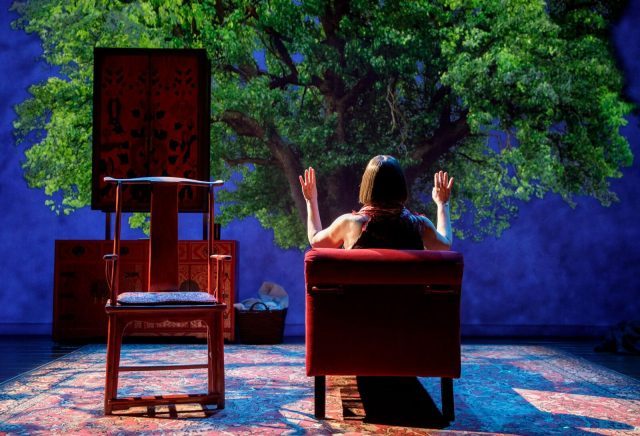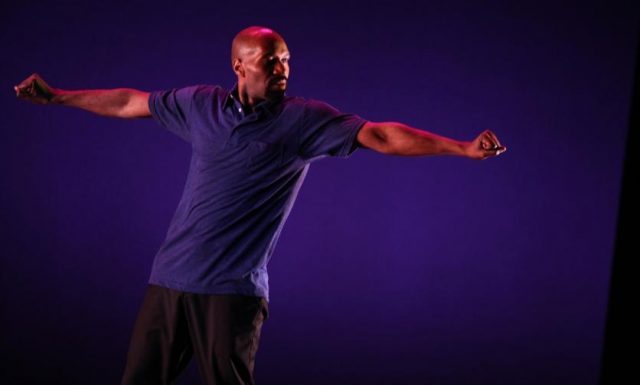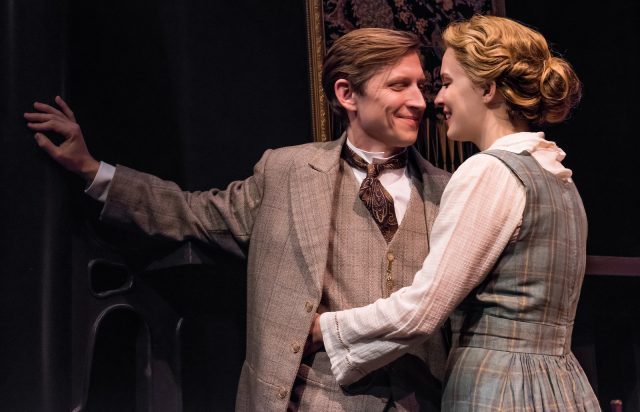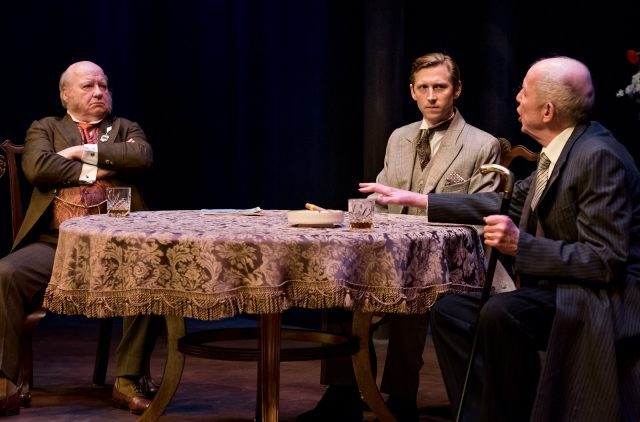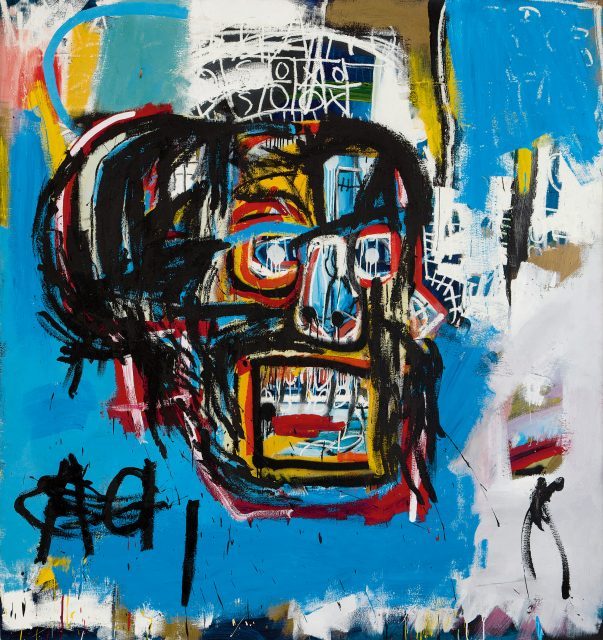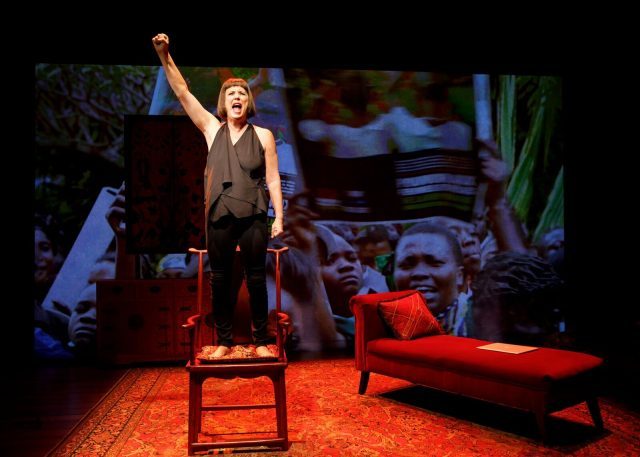
Tony winner Billy Crudup stars as a man in search of his genuine identity in Harry Clarke (photo by Carol Rosegg)
Vineyard Theatre
Gertrude and Irving Dimson Theatre
108 East 15th St. between Union Square East & Irving Pl.
Extended through December 23, $120 www.vineyardtheatre.org
Tony winner Billy Crudup charms the audience much as the character he plays charms the Schmidt family in David Cale’s riveting one-man show, Harry Clarke. In his first solo performance, Crudup is captivating as Philip Brugglestein, a wayward midwesterner who invented an alter ego, the British-speaking Harry Clarke, as a psychological defense against bullying schoolmates and his mentally and physically abusive father. As an adult, Philip has moved to New York City, where he is floundering. One day, in the mood for an adventure, he follows a random guy in the street; later, he befriends the man, a wealthy financier named Mark Schmidt, but Philip introduces himself as his childhood creation, pretending to be the fun-loving Harry Clarke, a smooth operator from Elstree. (He even claims that he worked for Sade for twenty years.) Harry insinuates himself into Mark’s life, as well as that of Mark’s sister, Stephanie, and mother, Ruth, in a way reminiscent of Tom Ripley in Patricia Highsmith’s books except Harry is no mere con man out for money; he’s seeking connections, searching for his identity, as are most of the characters in the play. “I could be myself if I had an English accent,” he recalls saying as child, later telling his parents, “But it’s my real voice.” Soon Harry finds himself caught up in a situation that he didn’t quite expect.
Billy Crudup voices multiple characters in world premiere of David Cale one-man show at the Vineyard (photo by Carol Rosegg)
An actor, composer, and playwright who was born in London and moved to New York when he was twenty, Cale originally wrote Harry Clarke for himself — he has previously written and starred in such solo works as Lillian, Deep in a Dream of You, and The Redthroats and has appeared on The Good Wife and in The Total Bent at the Public — but he eventually opted for Crudup, who has been nominated for four Tonys, winning one (for The Coast of Utopa), and has had major roles in such films as Almost Famous and Jesus’ Son. In his third play at the Vineyard, following Chiori Miyagawa’s America Dreaming and Adam Rapp’s The Metal Children, Crudup commands the virtually bare stage with a tender fury; Alexander Dodge’s set features a lone chair on a deck, a small table where Crudup keeps a glass of water, and a scrim in back for abstract projections that hint at a blue sea and sky, with occasional changes. Two-time Obie winner and Tony nominee Leigh Silverman (Violet, In the Wake), who directed Marin Ireland in the searing one-woman show On the Exhale earlier this year, knows just when to get Crudup on the move. Crudup (Waiting for Godot,No Man’s Land) sits casually before at last getting up and really hitting his stride, doing different voices for every character; the writing is so sharp, and the performance so astute, with a cinematic fervor, that you can easily visualize the places Harry goes, from Sixth Ave. to a gay bar to relaxing on board the Schmidts’ boat, Jewish American Princess. Harry is a big movie fan, preferring noirs and thrillers and listening to records by French film composer Georges Delerue, and Cale’s play becomes like a noir thriller itself; it’s no coincidence that Mark wants to become a movie producer. When Harry and Mark meet for the second time, in a theater, Harry says, “This play’s like a mystery, in that sense, seems more like a movie.” Meanwhile, Philip, of course, is a completely unreliable narrator; all of the events are related through his warped, damaged, unpredictable view, as if he’s created his own movie, but that’s part of what makes the show so tantalizing.
It’s not Christmas in New York until Darlene Love comes to town
Hanukkah is under way and Christmas is right around the corner, so the city is filled with holiday-themed comedy shows and concerts. They range from classical performances at the Met and Carnegie Hall to hip-hop, soul, and rock extravaganzas at smaller clubs to Jewish takes on the season. Below is a sampling of some of the cooler events; keep watching this space for more additions.
The Fire & Ice Hanukkah Celebration!, with fire dancers, fire breathers, poi juggling, live musical performances, Israeli music with DJ Adidor, glow in the dark madness, Hanukkah video art installations, Hanukkah drink specials, chocolate dessert bar, sufganiyot, and more, Highline Ballroom, 431 West 16th St., 212-414-5994, $40, 8:00
Thursday, December 14
through
Saturday, December 16 The 38th Annual Winter Solstice Celebration, with the Paul Winter Consort and Forces of Nature Dance Theatre, Cathedral of St. John the Divine, 1047 Amsterdam Ave., $40-$150
Sunday, December 17 Natasha’s Christmas Spirit Brunch Show, with Matt Koplik, Danny Caraballo, Brian Klimowski, Hallie Brevetti, Sophie Bell, Abby Goldfarb, and Alexandria Grace Williams, hosted by Natasha Edwards, benefiting the HAVE Foundation (Honduras Agalta Valley Education), Stand Up NY, 236 West 78th St., $20, 2:00
Unsilent Night, participatory boombox concert with Phil Kline, Washington Square Park, free, 6:00
New York Baroque Incorporated: Baroque Holiday Music and Dance, led by Robert Mealy, with dancers Caroline Copeland and Carlos Fittante, featuring suites by Rameau, Lully, Purcell, and Handel, the Met Fifth Avenue, 1000 Fifth Ave., $65 (includes same-day museum admission), 7:00
Ronnie Spector will celebrate the annual best Christmas ever at City Winery
Wednesday, December 20
and
Thursday, December 21 Ronnie Spector’s Best Christmas Party Ever! with Ronnie Spector and the Ronettes, City Winery, 155 Varick St., 212-608-0555, $35-$75, 8:00
Sunday, December 24 A Very Jewish Christmas, with Brad Trackman, Ophira Eisenberg, Jared Freid, Jon Fisch and others, Gotham Comedy Club, 208 West 23rd St., 212-367-9000, $25, 7:00 & 9:00
The Jew(ish) Show, with Jared Freid, Marion Grodin, Myq Kaplan, and Talia Reese, Stand Up NY, 236 West 78th St., $20, 8:00
Monday, December 25 Oy Vey Festival w/ Soulfarm, featuring Kosha Dillz, Zalman Krause, Meir Kay, and Chillent, Highline Ballroom, 431 West 16th St., 212-414-5994, $20-$49.99, 8:00
Theater doesn’t get much more immersive — or personally involving — than Mark and Marichka Marczyk’s Counting Sheep, a nonstop, exhilarating, highly emotional experience that puts you right in the middle of a re-creation of the stalwart Revolution of Dignity that took place in February 2014 in Kiev, as Ukrainians rose up against President Viktor Yanukovych’s corrupt, Russia-friendly, anti-EU policies. The international Occupy movement meets Les Miz in the multimedia production, continuing at 3LD through December 17. Ingeniously conceived by the Marcyzks, who met during the protests and fell in love, the seventy-five-minute interactive show invites the audience to participate as much as they’d like, from dining at a long, communal table with various characters to carrying banners, throwing (foam) bricks, singing songs, dancing, and building a barricade. It’s virtually all in Ukrainian, except for occasional facts, figures, and slogans projected onto the walls in English, but that won’t prevent you from understanding what the common people and revolutionaries are singing and saying as they battle the special police force known as the Berkut. The dedicated cast, wearing sheep masks, consists primarily of Toronto’s Lemon Bucket Orkestra (which refers to itself as “a guerilla-punk-balkan-folk-brass band”), featuring violinist Mark Marczyk, trombonists Eli Camilo and Nathan Dell-Vandenberg, darbouka player Jaash Singh, trumpeter Michael Louis Johnson, guitarist Alex Nahirny, percussionist Oskar Lambarri, singer Tamar Ilana, dancer and percussionist Stephania Woloshyn, cellist Volodymyr Bedzvin, and Natalia Telentso and George Rush. (Music director Marichka Marczyk was only recently replaced in the cast because she is in her third trimester.) The revolutionaries are played by Joshua Hopkins, Taylor Kozak, Matt McGill, Adam Munoz, and Danielle Ruth, with Dima Nechepurenko as the roving cameraman, his live shots often projected onto the walls, along with archival footage and actual television reports.
Cocreator Mark Marczyk surveys the damage done in immersive multimedia production at 3LD (photo by Mati Bardosh Gelman)
Don’t worry if you didn’t spring for the extra thirty bucks to sit at the table and eat the opening meal; the menu, from Veselka, includes fried pierogi, borscht, kasha, mushroom stroganoff, cucumber salad, rye bread, sliced pickles, sour cream, applesauce, and fried onions, but some of it is served later for free as sustenance is needed to keep the struggle going. The actors will not force you to do anything you don’t want to, but the more you get involved, the more you will get out of this breathtaking, breathlessly paced show, which is directed by Kevin Newbury and the Marczyks, with the ever-frantic set design and costumes by Vita Tzykun, lighting by Eric Southern, movement by Chloe Treat, fight direction by Joseph Travers, and video design by Greg Emetaz, immersing the audience in the carefully controlled chaos. Photography is allowed, but don’t get too caught up in capturing things on film and instead go full throttle with your participation, constructing lasting memories in your head and heart. Billed as an “Immersive Guerrilla Folk Opera,” Counting Sheep might ostensibly be about the Maidan revolution, but it could really be about any of the recent events in which the people stood up to the government, usually paying a high price. By the end, you’ll be exhausted and uplifted and might even break into tears. Finally, there is no program to give further information about the cast, crew, and show; instead, you’re left to venture into the good night, processing your own private experience of this unique and powerful creation. (The Lemon Bucket Orkestra will be celebrating the end of the New York run of Counting Sheep with a concert at 3LD on December 16 at 11:00 pm; tickets are $20.)
Rock Hudson and Jane Wyman star in Douglas Sirk’s gorgeous Technicolor emotional melodrama All That Heaven Allows
ALL THAT HEAVEN ALLOWS (Douglas Sirk, 1955)
Film Society of Lincoln Center, Walter Reade Theater, Francesca Beale Theater
144/165 West 65th St. between Eighth Ave. & Broadway
Wednesday, December 13, 6:30
Monday, January 1, 7:00
Series runs December 13 – January 6
212-875-5050 www.filmlinc.org
Forget about It’s a Wonderful Life, Miracle on Thirty-Fourth Street, and endless versions of A Christmas Carol; our favorite holiday movie is Douglas Sirk’s sensationally strange and beautiful All That Heaven Allows, which you can see December 13 and January 1 as part of the Film Society of Lincoln Center’s four-week, fifty-four-movie, get-out-your-handkerchiefs series “Emotion Pictures: International Melodrama.” Rock Hudson and Jane Wyman, who played characters who fell in love in Sirk’s Magnificent Obsession, are at it again in All That Heaven Allows. This time around, Hudson is Ron Kirby, a softhearted, hunky gardener who prefers a simple, outdoorsy life yet is drawn to Cary Scott (Wyman), an older widow who is firmly entrenched in her community’s country-club lifestyle with her best friend, Sara (Agnes Moorehead). Kirby and Cary begin a passionate affair but when they decide to wed, the snooty members of the town’s social register are thoroughly appalled and do everything in their power to drive them apart because of class, wealth, and age differences. (At thirty-seven, Wyman was a mere eight years older than Hudson in real life.) Meanwhile, Cary’s kids, high schooler Kay (Gloria Talbott) and college student Ned (William Reynolds), find their mother’s impending marriage to Kirby disgusting and distasteful as well, preferring she marry Harvey (Conrad Nagel), a plain, sexless widower. In 1950s America, women were still subservient to the needs of men and to raising their children, not permitted by society to lead their own lives and make decisions for themselves, especially when it came to their sexuality. The film features an essentially nonreligious belief system that is embodied by Kirby, who is inspired by the writings on naturalism and the true meaning of success espoused by Henry David Thoreau in Walden. Indeed, the outside world is central to the film; Sirk and his longtime cinematographer, Russell Metty, let the camera linger on trees, lakes, snow banks, and deer. Flowers abound indoors and out, and windows always look out on beautiful scenery, as if paintings, accompanied by Frank Skinner’s equally lush score and Bill Thomas’s colorful costumes.
It all makes for the kind of candy-coated America that David Lynch turned upside down and inside out in Blue Velvet and that directly influenced Todd Haynes’s 2002 Sirk homage, Far from Heaven, in which white Connecticut housewife Cathy Whitaker (Julianne Moore), who is married to a closeted white executive (Dennis Quaid), becomes perhaps too friendly with her black gardener (Dennis Haysbert), a melding of All That Heaven Allows and Sirk’s Imitation of Life. (Both Far from Heaven and Imitation of Life are part of the series as well.) At one point, Kirby talks about how his best friend learned to be his own man. “And you want me to be a man,” Cary says. “Only in that one way,” Kirby responds, playfully looking over at Cary; it’s as if Hudson is teasing her about his real-life sexuality. People’s double nature is reflected throughout, as Sirk and Metty use fireplace screens, windshields, mirrors, and even a television set to create physical separation between characters as well as the inner and outer parts of the same character. In addition, there is a vast array of ties, cravats, scarves, ascots, bow ties, and other articles of clothing that everyone wears around their necks, as if their true feelings are always being choked and hidden. It’s a magnificent film, richly textured and multilayered, not nearly as cynical and tongue-in-cheek as some claim it to be. All That Heaven Allows is screening December 13 and January 1 in “Emotion Pictures: International Melodrama,” which divides its films into four categories: Silent Screen, Hollywood’s Golden Age, International Classics, and Modern/Postmodern Drama, with works by Yasujirô Ozu, Martin Scorsese, Pier-Paolo Pasolini, Charlie Chaplin, Pedro Almodóvar, Clint Eastwood, Federico Fellini, Youssef Chahine, David Lean, Rainer Werner Fassbinder, Vincente Minnelli, Max Ophüls, and many more.
Sergey Urusevsky’s dazzling camera work is a character unto itself in The Cranes Are Flying
THE CRANES ARE FLYING (Mikhail Kalatozov, 1957)
Sunday, December 17, 4:00
Saturday, December 30, 3:30 www.filmlinc.org
Even at a mere ninety-seven minutes, Mikhail Kalatozov’s The Cranes Are Flying is a sweeping Russian antiwar epic, an intimate and moving black-and-white tale of romance and betrayal during WWII. Veronika (Tatyana Samojlova) and Boris (Aleksey Batalov) are madly in love, swirling dizzyingly through the streets and up and down a winding staircase. But when Russia enters the war, Boris signs up and heads to the front, while Veronika is pursued by Boris’s cousin, Mark (Aleksandr Shvorin). Pining for word from Boris, Veronika works as a nurse at a hospital run by Boris’s father, Fyodor Ivanovich (Vasili Merkuryev), as the family, including Boris’s sister, Irina (Svetlana Kharitonova), looks askance at her relationship with Mark. The personal and political intrigue comes to a harrowing conclusion in a grand finale that for all its scale and scope gets to the very heart and soul of how the war affected the Soviet people on an individual, human level, in the family lives of women and children, lovers and cousins, husbands and wives.
Unforeseen circumstances trap Veronika (Tatyana Samojlova) in wartime Russia in Mikhail Kalatozov’s masterful The Cranes Are Flying
The only Russian film to win the Palme d’Or at Cannes by itself, The Cranes Are Flying is a masterful work of art, a searing portrait of the horrors of war as seen through the eyes of one desperate woman. Adapting his own play, Viktor Rozov’s story sets up Boris and his family as a microcosm of Soviet society under Stalin; it’s no coincidence that the film was made only after the leader’s death. It’s a whirlwind piece of filmmaking, a marvelous collaboration between director Kalatozov, editor Mariya Timofeyeva (Ballad of a Soldier), composer Moisey Vaynberg (the opera The Passenger), and cinematographer Sergey Urusevsky, who also worked with Kalatozov on I Am Cuba and The Unsent Letter; Urusevsky’s camera, often handheld, is simply dazzling, whether moving through and above crowd scenes, closing in on Samojlova’s face and Batalov’s eyes, or twirling up at the sky. Poetic and lyrical, heartbreaking and maddening, The Cranes Are Flying is an exquisite example of the power of cinema. You can see it December 17 and 30 in the Film Society of Lincoln Center series “Emotion Pictures: International Melodrama,” which also features works by D. W. Griffith, F. W. Murnau, Oscar Micheaux, Nicholas Ray, George Cukor, Ida Lupino, Leo McCarey, Ritwik Ghatak, Mikio Naruse, Jacques Demy, Lars von Trier, Guy Maddin, and many more.
Oharu (Kinuyo Tanaka) lives a life filled with misery after misery in Mizoguchi melodrama
THE LIFE OF OHARU (SAIKAKU ICHIDAI ONNA) (Kenji Mizoguchi, 1952)
Monday, December 18, 1:30
Saturday, January 6, 3:45 www.filmlinc.org
We used to think that Aki Kaurismäki’s The Match Factory Girl was the saddest film ever made about a young woman who just can’t catch a break, as misery after misery keeps piling up on her ever-more-pathetic existence. But the Finnish black comedy has nothing on Kenji Mizoguchi’s The Life of Oharu, a searing, brutal example of the Buddhist observation of impermanence and the role of women in Japanese society. The film, based on a seventeenth-century novel by Ihara Saikaku, is told in flashback, with Oharu (Kinuyo Tanaka) recounting what led her to become a fifty-year-old prostitute nobody wants. It all starts to go downhill after she falls in love with Katsunosuke (Toshirô Mifune), a lowly page beneath her family’s station. The affair brings shame to her mother (Tsukie Matsuura) and father (Ichiro Sugai), as well as exile. The family is redeemed when Oharu is chosen to be the concubine of Lord Matsudaira (Toshiaki Konoe) in order to give birth to his heir, but Lady Matsudaira (Hisako Yamane) wants her gone once the baby is born, and so she is sent home again, without the money her father was sure would come to them.
Mizoguchi’s The Life of Oharu is an elegant film about one woman’s struggle to survive in a cold world
Over the next several years, Oharu becomes involved in a series of personal and financial relationships, each one beginning with at least some hope and promise for a better future but always ending in tragedy. Nevertheless, she keeps on going, despite setback after setback, bearing terrible burdens while never giving up. Mizoguchi (Sansho the Bailiff, The 47 Ronin, Street of Shame) bathes much of the film in darkness and shadow, casting an eerie glow over the unrelentingly melodramatic narrative. Tanaka, who appeared in fifteen of Mizoguchi’s films and also became the second Japanese woman director (Love Letter, Love Under the Crucifix), gives a subtly compelling performance as Oharu, one of the most tragic figures in the history of cinema. Winner of the International Prize at the 1952 Venice International Film Festival, The Life of Oharu is screening December 18 and January 6 in the Film Society of Lincoln Center series “Emotion Pictures: International Melodrama,” which also features works Teuvo Tulio, Fei Mu, George Kuchar, Todd Haynes, Wong Kar Wai, Terence Davies, Leos Carax, Wu Yonggang, Robert Stevenson, and many more.
Letty Mason (Lillian Gish) is being driven crazy by internal and external sources in The Wind
THE WIND (Victor Sjöström, 1928)
December 19, 8:30 www.filmlinc.org
Victor Sjöström’s 1928 now-classic silent film The Wind stars Lillian Gish as Letty Mason, a young woman traveling from Virginia to Texas to live with her cousin Beverly (Edward Earle). Traveling from the cultured, civilized East to what was still the wild West, the uncertain Letty must confront the fierceness of nature head-on — both human nature and the harsh natural environment. On the train, she is wooed by cattleman Wirt Roddy (Montagu Love), but her fears grow as she first sees the vicious wind howling outside the train window the closer she gets to her destination. Once in Sweetwater, she is picked up by her cousin’s neighbors, the handsome Lige Hightower (Lars Hanson), and his goofy sidekick, Sourdough (William Orlamond). Both men take a quick liking to Letty, who seems most attracted to Wirt. Soon Beverly’s wife, Cora (Dorothy Cumming, in her next-to-last film before retiring), becomes jealous of Letty’s closeness with her husband and kids and kicks her out, leaving a desperate Letty to make choices she might not be ready for as the wind outside becomes fiercer and ever-more dangerous. The Wind is a tour de force for Gish in her last silent movie, not only because of her emotionally gripping portrayal of Letty but because she put the entire production together, obtaining the rights to the novel by Dorothy Scarborough, hiring the Swedish director and star Hanson, and arguing over the ending with the producers and Irving Thalberg. (Unfortunately, she lost on that account, just about the only thing that did not go the way she wanted.)
Letty Mason (Lillian Gish) and Lige Hightower (Lars Hanson) have some tough decisions to make in Victor Sjöström’s silent classic
Sjöström (The Phantom Carriage, The Divine Woman), who played Professor Isak Borg in Ingmar Bergman’s Wild Strawberries, and cinematographer John Arnold create some dazzling effects as a twister threatens and Letty battles both inside and outside; she is regularly shot from the side, at the door of the shack where she lives, not knowing if she’d be safer inside or outside as the wind and sand blast over her. The film, an early look at climate change, was shot in the Mojave Desert in difficult circumstances; to get the wind to swirl, the crew used propellers from eight airplanes. Dialogue is sparse, and the story is told primarily in taut visuals. A restored 35mm print of The Wind with the original music and effects soundtrack is screening December 19 in the Film Society of Lincoln Center series “Emotion Pictures: International Melodrama.”
Loung Ung and Angelina Jolie, seen above in Cambodia collaborating on film project, will be at Asia Society on December 14 for panel discussion (photo courtesy of Netflix)
Who: Angelina Jolie, Rithy Panh, Phloeun Prim, Loung Ung, Darren Walker What: Panel discussion on the journey of resilience experienced by the Cambodian people and documented by artists in the post-Khmer Rouge era Where:Asia Society, 725 Park Ave. at 70th St., 212-288-6400 When: Thursday, December 14, $25, 5:00 Why: In conjunction with the outstanding Asia Society exhibition “After Darkness: Southeast Asian Art in the Wake of History” and the U.S. premiere of Him Sophy and Rithy Panh’s Bangsokol: a Requiem for Cambodia at BAM, Asia Society is hosting “Light after Darkness: Memory, Resilience, and Renewal in Cambodia,” a panel discussion on December 14 with American actress, filmmaker, and Special Envoy to UN High Commissioner for Refugees Angelina Jolie, Cambodian director Panh (The Missing Picture), Cambodian Living Arts executive director Phloeun Pri, and memoirist and screenwriter Loung Ung (First They Killed My Father, which was directed by Jolie), moderated by Ford Foundation president Darren Walker. “Some have said that poetry after atrocity is not possible anymore, yet we need to have it. We must continue to create. We can’t start mourning without knowing how, and part of knowing how is to accept something very painful, something unexplainable. This art may bring us answers, help us accept our pain and loss. Yet, it is more than an act of remembrance; it’s an act of transmission and brings humanization,” Panh says about Bangsokol.
Lois Smith will be at the Quad this week for a celebration of her long career, including her acclaimed performance in Marjorie Prime
Quad Cinema
34 West 13th St. between Fifth & Sixth Aves.
December 12-14
212-255-2243 quadcinema.com
Topeka-born stage and screen actress Lois Smith will be at the Quad this week to celebrate her seven-decade career, which has featured such plays as The Grapes of Wrath, The Trip to Bountiful, Buried Child, and John, earning two Tony nominations and an Obie, and such films as East of Eden; Foxes; Five Easy Pieces; Next Stop, Greenwich Village; and this year’s Marjorie Prime and Lady Bird. Five of those films, with the exception of Lady Bird, make up the Quad series “Prime Lois Smith,” running December 12–14, with Smith either introducing or taking part in Q&As for every screening but one. Among the television programs she’s had recurring roles on are Desperate Housewives, True Blood, ER, and Grace and Frankie. Smith, who was on the November 21, 1955, cover of Life magazine with Judy Tyler, Jayne Mansfield, Susan Strasberg, and Diane Cilento, is still going strong at the age of eighty-seven, with more work on the horizon.
Cal Trask (James Dean) and Anne (Lois Smith) share a tender moment in Elia Kazan’s adaptation of John Steinbeck’s East of Eden
EAST OF EDEN (Elia Kazan, 1955)
Tuesday, December 12, 6:30 quadcinema.com
“I guess there’s just a certain amount of good and bad you get from your parents and I just got the bad,” Cal (James Dean) says in Elia Kazan’s cinematic adaptation of part of John Steinbeck’s 1952 novel, East of Eden, a modern retelling of the biblical Cain and Abel story. In his first starring role, Dean received a posthumous Oscar nomination for his moody, angst-ridden performance as Cal Trask, a troubled young man who discovers that the mother (Best Supporting Actress winner Jo Van Fleet) he thought was dead is actually alive and well and running a successful house of prostitution nearby. Cal tries to win his father’s (Raymond Massey as Adam Trask) love and acceptance any way he can, including helping him develop his grand plan to transport lettuce from their farm via refrigerated railway cars, but his father seems to always favor his other son, Aron (Richard Davalos). Aron, meanwhile, is in love with Abra (Julie Harris), a sweet young woman who takes a serious interest in Cal and desperately wants him to succeed. But the well-meaning though misunderstood Cal does things his own way, which gets him in trouble with his father and brother, the mother who wants nothing to do with him, the sheriff (Burl Ives), and just about everyone else he comes in contact with.
Set in Monterey and Salinas, East of Eden begins with a grand overture by Leonard Rosenman, announcing the film is going to be a major undertaking, and it lives up to its billing. Dean is masterful as Cal, peppering Paul Osborn’s script with powerful improvisational moments as he expresses his frustration with his family and life in general. His inner turmoil threatens to explode in both word and gesture as he just seeks to be loved. Dean would follow up East of Eden with seminal roles in Rebel Without a Cause and Giant before his death in a car crash in 1955 at the age of twenty-four, leaving behind a remarkable legacy that has influenced generations of actors ever since. Lois Smith makes her film debut as Anne, the young woman who works at the brothel and is charmed by Cal in a steamy scene. Smith will be on hand for a Q&A following the December 12 screening of the film at the Quad as part of the series “Prime Lois Smith.”
Lois Smith plays the sister of prodigal son Bobby Dupea (Jack Nicholson) in Bob Rafelson’s Five Easy Pieces
FIVE EASY PIECES (Bob Rafelson, 1970)
Wednesday, December 13, 6:30
Thursday, December 14, 9:10 quadcinema.com
A key film that helped lead 1960s cinema into the grittier 1970s, Bob Rafelson’s Five Easy Pieces is one of the most American of dramas, a tale of ennui and unrest among the rich and the poor, a road movie that travels from trailer parks to fashionable country estates. Caught in between is Bobby Dupea (Jack Nicholson), a former piano prodigy now working on an oil rig and living with a well-meaning but not very bright waitress, Rayette (Karen Black). When Bobby finds out that his father is ill, he reluctantly returns to the family home, the prodigal son who had left all that behind, escaping to a less-complicated though unsatisfying life putting his fingers in a bowling ball rather than tickling the keys of a grand piano. Back in his old house, he has to deal with his brother, Carl (Ralph Waite), a onetime violinist who can no longer play because of an injured neck and who serves as the film’s comic relief; Carl’s wife, Catherine (Susan Anspach), a snooty woman Bobby has always been attracted to; and Bobby’s sister, Partita (Lois Smith), a lonely, troubled soul who has the hots for Spicer (John Ryan), the live-in nurse who takes care of their wheelchair-bound father (William Challee).
Jack Nicholson, sitting next to Karen Black, is about to place the most famous sandwich order in film history
Rafelson had previously directed the psychedelic movie Head (he cocreated the Monkees band and TV show) and would go on to make such films as The King of Marvin Gardens, Stay Hungry, and Black Widow; written by Carole Eastman, Five Easy Pieces fits flawlessly in between them, a deeply philosophical work that captures the myriad changes the country was experiencing as the Woodstock Generation was forced to start growing up. The film suffers from some unsteady editing primarily in the earlier scenes, but it is still a gem, featuring at least two unforgettable scenes, one that takes place in a California highway traffic jam and the other in a diner, where Bobby places an order for the ages. And as good as both Nicholson, who earned the first of seven Best Actor Oscar nominations, and Black, who was nominated for Best Supporting Actress, are, Helena Kallianiotes nearly steals the picture as a crazy woman railing against the ills of the world from the backseat of Bobby’s car. Five Easy Pieces is screening December 13 and 14 in the Quad series “Prime Lois Smith,” with Smith taking part in a Q&A following the 6:30 screening on the 13th.
The Deputy (Yves Montand, rear left) is on his way to a fateful encounter in Costa-Gavras’s Z
CINÉSALON: Z (Costa-Gavras, 1969)
French Institute Alliance Française, Florence Gould Hall
55 East 59th St. between Madison & Park Aves.
Tuesday, December 12, $13, 4:00 & 7:30
Series continues Tuesdays through December 19
212-355-6100 fiaf.org
In her new book Cinematic Overtures: How to Read Opening Scenes (Columbia University Press, $20, November 2017), Columbia professor and film historian Annette Insdorf writes that the beginning moments of Costa-Gavras’s masterful 1969 political thriller, Z, “places us metaphorically in the perspective of the investigator even before we meet him: we must be attentive to detail, skeptical, and then capable of seeing the larger picture. Given the film’s incorporation of flashbacks as well, Z builds a cumulative sense of inevitability that the truth will emerge.” Insdorf will be at FIAF on December 12 to sign copies of her book and introduce the 7:30 screening of Z, which is part of the CinéSalon series “Actor’s Choice: Lambert Wilson & Yves Montand,” curated by French actor and singer Wilson. (The film will also be shown at 4:00; both screenings will be followed by a wine reception.) The Algerian-French coproduction was adapted by Costa-Gavras and Jorge Semprún from Vassilis Vassilikos’s novel, a fictionalized account of the 1963 assassination of Greek left-wing antiwar activist Grigoris Lambrakis and the government cover-up that tried to make it look like an unavoidable accident. “Any similarity to real persons and events is not coincidental. It is intentional,” the credits explain. The film opens with rapid cuts of military and religious medals before zeroing in on a meeting in which the General (Pierre Dux) tells fellow law enforcement and governmental figures that they must eradicate the “ideological mildew,” referring to left-wing activists and, specifically, a deputy (Montand), based on Lambrakis, who is scheduled to speak at a large rally. After a violent incident, the Magistrate (Jean-Louis Trintignant) starts interviewing participants and witnesses and refuses to give up even when the General, the Colonel (Julien Guiomar), and other important figures threaten him as he seeks the truth, which doesn’t matter at all to those in power, who feel they understand the larger scheme of things. The Magistrate is helped by a photojournalist (producer Jacques Perrin) who is not afraid of asking penetrating questions and secretly snapping pictures. As the lies build, the truth slowly emerges, but that doesn’t mean the violence is over.
The Magistrate (Jean-Louis Trintignant) is intent on getting to the bottom of a government cover-up in classic political thriller
Costa-Gavras, a Greek expat who lives and works in France, has made many political films in his long career (State of Siege, L’Aveu, Missing, Amen.), influenced by his father, who was part of the anti-Nazi Greek resistance and was later imprisoned by Greece for being a Communist. Z might ostensibly be based on specific events, but unfortunately it’s a universal story that could take place just about anywhere in a world that has lost such leaders as Martin Luther King Jr., the Kennedy brothers, Yitzhak Rabin, Anwar Sadat, Mahatma Gandhi, Malcolm X, and others to assassination. The film, which is in French, never reveals where it is set, and most of the characters are not named, instead identified by their jobs: the deputy, the colonel, the general, the magistrate, etc. Cinematographer Raoul Coutard, best known for his work with Jean-Luc Godard, François Truffaut, and Philippe Garrel, shoots the film in a cinéma-vérité style, favoring handheld cameras (he also plays the English surgeon); Françoise Bonnot’s editing keeps building the tension while flirting with documentary-like elements; and Mikis Theodorakis’s lively score complements the action with energy and fervor. There’s also a huge dose of sly humor bordering on farce throughout. The film is particularly relevant in America, where terms such as “fake news” and “truthiness” have taken hold and the forty-fifth president has repeatedly called for and/or condoned violence against his opponents, his rivals’ supporters, and the free press. The title refers to the French word “Zei,” which means “He lives!” a phrase used by protestors; when the military took over Greece in 1967, it banned the use of the letter “Z” on placards and graffiti, along with many other things, which are listed over the closing credits. “Z” was nominated for five Oscars — Best Picture, Best Adapted Screenplay, Best Director, Best Editing, and Best Foreign Language Film, winning the latter two; it was the first film to be nominated for both Best Picture and Best Foreign Language Film. In addition, Trintignant (Amour, The Conformist, A Man and a Woman) was named Best Actor at Cannes. “Actor’s Choice” concludes December 19 with Jérôme Salle’s The Odyssey, with Lambert Wilson, Pierre Niney, and Audrey Tatou.