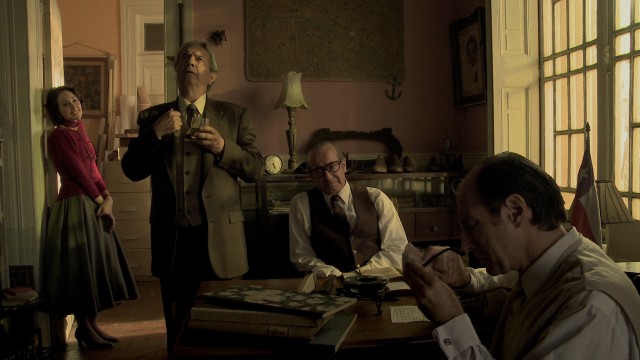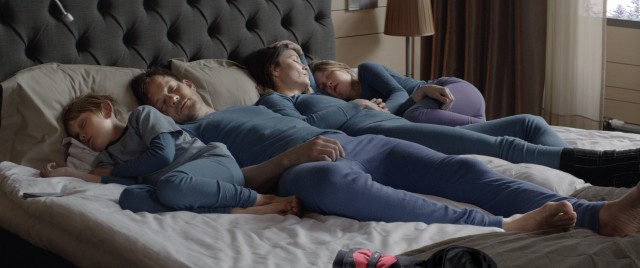
A close-knit Swedish family is about to face a serious crisis in Ruben Östlund’s Force Majeure
FORCE MAJEURE (Ruben Östlund, 2014)
THE SQUARE (Ruben Östlund, 2017)
Scandinavia House
58 Park Ave. at 38th St.
Tuesday, February 20, $20, 4:00
212-847-9740
www.scandinaviahouse.org
www.magpictures.com
 After three skiing films and two documentaries, Swedish writer-director Ruben Östlund experienced near-instant success with his fiction work, which has included five features and two shorts since 2004, earning him numerous international awards. Scandinavia House will be honoring the Styrsö native on February 20 with a double feature of his two latest gems, Force Majeure, which was shortlisted for a Best Foreign Language Film Oscar, and The Square, which is competing for the award at this year’s Oscars. Östlund will be at the Park Ave. cultural institution for a Q&A following The Square, which won the coveted Palme d’Or at Cannes. First up at 4:00 is Force Majeure, one of the best films you’ll ever hear. Not that Fredrik Wenzel’s photography of a lovely Savoie ski resort and Ola Fløttum’s bold, classical-based score aren’t stunning in their own right, but Kjetil Mørk, Rune Van Deurs, and Jesper Miller’s sound design makes every boot crunching on the snow, every buzzing electric toothbrush, every ski lift going up a mountain, every explosion setting off a controlled avalanche a character unto itself, heightening the tension (and black comedy) of this dark satire about a family dealing with a crisis. On the first day of their five-day French Alps vacation, workaholic Tomas (Johannes Bah Kuhnke) and his wife, Ebba (Lisa Loven Kongsli), are enjoying lunch on an outdoor veranda with their small children, Harry (Vincent Wettergren) and Vera (Clara Wettergren), when a potential tragedy comes barreling at them, but in the heat of the moment, while Ebba instantly seeks to protect the kids, Tomas runs for his life, leaving his family behind. After the event, which was not as bad as anticipated, the relationship among the four of them has forever changed, especially because Tomas will not own up to what happened. Even Harry and Vera (who are brother and sister in real life) know something went wrong that afternoon and are now terrified that their parents will divorce. But with Tomas unwilling to talk about his flight response, Ebba starts sharing the story with other couples, including their hirsute friend Mats (Kristofer Hivju) and his young girlfriend, Fanni (Fanni Metelius), who are soon arguing in private about what they would do in a similar situation.
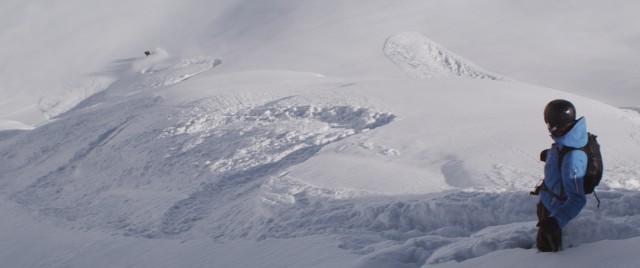
There might be no going back in beautiful-looking and -sounding Swedish satire
Winner of the Jury Prize in the Un Certain Regard sidebar of the Cannes Film Festival and the Swedish entry for the 2014 Academy Award for Best Foreign Language Film, Force Majeure is a blistering exploration of human nature, gender roles, and survival instinct. The often uncomfortable and utterly believable tale, inspired by a real-life event in which friends of Östlund’s were attacked by gunmen, recalls Julia Loktev’s The Loneliest Planet, in which an engaged couple encounter serious trouble and their immediate, individual reactions change their dynamic. Östlund (Play, Involuntary), who was also influenced by statistics that show that more men survive shipwrecks than women and children on a percentage basis, often keeps dialogue at a minimum, revealing the family’s growing predicament by repeating visuals with slight differences, from the way they sleep in the same bed to how they brush their teeth in front of a long mirror to the looks on their faces as they move along a motorized walkway in a tunnel at the ski resort. The ending feels forced and confusing, but everything leading up to that is simply dazzling, a treat for the senses that is impossible not to experience without wondering what you would do if danger suddenly threatened you and your loved ones.
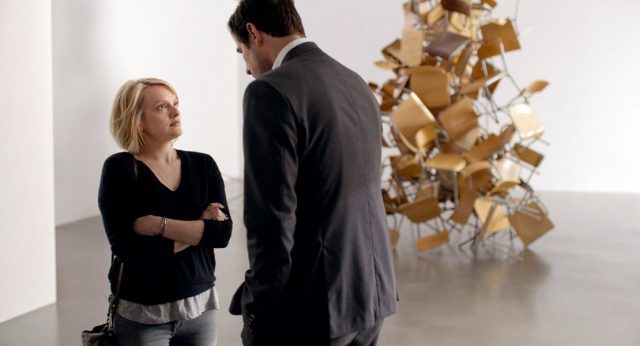
Ann (Elisabeth Moss) and Christian (Claes Bang) discuss more than just art in Ruben Östlund’s The Square
The plot of Östlund’s 2014 absurdist satire, Force Majeure, turns on a man’s momentary act of surprising cowardice when an avalanche threatens him and his family at a ski resort. In the Swedish writer-director’s absurdist satire The Square, screening at 6:30 at Scandinavia House, the plot is set in motion when a man’s momentary act of surprising bravery leads him into a spiral of personal and professional chaos. The Tesla-driving chief curator of the fictional X-Royal contemporary art museum in Sweden, Christian (Claes Bang) is walking through a busy plaza when he hears a woman crying for help as bystanders do nothing. After his initial hesitation, Christian intervenes and is ultimately quite pleased with himself and his decision to do the right thing — until, a few moments later, he realizes he’s been robbed. Back at the museum, Christian listens to a pair of millennial marketers pitching their campaign for the institution’s upcoming exhibit, “The Square,” which is highlighted by a four-meter-by-four-meter square positioned on the cobblestones in the museum’s front courtyard. An accompanying plaque reads, “‘The Square’ is a sanctuary of trust and caring. Within it we all share equal rights and obligations.” As the museum contemplates a cutting-edge ad campaign for the exhibit, Christian has to deal with an arts journalist, an angry kid, the museum board, and his own moral decisions.
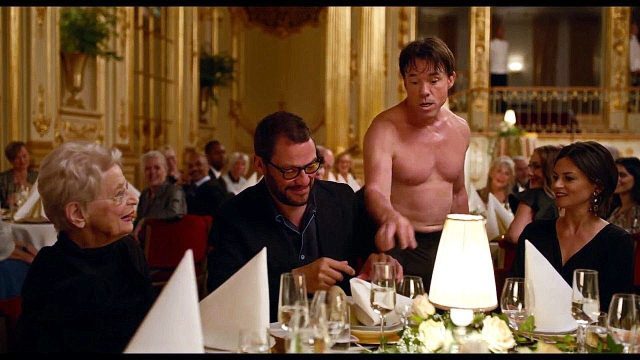
Oleg (Terry Notary) takes performance art to another level in The Square
The film opens as Christian is being interviewed by Ann (Elisabeth Moss) in a gallery, in front of a neon wall sign that says, “You have nothing.” Later, the sign says, “You have everything.” This dichotomy is central to Christian’s inner dilemma; he seemingly does have everything, but his world is slowly shattering, just like the artworks heard crashing to the ground later while he is in a deep personal discussion with Ann. Östlund skewers the art world, political correctness, class conflict, freedom of speech, privileged social groups, and the concept of “safe spaces” in the film, which was inspired by a real exhibition by Östlund and producer Kalle Boman that ran at the Vandalorum Museum in Sweden in 2015. Immediately following the opening interview, which reveals Ann has no feel whatsoever for contemporary art, workers remove the statue of King Karl XIV Johan that stands in front of the museum; on the base is his royal motto, “The love of the people my reward.” As the monument is being taken off its plinth, the crane drops it and the king’s head falls off. “The Square” takes its place, signaling the old being replaced by the new, physical objects replaced by lofty ideals, with an utter disregard for what has come before. Östlund (The Guitar Mongoloid, Incident by a Bank) is not above making such obvious analogies and references, including naming his protagonist Christian, a man who spends much of the film attempting to do what he considers the right thing. (Östlund, who also edited the film with Jacob Secher Schulsinger, has said that “The Square” installation is a place where the Golden Rule and the Universal Declaration of Human Rights should take precedence.)
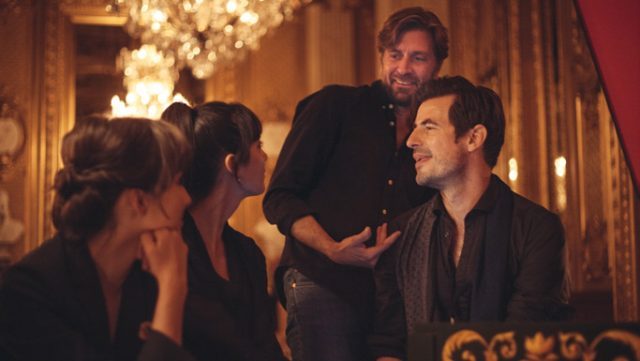
Writer-director-editor Ruben Östlund (standing) on the set of The Square
The film focuses on the issue of trust, and particularly how humans lose their ability to have faith in others as they mature. At the entrance to the “Square” installation, visitors are given the option of deciding between two paths, one marked “I Trust People,” the other “I Mistrust People.” Christian’s two daughters both take the former. The older daughter is a cheerleader, showing trust in her teammates as the girls are tossed high in the air and wait to be caught — but not without several men hovering right behind them to try to prevent any possible falls. The difference between childhood and adulthood is also evident in how Christian deals with a determined young boy in trouble because of the divorced curator. Bang is stoic as Christian, a man who feels more at home among works of art than with other people. He wants so desperately to be good, but it’s getting harder and harder to make the right decision in the current politically correct atmosphere, and he is so self-absorbed that he even fights over possession of a used condom, in one of the film’s most bizarrely comic moments. Those choices come to the fore in two wildly uncomfortable scenes involving an American artist named Julian (Dominic West), first at a public Q&A where he is bedeviled by an audience member with Tourette syndrome, and later at a gala fundraiser where a bare-chested performer (motion-capture actor Terry Notary) moves around the luxurious room, acting like an ape, but as he begins breaking physical and socially acceptable boundaries, no one knows how to react. (His acting like an ape is in direct contrast to Ann’s roommate, an ape who is far more civilized and is never commented on.) Both situations frustrate the viewer as well, as we are as hamstrung as the people in the film, all of us experiencing the bystander effect together. And the mood is further joyfully complicated by the lighthearted, satiric music. Despite a few minor missteps, The Square is a searingly intelligent exploration, and condemnation, of where humanity stands as a society in the twenty-first century, fearful of our every move, searching for that imaginary safe space where we can live and breathe freely with our fellow beings, consequences be damned.