twi-ny recommended events

DOCUMENTARISTS FOR A DAY: A MAN VANISHES

is part of documentary film series at Anthology Archives

Shôhei Imamura’s A Man Vanishes is part of documentary film series at Anthology Archives

A MAN VANISHES (NINGEN JŌHATSU) (Shôhei Imamura, 1967)
Anthology Film Archives
32 Second Ave. at Second St.
Saturday, February 3, 6:15; Thursday, February 8, 9:00; Sunday, February 11, 6:15
Series runs February 2 – February 20
212-505-5181
anthologyfilmarchives.org

Japanese filmmaker Shôhei Imamura blurs the lines between reality and fiction in his cinéma vérité masterpiece, A Man Vanishes. The 1967 black-and-white documentary delves into one of Japan’s annual multitude of missing persons cases, this time investigating the mysterious disappearance of Tadashi Ôshima, a plastics wholesaler who vanished during a business trip. Imamura sends out actor Shigeru Tsuyuguchi (The Insect Woman, Intentions of Murder) to conduct interviews with Ôshima’s fiancée, Yoshie Hayakawa, who develops an interest in her inquisitor; Yoshie’s sister, Sayo, who quickly finds herself on the defensive; business associates who talk about Ôshima’s drinking, womanizing, and embezzling from the company; and several people who remember seeing Sayo together with Ôshima, something she adamantly denies despite the building evidence. Throughout the 130-minute work, the film references itself as being a film, culminating in Imamura’s pulling the rug out from under viewers and calling everything they’ve seen into question in an unforgettable moment that breaks down the fourth wall and explodes the very nature of truth and cinematic storytelling itself. It also explores individual identity and just how much one really knows those closest to them. Originally supposed to be the first of a twenty-four-part series exploring two dozen missing-persons cases, A Man Vanishes ended up being such a challenging undertaking that it was the only one Imamura made, but what a film it is; it would be more than a decade before he returned to fiction, with 1979’s Vengeance Is Mine, which led the way to a spectacular final two decades that also included The Ballad of Narayama, Eijanaika, Black Rain, The Eel, Dr. Akagi, and Warm Water Under a Red Bridge. The amazing A Man Vanishes is screening February 3, 8, and 11 in the Anthology Film Archives series “Documentarists for a Day,” which highlights nonfiction works made by directors better known for their fiction films. The first part of the festival runs February 2-20 and also includes Orson Welles’s F for Fake, Roberto Rossellini’s India: Matri Bhumi and Interview with Salvador Allende, Rainer Werner Fassbinder’s Theater in Trance, and Louis Malle’s God’s Country before returning in the spring with documentaries by Eric Rohmer, Manoel de Oliveira, Claire Denis, Satyajit Ray, and others.

HE BROUGHT HER HEART BACK IN A BOX

(photo by Gerry Goodstein)

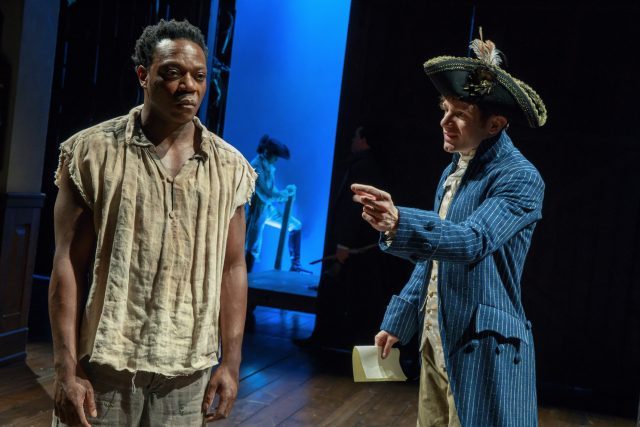
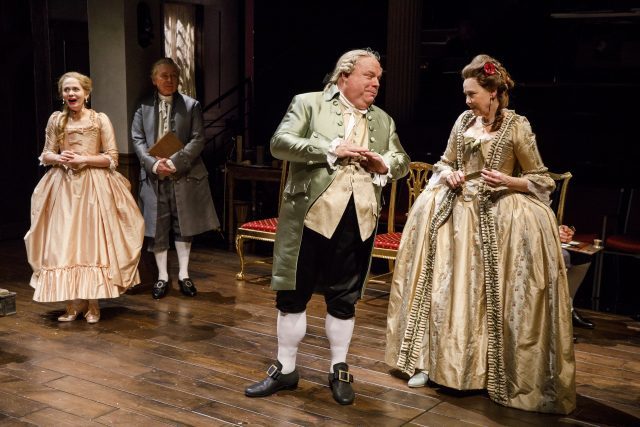
Kay (Juliana Canfield) and Christopher (Tom Pecinka) battle racism in the Jim Crow south in He Brought Her Heart Back in a Box (photo by Gerry Goodstein)

Theatre for a New Audience, Polonsky Shakespeare Center
262 Ashland Pl. between Lafayette Ave. & Fulton St.
Tuesday – Sunday through February 11, $90-$125
866-811-4111
www.tfana.org

In 2016, the Signature presented a powerful revival of Adrienne Kennedy’s Obie-winning debut play, 1964’s Funnyhouse of a Negro, as part of a trio of experimental one-act plays, with Edward Albee’s The Sandbox and María Irene Fornés’s The Drowning. Now Theatre for a New Audience is staging the world premiere of the eighty-six-year-old Kennedy’s first play in nine years and first solo-written drama in two decades, He Brought Her Heart Back in a Box, which opened last night and deals with many of the same issues, focusing on generations of Americans affected by Jim Crow laws and institutional racism, and it feels like not a moment too soon nor a moment too late. Inspired by events in her own life and featuring snippets from Noël Coward’s Bitter Sweet and Christopher Marlowe’s The Massacre at Paris, the fifty-minute show is set in the fictional town of Montefiore, Georgia, in June 1941, where Christopher (Tom Pecinka), son of successful white businessman Harrison Aherne and a white woman — Harrison also has three young children by three black women — and Kay (Juliana Canfield), the daughter of a white writer and a black woman who died mysteriously shortly after Kay was born, have declared their desire for each other. The two seventeen-year-olds know their love is forbidden so they keep it a secret as Christopher leaves for New York City to pursue a stage career and they exchange letters. “He just knew these things. He understands history. He understands the devastation of the human spirit,” Chris writes about his father. “He knows the importance of making a person enter through the back door and of never addressing them as you are addressed. He understands how language can be used to humiliate.” Kay writes back, “My grandmother always said we saw my father all the time on Main Street but he never looked our way. My grandmother said, ‘Your father would look away but his mother would look at you like she was going to kill you right there.’” Meanwhile, Christopher begins to question his father’s friendship with Germans as WWII spreads around the world and is about to involve America. As they continue writing letters and planning their marriage, they traverse Christopher Barreca’s breathtaking set, a floor with several chairs, one of which is occupied by a life-size puppet representing Harrison Aherne. A long stairway leads up to a closed door; on either side are huge brick barriers. Video designer Austin Switser projects images on the floor, walls, and steps of two trains, one for blacks, one for whites; signs in waiting rooms and at water fountains declaring “White” and “Colored”; and photographs further displaying differences in class and race embodied by Christopher and Kay’s relationship.

stein)

Adrienne Kennedy’s He Brought Her Heart Back in a Box is a haunting memory play about childhood, first love, and Jim Crow (photo by Gerry Goodstein)

Kennedy (Sleep Deprivation Chamber, June and Jean in Concert), who lived in New York for thirty years before moving to Virginia six years ago to be with her son, Adam, her collaborator on several plays, looks directly at racism and segregation and the lasting effects of slavery in He Brought Her Heart Back in a Box, as the history of two families becomes a microcosm for societal ills that sadly continue to be crucial sources of pain in American life today. It’s a dark fairy tale ably guided by Obie-winning director Evan Yionoulis (The Violet Hour, Three Days of Rain), who helmed the Lortel Award-winning TFANA revival of Kennedy’s Ohio State Murders in 2007. Despite its often confusing and fragmentary narrative, which eschews contemporary realism, Pecinka and Canfield, in her professional New York stage debut, are tantalizing together, striking surprisingly emotional chords as Kay and Christopher’s Romeo-and-Juliet-style love grows. The play is exceedingly angry and at times agonizingly personal, as if we are meeting Kennedy’s inner demons, as if she knew what she wanted to say and got right to the point, unconcerned with conventional plot and character development. (She wrote the play for her grandson after watching him graduate from a Virginia high school, feeling that not much had changed since the 1950s.) But there are also transcendent moments of pure poetry as Kennedy illuminates the sheer hatred that lies at the heart of racism. As you enter the theater, be sure to stop by the miniature model of the gray, dank Montefiore town, devoid of people, as if haunted, with tiny segregation signs at a water fountain and in the train station waiting room. As Kennedy demonstrates, one possible future is that there will ultimately be no one left, neither blacks nor whites, all victims of fear, jealousy, and the violence that comes with that.

MONTHLY CLASSICS: GODZILLA / DIRECTING GODZILLA: THE LIFE OF FILMMAKER ISHIRO HONDA

Godzilla

Godzilla emerges from the ocean after nuclear testing in classic monster movie

GODZILLA (Ishirō Honda, 1954)
Japan Society
333 East 47th St. at First Ave.
Friday, February 2, $13, 7:00
Directing Godzilla: Wednesday, February 21, $14, 6:30
212-715-1258
www.japansociety.org

More than two dozen sequels, prequels, remakes, and reboots have not diluted in the slightest the grandeur of the original 1954 version of Godzilla, one of the greatest monster movies ever made. If you’ve only seen the feeble, reedited, Americanized Godzilla, King of the Monsters!, made two years later with Canadian-born actor Raymond Burr inserted as an American reporter, well, wipe that out of your head. On February 2, Japan Society is screening the real thing, the restored treasure as part of its Monthly Classics series; it will be followed on February 21 with “Directing Godzilla: The Life of Filmmaker Ishirō Honda,” a talk with Steve Ryfle, author of Ishirō Honda: A Life in Film, From Godzilla to Kurosawa, moderated by Film Forum repertory programming director Bruce Goldstein, whose Rialto Pictures released the film in theaters in 2004 and 2014, followed by a book signing and reception with many old Godzilla posters and memorabilia items on view.

Godzilla

Ishirō Honda has a smoke with his atomic-gas-breathing monster on the set of Godzilla

The film was inspired by Eugène Lourié’s The Beast from 20,000 Fathoms and a real incident involving the Daigo Fukuryū Maru, a tuna-fishing boat that got hit by radioactive fallout in January 1954 from a U.S. test of a dry-fuel thermonuclear device in the Pacific Ocean. Writer-director Ishirō Honda and cowriter Takeo Murata expanded on Shigeru Kayama’s story, focusing on a giant dinosaur under the sea who comes back to life after H-bomb testing by the U.S. Standing 165 feet tall and able to breathe atomic gas, Godzilla — known as Gojira in Japanese, a combination of gorira, the Japanese word for gorilla, and kujira, which means whale — wreaks havoc on Japanese towns as he makes his way toward Tokyo. While the military and the government want to destroy the creature — who is played by Haruo Nakajima and Katsumi Tezuka in a monster suit, tramping over miniature houses, streets, cars, trains, and buildings using the suitmation technique (both men also make cameos outside the costume) — Dr. Yamane (Takashi Shimura) wants to study Godzilla to find out how the radiation only makes it stronger instead of destroying it. (Throughout, Godzilla is referred to as “it” and not “he,” perhaps because the creature is in part a representation of America and what it wrought in Hiroshima and Nagasaki.) “Godzilla was baptized in the fire of the H-bomb and survived. What could kill it now?” Dr. Yamane asks. Meanwhile, one of Dr. Yamane’s assistants, Dr. Serizawa (Akihiko Hirata), is working on a secret oxygen destroyer that he will show only to his fiancée, Yamane’s daughter, Emiko (Momoko Kōchi), who is having trouble telling Dr. Serizawa that she is actually in love with salvage ship captain Hideto Ogata (Akira Takarada). “Godzilla’s no different from the H-bomb still hanging over Japan’s head,” Ogata tells Dr. Yamane, who is none too pleased with his take on the situation. Through it all, the media risks everything to get the story.

Even for 1954, many of the special effects, photographed by Masao Tamai, are cheesy but fun, and composer Akira Ifukube’s fiercely dramatic score goes toe-to-toe with the monster. The Toho film is no mere monster movie but instead is filled with metaphors and references about WWII and the use of atomic bombs, examining it from political and socioeconomic vantage points while questioning the future of technological advances. “But what if your discovery is used for some horrible purpose?” Emiko asks Dr. Serizawa, who wears an eye patch, as if he can only see part of things. Godzilla could only have come from Japan, much like King Kong was purely an American creation produced by Hollywood; in fact, the two went at it in Honda’s 1962 film, King Kong vs. Godzilla. The next year, Akira Kurosawa would make I Live in Fear (Ikimono no kiroku), an intense psychological drama about the nuclear holocaust’s effects on one man, a factory owner played by Toshirô Mifune — who meets with a dentist portrayed by Kurosawa regular Shimura — a kind of companion piece to Godzilla. Honda, who served as an assistant director to Kurosawa on many films before making his own pictures, would go on to make such other sci-fi flicks as Rodan, The H-Man, Mothra, and Destroy All Monsters, but it was on Godzilla that he got everything right, capturing the fate of a nation in the aftermath of nuclear devastation while still managing to gain sympathy for the monster. It is also difficult to watch the film in 2018 without thinking of America’s current debate over illegal immigration and fear of the other, particularly when Godzilla approaches an electrified fence meant to keep him out, as well as the threat of nuclear war as President Trump battles Kim Jon Un on Twitter.

PARADISO

The New York City Players are performing Paradiso for free at Greene Naftali in Chelsea through February 10

The New York City Players are performing Paradiso for free at Greene Naftali in Chelsea through February 10

Greene Naftali Gallery
508 West 26th St. between Tenth & Eleventh Aves., ground floor
Wednesday – Saturday through February 10, free with advance RSVP, 718-622-0330, 7:00
www.greenenaftaligallery.com
www.nycplayers.org

Life and death, science and mythology, earth and water, and past and future merge in Richard Maxwell’s Paradiso, continuing through February 10 at Chelsea’s Greene Naftali Gallery. The sixty-minute show, set in a pre- and postapocalyptic time, concludes Maxwell’s theatrical trilogy inspired by Dante’s Divine Comedy, following The Evening and Samara. In Paradiso, characters search for hope and question faith amid grief and despair in an empty, almost blindingly white space save for three sets of three-row semicircular wooden benches for the audience; two pillars offer some respite from the desolation. The staging makes the most of the unusual gallery space; the large, long glass east side walls can open like industrial garage doors, through which Maxwell has a shining white SUV drive in. A home-made robotic figure that evokes Erector-set-level technology, with a small, creaking camera for eyes and a speaker for a mouth, gets out of the car and put-puts toward the audience. “The sky isn’t blue,” it says in somewhat garbled electronic speech. “It’s neither overcast nor sunny — it’s a white slate that blanks your eyes across the day and it daily worsens.” His long soliloquy, with his camera eye surveilling the crowd, is followed by short vignettes and monologues by Elaine Davis, Jessica Gallucci, Carina Goebelbecker, and Charles Reina as various mostly unidentified characters, from strangers and friends to family members facing dilemmas both vague and specific. Occasionally they break into slow, silent modern-dance movements.

The New York City Players are performing Paradiso for free at Greene Naftali in Chelsea through February 10

A robot assesses the state of a pre- and postapocalyptic world in Richard Maxwell’s Paradiso

Maxwell, whose first monograph, The Theater Years, was recently copublished by Greene Naftali, wrote and directed Paradiso, which, despite all the gloom and doom, is ostensibly about love, in all its forms. “Love has no merit nor no blame,” the robot says. “Love is all that remains,” a character opines. “We are loving. Paradise means to be with the people you love who you lost, to reside in all the energy and vitality of hope,” another character says, adding, “What am I saying? I don’t use words anymore. Fuck it, I can’t dwell on it, I have to move on.” Meanwhile, two people have tea. A man and a woman sleep in the desert. A couple helps their daughter following an operation. Everyone talks primarily in nonspecific dialogue delivered in an often straightforward, detached manner. Snippets give tiny clues to what might have happened, including a major war. “Who were the people who could have saved us?” someone asks. At the end, all that is left is the robot, spewing out a long, narrow sheet of paper that conjures up a neverending CVS receipt. The audience can go up and read what keeps coming out, a series of randomly generated scenes between multiple characters that has nothing whatsoever to do with what we just saw, except everything — little fragments of life, much like Paradiso itself, offering more questions than answers but clinging to hope in an indeterminate, potentially cataclysmic future.

mecca vazie andrews and the MOVEMENT movement: [title]

(photo courtesy of mecca vazie andrews)

mecca vazie andrews and the MOVEMENT movement will present new immersive work in dialogue with Laura Owens exhibition at the Whitney (photo courtesy of mecca vazie andrews)

Whitney Museum of American Art
99 Gansevoort St.
Saturday, February 3, $10, 4:00
Exhibition continues through February 4
212-570-3600
whitney.org
meccavazieandrews.tumblr.com

In conjunction with the exhibition Laura Owens, a midcareer survey of the work of the LA-based artist, the Whitney is hosting the immersive multimedia performance [title], by LA dancer, choreographer, and teacher mecca vazie andrews and her company, the MOVEMENT movement. The fifty-minute presentation will feature movement, sound, and projection as andrews responds to Owens’s radical style of painting, exploring freedom, enlightenment, and the future. The performance takes place on February 3 at 4:00, the day before the exhibition closes; tickets are ten dollars in addition to museum admission. Also currently on view at the Whitney are “Toyin Ojih Odutola: To Wander Determined,” “An Incomplete History of Protest: Selections from the Whitney’s Collection, 1940-2017,” “Where We Are: Selections from the Whitney’s Collection, 1900-1960,” and “Experiments in Electrostatics: Photocopy Art from the Whitney’s Collection, 1966-1986.”

EDVARD MUNCH: BETWEEN THE CLOCK AND THE BED

Edvard Munch, “Self Portrait between the Clock and the Bed,” oil on canvas, 1940–43 (© 2017 Artists Rights Society (ARS), New York / photo © Munch Museum)

Edvard Munch, “Self Portrait between the Clock and the Bed,” oil on canvas, 1940–43 (© 2017 Artists Rights Society (ARS), New York / photo © Munch Museum)

The Met Breuer
945 Madison Ave. at 75th St.
Tuesday – Sunday through February 4, suggested admission $12-$25
212-535-7710
www.metmuseum.org

The Met Breur’s exemplary exhibition “Edvard Munch: Between the Clock and the Bed” is anchored by the Norwegian artist’s remarkable “Self-Portrait between the Clock and the Bed,” which Munch worked on from 1940 to 1943. When the painting was completed, Munch was eighty; he passed away the following year. His last major self-portrait, it’s an exquisite reckoning of a man’s life. Munch pictures himself standing straight, eyes slightly closed, his hands at his sides. To his right is a grandfather clock that is a virtual doppelgänger for the artist, the round face and three sections mimicking Munch’s head, upper body, and legs. He knows his time is running out, and in true Munch style, he is none too happy about it, though seemingly resigned to his fate. To his left are representations of some of his other paintings as well as a bed with black and red cross hatches, which may be where he goes to sleep for the last time and never wakes up. The wide range of colors counterbalance the somber mood; this might be a kind of farewell from Munch, but it could be anybody facing mortality. At the beginning of his catalog preface “On Edvard Munch,” novelist Karl Ove Knausgaard writes, “‘My art has been an act of confession.’ So said Edvard Munch at the end of his life. I believe that anyone who has seen Munch’s paintings will understand that remark. Not only because he painted so many self-portraits, or because so many of the stock scenes he returned to again and again have clearly autobiographical elements, but because it’s as if something is revealed in everything he painted, even the landscapes without people, a field covered in snow, a jetty by the shore, a pine forest in the gloam. This is the essence of Munch’s art. But also what we can say least about.” Museumgoers will understand that and more after seeing the fifty works on view at the Breuer through February 4, several of which have never been shown publicly before and were part of Munch’s personal collection. “In fact,” Knausgaard (Out of the World, Min Kamp) continues, “the question is rather whether it is possible to say anything about the essence of Munch’s paintings at all. The paintings are wordless, they are silent and unmoving. They are made up of colors and shapes and they touch us in a way that words never can, they reach places in us where words have no access.”

Edvard Munch, The Dance of Life, oil on canvas, 1925 (Munch Museum, Oslo / © 2017 Artists Rights Society (ARS), New York)

Edvard Munch, “The Dance of Life,” oil on canvas, 1925 (Munch Museum, Oslo / © 2017 Artists Rights Society (ARS), New York)

The exhibition is divided into seven sections whose titles alone capture the essence of Munch’s oeuvre: “Self-Portraits,” “Nocturnes,” “Despair,” “Sickness and Death,” “Puberty and Passion,” “Attraction and Repulsion,” and “In the Studio.” In the 1906 “Self-Portrait with a Bottle of Wine,” Munch sits in the foreground, looking contemplative and forlorn, his hands clasped in his lap, the loose brushwork placing him in an undetermined reality; he would suffer a nervous breakdown two years later. In two renditions of “The Sick Child,” Munch revisits the death of his beloved sister Sophie, who died from tuberculosis in 1877 at the age of fifteen; in the 1896 painting, Sophie is accepting of her fate, offering solace to her distraught mother, while the brushwork in the 1906 version, in which Munch layered paint and then scraped away color, creates an angrier, more expressionistic scene. Munch, who never married, explores sexuality and romance in “Madonna” and “The Kiss”; the former turns Jesus’s mother into a passionate woman, while the latter melds the two lovers’ faces into one. A lithographic crayon version of Munch’s most famous image, “The Scream,” features the handprinted text “I felt a loud, unending scream piercing nature”; nearby is a photograph of the Ljaborveien road that was the setting for the iconic work. The 1925 oil painting “The Dance of Life” is a more experimental version of the 1899–1900 original, depicting the three stages of a woman’s life as she ages — youthful in white, seductive in red, mourning in black — but it is also more dour despite the light glistening over the ocean. Other extraordinary pieces include “Sick Mood at Sunset: Despair,” “Moonlight,” “Puberty,” “Weeping Nude,” two versions of “The Artist and His Model,” “Death in the Sick Room,” and “The Night Wanderer,” which reveals Munch hunched over, unable to sleep, restless and uneasy, not knowing what to do and where to go next. “Edvard Munch: Between the Clock and the Bed” is an intense, emotional, deeply psychological journey into the abyss as portrayed by a supremely talented and innovative artist overwhelmed by mental anguish. (In Midtown, coinciding with the Met Breuer show, Scandinavia House has just extended “The Experimental Self: Edvard Munch’s Photography,” consisting of photographs, film, and prints, through April 4.)

MARTIAL/ART: THE ASSASSIN

THE ASSASSIN

Shu Qi is an expertly trained killer with a conscience in Hou Hsiao-hsien’s gorgeous period drama The Assassin

THE ASSASSIN (刺客聶隱娘) (NIE YINNIANG) (Hou Hsiao-hsien, 2015)
Metrograph
7 Ludlow St. between Canal & Hester Sts.
Saturday, February 3, 3:30
Series runs through February 10
212-660-0312
metrograph.com
wellgousa.com

Taiwanese master Hou Hsiao-hsien’s first film in eight years is a visually sumptuous feast, perhaps the most beautifully poetic wuxia film ever made. Inspired by a chuanqi story by Pei Xing, The Assassin is set during the ninth-century Tang dynasty, on the brink of war between Weibo and the Royal Court. Exiled from her home since she was ten, Nie Yinniang (Hou muse Shu Qi) has returned thirteen years later, now an expert assassin, trained by the nun (Fang-Yi Sheu) who raised her to be a cold-blooded killer out for revenge. After being unable to execute a hit out of sympathy for her target’s child, Yinniang is ordered to kill Tian Ji’an (Chang Chen), her cousin and the man to whom she was betrothed as a young girl, as a lesson to teach her not to let personal passions rule her. But don’t worry about the plot, which is far from clear and at times impossible to follow. Instead, glory in Hou’s virtuosity as a filmmaker; he was named Best Director at Cannes for The Assassin, a meditative journey through a fantastical medieval world. Hou and cinematographer Mark Lee Ping-Bing craft each frame like it’s a classical Chinese painting, a work of art unto itself. The camera moves slowly, if at all, as the story plays out in long shots, in both time and space, with very few close-ups and no quick cuts, even during the martial arts fights in which Yinniang displays her awesome skills. Hou often lingers on her face, which shows no outward emotion, although her soul is in turmoil. Hou evokes Andrei Tarkovsky, Akira Kurosawa, Ang Lee, and Zhang Yimou as he takes the viewer from spectacular mountains and river valleys to lush interiors (the stunning sets and gorgeous costumes, bathed in red, black, and gold, are by Hwarng Wern-ying), with silk curtains, bamboo and birch trees, columns, and other elements often in the foreground, along with mist, fog, and smoke, occasionally obscuring the proceedings, lending a surreal quality to Hou’s innate realism.

There are long passages of silence or with only quiet, barely audible music by composer Lim Giong, with very little dialogue, as rituals are performed, baths are prepared, and a bit of black magic takes place. The opening scenes, set around a breathtaking mountain abbey in Inner Mongolia, are shot in black-and-white with no soundtrack, like a silent film, harkening to cinema’s past as well as Yinniang’s; when it switches over to color, fiery reds take over as the credits begin. Throughout the film, the nun wears white and the assassin wears black, in stark contrast to the others’ exquisitely colorful attire; however, the film is not about good and evil but something in between. Shu and Cheng, who played a trio of lovers in Hou’s Three Times, seem to be barely acting in The Assassin, immersing themselves in their characters; Hou (The Puppetmaster, Flowers of Shanghai) gives all of his cast, professional and nonprofessional alike, a tremendous amount of freedom, and it results here in scenes that feel real despite our knowing better. Sure, a touch more plot explication would have been nice, but that was not what Hou was after; he wanted to create a mood, an atmosphere, to transport the actors and the audience to another time and place, and he has done that marvelously. The Assassin is a treasure chest of memorable moments that rewards multiple viewings. I’ve seen it twice and can’t wait to see it again — and I’ve given up trying to figure out exactly what it’s about, instead reveling in its immense, contemplative beauty. Hou’s previous full-length film was 2007’s Flight of the Red Balloon; here’s hoping it’s not another eight years till his next one. The Assassin is screening February 3 at 3:30 in the Metrograph series “Martial/Art,” which continues through February 10 with such other high-end martial-arts fare as Tsui Hark’s Zu: Warriors from the Magic Mountain and The Blade, Jeffrey Lau’s The Eagle Shooting Heroes, and King Hu’s A Touch of Zen.