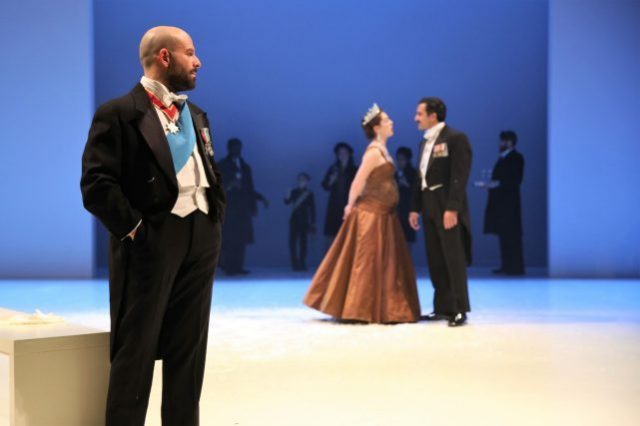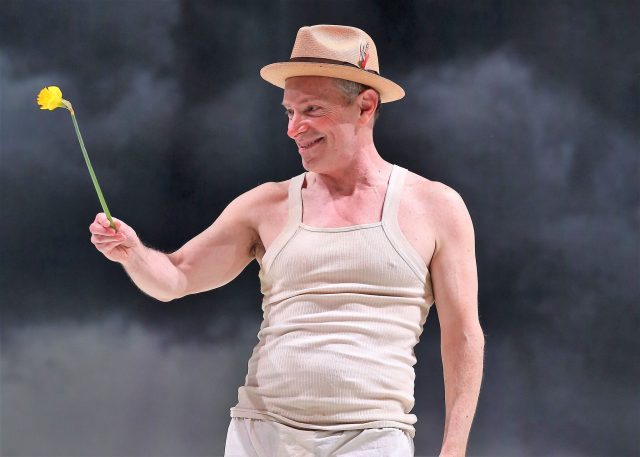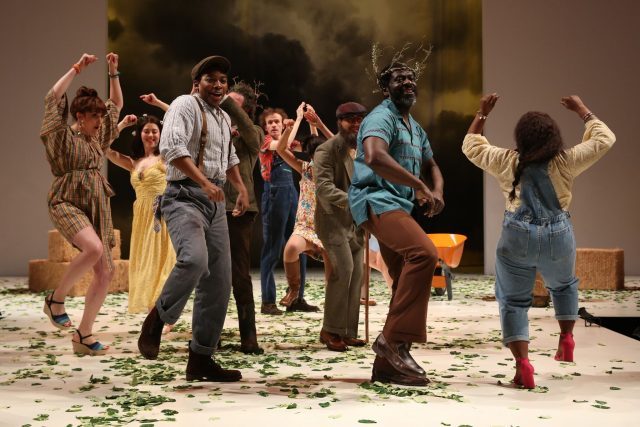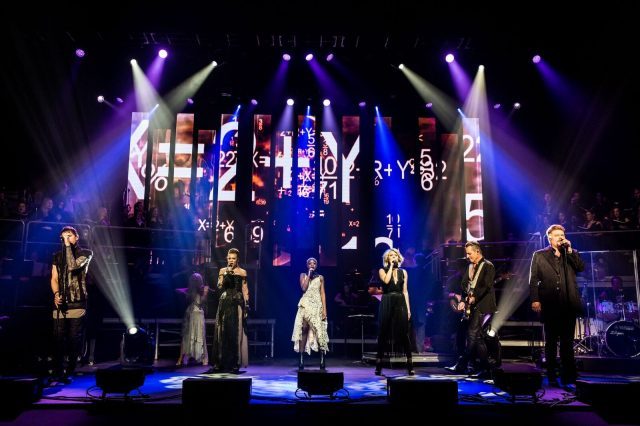
Rocktopia blends classic rock and classical music on Broadway (photo by Matthew Murphy)
The Broadway Theatre
1681 Broadway at 53rd St.
Through April 29, $39 – $187
rocktopia.com
Much of Rocktopia, which opened Tuesday night at the Broadway Theatre, is a curiosity, a blending of classic rock and classical music that in theory might be a cool idea but in execution could be problematic. Rocktopia is a different kind of jukebox musical, with no narrative, consisting of overly familiar songs performed by pop, rock, theater, reality show, and opera singers, a five-piece rock band, the thirty-person New York Contemporary Choir, and the twenty-piece New York Contemporary Symphony Orchestra. Conceived by Trans-Siberian Orchestra member and Broadway veteran Rob Evan (Jekyll and Hyde, Les Misérables) and American conductor Randall Craig Fleischer, the traveling project is an up-and-down affair, as vocal histrionics get carried away, the setlist is about as standard as it comes, and amateurish, seemingly unrelated visuals are projected onto fifteen large, vertical piano keys at the top rear of the stage. But then something magical happens, where it all suddenly comes together for an absolutely smashing last few numbers that brought the crowd to its feet, everyone singing and dancing with an intoxicating fervor.
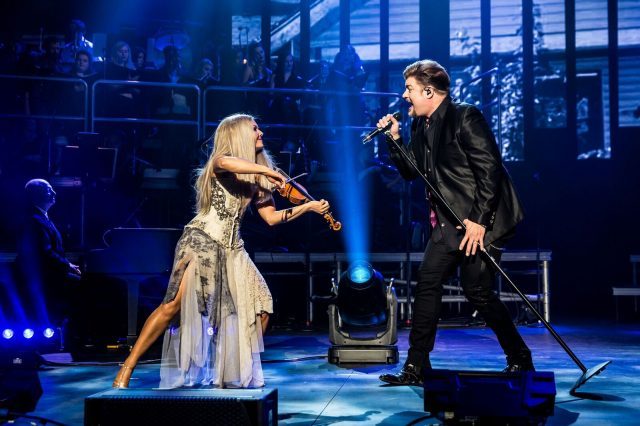
Celtic violinist Máiréad Nesbit and vocalist Rob Evan rock out at the Broadway Theatre (photo by Matthew Murphy)
The show opens with the pairing of Richard Strauss’s “Also sprach Zarathustra” and the Who’s “Baba O’Riley,” sung by Evan and Tony Vincent (American Idiot, Jesus Christ Superstar), followed by Mozart’s “Eine kleine Nachtmusik” with Styx’s “Come Sail Away,” performed by Evan, Vincent (The Voice), Chloe Lowery (Trans-Siberian Orchestra), and Kimberly Nichole (The Voice). The double shot gets the point across but without any fireworks, as the melding of the two genres felt too obvious and separate. Special guest Pat Monahan of Train, who will be part of the show through April 6 (Twisted Sister’s Dee Snider is the guest April 9-15, followed by Cheap Trick’s Robin Zander April 23-29), takes center stage to get the Led out (first with Beethoven, then Puccini), but Stravinsky/Hendrix is out of place, as is Mussorgsky/U2, the latter accompanied by documentary footage of poor communities. However, it’s a thrill to see diva Alyson Cambridge, who has performed at the Met and the Washington National Opera, lend class to the festivities by singing Handel’s “Lascia ch’io pianga” and Lucio Dalla’s “Caruso” and also duetting with Evan. On nearly every song, Celtic violinist Máiréad Nesbitt sparkles, playing her fiddle as she flits about the stage like a mad fairy or sprite. There actually is a rhyme and reason for the visuals; in the online Rocktopia study guide, the evening moves from “Creation/Birth,” “Adolescence,” and “Experimentation” through “Dreams,” “Oppression/Rebellion,” and other aspects of the human condition, not that you would know that from what’s happening onstage. And we’re still trying to figure out the inclusion of John Denver in a video tribute to such dead rock stars as Jimi, Janis, Jerry, Jim, George, John, Prince, and Bowie, as well as photos of Eleanor Roosevelt, Amelia Earhart, and, yes, Anne Frank during the theme from Schindler’s List. Meanwhile, the woman vocalists and Nesbitt look like they just stepped out of a Mad Max movie, wearing postapocalyptic gowns designed by Cynthia Nordstrom, and Vincent appears to be doubling for Robin Lord Taylor’s Penguin on Gotham.
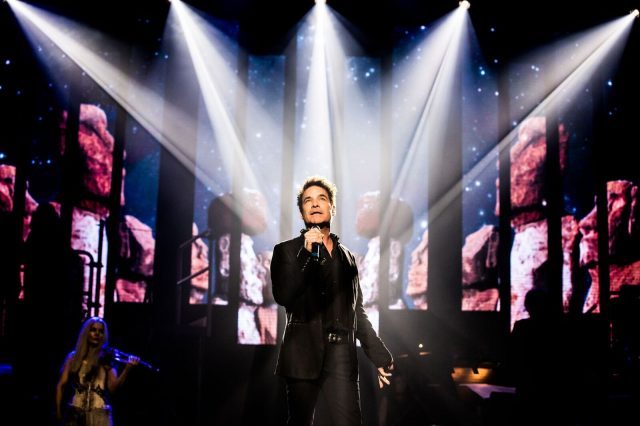
Rob Monahan of Train is Rocktopia’s special guest through April 6 (photo by Matthew Murphy)
And then it happens. Samuel Barber meets Queen, Beethoven takes on Journey, and Gershwin intertwines with Queen in all the ways Evan and Fleischer intended, the classical music and the classic rock coming together, weaving in and out of each other, sending electricity across a room that suddenly comes alive as one. Guitarist Tony Bruno, bassist Mat Fieldes, drummer Alex Alexander, pianist and music director Henry Aronson (Rock of Ages, Grease), Nesbitt, the choir, the orchestra, and the singers — if still not the projections — bring down the house, leaving no one in their seat. Sure, it’s cheesy and extremely safe, but it’s also tons of fun if you just let yourself go. It might not be quite the revolution Evan and Fleischer intended, and it’s far more likely to attract fans of American Idol and The Voice and baby boomers who go to Jones Beach to see 1970s retreads rather than classical music lovers who go to the Met and Lincoln Center for opera and the symphony, but you can’t have everything. And what’s wrong with a little mindless entertainment in these hard times?