twi-ny recommended events

RELEVANCE

(photo by Joan Marcus)

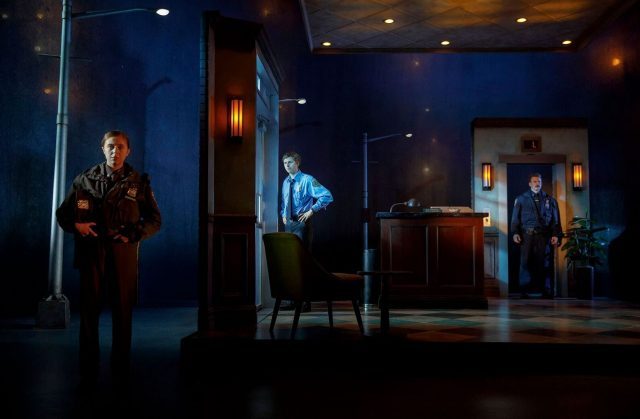
Dr. Kelly Taylor (Molly Camp) moderates a discussion with Dr. Theresa Hanneck (Jayne Houdyshell) and Msemaji Ukweli (Pascale Armand) in Relevance (photo by Joan Marcus)

MCC Theater at the Lucille Lortel Theatre
121 Christopher St. between Bleecker & Hudson Sts.
Tuesday – Sunday through March 11, $49-$99
212-352-3101
www.mcctheater.org

“What you hear underneath it is hate. It’s pure, unadulterated hate,” Dr. Theresa Hanneck (Tony winner Jayne Houdyshell) says at the beginning of JC Lee’s electrifying Relevance, which opened this afternoon at the Lucille Lortel Theatre. The timely and topical MCC world premiere takes place at the fictional American Conference for Letters and Culture, where Theresa, a white woman in her late fifties, is being honored with the Alcott lifetime achievement award for her influential career as an outspoken feminist writer and teacher. As the play opens, she is on a panel with up-and-coming writer and activist Msemaji Ukweli (Tony nominee Pascale Armand), a twentysomething African American woman who quickly reveals that she is not afraid to take down her idols to prove a point. The talk is being moderated by vice committee chair Dr. Kelly Taylor (Molly Camp), a white woman in her thirties who desperately wants to avoid controversy, especially involving race, gender, and age. After Theresa brings up the concept of privilege, Msemaji fires back, and the two women go for each other’s throat as Kelly tries to calm things down.

(photo by Joan Marcus)

David (Richard Masur) and Theresa (Jayne Houdyshell) have a lot to talk about in MCC world premiere at the Lucille Lortel (photo by Joan Marcus)

Theresa is livid about how she was treated by Msemaji; her longtime agent and former lover, David (Emmy nominee Richard Masur), thinks she should let it go, but Theresa is dead-set on revenge, belittling her new rival. “You pick a topic people are afraid to confront, you feign bravery with a cursory glimpse, and everyone showers you with accolades for showing them a touchstone they already knew was there,” she says, convinced that Msemaji is a phony. Meanwhile, Msemaji is not going to back off just because of Theresa’s history. “Her work is a clarion call from the past, a touchstone for my generation as we move the conversation forward, unmarked by the same scars that are tokens of her survival,” Msemaji explains. The ever-widening generation gap is also evident in social media; whereas Msemaji spreads her message on Twitter and on such sites as Jezebel, Theresa has never tweeted and doesn’t even know how to scroll on her smartphone. “Twitter is hardly Vidal versus Buckley,” a defiant Theresa says. “It’s people climbing on top of one another to see what the kids at the cool table are talking about. Who can ‘out woke’ who. It’s as much a debate as a Fox & Friends panel.” But when she digs up some dirt on Msemaji, Theresa becomes digitally literate on the spot while she decides how far she is willing to go to protect her legacy and not be shoved aside.

(photo by Joan Marcus)

Msemaji Ukweli (Pascale Armand) knows just what she wants in Relevance (photo by Joan Marcus)

Relevance is gripping theater, focusing on many of the key hot-button issues that have led to rising hatred on the streets, in the government, and, of course, across social media. Lee (Luce, Looking) and director Liesl Tommy (Eclipsed, The Good Negro) zero in on the bickering that exists among liberals with views not that different from each other but who find themselves at odds regarding their methods. Houdyshell (The Humans, A Dolls House, Part 2), one of the leading ladies of New York theater, is a force of nature as Theresa, a strong, determined woman who is not about to yield her place as a major figure in the women’s rights movement. Armand (Eclipsed, The Trip to Bountiful) is tough as nails as Msemaji, a bold, future-thinking woman who knows it’s her time to shine. Camp (The Heiress, Close Up Space) strikes just the right note as Kelly, whose conflict-avoidant perkiness covers a steely ambition to excel in a position long dominated by men. And Masur (Transparent, One Day at a Time) is subtle and gentle as David, a seemingly reasonable man who has his own personal agenda.

Tony winner Clint Ramos’s (Eclipsed, Sunday in the Park with George) revolving set goes from conference stage to hotel bar to bedroom, with such songs as Joan Armatrading’s “Drop the Pilot” — which includes the line “Don’t use your army to fight a losing battle” — accompanying the changes. However, Jeanette Oi-Suk Yew’s projections, mostly depicting what is happening “live” on social media, can be overwhelming and distracting. Relevance unfolds like a classic courtroom drama, with Theresa and Msemaji evoking Clarence Darrow and William Jennings Bryan going at it back and forth, each one making salient, hard-hitting points, taking on hypocrisy while also serving their own substantial egos. Lee and Tommy do a superb job navigating the deeply intellectual and philosophical arguments being made, which easily could turn to the pedantic and pretentious but instead are thought-provoking and eye-opening. In a world fraught with oversensitivity and political correctness, Relevance also stands as a cogent reminder of what could possibly be accomplished if some people could just come together and fight on the same side — and the tremendous cost incurred when they don’t.

WORK UP 4.0

servlet.ImageServer

The White Box at Gibney Dance
Gibney Dance Agnes Varis Performing Arts Center
280 Broadway between Chambers & Reade Sts.
March 2-3, 9-10, 16-17, $10, 8:00
646-837-6809
gibneydance.org

The fourth annual “Work Up” series at Gibney Dance takes place the first three Friday and Saturday nights in March, with shared programs by emerging dance and performance artists. Tickets are only ten dollars to get a sneak peek at some up-and-coming dancers and choreographers in a very cool space. On March 2-3, “Work Up 4.1” consists of Ainesh Madan’s Phantasies, Evelyn Lilian Sanchez Narvaez’s okay, I’m gunna start now…, and Marion Spencer’s Rosalie. On March 9-10, “Work Up 4.2” features Babay L. Angles’s May Malas Sa Loob Pero May Datating Pa (There’s been wickedness within but something else is coming).: An exploration of the Pinay Psyche in process of Decolonization, J. Bouey’s The Space Between Words, and Rourou Ye’s Phantom Duet. And on March 16-17, “Work Up 4.3” brings together Melanie Greene’s Sapphire, Summer Minerva’s Femminiello/Belonging, and EmmaGrace Skove-Epes’s in search of mirrors, and catch the light just right. Each Friday night performance is followed by a reception, and each Saturday night show concludes with a discussion with the artists. In addition, there is a free multimedia gallery exhibit, running through March 18, consisting of works by the participating artists.

VICTOR SJÖSTRÖM — THE SCREEN’S FIRST MASTER: HE WHO GETS SLAPPED

Lon Chaney

Lon Chaney stars as a scientist-turned-clown in Victor Sjöström’s He Who Gets Slapped

HE WHO GETS SLAPPED (Victor Sjöström, 1924)
Film Forum
209 West Houston St.
Monday, February 26, 6:20
Series continues through March 5
212-727-8110
filmforum.org

In conjunction with its Ingmar Bergman Centennial Retrospective, Film Forum is presenting “Victor Sjöström: The Screen’s First Master,” five films by the Swedish master who was Bergman’s mentor and appeared in two of his films, To Joy and Wild Strawberries. The mini-festival continues February 26 with Sjöström’s second English-language film and MGM’s first-ever picture, He Who Gets Slapped, which Sjöström wrote and directed under the Americanized last name Seastrom. Lon Chaney stars as scientist Paul Beaumont, who is excited when he makes a major discovery about the origins of humankind, but his wealthy benefactor, Baron Regnard (Marc McDermott), steals his work and presents it to the Academy, slapping Beaumont’s face to great hilarity and applause when the scientist claims it is actually his theory. After Regnard also steals Beaumont’s wife, Maria (Ruth King), the sad-sack scientist runs off and joins the circus, rising in stature as He, a clown who gets slapped over and over and over as a kind of self-flagellation, much to the delight of audiences everywhere. “Over a hundred slaps last night, He,” fellow clown Tricaud (Ford Sterling) tells him. “You lucky fellow! Soon you’ll be getting famous! But you know what they like — there’s nothing makes people laugh so hard as seeing someone else get slapped!” The distraught clown perks up when Consuelo (Norma Shearer) joins the circus as a bareback rider who will team up with Bezano (John Gilbert), but He — Beaumont doesn’t even exist anymore — gets mad when he finds out that Consuelo’s father, Count Mancini (Tully Marshall), has sold her to the circus because he is nearly broke — and shortly after that the Count is pimping his daughter off to none other than the Baron, something that neither Bezano nor He is about to let happen.

he who gets slapped poster

Based on Leonid Andreyev’s 1914 Russian play, He Who Gets Slapped is a taut psychological drama in which Sjöström and cowriter Carey Wilson explore the mind of a smart, talented man who loses his sanity, choosing to let himself be continually humiliated instead of fighting for what’s right. Sjöström (The Wind, The Phantom Carriage) and cinematographer Milton Moore add several cinematic tricks to reveal He’s mental state, including a circle of miniature clowns surrounding a globe as well as an early morphing effect that would be later developed to change Lon Chaney Jr. into a killer beast in Frankenstein Meets the Wolf Man. Chaney, the Man of a Thousand Faces, would also play a clown opposite Loretta Young in the 1928 silent film Laugh, Clown, Laugh. It is thrilling to see Gilbert and Shearer together, shortly before their stardom took off; they would also both appear in Edmund Mortimer’s The Wolf Man and Monta Bell’s The Snob that same year. Coincidentally, He Who Gets Slapped is the first film introduced by Leo the Lion, and a circus lion plays a key role in the story. Chaney will break your heart, especially when he has to deal with his own fake heart that is part of his act; even if you hate clowns, you won’t hate this one. The film, which asks the question “What is it in human nature that makes people quick to laugh when someone else gets slapped — whether the slap be spiritual, mental, or physical?” is screening February 26 at 6:20 and will be accompanied by live music by pianist Steve Sterner. The series continues with Lillian Gish in The Scarlet Letter on March 4 and The Outlaw and His Wife on March 5, both also with Sterner.

TOM WESSELMANN: STANDING STILL LIFES

(photo by twi-ny/mdr)

Tom Wesselmann’s “Standing Still Lifes” are brought together for the first time at Gagosian (photo by twi-ny/mdr)

Gagosian Gallery
555 West 24th St. between Tenth & Eleventh Aves.
Through February 24, free, 10:00 am – 6:00 pm
212-741-1111
www.gagosian.com

For the first time ever, Gagosian has gathered all nine of Tom Wesselmann’s large-scale “Standing Still Lifes,” made between 1967 and 1981, joined by drawings, maquettes, magazines, photographs, and other paraphernalia associated with the dynamic, colorful works. Melding Pop art with hyperrealism, each work consists of multiple freestanding pieces that depict basic objects, from lipstick, a telephone, sunglasses, and keys to a toothbrush, a framed picture, a cigarette, and an orange. Other subjects include his wife, Claire Selley, and actress Mary Tyler Moore. “In all of my dimensional work I use the third dimension to intensify the two-dimensional experience,” the Ohio-born Wesselmann, who died in New York in 2004 at the age of seventy-three, explained under a pseudonym, Slim Stealingworth. “It becomes part of a vivid two-dimensional image. The third dimension, while actually existing, is only an illusion in terms of the painting, which remains by intent in a painting and not a sculptural context.” The show continues through February 24 at Gagosian’s Twenty-Fourth St. space.

SERGE ALAIN NITEGEKA: PERSONAL EFFECTS IN BLACK

(photo by twi-ny/mdr)

Painting and sculpture merge in Serge Alain Nitegeka exhibit in Chelsea (photo by twi-ny/mdr)

Marianne Boesky Gallery
507-509 West 24th St. between Tenth & Eleventh Aves.
Through February 24, free, 10:00 am – 6:00 pm
347-296-3667
www.marianneboeskygallery.com

Burundi-born, Johannesburg-based artist Serge Alain Nitegeka explores space and volume, flatness and depth in “Personal Effects in BLACK,” continuing at both Marianne Boesky Galleries in Chelsea through February 24. Seen from different angles, many of the works seems to have a three-dimensionality — and in fact, several do. His “Colour & Form” series consists of geometric shapes in soft blues, sunny yellows, sharp whites, and dense blacks that seem to emerge from and go deep into the unprimed plywood. A pair of “Form Ephemeral” pieces actually do extend off the wood like wall sculptures. And in one of the two galleries, the five objects that comprise “Personal Effects” are like unfinished paintings gathered on the floor. Nitegeka has connected the two galleries with a site-specific installation through a narrow corridor filled with black bars partially blocking the way, a kind of maze.

(photo by twi-ny/mdr)

Serge Alain Nitegeka links the two Boesky Galleries with immersive site-specific installation in corridor (photo by twi-ny/mdr)

“Black is brute darkness,” Nitegeka explains about the exhibit. “An intangible destructive mass that is dense and viscous, weighing me down deep into silence. It puts me into a state of overwhelming appreciation and meditation — a space of unknown emptiness and depth. There is an uninterrupted silence, and nothing is familiar. It is there as I drift in and out of sleep, where I wander blindly, arms stretched outwards trying to clutch onto something. I move about in a majestic solitude of colors and forms. My mind blank and hands busy. The once straight lines bend evenly into curves as I learn to surrender.” Nitegeka develops his pieces spontaneously rather than planning out every detail, resulting in shapes and colors that are unexpected and abstract. In several works the raw plywood shows through, acting like a floor or a table. “I know that no one is exempt from the heaviness of the unknown,” he adds. “At the end of the day, while we close our eyes asleep in the black, the heaviness catches up. No one is spared. Black is ever constant.”

INGMAR BERGMAN CENTENNIAL RETROSPECTIVE: SUMMER WITH MONIKA / HOUR OF THE WOLF / PERSONA

Summer with Monika

Harry (Lars Ekborg) and Monika (Harriet Andersson) run away to start a new life in Summer with Monika

SUMMER WITH MONIKA (SOMMAREN MED MONIKA) (Ingmar Bergman, 1953)
Film Forum
209 West Houston St.
February 23, 24, 26, 27, March 3
Series runs February 7 – March 15
212-727-8110
filmforum.org

Swedish director Ingmar Bergman shocked the film world in 1953 with the controversial Summer with Monika, the tale of two young lovers who run away from their families and go on a brief but intense sexual adventure. The film featured full-frontal nudity by Harriet Andersson, with whom Bergman had a short relationship; the movie was actually edited down by distributor Kroger Babb to focus on the sex and nudity, renaming it Monika, the Story of a Bad Girl! and marketing it to US audiences as an exploitation picture. But Film Forum is screening the superb original version as part of its five-week centennial celebration of Bergman’s birth. Based on the 1951 novel by Per Anders Fogelström, Summer with Monika takes place in a working-class area of Stockholm, where Harry (Lars Ekborg) and Monika (Harriet Andersson) toil away in a glassware factory. Harry lives with his ailing father (Georg Skarstedt), while Monika sleeps in her family’s kitchen. Both teens are bored with their already dull and unfulfilling lives. So when they meet in a café, the bold, forward Monika lures the shy, fragile Harry into what begins as a summer of fun, as they steal Harry’s father’s boat and head out to their own private hideaway, but ends up as something very different. Bergman boils down an entire relationship — courtship, romance, children, breakup, in a way a precursor to his later epic, Scenes from a Marriage — into ninety-seven sharp, intuitive moments, turning clichéd plot twists into subtle statements on life and family. Cinematographer Gunnar Fischer shoots the film in a dark, gloomy black-and-white, with stark close-ups — Monika stares directly into the camera at one point, challenging the audience — and long shots of water and nature, while Erik Nordgren’s score is kept spare, with Bergman favoring natural sound and light.

Summer with Monika

Harriet Andersson stars as a fierce, independent spirit in Ingmar Bergman’s Summer with Monika

Andersson, who would go on to make many more films with Bergman, including Sawdust and Tinsel, Smiles of a Summer Night, Cries and Whispers, and Fanny and Alexander, is enticing as Monika, who doesn’t mind stepping on people’s souls while asserting herself as an independent woman, while Ekborg, who had a small part in Bergman’s The Magician, shows plenty of vulnerability as Harry, who wants to do the right thing and is ready to at least try to be a grown-up when things get complicated. The film is still shocking after all these years, and still rings true. “I want summer to go on just like this,” Monika says. But there are always other seasons, and more summers, to come. Summer with Monika is screening February 23, 24, 26, and 27 and March 3 in the Film Forum series, which continues through March 15 with such other seasonal Bergman works as Smiles of a Summer Night, Summer Interlude, and Autumn Sonata.

Liv Ullmann and Ingmar Bergman alter ego Max Von Sydow pull up to shore in HOUR OF THE WOLF

Liv Ullmann and Ingmar Bergman alter ego Max von Sydow pull up to shore in Hour of the Wolf

HOUR OF THE WOLF (VARGTIMMEN) (Ingmar Bergman, 1968)
Film Forum
February 24 and 28, March 1, 2, 5, 9
filmforum.org

One of Ingmar Bergman’s most critically polarizing films — the director himself wrote, “No, I made it the wrong way” three years after its release — Hour of the Wolf is a gripping examination of an artist’s psychological deterioration. Bergman frames the story as if it’s a true tale being told by Alma Borg (Liv Ullmann) based on her husband Johan’s (Max von Sydow) diary, which she has given to the director. In fact, as this information is being shown in words onscreen right after the opening credits, the sound of a film shoot being set up can be heard behind the blackness; thus, from the very start, Bergman is letting viewers know that everything they are about to see might or might not be happening, blurring the lines between fact and fiction in the film itself as well as the story being told within. And what a story it is, a gothic horror tale about an artist facing both a personal and professional crisis, echoing the life of Bergman himself. Johan and Alma, who is pregnant (Ullmann was carrying Bergman’s child at the time), have gone to a remote island where he can pursue his painting in peace and isolation. But soon Johan is fighting with a boy on the rocks, Alma is getting a dire warning from an old woman telling her to read Johan’s diary, and the husband and wife spend some bizarre time at a party in a castle, where a man walks on the ceiling, a dead woman arises, and other odd goings-on occur involving people who might be ghosts. Bergman keeps the protagonists and the audience guessing as to what’s actually happening throughout: The events could be taking place in one of the character’s imaginations or dreams (or nightmares), they could be flashbacks, or they could be part of the diary come to life. Whatever it is, it is very dark, shot in an eerie black-and-white by Sven Nykvist, part of a trilogy of grim 1968-69 films by Bergman featuring von Sydow and Ullmann that also includes Shame and The Passion of Anna. Today, Hour of the Wolf feels like a combination of Roman Polanski’s Rosemary’s Baby and Stanley Kubrick’s The Shining with elements of Mozart’s The Magic Flute — which Bergman would actually adapt for the screen in 1975 and features in a key, extremely strange scene in Hour of the Wolf. But in Bergman’s case, all work and no play does not make him a dull boy at all. Hour of the Wolf is screening February 24 and 28 and March 1, 2, 5, and 9 in Film Forum’s centennial celebration of the birth of Ingmar Bergman.

PERSONA

Liv Ullmann and Bibi Andersson come together in Ingmar Bergman’s dazzling Persona

PERSONA (Ingmar Bergman, 1966)
Film Forum
February 23-25, March 1-3, 7
filmforum.org

Ingmar Bergman’s magnificently complex 1966 avant-garde masterpiece, Persona, is not just about the relationship between an actress who has suddenly decided to stop speaking and the young nurse caring for her but about the very power of film as a narrative device able to explore and examine the psychological behavior of characters both fictional and real. Persona opens with mysterious, penetrating music by Lars Johan Werle joined by the sound and image of a movie projector as the reel counts down from ten, featuring snippets of an erect male member, a cartoon, a child’s hands, a comedic silent ghost story, a tarantula, a bleeding slaughtered lamb, and a nail being hammered through a man’s palm before the camera takes viewers inside a hospital where a boy in a bed (Jörgen Lindström) starts reading Mikhail Lermontov’s mid-nineteenth-century book A Hero of Our Time, which the author describes as “a portrait, but not of one man only. . . . You will tell me, as you have told me before, that no man can be so bad as this; and my reply will be: ‘If you believe that such persons as the villains of tragedy and romance could exist in real life, why can you not believe in the reality of Pechorin?’ . . . Is it not because there is more truth in it than may be altogether palatable to you?” That passage relates to Bergman’s oeuvre as a whole but particularly to Persona, a film about identity, storytelling, and the medium itself.

A young boy reaches out in avant-garde Bergman masterpiece

A young boy reaches out in avant-garde Bergman masterpiece, spectacularly photographed by Sven Nykvist

Bergman muse Liv Ullmann stars as Elisabet Vogler, an actress who suddenly stops talking while onstage in the midst of a play and continues her silence as she is hospitalized in an institution. Her doctor (Margaretha Krook) is sure there is nothing seriously wrong with Elisabet, that her refraining from speech is a choice based on the horrors she sees in the world. “Reality is diabolical,” she tells her, before sending Elisabeth and Nurse Alma (Bibi Andersson) to her cottage on Fårö Island, hoping the isolation will help ease her fears. On the island, Alma opens up about her own life, particularly about sex, but as the two women grow extremely close, they are also torn apart, both by the narrative and the celluloid, which rips and burns halfway through, setting up a chilling conclusion that is part existential thriller, part ghost story, and very much a sharp, incisive look deep into the human psyche. Filmed in haunting black-and-white by Sven Nykvist and including numerous dazzling, experimental shots, Persona is a grand cinematic achievement, an intense work that expanded the boundaries of what the medium can do. In his 1990 book, Images: My Life in Film, Bergman wrote, “Today I feel that in Persona — and later in Cries and Whispers — I had gone as far as I could go. And that in these two instances, when working in total freedom, I touched wordless secrets that only the cinema can discover.” Indeed, “wordless secrets” abound in Persona, one of Bergman’s most penetrating and mesmerizing tales. Even the title holds additional meaning, as “persona,” in Latin, originally referred to the mask an actor wore that represented the character they were playing onstage. Persona is screening February 23-25 and March 1-3 and 7 in Film Forum’s Ingmar Bergman Centennial Retrospective.

POLLOCK

Pollock

Jim Fletcher and Birgit Huppuch star in US premiere of Pollock at Abrons Arts Center (photo by Laurent Schneegans)

Abrons Arts Center, Underground Theater
466 Grand St. at Pitt St.
February 22-25, $20
212-352-3101
www.abronsartscenter.org

Abrons Arts Center and the Cultural Services of the French Embassy in New York have joined forces for the US premiere of Compagnie l’heliotrope’s Pollock, a riveting show about the tempestuous relationship between Abstract Expressionists Jackson Pollock and Lee Krasner, who met in 1942, married in 1945, and stayed together, through good and bad — primarily Pollock’s alcoholism and infidelities — until his death in a car crash in 1956. Written by Fabrice Melquiot and directed by Paul Desveaux as part of a trilogy about American artists that also includes works about Janis Joplin and Diane Arbus, Pollock unfurls like one of Pollock’s paintings, nonlinear, experimental, and abstract, forming an intense and entertaining whole. Pollock (Jim Fletcher) and Krasner (Birgit Huppuch) tramp barefoot across Desveaux’s set, which features a pair of transparent plastic canvases, a small kitchen area, and microphones at either side, where Pollock and Krasner share some of their tale. The stage is a metaphor for Pollock’s thoughts; “Jackson Pollock drags on his cigarette and now he’ll go / into / into the bar that functions as his head / Jackson Pollock’s head is a bar not a head all I serve in my bar is pure genius no ice it rips out your tonsils plucks off your uvula,” the Wyoming-born Pollock says. Brooklyn native Krasner adds, “That’s what genius is /
 Pollock 
/ It’s on your face like a mark of shame you’d like to hide but it’s got you in its grip /
 It won’t let go will never let go drink all you like Pollock you’ll never escape it 
/ It’s how you’re made it’s there it’s /
 It’s on your face on every one of your paintings poor love my poor love and because your face lets you see where to put your feet like the paintings help you stand up straight
 / You keep your beautiful face for all to see and tuck your crutches under your arm / Then your genius explodes 
/ You don’t wanna fall flat on your face.”

Pollock

Pollock depicts the tempestuous relationship between Jackson Pollock and Lee Krasner (photo by Laurent Schneegans)

The couple cuddle and argue, smoke cigarettes, drink from bottles, interview each other, dance, paint, and name-drop such friends and colleagues as Hans Hoffmann, Tony Smith, Pablo Picasso, Andre Derain, Pierre Matisse, Piet Mondrian, and Alexander Calder. They speak in poetic rhythms — the English translation is by Kenneth Casler and Myriam Heard — as they relate various aspects of their relationship, including events after Pollock’s death in a one-car accident that might have been a suicide; Pollock’s mistress at the time, Ruth Kligman, was in the car too but survived. “Painting / And killing myself / I don’t do anything else,” Pollock says. A moment later, Krasner examines a Pollock painting using mathematics and fractal density. “You’re exactly what I wasn’t expecting this evening,” he says. It’s not exactly what the audience was expecting either, but Pollock is an insightful and entertaining exploration of love and the creative process. Fletcher (Isolde, The Evening), a longtime member of Richard Maxwell’s New York City Players and who most recently played Lemmy Caution in Why Why Always at Abrons, Shaun Irons and Lauren Petty’s multimedia adaptation of Jean-Luc Godard’s Alphaville, inhabits Pollock’s mind, body, and spirit, giving an expert performance that is complemented by Huppuch’s (Men on Boats, Telephone) bold, beautiful portrayal of Krasner, just as Pollock was complemented by Krasner. Many of the scenes and much of the dialogue were inspired by real episodes, as Melquiot and Desveaux drip, scratch, and splatter the elements together to come up with an impressive theatrical canvas.