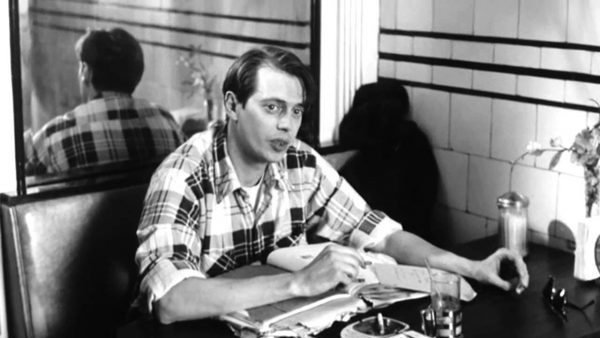
Steve Buscemi stars as a New York City nebbish with big dreams in Alexandre Rockwell’s In the Soup
IN THE SOUP (Alexandre Rockwell, 1992)
SVA Theater 1 Silas
333 West Twenty-Third St. between Seventh & Eighth Aves.
Tuesday, April 24, $25.94, 7:30
Tribeca Film Festival runs April 18-29
www.tribecafilm.com
www.factorytwentyfive.com
 The 2018 Tribeca Film Festival might be hosting gala anniversary screenings of Scarface and Schindler’s List at the Beacon with impressive rosters of superstar guests and high price tags, but the one to see is Alexandre Rockwell’s 1992 black-and-white indie cult classic, In the Soup, which is being shown April 24 at the SVA Theater. The twenty-fifth anniversary screening is a case of life imitating art (imitating life): The black comedy is about the fabulously named Adolpho Rollo (Steve Buscemi), a ne’er-do-well New Yorker living in a run-down apartment building, working on his master opus, a five-hundred-page screenplay called Unconditional Surrender that he believes will change the face of cinema itself. A familiar New York story? Perhaps, but the film was largely unfamiliar to almost everyone but the most dedicated enthusiasts, since it has been out of circulation for most of its existence. A few years ago, In the Soup was down to one last, damaged archival print, but distribution company Factory 25 began a Kickstarter campaign to restore the film in time for its quarter-century anniversary, somewhat mimicking Adolpho’s efforts to get his movie made — which, in turn, is based on Rockwell’s attempts to make In the Soup in the first place, as many of the characters and situations in the film are based on real people and actual events. With wanna-be gangster brothers Louis Barfardi (Steven Randazzo) and Frank Barfardi (Francesco Messina) breathing down his neck for the rent, Adolpho decides to sell the last thing of value (at least in his mind) that he owns, his screenplay. (In real life, Rockwell sold his saxophone to help get In the Soup financed.) His first offer is not quite what he imagined, involving a pair of cable TV producers played by Jim Jarmusch and Carol Kane. But next he meets Joe (Seymour Cassel), an older, white-haired teddy bear of a man who may or may not be connected. Joe is so excited about making a movie that he can’t stop hugging and kissing — and even getting in bed with — a confused Adolpho, who really has nowhere else to turn. Adolpho wants his next-door neighbor, Angelica (Jennifer Beals, who was married to Rockwell at the time), to star in his film, but she wants nothing to do with him, although he does succeed in making Angelica’s estranged, and plenty strange, husband, Gregoire (Stanley Tucci), mighty jealous. Adolpho is also terrified of Joe’s mysterious, apparently rather dangerous, brother, Skippy (Will Patton). Little by little, the money starts coming in, but Adolpho and Joe start having creative differences about fundraising and moviemaking, leading to a series of even odder situations with more bizarre characters.
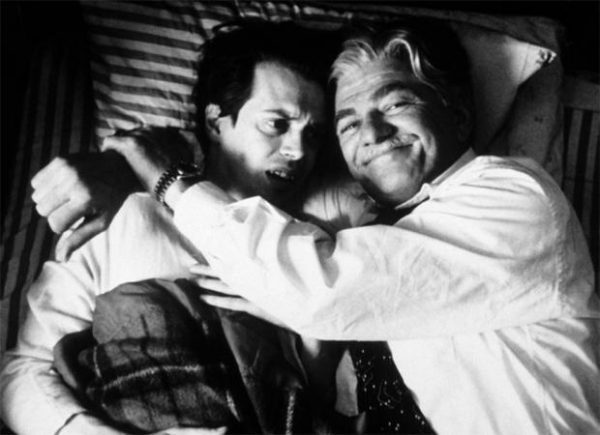
Adolpho Rollo (Steve Buscemi) meets a strange bedfellow (Seymour Cassel) in indie cult classic
A kind of cousin to Jarmusch’s 1984 gem, Stranger than Paradise, Rockwell’s third feature (following Hero and Sons) was made on a shoestring budget, shot in color by cinematographer Phil Parmet but then transferred to black-and-white to obtain a stark, drenched look. Veteran character actor and Cassavetes regular Cassel and up-and-coming actor/fireman Buscemi form a great comic duo, Cassel filling Joe with an unquenchable thirst for all life has to offer, Buscemi imbuing Adolpho with a rigid, sheltered view of existence, a young man lost in his own warped reality. “My father died the day I was born. I was raised by Fyodor Dostoevsky and Friedrich Nietzsche,” Adolpho says, as if that’s a good thing. Patton is a riot as the menacing Skippy, while Beals and Tucci have fun with their accents. The fab cast also includes Debi Mazar as Suzie, Elizabeth Bracco as Jackie, Sully Boyar as the old man, Pat Moya as Joe’s companion, Dang, Ruth Maleczech as Adolpho’s mother, Michael J. Anderson as a drug dealer, and Sam Rockwell (no relation to Alexandre) as Angelica’s brother, Pauli. In the Soup is also a great New York City film, with several awesome locations. The film won the Grand Jury Prize at Sundance, beating out Allison Anders’s Gas Food Lodging and Quentin Tarantino’s Reservoir Dogs (Cassel also won for acting), but the distribution company handling the picture went bankrupt shortly after releasing it, resulting in its scarce availability, which was a shame, because it’s an absolute treasure. But now it’s back and looking better than ever. (Coincidentally, Rockwell, Anders, and Tarantino were three of the quartet of directors who made the 1995 omnibus Four Rooms, along with Robert Rodriguez.) Alexandre Rockwell, who went on to make such other films as Somebody to Love, 13 Moons, and Pete Smalls Is Dead (with many of the actors from In the Soup), will take part in a conversation following the Tribeca Film Festival screening, joined by Buscemi, Beals, Sam Rockwell, and Parmet.