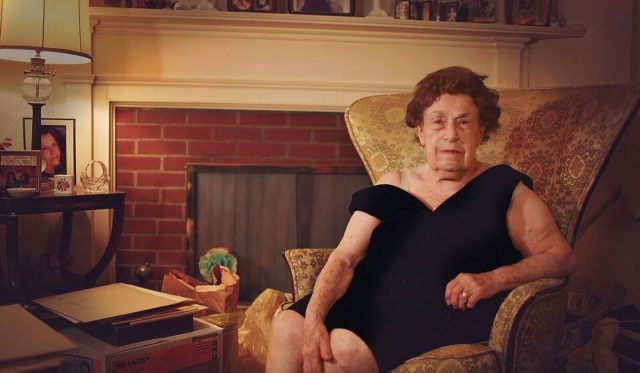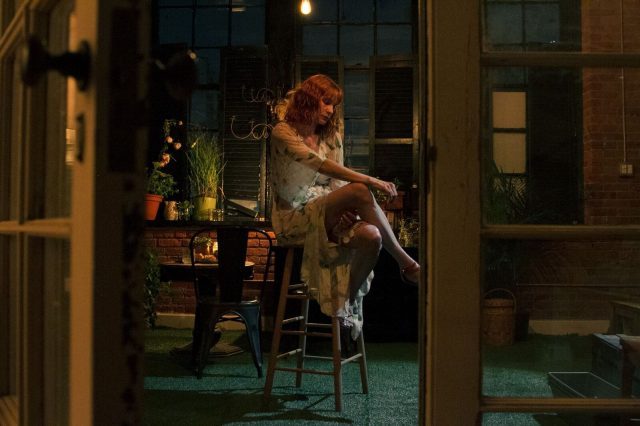
Betty 1 (Dana Delany) lets it all out in Collective Rage (photo by Joan Marcus)
MCC Theater at the Lucille Lortel Theatre
121 Christopher St. between Bleecker & Hudson Sts.
Sunday – Friday through October 7, $49-$125
212-352-3101
www.mcctheater.org
For hundreds of years, the name “Betty” has been used to describe various types of women, from hot and stylish to relaxed and self-confident, from schoolteachers and the girl-next-door to wholesome and plain; it can also refer to a man who performs household duties, a gay man, and a light-skinned black man, according to Cassell’s Dictionary of Slang. The term has been linked to Betty Grable, Bettie Page, Betty Rubble from The Flintstones, Betty Cooper from the Archie comics, Betty Boop, and Betty Crocker and has been popularized in such films as Clueless and Encino Man. The word, with its wide range of meaning, can be a metaphor for the obscured individuality of women, one name covering the vast diversity and lack of sameness for a gender that has been treated as second-class citizens for millennia. But the second sex, as Simone de Beauvoir called women, has been fighting back in new ways in recent years, as depicted in Jen Silverman’s outrageously funny and perceptive play, Collective Rage: A Play in 5 Betties, an MCC production that continues at the Lucille Lortel through October 7. In the show, Silverman also reclaims the word “pussy,” which has multiple meanings too but has become a kind of feminist call to arms given its controversial usage by President Trump. The word appears about fifty times in the play, including in the subtitle: In Essence, a Queer and Occasionally Hazardous Exploration; Do You Remember When You Were in Middle School and You Read About Shackleton and How He Explored the Antarctic?; Imagine the Antarctic as a Pussy and It’s Sort of Like That.
Collective Rage features five characters from across the spectrum: Betty 1 (Dana Delany) is white and uptight, an erudite and elegant woman in a loveless marriage with the wealthy Richard; Betty 2 (Adina Verson) is white and unsophisticated, in a boring marriage with Charles; Betty 3 (Ana Villafañe) is a tough-talking bisexual Latinx who says what’s on her mind; Betty 4 (Lea DeLaria) is a heavily tattooed white butch lesbian who spends most of her time working on her truck and pining for Betty 3; and Betty 5 (Chaunté Wayans) is an African American boxing gym owner who self-identifies as a “gender-non-conforming masculine-presenting female-bodied individual.”

Five Betties gather together to stage their own play in biting work by Jen Silverman (photo by Joan Marcus)
Betty 1 sets the tone in her opening monologue, in which she states after watching the news, “This world is terrible. This world is awful. / I am Very Very Concerned about the State of Things. / My husband Richard came home and I said to him RICHARD / I said RICHARD / I am Very Very Concerned About the State of Things. / My husband Richard is a calm person. / He is a logical and a rational person and He Wears a Suit. / And Richard said to me: BETTY / Richard said: BETTY / Richard said: Betty, Don’t Worry. / AND THAT DIDN’T MAKE ME FEEL BETTER.”
Each Betty busts female stereotypes; yet even as each is different, they all share a common loneliness, which is revealed at several women-only dinner parties. The intimate gatherings are not for men; in fact, the play itself was not written for the male gender, and in particular not straight white men. At one party, after Betty 3 raves about the first time she had sex with a woman, Betty 1 says, “That’s not good conversation for a dinner party.” Betty 3 says, “No?” Betties 1 and 2 answer in unison, “No.” Betty 3 asks, “How come?” Betty 1 says, “We don’t talk about sex at dinner parties.” Betty 3 responds, “What else you talk about?” Betty 2 replies, “We aren’t having sex, so we can’t talk about it.” Betty 3 offers, “Maybe you should start having it.” Betty 1 ends the discussion by saying, “We’re married.”

Betty 5 (Chaunté Wayans) teaches Betty 1 (Dana Delany) how to fight back in Collective Rage (photo by Joan Marcus)
At another dinner party, Betty 3 gives Betty 2 and Betty 4 hand mirrors so they can look at their vaginas up close and personal. Betty 2 is terrified, claiming she has never done that before. “What if it’s ugly?” she says. “What if there’s teeth? What if it’s lopsided? What if it’s lumpy? Or flat? Or geometrically displeasing? Or what if I don’t have one at all and there’s just a small animal who lives there, like a lizard or a dwarf-hamster, and all I see are the gleam of its little eyes as it stares back up at me?” It’s a hysterically funny scene, but it also brilliantly depicts a woman’s fear of her sexuality and control of her own body. “Look at your pussy,” Betty 3 tells her. “Both eyes,” Betty 4 adds.
After Betty 3 goes to a play with a rich white woman — they see what she calls “Summer’s Midnight Dream” — Betty 3 decides to quit her job and stage her own piece of “Thea-tah”; entranced by the play-within-a-play narrative (of Shakespeare’s A Midsummer Night’s Dream,), she is going to do the same thing, a sly reference to Collective Rage, which now also has a similar structure. All five Betties become involved in the venture, for different reasons, furthering their relationships with one another and cleverly developing their individual characters as Silverman explores their innermost desires and their sense of self, as well as their thoughts on theater. “I think a lotta things that seem like art are maybe actually just about pussy. And then also, things that are mostly about pussy might actually be about art,” Betty 4 tells Betty 3, getting right to the point.
Collective Rage unfolds over ninety riotous yet poignant minutes, in chapters with such descriptive names as “Betty 2 Acts Out Her Feelings with a Puppet Because She Has No Real Friends,” “Betty 1 Has More Rage, and Does Something About It,” and “Betty 4 and 5 Work on Their Trucks and Talk About Relationships, Which Is Just Another Word for Pussy,” the titles projected above the stage. Dane Laffrey’s relatively spare set, just a few chairs and a desk, constantly surprises as items fall down through open grids in the ceiling, from truck engines and a punching bag to other key props, like gifts from heaven. (Kudos to prop master Joshua Yocom.) Director Mike Donahue (The Legend of Georgia McBride, Silverman’s The Moors) lets the women strut their stuff, and Delany (China Beach, Dinner with Friends), DeLaria (Orange Is the New Black, The Rocky Horror Show), Verson (Indecent, The Lucky Ones), Villafañe (On Your Feet, In the Heights), and Wayans (50 Shades of Black, Hollywood Misconceptions) don’t disappoint, shining a light on gender identity, sexuality, lust, love, societal expectations, and power in the twenty-first century. It’s about how to be a Betty, and how not to be a Betty, whatever that means. “I feel like things are changing,” Betty 4 says to Betty 5, who responds, “I hope so.” Betty 4 adds, “But everything was good the way it was. Wasn’t it?” Betty 5 replies, “Change is exciting.” And Betty 4 opines, “Change is sad. Change is things getting forgotten. Change is people getting left behind.” Exactly.


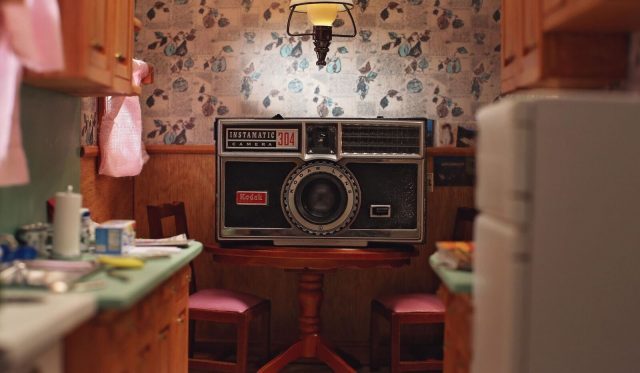
 Psychoanalysts Sigmund Freud and Carl Jung both used the metaphor of a house to represent the whole of a person and his or her psyche. Siblings Elan and Jonathan Bogarín explore that concept in 306 Hollywood, an imaginative documentary in which they seek to define who their beloved late grandmother was — and where she is after her death. In 2011, Annette Ontell passed away at the age of ninety-three. In her will, she left her home of sixty-seven years, a relatively basic suburban house at 306 Hollywood Ave. in Hillside, New Jersey, to Elan and Jonathan, who at first were encouraged by their mother, Marilyn Ontell, to sell it. But after funeral director Sherry Anthony tells the siblings that it is believed that following a death, the soul of the deceased hovers around its home for nearly a year, they changed their mind. “You have eleven months to make your grandmother tangible again,” she explains. And the Bogaríns take that time to turn the house into an archaeological dig, excavating through physical items that spur memories of the past to celebrate the life of their beloved grandmother. “As far as we knew, the house was her world,” Jonathan says. “When you lose someone you love, you start to look for new ways to understand the world,” Elan adds.