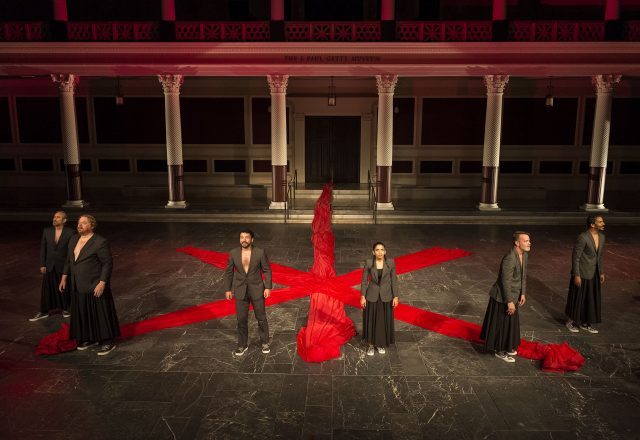
Anne Bogart and SITI Company relate Euripides’ The Bacchae to today’s sociopolitical ills in new interpretation (photo by Craig Schwartz)
THE BACCHAE
Brooklyn Academy of Music
BAM Harvey Theater
651 Fulton St. at Ashland Pl.
October 3-7, $40-$75
718-636-4100 www.bam.org
Anne Bogart and SITI Company return to BAM’s Next Wave Festival with their new interpretation of Euripides’ classic tale of gods and mortals, religion and the state, the earthly and the divine, The Bacchae. “More than any other play in Western civilization, Euripides’ is probably the one that most directly addresses the art of theater,” Bogart explains in a program note. “We are aware, for example, that we are looking at an actor or at a precisely lit staging and scenery, but at the same time we allow ourselves to enter into another world that is merely suggested by what is actually present.” The work, which premiered at the Getty Villa in California last month, is translated by Aaron Poochigian, with set and lighting by Brian H Scott, sound by Darron L West, and music composed by Erik Sanko. The cast features Ellen Lauren as Dionysus, Barney O’Hanlon as Tiresias, Stephen Duff Webber as Cadmus, Eric Berryman as Pentheus, and Akiko Aizawa as Agave. In conjunction with the show, the talk “Speaking Truth to Power: On Fear and Governance” will take place October 5 at the BAM Fisher’s Hillman Studio ($15, 6:00), with Anne Bogart and Monica Youn in conversation with Corey Robin, and BAM and the Mark Morris Dance Group are teaming up for “Introduction to Suzuki & Viewpoints,” a master class with SITI, on October 10 ($25, 12 noon) for theater artists, actors, dancers, performers, and directors.
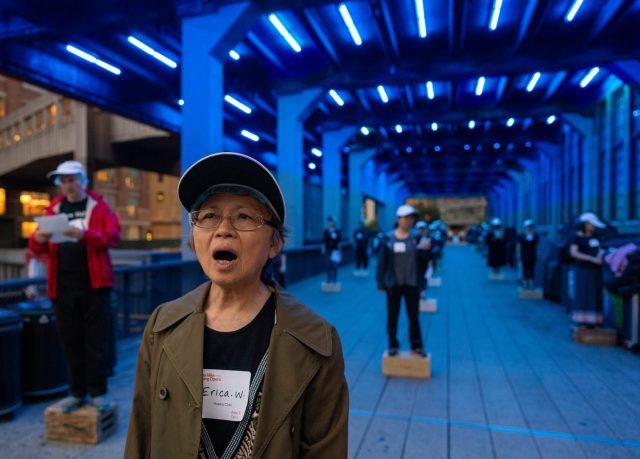
Now that we’re in October, sunset has moved into the 6:30 range, but “civil” twilight is hovering around 7:00. So it is appropriate that from October 3-8, the High Line will be hosting The Mile-Long Opera, a biography of 7 o’clock, beginning each night at seven. The free presentation consists of one thousand singers from across New York, delivering the world premiere of this site-specific event, as the audience makes their way along the elevated park. The words were written by poets Anne Carson (librettist) and Claudia Rankine (essayist), based on interviews conducted with New Yorkers at Abrons Arts Center and the Greater Harlem Chamber of Commerce in Manhattan, ARTs East NY in Brooklyn, Jacob A. Riis Neighborhood Settlement in Queens, the POINTCDC in the Bronx, and Snug Harbor in Staten Island, discussing what seven o’clock means to them. The work was created by composer David Lang and Diller Scofidio + Renfro, the design studio behind the High Line. The Mile-Long Opera is directed by Elizabeth Diller and Lynsey Peisinger, with music direction by Donald Nally, sound by Jody Elff, lighting by John Torres, and costumes by Carlos Soto; wildly inventive, multidisciplinary Icelandic artist Ragnar Kjartansson is the creative adviser. Although advance registration is closed, there will be standby lines beginning at 6:30 each night at Gansevoort & Washington Sts.; since the event is free, you can expect many people who have signed up will not show, so there should be a pretty good chance of getting in. You can also experience the event in 360 degrees via an app that will be available on October 3. So think about it: Just what does 7:00 mean to you?
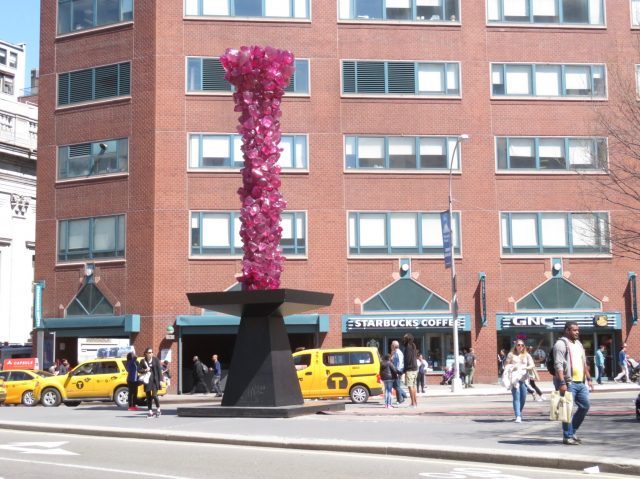
For a year, Dale Chihuly’s “Rose Crystal Tower” has stood tall on the median by the southeast corner of Union Square Park, but it’s set to come down October 5. Presented by NYC Parks, the Union Square Partnership, and the Marlborough Gallery, the thirty-one-foot-high sculpture, made of Polyvitro crystals and steel, is part of the fiftieth anniversary of the Art in the Parks program. The seventy-seven-year-old, internationally renowned, Tacoma-born Chihuly has been working with glass since the late 1960s; oddly, he was blinded in his left eye by glass in a car accident in 1976. “New York City’s energy, architecture, and rich creative history is formidable and it continues to offer infinite inspiration for artists,” Chihuly, whose “CHIHULY” exhibition was on view last year at the New York Botanical Garden, said in a statement.
King Hu’s A Touch of Zen is a trippy journey toward enlightenment
NEW YORK FILM FESTIVAL: A TOUCH OF ZEN (King Hu, 1969)
Film Society of Lincoln Center, Howard Gilman Theater
165 West 65th St. between Eighth Ave. & Broadway
Tuesday, October 2, 6:30
Festival runs through October 14
212-875-5610 www.filmlinc.org
Watching King Hu’s 1969 wuxia classic, A Touch of Zen, brings us back to the days of couching out with Kung Fu Theater on rainy Saturday afternoons. The highly influential three-plus-hour epic features an impossible-to-figure-out plot, a goofy romance, wicked-cool weaponry, an awesome Buddhist monk, a bloody massacre, and action scenes that clearly involve the overuse of trampolines. Still, it’s great fun, even if it is way too long. (The film, which was initially shown in two parts, earned a special technical prize at the 1975 Cannes Film Festival.) Shih Jun stars as Ku Shen Chai, a local calligrapher and scholar who is extremely curious when the mysterious Ouyang Nin (Tin Peng) suddenly show up in town. It turns out that Ouyang is after Miss Yang (Hsu Feng) to exact “justice” for the corrupt Eunuch Wei, who is out to kill her entire family. Hu (Come Drink with Me, Dragon Gate Inn) fills the film with long, poetic establishing shots of fields and the fort, using herky-jerky camera movements (that might or might not have been done on purpose) and throwing in an ultra-trippy psychedelic mountain scene that is about as 1960s as it gets. A Touch of Zen is ostensibly about Ku’s journey toward enlightenment, but it’s also about so much more, although we’re not completely sure what that is. The film is screening on October 2 at 6:30 as part of the fifty-sixth New York Film Festival’s Retrospective tribute to Pierre Rissient, Cannes film scout, publicist, producer, distributor, etc., who believed, “It is not enough to love a film. One must love it for the right reasons!” Rissient passed away in May at the age of eighty-one; the sidebar also includes such other films that Rissient championed as Lino Brocka’s Manila in the Claws of Light, Clint Eastwood’s Play Misty for Me, Fritz Lang’s House by the River, and Joseph Losey’s Time without Pity.
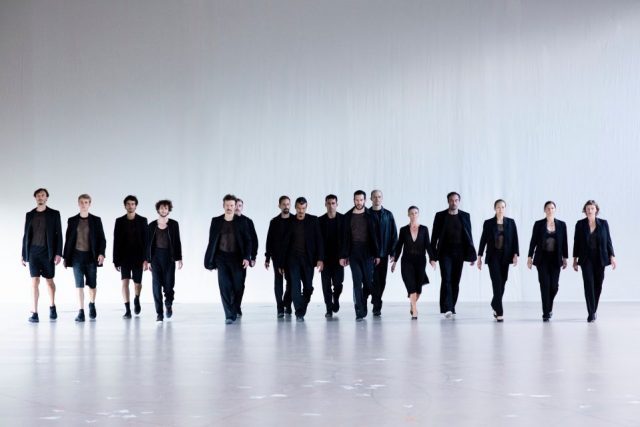
Belgian choreographer Anne de Keersmaeker has been making deeply thoughtful, intellectually exciting, stunningly beautiful work — “the art of dance as an act of writing movements in space and time,” as it says in the mission statement of her company — for nearly four decades. On October 1, just a few weeks after its September 12 world premiere in Berlin, her eagerly anticipated adaptation of The Six Brandenburg Concertos opens at the Park Avenue Armory, home to several great explorations of Bach, from the 2014 St. Matthew Passion by Peter Sellars, with the Berliner Philharmoniker conducted by Sir Simon Rattle, to the 2015 Goldberg by pianist Igor Levit and visual artist Marina Abramovic. De Keersmaeker’s piece is choreographed for sixteen members of all generations in her Rosas company, performed to all six concertos played live by noted baroque orchestra B’Rock, conducted by Amandine Beyer, who has worked with De Keekrmaeker previously. With costumes by An D’Huys and set and lighting design by Jan Versweyveld, Ivo van Hove’s partner and regular collaborator, the two-hour piece promises to be a fascinating look at the interplay of pattern in music and movement, interpreted by masters.
De Keersmaeker has never shied from setting her works to music that is both challenging and fiercely beloved; in 1980, her well-known Violin Phase was performed to the music of Steve Reich, and just a year ago in September, twi-ny was riveted by her work with Salva Sanchez on A Love Supreme at New York Live Arts, performed to John Coltrane’s classic album. “Like no other, Bach’s music carries within itself movement and dance, managing to combine the greatest abstraction with a concrete, physical, and, subsequently, even transcendental dimension,” De Keersmaeker has said. In a recent interview with Jan Vandenhouwe, artistic director of Kunsthuis Opera Vlaanderen Royal Ballet Flanders, De Keersmaeker noted, “Just like Bach in composing, I have to impose rules on myself which over time I can break. . . . Measure by measure we try to compensate Bach’s musical counterpoint with a choreographic counterpoint. It is certainly an enormous challenge to match the logic of the dance vocabulary with that of the music.” It’s a challenge that will be met in the Wade Thompson Drill Hall during this very special week of performances, by De Keersmaeker and her co-creators and dancers, Boštjan Antončič, Carlos Garbin, Frank Gizycki, Marie Goudot, Robin Haghi, Cynthia Loemij, Mark Lorimer, Michaël Pomero, Jason Respilieux, Igor Shyshko, Luka Švajda, Jakub Truszkowski, Thomas Vantuycom, Samantha van Wissen, Sandy Williams, and Sue Yeon Youn. De Keersmaeker and Beyer will take part in an artist talk with Performa founding director and chief curator RoseLee Goldberg on October 4 at 6:00; the event is sold out, but it will be streamed live on Facebook here.
Sundance-winning documentary reveals the many sides of musician and activist M.I.A.
MATANGA/MAYA/M.I.A. (Steve Loveridge, 2018)
IFC Center
323 Sixth Ave. at West Third St.
Opens Friday, September 28
212-924-7771 www.ifccenter.com www.miadocumentary.com
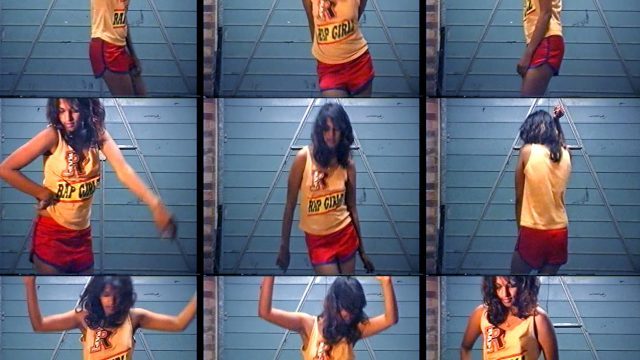
In the mid-1990s, Steve Loveridge and Maya Arulpragasam met at St. Martin’s College and became friends. Over the last twenty years, Loveridge and Maya — better known as M.I.A. — have collaborated on songs and videos, leading up to the documentary Matangi/Maya/M.I.A., an intimate portrait of Arulpragasam, from her childhood days as Matangi in Sri Lanka, where her father was the founder of the Tamil Resistance Movement, to her teen years as Maya, a developing artist, and finally as M.I.A., the controversial music star and political activist who has released such albums as Arular, Kala, and 2016’s AIM, which she claimed would be her last. Maya has been filming herself since she was very young, and she opened up her vast archives to Loveridge, who sifted through nearly nine hundred hours of recordings to make his first film. Loveridge shows Maya working on her music, protesting for peace, and famously raising her middle finger while performing with Madonna at the Super Bowl. M.I.A. is a powerhouse onstage — I was blown away by an October 2007 concert at Terminal Five — but Loveridge reveals her more sensitive and vulnerable sides in addition to her fierce ambition and pride in who she is and where she is from. Matangi/Maya/M.I.A. is now playing at IFC Center; before attending several postscreening Q&As, Loveridge discussed the film with twi-ny, giving thoughtful, extremely honest, and provocative answers to questions about his friendship with Maya, his feelings about the music industry, and his future as a filmmaker.
twi-ny: What was it that first attracted you to Maya at art school?
Steve Loveridge: She was confident. I was very shy and I think she was much better at meeting people, finding ways to access different places. She took me on lots of adventures and made London seem like a playground.
Also, in our work — I think the other students and tutors on the course kind of looked down on pop culture — music videos, TV movies, mainstream film — but Maya and I, being a gay guy and a brown girl, maybe we saw more value and significance in what pop culture could mean and how it could reach and create change in the world because we had personal experience of it changing our ideas of ourselves, helping us have a vision of who we could become, and being a lifeline when we were teenagers and we didn’t have any people the same as us around to guide us in real life.
twi-ny: Could you tell back then that she was primed for international stardom?
sl: Yes. I think everybody’s got a story, everyone is interesting — but if you’re a poor person and don’t have a “way in” to the arts, or any connections, you have to have a special kind of confidence and robustness to go and knock on doors and ask to be let in, because no one’s going to do it for you. She had that. It took a while for her to find the right door, but she was looking for a way in every day.
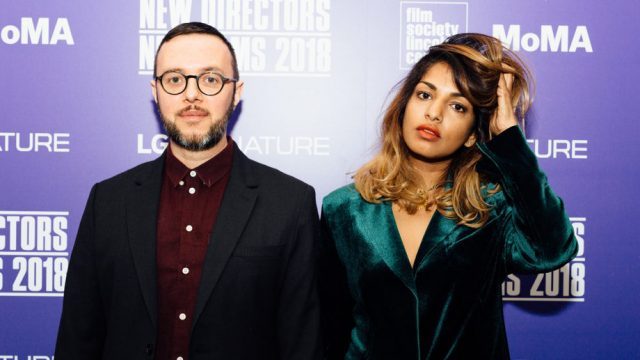
Steve Loveridge and M.I.A. at New York premiere of documentary at Film Society of Lincoln Center at New Directors/New Films festival (photo by Sean DiSerio)
twi-ny: Do you think it is easier or harder to make a documentary about someone you know so well?
sl: Ordinarily, I’d say it’s harder. I think objectivity is too difficult and I would question the wisdom of a friend making a film about a friend. But in this circumstance I feel like Maya, and her family, and the Tamil community were so jaded and mistrustful of the media and interviewers that this story had to be trusted to someone who had earned that trust on a personal level.
twi-ny: In the film, Maya says that she originally wanted to become a documentary filmmaker, and that is evidenced by how much footage she compiled over the years. Did she ever stray from being the subject and instead act like a director or editor? How involved in the process was she?
sl: It was vital from the outset that she wasn’t involved in the edit at all. Even though we’re friends, just to keep things clear, we got a lawyer and did a contract that said I had final cut and she wasn’t allowed into the edit suite. I think that’s amazing trust on her part — I would never ever let someone do that with my personal videos. Especially as she hadn’t watched most of them for years.
twi-ny: What was it like sifting through her archives?
sl: It was emotional and also very educational — I learnt a lot more about her family story. It also reminded me of why I became her friend in the first place.
twi-ny: Was there anything that she declared was off-limits?
sl: On a couple of the tapes she’s chatting to people about me when she’s in a bad mood, and it’s funny eavesdropping on conversations about you that people had fifteen years ago.
twi-ny: How many hours of footage was available?
sl: It was very difficult to deal with the amount of material. There was about seven hundred hours of vérité filming, one hundred of media archive of M.I.A., about thirty hours of performance. One of the hardest things was watching footage of her and talking about her all day and then also trying to maintain a friendship — it was too much, so we had to take a break from each other for a bit and not really talk much.
twi-ny: Regarding that, there were some issues between you, Maya, and her record label, leading to your posting that you “would rather die than work on this.” How did that all get settled? It certainly appears that you and M.I.A. are on good terms again, if there ever really were problems.
sl: Yeah, the problem wasn’t Maya (although I did think she coulda stepped in and helped me out a bit more — it’s hard for a little filmmaker to deal with Interscope, Roc Nation, and all these music industry people all on your own!).
The basic problem was that I worked on the film for a whole year in 2012, with it funded by Interscope, and then suddenly one day they just stopped the funding — but not in a professional, courteous way; they just didn’t pay their bills, stopped answering the phone, and left the production company just guessing. I got angry that Maya’s management weren’t interested in helping me sort the situation and we had a fight about it.
Part of the frustration was that in 2013, Sri Lanka was controversially chosen to host the Commonwealth Heads of Government Meeting, which felt like a real blow to the Sri Lankan Tamil community in their quest for some kind of accountability for the human rights abuses that had happened at the end of the civil war in 2009.
Maya was really, really keen to get the film out in some form that year, in case it helped raise awareness in some tiny way, so it was difficult feeling blocked by her own team.
In the end, the situation was resolved by scrapping the whole project with the record label. I went away and got a job, forgot about the movie for a year, and then in 2014 we found funding from Cinereach, a New York not-for-profit who had seen the trailer I leaked online and got in touch. We started again from scratch with a whole different approach. Making the film in the independent documentary space instead of from inside the music industry transformed it completely, and I was able to make a film that matched my vision.
So when Maya says the film took seven years, or ten years, like she keeps telling interviewers — it wasn’t all my fault! It really only took from 2014 to 2017, which apparently isn’t that bad for a feature doc, especially as I was a first-timer and had nearly nine hundred hours of material.
twi-ny: Are you fully satisfied with the final product? Is the Maya onscreen the Matangi/Maya/M.I.A. you’ve known for more than twenty years?
sl: I am. It’s definitely only about a certain aspect of her story — I focused on her cultural identity and how she negotiates being all these different things at once, and I think it does a good job at evoking what that feels like to be around. People describe the film as “messy in a good way,” and that’s how she feels. I left out all the gossipy relationship stuff with boyfriends, and it’s not really a traditional music doc in that there’s not much of her artistic process or output other than when it serves the identity narrative. But I feel like her music and art are out there and available for people to discover and dip into as much as they like.
twi-ny: Do you have a favorite song/album/video of hers?
sl:“The Message” is great, on her third album [Maya] — whoever wrote that is a genius. [Ed. note: The song was cowritten by Loveridge with Sugu Arulpragasam, Maya’s brother.] But my favorite is always “Galang” because it was the first thing. When the record label sent us the first pressing, it was so exciting holding a vinyl record in my hand that she’d actually made, and then doing the video with all her stencil artwork in it and seeing it on YouTube, it felt like some kind of validation and like the world was suddenly opening up for us.
twi-ny: This is your first feature documentary; do you plan on making more films in the future?
sl: Maybe — I’d certainly never sign up for something again where I only get paid based on hitting certain stages; making this film has crippled my personal finances, and it’s going to be hard to ever contemplate doing that again! I honestly sometimes feel like filmmaking is really only for rich people. But I love stories and storytelling and maybe I’ve learnt enough about the things that slowed this project down to not make the same mistakes again and I could do it in a way that can work for me creatively and financially.
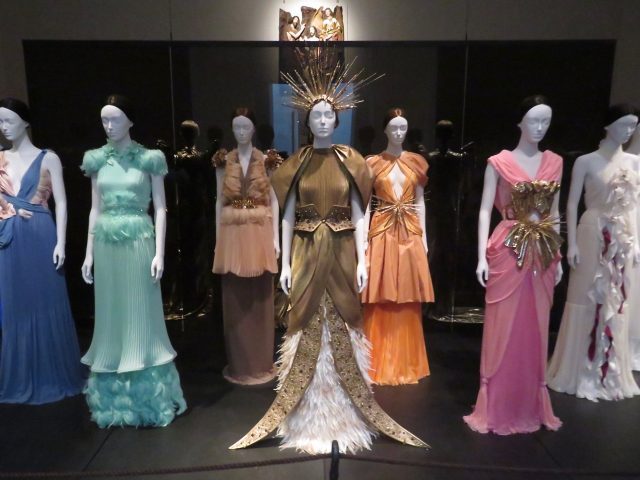
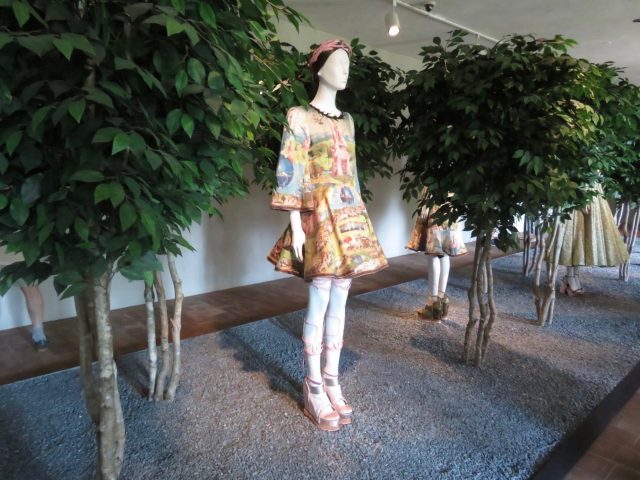
You don’t have to be a clothing aficionado or a Catholic to be awed by the Met’s spectacular exhibition “Heavenly Bodies: Fashion and the Catholic Imagination.” There’s a good reason why it has become the institution’s third most popular show ever (after the 1963 presentation of the Mona Lisa and the 1978 blockbuster “Treasures of Tutankhamun”), welcoming more than a million visitors: It’s a sensational display, superbly organized by Andrew Bolton. Continuing through October 8, “Heavenly Bodies” is spread across the Met Fifth Ave., in the medieval galleries, the Mary and Michael Jaharis Galleries for Byzantine Art, the Robert Lehman Wing, and the Anna Wintour Costume Center, as well as the Met Cloisters, totaling more than sixty thousand square feet. Mannequins dressed in jaw-dropping outfits line hallways, gather on pedestals, appear in surprising places, and interact with installations, revealing the influence Catholicism and art have had on fashion, and vice versa.
Cloisters installation re-creates the Garden of Eden inspired by Hieronymous Bosch’s “The Garden of Earthly Delights” (photo by twi-ny/mdr)
“Some practicing Catholics might perceive certain fashions shown as indelicate or even offensive, either for their retrograde and reactionary associations (by the liberal left) or for their sacrilegious and blasphemous implications (by the conservative right),” Bolton writes in his catalog introduction. “Similarly, there might be concerns on the part of Catholics and non-Catholics alike that fashion is an unfitting and unseemly medium by which to convey ideas or reflect imagery related to the sacred and the divine. Dress, however, is central to any discussion about religion: it affirms religious allegiances and, by extension, asserts religious differences.”
At the Met Fifth Ave., a row of colorful dresses refers to the ecclesiastical fashion show from Federico Fellini’s Roma. Hierarchical clothing and habits appear in front of medieval tapestries. Thierry Mugler’s tenth-anniversary collection, “The Winter of the Angels,” consists of celestial figures, while Jeanne Lanvin’s dresses are inspired by Fra Angelico paintings. Jean-Paul Gaultier’s “ex-Voto” evening ensemble is paired with Byzantine copper panels depicting scenes from the life of Jesus. An evening dress by Gianni Versace has a bold cross running down the entire front, inspired by a Byzantine processional cross he saw at the Met. A haunting choir row in robes by Cristóbal Balenciaga stands high above. John Galliano’s evening ensemble for the House of Dior looks like it could be worn by Jeremy Irons as the pope in The Borgias. In the Costume Institute, actual papal finery is on display, real items worn by religious leaders, shown in vitrines but not on mannequins.
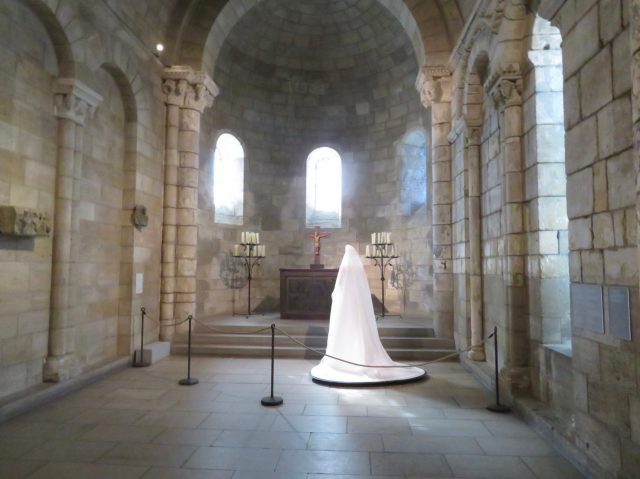
Marc Bohan’s “Hyménée” for the House of Dior plays out as a haunting narrative at the Cloisters (photo by twi-ny/mdr)
At the Cloisters, there are several tableaux in which a figure is placed in such a way as to create a narrative, most effectively with a woman seen primarily from the back in a wedding dress by Balenciaga as she waits alone in the Fuentidueña Chapel while “Ave Maria” plays on a loop, along with another wedding dress, by Marc Bohan for the House of Dior, worn by a woman in the Langon Chapel. The Garden of Eden is re-created in the Glass Gallery with garments by Maria Grazia Chiuri and Pierpaolo Piccioli for Valentino, Raf Simons for Christian Dior, and Jun Takahashi that include direct references to such famous works as Hieronymous Bosch’s “The Garden of Earthly Delights.” Thom Brown incorporates the Met’s famous Unicorn Tapestries into a wedding dress in that room. Chiuri and Piccioli’s daring red dress in the Merode Room is based on the virgin in “The Annunciation Triptych” (and is echoed in a small stained-glass image of Jesus behind it), on view nearby. Galliano’s stunning black gown for Dior in the Gothic Chapel mimics the crypts and armor surrounding it. Gaultier’s “Guadalupe” boasts a knife plunged through a dripping heart. Classical music echoes in each hall and gallery.
Another star of the show is Shay Ashual, who created the remarkable wigs and hairstyles on the mannequins, artworks in their own right that bring an unusual and engaging aspect to the wide-ranging couture. In his catalog essay, “A Vision of Beauty: Fashioning Heaven on Earth,” C. Griffith Mann writes, “Beauty and its role in visualizing the holy was a fundamental preoccupation of medieval thinkers, artists, and patrons.” As “Heavenly Bodies” so lovingly and intelligently demonstrates, the same is still true today, so make your pilgrimage before it’s too late.
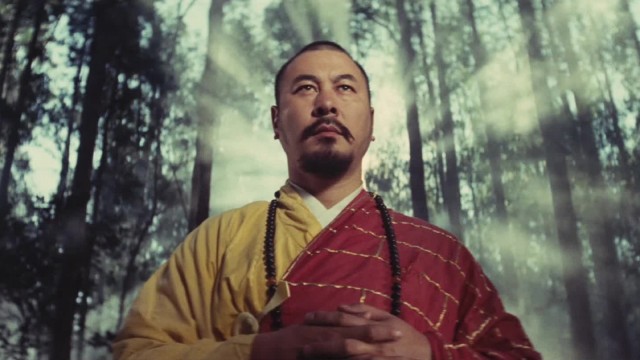
 Watching King Hu’s 1969 wuxia classic, A Touch of Zen, brings us back to the days of couching out with Kung Fu Theater on rainy Saturday afternoons. The highly influential three-plus-hour epic features an impossible-to-figure-out plot, a goofy romance, wicked-cool weaponry, an awesome Buddhist monk, a bloody massacre, and action scenes that clearly involve the overuse of trampolines. Still, it’s great fun, even if it is way too long. (The film, which was initially shown in two parts, earned a special technical prize at the 1975 Cannes Film Festival.) Shih Jun stars as Ku Shen Chai, a local calligrapher and scholar who is extremely curious when the mysterious Ouyang Nin (Tin Peng) suddenly show up in town. It turns out that Ouyang is after Miss Yang (Hsu Feng) to exact “justice” for the corrupt Eunuch Wei, who is out to kill her entire family. Hu (Come Drink with Me, Dragon Gate Inn) fills the film with long, poetic establishing shots of fields and the fort, using herky-jerky camera movements (that might or might not have been done on purpose) and throwing in an ultra-trippy psychedelic mountain scene that is about as 1960s as it gets. A Touch of Zen is ostensibly about Ku’s journey toward enlightenment, but it’s also about so much more, although we’re not completely sure what that is. The film is screening on October 2 at 6:30 as part of the fifty-sixth New York Film Festival’s Retrospective tribute to Pierre Rissient, Cannes film scout, publicist, producer, distributor, etc., who believed, “It is not enough to love a film. One must love it for the right reasons!” Rissient passed away in May at the age of eighty-one; the sidebar also includes such other films that Rissient championed as Lino Brocka’s Manila in the Claws of Light, Clint Eastwood’s Play Misty for Me, Fritz Lang’s House by the River, and Joseph Losey’s Time without Pity.