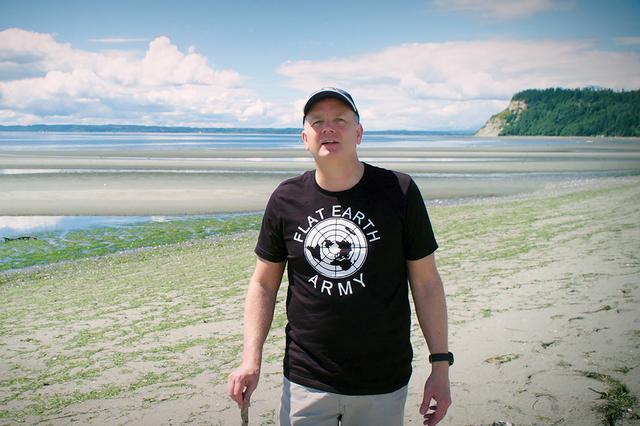
Flat Earth superstar Mark Sargent shares his theories in Behind the Curve
BEHIND THE CURVE (Daniel J. Clark, 2018)
Cinepolis Chelsea
260 West 23rd St. between Seventh & Eighth Aves.
Saturday, November 10, 8:00
Festival runs November 8-15
www.docnyc.net
www.behindthecurvefilm.com
A few years ago, I got into a series of social media discussions with an old high school acquaintance who believed in a lot of conspiracy theories. It turns out he is a Flat Earther, one of a growing number of Americans who believe that the planet is not round. He asked me to watch a bunch of videos that supported his beliefs, and I did, but no matter what science-based evidence I threw back at him, he was prepared with an answer that often included claims that high-level, respected scientists were part of the conspiracy, that they were being paid off by the secret government. I ultimately ended our social media friendship when it turned into a false flag discussion and it became evident he thought reports of mass shootings were hoaxes as well. Anyway, Daniel J. Clark’s Behind the Curve brought that all back for me. In the expertly made film, screening November 10 in the Science Fiction section of DOC NYC, Clark tracks the exploits of several very public Flat Earthers as they prepare for the first annual Flat Earth International Conference in 2017 in Raleigh, North Carolina. Many are eager to hear in person from those they follow online, leaders in the movement who regularly post videos “proving” that there’s no curve to the Earth. “I didn’t choose flat earth; flat earth chose me,” Flat Earth superstar and former digital pinball champion Mark Sargent explains. Clark spends a lot of time with Sargent and his cohort, the Morrissey-loving Patricia “the Interviewer” Steere, as they attend meetups, go to a NASA museum, watch the supposed solar eclipse, and make new videos. Among the others attending the conference are Nathan “the Evangelist” Thompson, Bob “the Engineer” Knodel, Chris “the Craftsman” Pontius, and Jeran “the Experimenter” Campanella as well as people who go by such names as Infinite Plane Society and Odd Reality; the only Flat Earther who turns his back on the conference is the angry Matt “Math Powerland” Boylan, who thinks Sargent is a plant working for Warner Bros.
Clark allows the Flat Earthers to make their case, neither judging them nor portraying them as idiots. He does, however, speak with a number of concerned professionals who delve into the psychological reasons why people fall for conspiracy theories, including Caltech astrophysicist Hannalore Gerling-Dunsmore, UCLA psychiatry professor Dr. Joe Pierre, Caltech physicist Dr. Spiros Michalakis, Caltech astronomer Dr. Erika Hamden, NASA astronaut Commander Scott Kelly, psychologist and writer Dr. Per Espen Stoknes, high school teacher Stephen Hagberg, and science writer Tim Urban. (He purposely avoided such well-known debunkers as Neil “He Who Shall Not Be Named” deGrasse Tyson and Bill Nye the Science Guy.) They all show empathy and understanding for the Flat Earthers, treating them as misguided people rather than absurd zealots for a ridiculous cause, a tempting characterization of those who believe, among other things, that we are all living inside a giant dome like in The Truman Show. The experts discuss such diagnoses as impostor syndrome, the Dunning-Kruger Effect, institutional disconfirmation, information bias, miseducation, scientific superiority complex, and a general distrust of authority, never outright criticizing any of the Flat Earthers. One of the Flat Earthers humorously states that most of them do not live in their mother’s basement; however, Sargent does spend a significant amount of time with his mom, who is not fully sold on the planet being flat. Clark and producers Nick Andert and Caroline Clark will be at the Cinepolis Chelsea screening to talk about the film.
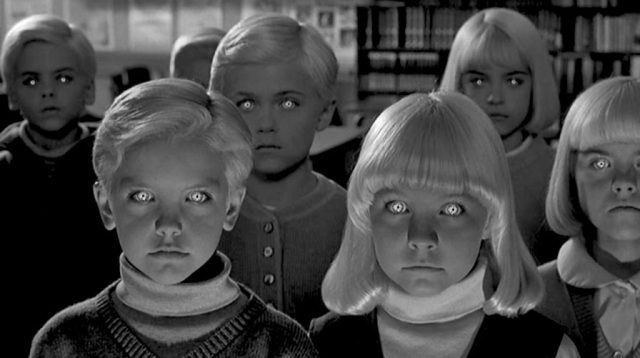
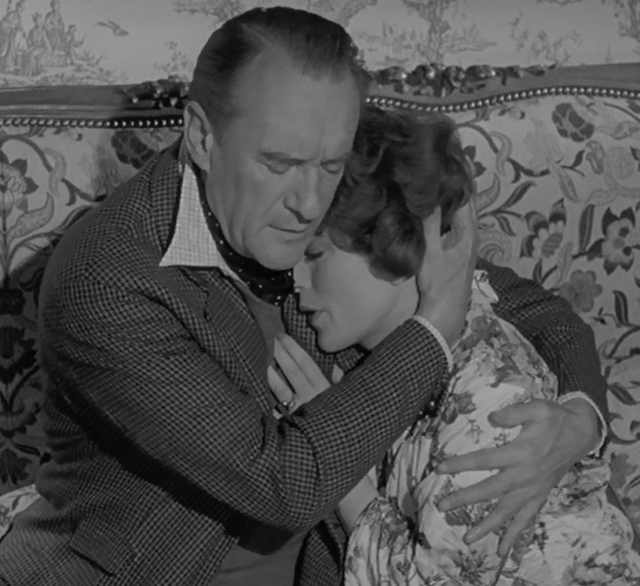
 The Rubin Museum’s Cabaret Cinema series “Sci Fi Cine Club Kolkata” comes to a creepy close November 9 with the classic 1960 British sci-fi horror flick Village of the Damned. Based on John Wyndham’s 1957 novel, The Midwich Cuckoos — Wyndham also wrote The Day of the Triffids as John Harris, among other books and at least one other pseudonym — Village of the Damned was the first film shown by Indian master and self-described “science-fiction addict” Satyajit Ray at the Sci Fi Cine Club he started in Kolkata in January 1966. The story combines postwar paranoia with a fear of alien invasion — as well as the normal worries associated with childbirth. On what appeared to be a regular afternoon in the quiet little English rural town of Midwich, every living being passes out at the same exact time. When they awaken, no one’s sure what happened — but two months later, every woman able to carry a child is pregnant, including Anthea Zellaby (Barbara Shelley), who is married to Professor Gordon Zellaby (George Sanders), a much older man who did not think it possible he could become a father. When the babies are all born on the same day and on an accelerated schedule, everyone knows there is something strange — the infants’ eerie eyes are a pretty big giveaway — but they decide to raise the children nonetheless. Professor Zellaby sees this as a terrific opportunity for research — even involving the boy born to Anthea, David (Martin Stephens), who appears to be the leader of the blond-haired bunch — while military men Alan Bernard (Michael Gwynn) and General Leighton (John Phillips) are far more skeptical of the town’s, and the world’s, future.