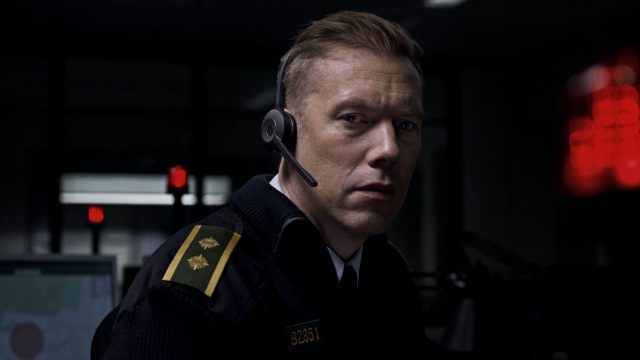
Jakob Cedergren stars as a cop on the edge in gripping thriller by debut director Gustav Möller (photo courtesy of Magnolia Pictures)
THE GUILTY (DEN SKYLDIGE) (Gustav Möller, 2018)
Quad Cinema
34 West 13th St. between Fifth & Sixth Aves.
November 13-15
212-255-2243 quadcinema.com www.theguiltyfilm.com
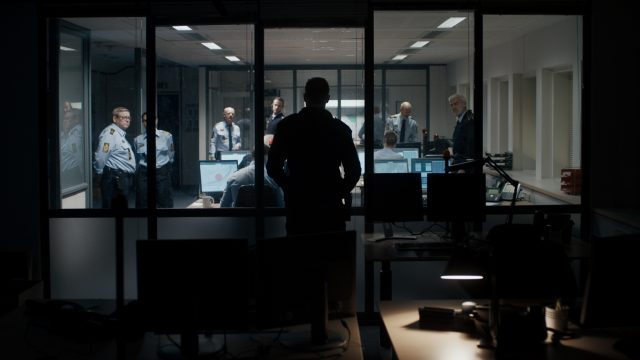
Danish director Gustav Möller’s debut feature, The Guilty, is a furiously intense, brilliant edge-of-your-seat procedural. Jakob Cedergren stars as police officer Asger Holm, who has been demoted to working in an emergency call center pending an investigative hearing into a mysterious incident; if the investigation exonerates him, he’ll be back out on the street, where he wants to be. The night before the hearing, he’s at the center, sitting in front of a computer, taking calls on a headset, mostly dismissing people’s problems with a shrug and a lack of concern, although his prowess is evident when he quickly gets to the bottom of things with callers who don’t tell him the full story. But then Iben Østergård (Jessica Dinnage) phones in, a distraught woman who apparently has been kidnapped by a crazed man (Johan Olsen), leaving her six-year-old daughter, Mathilde (Katinka Evers-Jahnsen), and infant home alone. Holm faces many of his own demons as he desperately tries to save Iben, demanding favors from dispatchers, including his friend and colleague Bo (Jacob Hauberg Lohmann); his partner, Rashid (Omar Shargawi), who is supposed to testify for him the next day; and others even as they warn him he is overstepping and needs to back off. It’s a pulse-pounding race against time as Holm continues to break the rules and protocol in order to rescue Iben — as if saving her would save him too, achieving the redemption he seeks.
Asger Holm (Jakob Cedergren) is battling more than just time in The Guilty (photo courtesy of Magnolia Pictures)
Denmark’s official submission for the 2019 Oscar for Best Foreign Language Film, The Guilty, which was written by Olsen with Emil Nygaard Albertsen, is a nonstop thrill ride and character study that takes place completely in the call center and in real time. Olsen, who also is the lead singer in two rock bands, maintains the frantic pace primarily through words, in addition to Cedergren’s facial expressions; the audience is caught up in the fierce action even though it is only heard, never seen. Cinematographer Jasper Spanning, editor Carla Luffe, and supervising sound editor Oskar Skriver expertly upend the claustrophobic nature of the story by making it seem like we can see the car chase, Iben’s terror, and Mathilde’s horrible situation. Of course, each viewer will see things slightly differently, bringing their own experiences and biases into the tale. Winner of audience awards at Rotterdam and Sundance, The Guilty is centered by an unrelenting performance by Cedergren (Submarino, Terribly Happy) as a man on a mission — and harboring some dark secrets — as the plot twists and turns. Don’t miss it.
Art During the Occupation Gallery, Bushwick
119 Ingraham St., Buzzer 05
Ground Floor Main Gallery, Brooklyn Fire Proof Building
Tuesday, November 13, and Wednesday, November 14, $15, 7:30 www.art-during-the-occupation-gallery.com
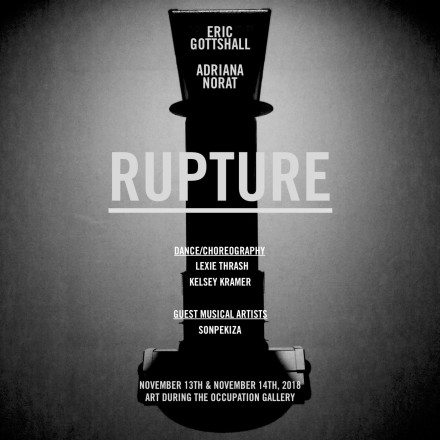
Art During the Occupation Gallery in Bushwick is temporarily deinstalling its current exhibition, David B. Frye’s “Return of the Mack,” in order to present the two-night experiential art performance Rupture. The thirty-five-minute piece features dance and choreography by Lexie Thrash and Kelsey Kramer, featuring performance artist Eric Gottshall, sound artist Adriana Norat, and musical artist Sonpekiza, exploring ideas of fear, pessimism, displacement, and death through music, movement and wearable sculpture. Tickets are $15; the shows begin at 7:30 and will be followed by a reception with the artists.
The Pershing Square Signature Center
The Irene Diamond Stage
480 West 42nd St. between Tenth & Eleventh Aves.
Tuesday-Sunday through December 9, $35-$65
212-244-7529 www.signaturetheatre.org
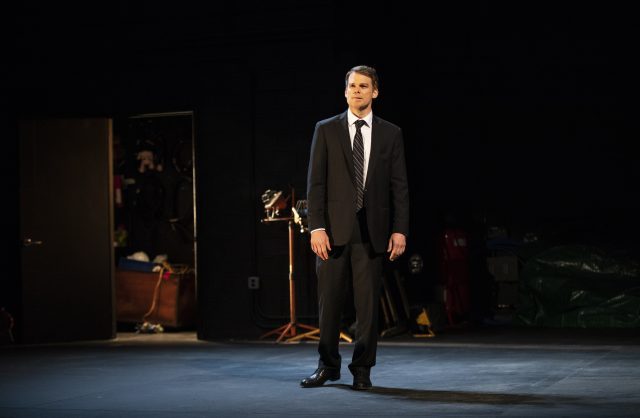
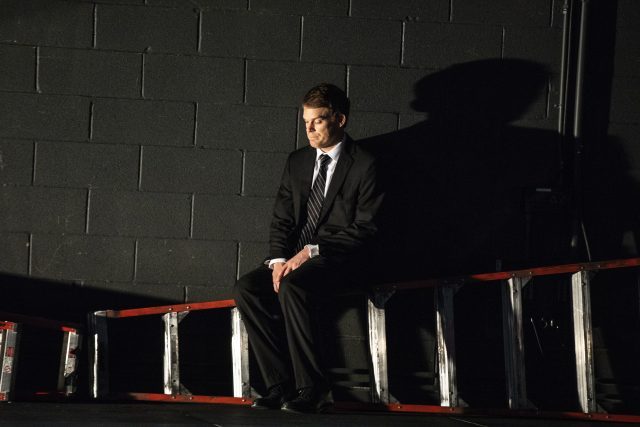
At the entrance to the Irene Diamond Stage at the Pershing Square Signature Center, a sloppily handwritten sign says, “Pardon Our Appearance.” The theater inside seems to be in the midst of some serious construction: There’s a huge hole in the floor at the front of the stage, which is littered with various pieces of equipment, and protective sheets hang on the walls and from the ceiling, as if preventing the place from collapsing. Amy Rubin’s deteriorating set matches the crumbling mind of Thom Pain, superbly played by Michael C. Hall, in the Signature revival of Will Eno’s 2004 Pulitzer Prize finalist, Thom Pain (based on nothing), which opened last night. Pain is the epitome of the unreliable narrator, beginning jokes and stories he never finishes, posing repeated questions that he answers differently each time, and inviting audience participation only to then take it back. “How wonderful to see you all,” he says at the start, in near-complete darkness save for the occasional light from his cigarette. The seventy-minute monologue, previously performed by James Urbaniak and, more recently, Rainn Wilson in LA in 2012, touches on such notions as time and memory, fear and loneliness. Wearing an everyman-style standard suit (the costume is by Anita Yavich), Pain walks back and forth across the deep stage and wanders through the audience as he indifferently relates a tale about a young boy, his dog, and a puddle, possibly a scene from his past that left him emotionally scarred. “When did your childhood end?” he asks rhetorically. “How badly did you get hurt, when you did, when you were this little, when you were this wee little hurtable thing, nothing but big eyes, a heart, a few hundred words? Isn’t it wonderful how we never recover? Injuries and wounds, ladies and gents. Slights and abuses, oh, what a paradise.”
He self-referentially refers to the show as “our little turn, on the themes of fear, boyhood, nature, hate, the nature of performance and vice-versa, the heart of man, of woman, et cetera.” He steps in and out of darkness courtesy of Jen Schriever’s sharp lighting design. “Does it scare you? Being face-to-face with the modern mind? It should. There is no reason for you not to be afraid. None. Or, I don’t know,” he says. He makes direct eye contact with as many audience members as he can, searching for connections that have otherwise eluded him. “As for our story, if you’re lost at all, you’re not alone,” he tells us. “Don’t think I’m somewhere out ahead, somewhere, anywhere, with a plan. I’m right here beside you, or hiding behind you, like you, in terrible pain, trying to make sense of my life. I’m just kidding — you probably are alone. Or, I don’t know. Where are we, exactly, I wonder, in your estimation, in mine.” By the end, we know everything about him, as well as nothing, his search for relevancy perhaps evoking our own.
Hall, the Dexter and Six Feet Under star who has excelled on Broadway in Eno’s The Realistic Joneses and John Cameron Mitchell and Stephen Trask’s Hedwig and the Angry Inch and off Broadway in Ivo van Hove’s Lazarus, is outstanding as Pain, a role that Eno (Title and Deed,The Open House,Wakey, Wakey, all at the Signature) notes in the script should be played by an “actor [who] must also create a character that is close to — and largely derived from — himself.” Hall keeps us mesmerized with just the right amount of confusion to make us wonder what is real and what isn’t, what is truth and what is not. When he asks several times if we like magic, he is also referring to the magic of theater, which Eno and director Oliver Butler (The Open House, What the Constitution Means to Me) tear down rather elegantly. It’s a disorienting yet exhilarating experience, a journey into the digressive nature of life, constantly under construction, and the mind of a man trying to find his place in the world, just like we all are.
Hoyt Richards looks back at a critical decision in his life in Welcome to the Beyond
WELCOME TO THE BEYOND (Brent Huff, 2018)
Cinepolis Chelsea
260 West 23rd St. between Seventh & Eighth Aves.
Tuesday, November 13, 7:30
Festival runs November 8-15 www.docnyc.net www.welcometothebeyond.com
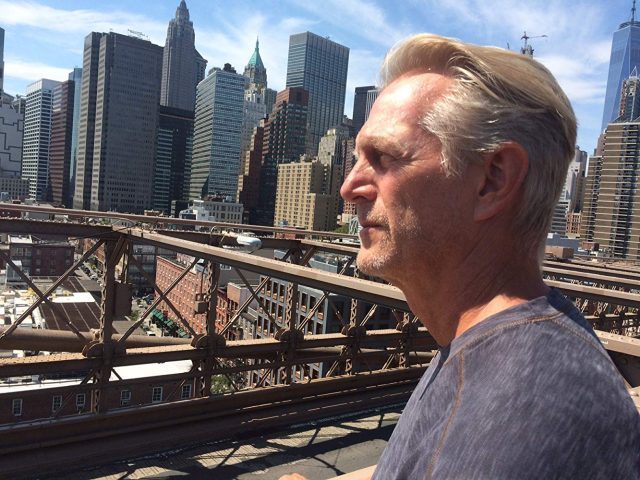
In the summer of 1978, Hoyt Richards, a gorgeous blond athlete from a large, successful family, was approached by a man on a beach in Nantucket who offered him a bright future. Richards, aka John Richards, appeared to already have it all, but he eventually followed the man, who turned out to be Frederick von Mierers, the leader of the Eternal Values cult, who claimed to be an alien from the planet Arcturus. Former model Brent Huff tells the bizarre story, in many ways a cautionary tale, in Welcome to the Beyond, screening November 13 at DOC NYC. In 2012, while filming a Ford Models reunion, actor, writer, and director Huff (Behind the Orange Curtain, Chasing Beauty) recognized Richards and approached him about making a documentary about his experience with Eternal Values. Richards agreed, and speaks extensively about what happened to him; Huff also meets with many of Richards’s friends and relatives. “There’s definitely a dynamic in this family that’s regrettable,” younger brother Garth says. “That dynamic had to do with, John was always my father’s favorite, and John epitomized what my father would have loved to have been: the blue-eyed, blond-haired, good-looking football player. There’s a cruel twist in all that, is that by my father making John his favorite, he created resentment from every other sibling of John. He put John on an island, and I don’t know how John internalized that, but that wasn’t a pretty place to be.”
Talking about his mother, John, who is one of the film’s producers, admits, “I always just felt like she was on a different planet.” John was the first male supermodel, went to Princeton, partied at Studio 54, and had a major career, but ultimately he came to understand that he was in a cult and that he had to get out. The psychology behind his story is related by Steven Hassan, a former cult member who became a deprogrammer and has written such books as Combatting Cult Mind Control. Richards’s five siblings, cousins, parents, and close friends as well as a fellow former cult member all share their thoughts on a situation that they still don’t really understand: Just why did Richards fall for von Mierers and Eternal Values? Welcome to the Beyond is screening November 13 at 7:30 at Cinepolis Chelsea in the Portraits section of DOC NYC, with Huff, producer Shawn Huff, and editor Pete Speneuk on hand for a Q&A.
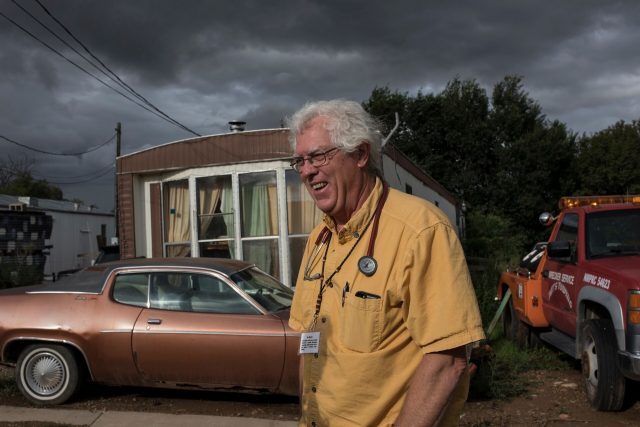
Chris Ruge is one of three health-care workers profiled in The Providers trying to make a difference in northern New Mexico
THE PROVIDERS (Anna Moot-Levin & Laura Green, 2018)
IFC Center
323 Sixth Ave. at West Third St.
Monday, November 12, 12:45
Festival runs November 8-15
212-924-7771 www.docnyc.net theprovidersdoc.com
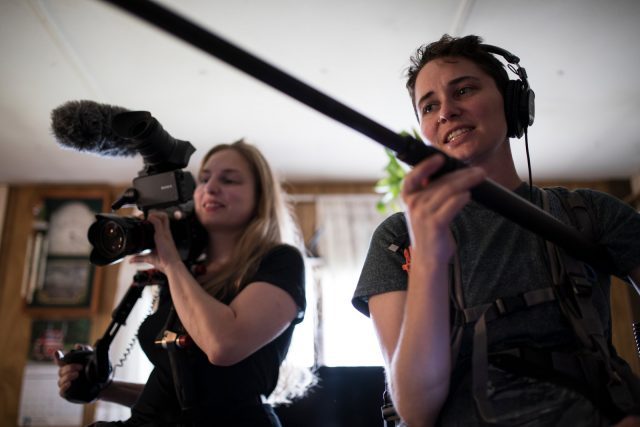
Most recent polls show that health care is the number one concern of most Americans, ahead of the economy, immigration, the environment, gun violence, and other issues. Filmmakers Anna Moot-Levin and Laura Green travel to northern New Mexico to explore a critical aspect of the health-care crisis in the moving, almost elegiac The Providers, which is making its New York City premiere at the DOC NYC festival. Moot-Levin and Green, both the children of doctors, directed, produced, photographed, recorded the sound, and edited (with Chris Brown) the film, which follows three health-care workers as they deal with poor, underserved patients with empathy, compassion, and understanding in small rural towns. “My job is to try to keep you alive,” nurse practitioner Chris Ruge tells one patient. “Health care is a relationship,” explains physician assistant Matt Probst. And family physician Leslie Hayes points out that once she retires, there is no one to take over for her. Moot-Levin and Green spent one hundred days over three years in Las Vegas, Albuquerque, and Española in New Mexico, going behind the scenes as Ruge, Probst, and Hayes treat men, women, and children, including many adults suffering from alcoholism, opioid abuse, and other addictions. The three providers are part of the ECHO Care program at El Centro clinics, which allows them to see patients who have little or no money; they visit them in the hospital and make house calls, often stopping by just to check on how things are going. “There is so much beauty here. And there is so much pain,” Probst says.
Anna Moot-Levin and Laura Green on the set of The Providers, their first film
The film also reveals how their dedication to their jobs impact their private lives; Ruge’s wife, nurse midwife Ann Ruge, complains that her husband cares more about his patients than about her, while Probst has to deal with an addicted father and troubled sister. When future funding for ECHO Care is in jeopardy, Chris Ruge notes, “If it ended, it would likely lead to the early death of a lot of our patients.” Another problem is where the next generation of health-care workers will come from to serve these indigent communities; Probst teaches physician assistant students at the University of New Mexico, where he hopes to find young men and women willing to stay local. “I want to go into the medical profession because this community is so far from medical help,” one student, Tiffany, says. The Providers is screening November 12 at IFC in the American Perspectives section of DOC NYC, with Moot-Levin participating in a Q&A after the film.
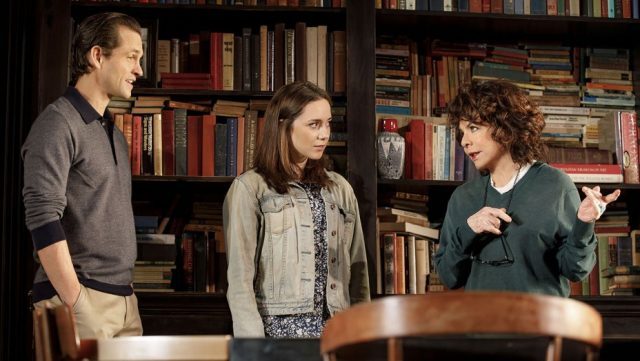
Kristin Miller (Stockard Channing) has a lot to say to her son Peter (Hugh Dancy) and his girlfriend, Trudi (Talene Monahon), in Apologia (photo by Joan Marcus)
Laura Pels Theatre
Harold and Miriam Steinberg Center for Theatre
111 West 46th St. between Sixth & Seventh Aves.
Tuesday – Sunday through November 30, $99
212-719-1300 www.roundabouttheatre.org
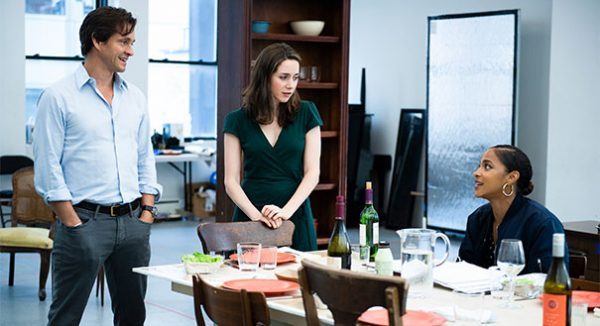
Successful art historian and proud humanist Kristin Miller (Stockard Channing) makes no apologies for the choices she’s made in Alexi Kaye Campbell’s Apologia, which continues at the Roundabout’s Laura Pels Theatre through November 30. An ex-pat living in the English countryside, Kristin is an uncompromising feminist and atheist who gave up custody of her children in order to pursue her career in Europe. On a spring day in 2009, she is expecting company for dinner, including her son Peter (Hugh Dancy), his new girlfriend, Trudi (Talene Monahon), her other son, Simon (also Dancy), his girlfriend, Claire (Megalyn Echikunwoke), and Kristin’s longtime friend, Hugh (John Tillinger). As they arrive, serious religious and socioeconomic conversations ensue, and it quickly becomes clear that Kristin respects no one as much as she does her own opinion. “Still raping the Third World?” she asks Peter, who responds, “If helping local initiatives and infrastructure projects off the ground is considered rape then, yes, brutally.” When she learns that Trudi is a vegetarian and a faithful Christian who met Peter at a prayer meeting, she digs in her talons. “I believe in mystery, imagination, and the power of myth and metaphor. But not in outmoded patriarchal propaganda,” she declares. When Claire, an actress, announces that her contract on a television series has been extended, all are happy for her except Kristin, who is quick to insult the program. “It was a little vacuous. I kept asking myself, ‘Why do people watch this? And why do they make it?’” But when the subject turns to Kristin’s latest book, a memoir called Apologia, the tension ratchets up, since she failed to mention anything about her sons or her family in it. But she’s not about to apologize for that either, as is evident when she explains what the title means: “a formal, written defence of one’s opinions or conduct.”
Hugh Dancy, Talene Monahon and Megalyn Echikunwoke in rehearsal for Apologia (photo by Jenny Anderson)
Tony winner Channing (Other Desert Cities, Six Degrees of Separation) is passionate and unrelenting as Kristin, who was English in the original version. She manages to keep the selfish, smug, and snarky writer from becoming too villainous or a mere relic from a different time; you keep wanting Kristin to say or do the right thing even though she never does, instead insisting on exploiting her supposed moral and intellectual superiority over everyone. She’s also not afraid to be exactly who she is; when she is given a Nigerian mask as a birthday present, she doesn’t hide her distaste. And it’s more than just a plot device that her oven isn’t working so she won’t be able to make dinner, a typically motherly responsibility. Dancy (Venus in Fur, The Pride) excels as both sons, whose names reference one of Jesus’s disciples, Simon Peter. Tillinger, a director who was lured back to the stage by Channing for this production — they starred together in Peter Nichols’s Joe Egg on Broadway in 1985 — does his best with Hugh, a relatively thankless part that merely serves as comic relief; when he departs Dane Laffrey’s book- and art-heavy set, his character is not really missed. Three-time Obie-winning director Daniel Aukin (Bad Jews,Admissions) guides the actors through some familiar, clichéd territory that is too straightforward and borders on just the kind of drama Kristin argues that Claire acts in. “She’s a bloody nightmare,” Peter tells Trudi. “Opinionated, didactic, dictatorial.” But that doesn’t mean she isn’t bold, brave, and heroic in her own way.
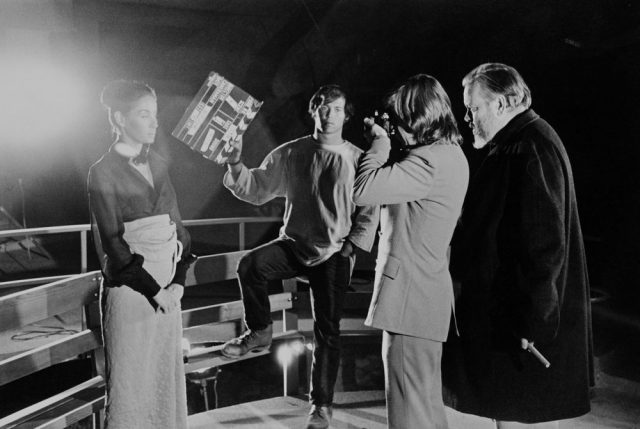
Orson Welles on the set of his final film, The Other Side of the Wind
THE OTHER SIDE OF THE WIND (Orson Welles, 2018)
MoMA Film, Museum of Modern Art
11 West 53rd St. between Fifth & Sixth Aves.
Sunday, November 11, 5:00
Series runs through January 8
212-708-9400 www.moma.org
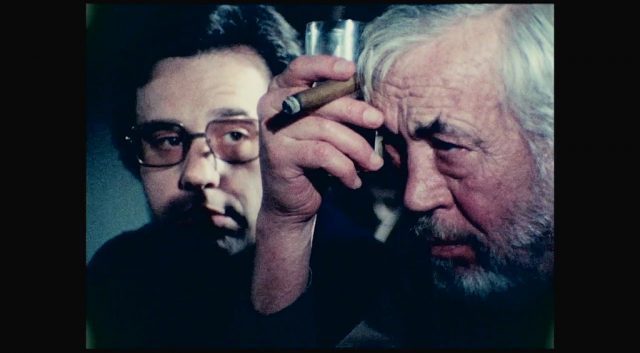
Throughout Orson Welles’s The Other Side of the Wind, characters make declarations that have been applied to Welles’s work over the years, and what audiences may even be thinking in the first minutes of this, his final film: “Does all this matter?” “What the hell is that?” “I’m bored with the whole story.” “You could tell me what’s going on here.” And “What happens here?” “I’m not really sure, Max.” But that wickedly sly self-referential commentary is one of the many reasons that The Other Side of the Wind is yet another masterpiece by the man who brought the world Citizen Kane, The Magnificent Ambersons, Touch of Evil, F for Fake, and other classics. Welles’s legendary difficulties — budgetary problems, editing and reshoots without his consent, productions that took years to finish — are both the subject and the story of the making of The Other Side of the Wind itself. Welles’s potent skewering of Hollywood was shot in the 1970s and remained incomplete until now; finally, nearly one hundred hours of footage have been edited into a two-hour gem that will be screening November 11 at MoMA in their annual “Contenders” series, made up of films the institution believes will last the test of time. The Other Side of the Wind begins with an equilibrium-challenging blast of grainy scenes photographed with shaky handheld cameras and sudden, disorienting closeups, switching from color to black-and-white, the audio track not quite synced, Michel Legrand’s jazzy noir score underlining the too-rapid pace as all the main characters are introduced. The conceit of the film is that it tells the story of the last day of iconic, ornery auteur J. J. Hannaford’s life, played by iconic, ornery auteur John Huston. (Welles always claimed that Hannaford was not based on himself but on other great directors.) “This little historical document has been put together from many sources,” Hannaford acolyte Brooks Otterlake (Peter Bogdanovich) announces in voice-over at the start, “from all the footage shot by TV and documentary filmmakers and also the students, critics, and young directors who happened to bring 16- and 8mm cameras, having been invited to Jake’s seventieth birthday party.”
Peter Bogdanovich and John Huston star in Orson Welles’s The Other Side of the Wind
Once the film calms down, it’s stupendous, a bittersweet takedown of the studio system and the end of an era, with a fabulous cast that covers nearly every aspect of the film world: Susan Strasberg as ruthless, ambitious critic Julie Rich; Edmond O’Brien as actor Pat Mullins; Mercedes McCambridge as Maggie Noonan, Hannaford’s manager; Norman Foster as Billy Boyle, an old-timer who knows how to handle things; Paul Stewart as Matt Costello, another of Hannaford’s old cohorts; Lilli Palmer as movie star Zarah Valeska, the host of the party; Cameron Mitchell as grumbling makeup artist Zimmie; Pat McMahon as journalist Marvin P. Fassbender; Joseph McBride as critic Pister; Tonio Selwart as a financier known only as the Baron; Howard Grossman as biographer Charles Higgam; Geoffrey Land as studio head Max David; Frank Marshall as one of the documentarians; Cathy Lucas as Mavis Henscher, a young woman Hannaford takes a liking to; Stafford Repp (Chief O’Hara on Batman) as Hannaford supporter Al Denny; Dennis Hopper as director Lucas Renard; Benny Rubin as Hollywood agent Abe Vogel; Gregory Sierra as screenwriter Jack Simon, who keeps throwing barbs at Hannaford; and Dan Tobin as the uptight Dr. Bradley Pease Burroughs. Among those being parodied or paid homage to in the casting and the plot are Marlene Dietrich, John Houseman, John Ford, William Wellman, Pauline Kael, Robert Evans, Charles Higham, Cybill Shepherd, and John Milius. Among the party guests are George Jessel, Curtis Harrington, Henry Jaglom, Paul Mazursky, Claude Chabrol, Cameron Crowe, Les Moonves, and Rich Little, who originally played Otterlake but was replaced by Bogdanovich, who extensively interviewed Welles for the seminal book This Is Orson Welles. (And yes, that man in the bathroom stall is William Katt, who would later become the Greatest American Hero, while 1970s/’80s star Cassie Yates is Martine.)
Cinematographer Gary Graver and editor Bob Murawski have done what must have been a nearly impossible job, creating a compelling narrative that interweaves the many styles with the making of Hannaford’s last film, also called The Other Side of the Wind, a somewhat existential erotic tale of a Native American woman played by an unnamed actress (Oja Kodar, Welles’s companion) who’s being followed by a motorcycle rebel portrayed by first-time actor John Dale (Bob Random), a new discovery of Hannaford’s. The film is Hannaford’s attempt to remain relevant in the modern age; it’s shot in bold colors, with plenty of nudity and a hip score that serve as a stark counterpoint to the predominantly black-and-white footage of Hannaford and his exploits. “It’s a whole new business,” Zimmie laments. The Other Side of the Wind is a fitting coda to Welles’s career — although he does not appear in the film, his voice can be heard off-camera at one point — a grand finale lovingly put together with respect and admiration that once again makes us wonder what Welles could have achieved had he not continually run into so much trouble as a filmmaker. The MoMA screening will be followed by a Q&A with producer Filip Jan Rymsza. It will be preceded at 2:00 by Morgan Neville’s overly fanciful They’ll Love Me When I’m Dead, which goes behind-the-scenes of The Other Side of the Wind, detailing the making of the movie through interviews with many of the participants while also delving into Welles’s working process, fundraising methods, and, of course, genius. It’s narrated by Alan Cumming and features Bogdanovich, Kodar, Shepherd, Jaglom, Graver, Random, Marshall, Little, Mitchell, McBride, Simon Callow, George Stevens Jr., Jeanne Moreau, Danny Huston, and others. Neville will take part in a Q&A after the screening.