twi-ny recommended events

EMMA AND MAX

(photo by Joan Marcus)

Upper West Siders Jay (Matt Servitto) and Brooke (Ilana Becker) laugh as they fire their nanny, Britanny (Zonya Love), in Emma and Max (photo by Joan Marcus)

Flea Theater, the Sam
20 Thomas St. between Broadway & Church St.
Wednesday – Monday through November 11, $47-$102
866-811-4111
theflea.org

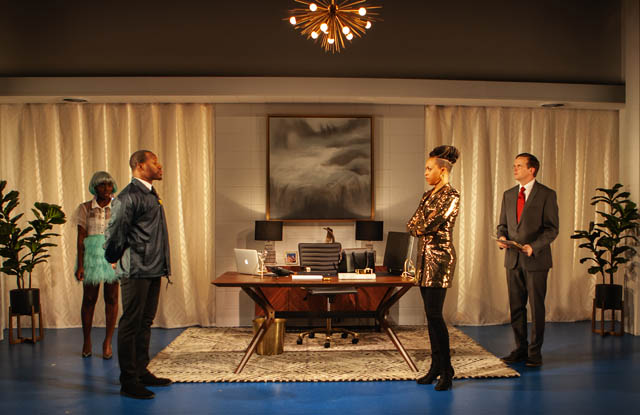
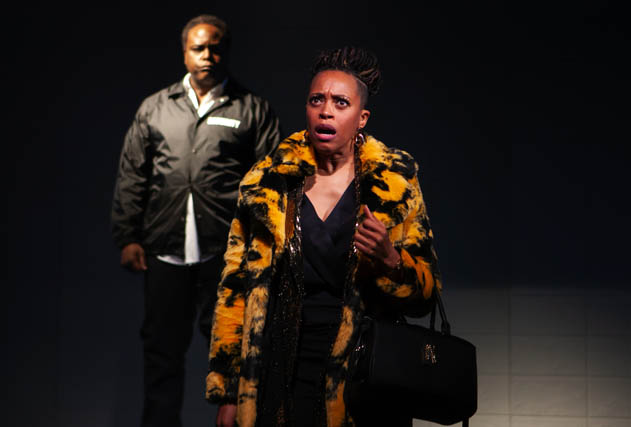
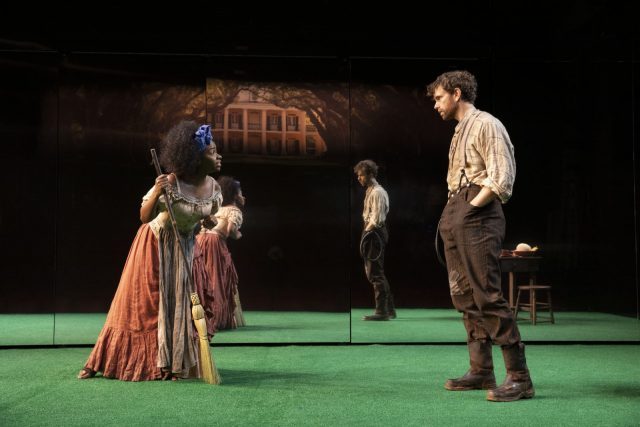
Eclectic auteur Todd Solondz, the creator of such offbeat, unusual indie films as Welcome to the Dollhouse, Happiness, and Storytelling, doesn’t disappoint with his first play, the dark, acerbic Emma and Max, which has been extended at the Flea through November 11. Solondz reveals the dark underbelly of suburbia in the ninety-minute show, which is wickedly funny and all too real. Wealthy white Upper West Siders Brooke (Ilana Becker) and Jay (Matt Servitto) are attempting to fire their black nanny, Britanny (Zonya Love), who has been taking care of their kids, three-year-old Emma and two-year-old Max (played by Sawyer Manning and Mason Goldstein, respectively, seen only briefly in video and photographs). “The children adore you,” Brooke tells Brittany, who looks at her blond boss stone-faced. “You’re more than we could ever have hoped for. So much more,” Jay adds. Brooke and Jay are acting like it is harder for them to get rid of her than it is for Brittany to get kicked out; they’re terrified of saying anything that can be construed as even the slightest bit politically incorrect. “What I do wrong?” Brittany asks. “Nothing,” Brooke replies, to which Brittany says, “Can’t be nothing. A person don’t get fired for nothing.” When Brooke explains that she is being replaced by an au pair from Holland, Brittany says, “What’s that? A white girl?” A disturbed Brooke answers, “Actually we don’t know her ethnicity. We didn’t ask,” as if a Dutch woman named Famke (Lacy Allen, also seen in video only) could be anything else.

(photo by Joan Marcus)

Brooke (Ilana Becker) and Jay (Matt Servitto) discuss privilege and more in world premiere of Todd Solondz’s first play (photo by Joan Marcus)

Brooke takes an instant liking to Famke but feels guilty that she doesn’t feel guilty over firing Brittany, who spends most of her time in bed listening to Meryl Streep singing “The Winner Takes It All” from Mamma Mia! and not responding to Brooke’s constant phone calls and texts asking her to return her keys to their house. When she’s not at home, Brittany is making the set changes, as if she is a slave still working for Brooke and Jay, who watch her opening and closing doors and pushing and pulling furniture, occasionally making faces at her if they think she is taking too long. It’s an ingenious conceit that extends beyond the narrative world of the play, as if Solondz the director is also abusing Love the actress, who portrays Brittany with a steely, decidedly unglamorous demeanor. (The storage-like set with aluminum-siding-like covering and clever props are designed by Julia Noulin-Mérat.) Brooke and Jay go on vacation in Barbados, where Brittany is from, rubbing yet more salt in the wound without even realizing it. Complaining about certain aspects of her own childhood, Brooke says, “The point is, I know something about what it means to feel marginalized . . . My experience, my pain . . . I wish I’d been born black — then at least I could’ve shared the pain, the injustice of it all.”

(photo by Joan Marcus)

Britanny (Zonya Love) finally gets to share her tragic story in Emma and Max at the Flea (photo by Joan Marcus)

Everything comes full circle as Brittany finally gets to share her own story, telling it to a woman named Padma (Rita Wolf, who also plays flight attendant Mira) who is recording the mostly one-sided conversation. “I believe in things I know and understand and see. I’m not good at make-believe. I’m not invisible,” Brittany explains. “White people see me. Black people see me. White people see my blackness. Black people see my blackness. That’s what they see. But I see water.” The concept of water is essential to Solondz, a New Jersey native who is married and has two young children; images of water are projected by Adam Thompson onto the set as well as forming the entrance to a resort swimming pool. Emma and Max is about how people see and judge one another, but primarily how whites see and judge blacks. Brooke and Jay get flustered by white people’s problems, reveling in their ingrained, unearned white privilege while believing the world owes them everything, from wealth and success to exceptional children and servants. The play is a sharply observant skewering of the status quo in a Trump America that continues to encounter racism, bigotry, and hatred every day and where the term “privilege” has become a dirty word to about half the country. It’s also a place where payback can be a bitch, where there are consequences for physical, psychological, and sexual abuse. It’s not a happy situation, but it’s damn funny and frighteningly realistic, a mirror brilliantly held up to a society in crisis.

A BREAD FACTORY — PART ONE: FOR THE SAKE OF GOLD

Tyne Daly

Dorothea (Tyne Daly) and Greta (Elisabeth Henry) fight to save their community arts center in A Bread Factory: For the Sake of Gold

A BREAD FACTORY — PART ONE: FOR THE SAKE OF GOLD (Patrick Wang, 2018)
Village East Cinema
181-189 Second Ave. at 12th St.
Opens Friday, October 26
212-529-6799
abreadfactory.com/the-films
www.villageeastcinema.com

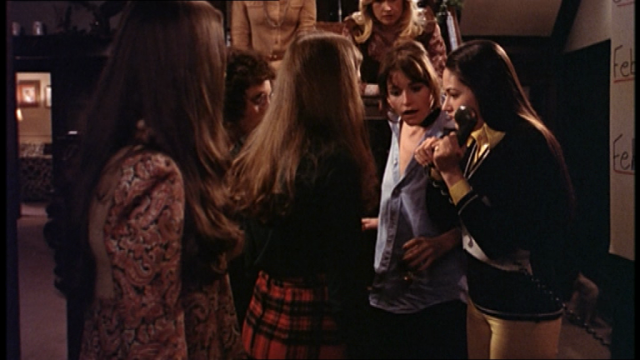
All politics are local, and so it is with Patrick Wang’s A Bread Factory: For the Sake of Gold, the first of a two-part epic about a small town’s battle over arts funding. Forty years ago, Dorothea (Tyne Daly, often in pigtails) and Greta (Elisabeth Henry) moved to Checkford in Upstate New York and turned a shuttered bread factory into an arts venue for the local community. They are now being challenged by businessman Karl (Trevor St. John) and the avant-garde performance art duo of May (Janet Hsieh) and Ray (George Young), who have constructed their own modern arts building, the FEEL Institute, and want the financial allocation that otherwise would have gone to the Bread Factory. Joined by Elsa (Nana Visitor), journalist Jan (Glynnis O’Connor), Sir Walter (Brian Murray, in his final film), and others, they have to convince the sketchy board — including Joel (Joe Felece), the ornery Alec (Joe Paparone), Darren (Eugene Brell), Pat (Kit Flanagan), Mavis (Nan-Lynn Nelson), and Laura (Julia Rock) — that it is more important to the town that the Bread Factory remains open, providing art, theater, film, music, and more to children and adults. Meanwhile, the shy Max has started dating Julie (Erica Durham), Mavis’s daughter, who wants to be an actress; Dorothea and Pat have a deeply personal feud; the rather unusual projectionist, Simon (Keaton Nigel Cooke), gets to meet one of his cinematic heroes, Jordan (Janeane Garofalo), who teaches an odd class to a group of youngsters; teacher Jason (James Marsters) demands administrative accountability; Dorothea is staging a version of Euripides’s Hecuba; Hollywood star Trooper Jaymes (Chris Conroy) unexpectedly arrives in town; and Sandra (opera soprano Martina Arroyo), who seems to live in a seat in the Bread Factory theater, shows a surprising aptitude for singing (and serves as a kind of Greek chorus).

Patrick Wang

Cinematographer Frank Barrera and writer-director Patrick Wang discuss a scene in first of two-part epic, A Bread Factory

The film takes on numerous contemporary issues, such as art against commerce, tradition versus the future, corruption, governmental conflict of interest, illegal immigration, Chinese influence, and even child labor laws. Wang (In the Family, The Grief of Others), who was partially inspired to make the film after visiting an old theater in Hudson, New York, adds plenty of absurdist humor to the proceedings, preventing things from getting too didactic; Daly is particularly adept at walking that fine line. Cinematographer Frank Barrera tends to keep his camera steady, preferring long shots with slow movement, giving the audience time to digest the wide-ranging, twisting plot. Be sure to pay attention to Chip Taylor’s self-referential, tongue-in-cheek song over the closing credits, which explains, “But is it over yet? Is it really over yet? Looking back, we all could use a little more story.” And more there is; A Bread Factory, Part Two: Walk with Me a While continues the tale, combining for more than four hours of Checkford intrigue at Village East, in addition to several postscreening Q&As, concluding at the 9:30 show on October 28, with critic Godfrey Cheshire, producer Daryl Freimark, and actors Zachard Sayle and Jonathan Iglesias. A Bread Factory will then be joined November 2 by Wang’s 2015 drama, The Grief of Others, with Q&As on Friday and Saturday after the 6:45 screenings.

NewFest 2018: EVERY ACT OF LIFE / MAKING MONTGOMERY CLIFT

Every Act of Life

Terrence McNally looks back at his life and career, as well as considering his future, in Every Act of Life

DOCUMENTARY FEATURE: EVERY ACT OF LIFE (Jeff Kaufman, 2018)
SVA Theatre
333 West 23rd St. between Seventh & Eighth Aves.
Monday, October 29, 6:00
Festival runs October 24-30
212-592-2980
everyactoflifedocumentary.com
newfest.org

Screening at NewFest on October 29, Jeff Kaufman’s Every Act of Life is a lovely and loving look at playwright and activist Terrence McNally, a compelling film about chasing one’s hopes and dreams, refusing to back down, and fighting for what’s right personally and professionally, onstage and off. Director, producer, and writer Kaufman speaks extensively with McNally, who is forthcoming about his career and his sexuality, which included relationships with Edward Albee and Wendy Wasserstein and several men who died during the height of the AIDS crisis. “Terrence is able to get to the core of the human condition in so many different ways. I defy you to name another playwright who can do this,” six-time Tony winner Audra McDonald says. Kaufman traces the life of four-time Tony winner McNally, from his dysfunctional childhood in Florida and Texas and his world travels as tutor to John Steinbeck’s children (“Don’t write for the theater; it will break your heart,” Steinbeck told him) to his first Broadway flop, his alcoholism, his championing of same-sex marriage, his battle against lung cancer, and the success of such (often controversial) shows as The Ritz; Corpus Christi; Master Class; A Perfect Ganesh; Frankie and Johnny in the Clair de Lune; Kiss of the Spiderwoman; Lips Together, Teeth Apart; and Love! Valour! Compassion!

The film includes wonderful clips from many productions in addition to scenes of pairs of actors talking about McNally, most entertainingly Edie Falco with F. Murray Abraham and McNally himself with Larry Kramer. McNally also goes through some old scrapbooks with his husband, Tom Kirdahy; they were previously featured in Kaufman’s The State of Marriage. “Terrence was way ahead of his time,” Abraham posits. Among the many other theater stalwarts offering their carefully considered thoughts on McNally are Angela Lansbury, Bryan Cranston, Rita Moreno, Nathan Lane, Meryl Streep, Patrick Wilson, Marin Mazzie, Jon Robin Baitz, Zoe Caldwell, Billy Porter, Chita Rivera, John Kander, Lynn Ahrens, and Stephen Flaherty, along with behind-the-scenes footage, theater memorabilia, archival photographs, and a lot of fascinating memories. “I’d have no career if it wasn’t for Terrence McNally,” Lane says. On the film’s KickStarter page, Kaufman (The Savoy King: Chick Webb and the Music That Changed America, Brush with Life: The Art of Being Edward Biberman) and producer Marcia Ross explain about McNally, “We thought, ‘Why hasn’t anyone done a documentary about this man?’ Then we said, ‘Well, we should.’” It’s simply grand that they did, and such a fine documentary to boot. Every Act of Life is screening at 6:00 on October 29 at the SVA Theatre and will be followed by a Q&A with McNally, who is still at work on several new plays as his eightieth birthday approaches.

Making Montgomery Clift

Making Montgomery Clift makes a compelling case for a new interpretation of the actor’s life and career

CLOSING NIGHT GALA: MAKING MONTGOMERY CLIFT (Robert Clift & Hillary Demmon, 2018)
SVA Theatre
333 West 23rd St. between Seventh & Eighth Aves.
Tuesday, October 30, 7:30
newfest.org
www.facebook.com/montyfilm

At the beginning of Making Montgomery Clift, Robert Clift, Montgomery Clift’s youngest nephew, explains, “This isn’t really a story about a man. It’s about what his life was allowed to mean. Remember that.” What is revealed will be hard to forget, even with Robert later admitting, “The idea of Monty’s brokenness has persisted all these years, and I don’t know if it could ever change.” But with the documentary, making its New York premiere on October 30 as the closing-night selection of the thirtieth annual NewFest, Robert strives to set the record straight about the uncle he never met, a four-time Oscar nominee who is perhaps best known as a drug-addicted, self-destructive drunk unable to deal with his homosexuality and whose career went downhill following a car accident that marred his beautiful face. Directed, produced, and written by Robert Clift and Hillary Demmon and photographed by Clift, Making Montgomery Clift instead shows the actor to be a man dedicated to his craft, from his teenage years in the theater to his ascent to Hollywood stardom, as well as a caring human being who did not suffer deeply because of his sexuality. “He was really not that closeted!” Clift’s companion, Lorenzo James, declares. “He didn’t hate himself!”

Robert is continuing his father’s legacy; Brooks Clift, Montgomery’s brother, spent many years trying to correct the public misunderstandings and damaging lies about his sibling, pointing out the critical errors in major biographies by Patricia Bosworth and Robert LaGuardia — Bosworth herself is featured prominently in the film — as well as newspaper and magazine articles and news reports that focused on supposed scandals. It turns out that Brooks, an information gatherer during WWII, was a persistent audio taper, recording every conversation he possibly could, giving his son a treasure trove of material to sift through and now share alongside film clips, archival media footage, home movies, and yet more tapes, secretly recorded by Montgomery himself. Together they give Robert, who also interviews his brothers Eddie and Woody, Jimmy Olsen portrayer and producer Jack Larson, and other friends, colleagues, and relatives, compelling evidence that many of the gossip-heavy stories about Montgomery are sensationalistic if not outright fabricated. “I guess I always felt he was a little bit like Sisyphus battling the myth-making apparatus” of the media, Eddie says.

The film follows Montgomery’s career trajectory, including his decision-making process when it came to choosing roles, turning down East of Eden and On the Watefront while accepting Red River, I Confess, From Here to Eternity, and Judgment at Nuremberg. It also explores his penchant for rewriting scripts, his refusal to become part of the studio system, and his problems working with John Huston on Freud: The Secret Passion. Montgomery Clift died in 1966 at the age of forty-five; his nephew Robert has done a terrific job of resurrecting his uncle’s influential legacy, taking it back from the tabloids and redefining it for generations to come. The screening will be followed by a Q&A with the filmmakers and an after-party at Plunge Rooftop Lounge. NewFest continues through October 30 with such other films as Ondi Timoner’s Mapplethorpe, Jonah Greenstein’s Daddy, Michael Fisher’s Cherry Grove Stories, and a twentieth anniversary screening of Lisa Cholodenko’s High Art.

GHOSTS AND MONSTERS: POSTWAR JAPANESE HORROR

Godzilla

Godzilla emerges from the ocean after nuclear testing in classic monster movie

GHOSTS AND MONSTERS: POSTWAR JAPANESE HORROR
BAMcinématek, BAM Rose Cinemas
30 Lafayette Ave. between Ashland Pl. & St. Felix St.
October 26 – November 1
718-636-4100
www.bam.org

Wanna see something really scary? Then head over to BAMcinématek to see any one of the nine fright flicks comprising “Ghosts and Monsters: Postwar Japanese Horror,” running October 26 to November 1. No one makes scary movies like the Japanese do, and the 1950s and 1960s were a particular fertile time in the aftermath of WWII and the fear of global nuclear war. BAM is showing a great mix of films as Halloween approaches, with fantasy and sci-fi, blood and gore, monsters and aliens, and psychological mayhem. You can’t go wrong with any of them; below is only some of the awesomeness. (Also on the schedule are Ishirô Honda’s Mothra, Hiroshi Teshigahara’s Pitfall, and Kaneto Shindô’s Onibaba.)

Godzilla

Ishirō Honda has a smoke with his atomic-gas-breathing monster on the set of Godzilla

GODZILLA (Ishirō Honda, 1954)
BAMcinématek, BAM Rose Cinemas
Friday, October 26, 2:00, 4:30, 7:00
www.bam.org

More than two dozen sequels, prequels, remakes, and reboots have not diluted in the slightest the grandeur of the original 1954 version of Godzilla, one of the greatest monster movies ever made. If you’ve only seen the feeble, reedited, Americanized Godzilla, King of the Monsters!, made two years later with Canadian-born actor Raymond Burr inserted as an American reporter, well, wipe that out of your head. On October 26, BAMcinématek is screening the real thing, the restored treasure as part of “Ghosts and Monsters: Postwar Japanese Horror.” The film was inspired by Eugène Lourié’s The Beast from 20,000 Fathoms and a real incident involving the Daigo Fukuryū Maru, a tuna-fishing boat that got hit by radioactive fallout in January 1954 from a U.S. test of a dry-fuel thermonuclear device in the Pacific Ocean. Writer-director Ishirō Honda and cowriter Takeo Murata expanded on Shigeru Kayama’s story, focusing on a giant dinosaur under the sea who comes back to life after H-bomb testing by the U.S. Standing 165 feet tall and able to breathe atomic gas, Godzilla — known as Gojira in Japanese, a combination of gorira, the Japanese word for gorilla, and kujira, which means whale — wreaks havoc on Japanese towns as he makes his way toward Tokyo. While the military and the government want to destroy the creature — who is played by Haruo Nakajima and Katsumi Tezuka in a monster suit, tramping over miniature houses, streets, cars, trains, and buildings using the suitmation technique (both men also make cameos outside the costume) — Dr. Yamane (Takashi Shimura) wants to study Godzilla to find out how the radiation only makes it stronger instead of destroying it. (Throughout, Godzilla is referred to as “it” and not “he,” perhaps because the creature is in part a representation of America and what it wrought in Hiroshima and Nagasaki.) “Godzilla was baptized in the fire of the H-bomb and survived. What could kill it now?” Dr. Yamane asks. Meanwhile, one of Dr. Yamane’s assistants, Dr. Serizawa (Akihiko Hirata), is working on a secret oxygen destroyer that he will show only to his fiancée, Yamane’s daughter, Emiko (Momoko Kōchi), who is having trouble telling Dr. Serizawa that she is actually in love with salvage ship captain Hideto Ogata (Akira Takarada). “Godzilla’s no different from the H-bomb still hanging over Japan’s head,” Ogata tells Dr. Yamane, who is none too pleased with his take on the situation. Through it all, the media risks everything to get the story.

Even for 1954, many of the special effects, photographed by Masao Tamai, are cheesy but fun, and composer Akira Ifukube’s fiercely dramatic score goes toe-to-toe with the monster. The Toho film is no mere monster movie but instead is filled with metaphors and references about WWII and the use of atomic bombs, examining it from political and socioeconomic vantage points while questioning the future of technological advances. “But what if your discovery is used for some horrible purpose?” Emiko asks Dr. Serizawa, who wears an eye patch, as if he can only see part of things. Godzilla could only have come from Japan, much like King Kong was purely an American creation produced by Hollywood; in fact, the two went at it in Honda’s 1962 film, King Kong vs. Godzilla. The next year, Akira Kurosawa would make I Live in Fear (Ikimono no kiroku), an intense psychological drama about the nuclear holocaust’s effects on one man, a factory owner played by Toshirô Mifune — who meets with a dentist portrayed by Kurosawa regular Shimura — a kind of companion piece to Godzilla. Honda, who served as an assistant director to Kurosawa on many films before making his own pictures, would go on to make such other sci-fi flicks as Rodan, The H-Man, Mothra, and Destroy All Monsters, but it was on Godzilla that he got everything right, capturing the fate of a nation in the aftermath of nuclear devastation while still managing to gain sympathy for the monster. It is also difficult to watch the film in 2018 without thinking of America’s current debate over illegal immigration and fear of the other, particularly when Godzilla approaches an electrified fence meant to keep him out, as well as the threat of nuclear war.

Goke

Goke, Body Snatcher from Hell is part of BAMcinématek tribute to Japanese horror films

GOKE, BODY SNATCHER FROM HELL (Hajime Satô, 1968)
BAMcinématek, BAM Rose Cinemas
30 Lafayette Ave. between Ashland Pl. & St. Felix St.
Saturday, October 27, 9:30
718-636-4100
www.bam.org

Birds start slamming into the windows of an airplane. The sky has turned a deep red. “It’s just like flying through a sea of blood,” first officer Ei Sugisaka (Teruo Yoshida) says. It’s reported that a bomb might be on board the aircraft. A suitcase with a rifle is discovered. A spectacular yellow UFO buzzes over the plane, which catches fire and crashes in a vast postapocalyptic wasteland in the middle of nowhere, as if on a deserted planet. And then the real trouble begins in Hajime Satô’s Goke, Body Snatcher from Hell, a color-saturated nightmare released by Shochiko in 1968. The survivors include the stalwart and dedicated Captain Sugisaka; sweet and innocent flight attendant Kazumi Asakura (Tomomi Saito); corrupt politician Gôzô Mano (Eizo Kitamura); weapons dealer Tokuyasu (Nobu Kaneko), who is so desperate to make a sale that he offers his wife, Noriko Tokuyasu (Yûko Kusunoki), to Mano; a blonde American, Mrs. Neal (Kathy Horan), who is picking up the body of her dead husband, who was killed in the Vietnam War; Momotake (Kazuo Kato), a psychiatrist who sees this as a great opportunity to study human nature in a time of severe crisis; Professor Sagai (Hideo Masaya Takahashi), a space biologist with some wacky theories; Hirofumi Teraoka (Hideo Ko), a suspicious passenger in a white suit and sunglasses; and Matsumiya (Norihiko Yamamoto), the young bomber.

goke

Nearby, the Gokemidoro ship glows like it’s an acid trip, but anyone who gets too close is invaded by the species, with extraterrestrial goop entering through a newly created vaginal slit in the human’s head. Tempers flare, flirtations rise up, and the Earth is in danger in this certifiably crazy-ass film, in which Invasion of the Body Snatchers meets The Blob by way of Forbidden Planet, Dracula, and The Day the Earth Stood Still. The film, a favorite of Quentin Tarantino’s, was written by Susumi Takahasi and Kyuzo Kobayashi and photographed by Shizuo Hirase, with awesome art direction by Masataka Kayano and a Theramin-heavy score by Toshiwa Kikuchi. So what’s it all really about? There’s a thick antiwar sentiment — television and superhero veteran Satô (Captain Ultra, The Terror Beneath the Sea) occasionally cuts to images from Vietnam, bathed in red — and a general lack of humanity pervades. “The end has come and mankind is on the verge of destruction,” the Gokemidoro declare. No kidding.

UGETSU

Genjurō (Masayuki Mori) makes his pottery as son Genichi (Ikio Sawamura) and wife Miyagi (Kinuyo Tanaka) look on in UGETSU

UGETSU (UGETSU MONOGATARI) (Kenji Mizoguchi, 1953)
BAMcinématek, BAM Rose Cinemas
Saturday, October 27, 7:00
www.bam.org

BAMcinématek is presenting a 4K restoration of one of the most important and influential — and greatest — works to ever come from Japan. Winner of the Silver Lion for Best Director at the 1953 Venice Film Festival, Kenji Mizoguchi’s seventy-eighth film, Ugetsu, is a dazzling masterpiece steeped in Japanese storytelling tradition, especially ghost lore. Based on two tales by Ueda Akinari and Guy de Maupassant’s “How He Got the Legion of Honor,” Ugetsu unfolds like a scroll painting beginning with the credits, which run over artworks of nature scenes while Fumio Hayasaka’s urgent score starts setting the mood, and continues into the first three shots, pans of the vast countryside leading to Genjurō (Masayuki Mori) loading his cart to sell his pottery in nearby Nagahama, helped by his wife, Miyagi (Kinuyo Tanaka), clutching their small child, Genichi (Ikio Sawamura). Miyagi’s assistant, Tōbei (Sakae Ozawa), insists on coming along, despite the protestations of his nagging wife, Ohama (Mitsuko Mito), as he is determined to become a samurai even though he is more of a hapless fool. “I need to sell all this before the fighting starts,” Genjurō tells Miyagi, referring to a civil war that is making its way through the land. Tōbei adds, “I swear by the god of war: I’m tired of being poor.” After unexpected success with his wares, Genjurō furiously makes more pottery to sell at another market even as the soldiers are approaching and the rest of the villagers run for their lives. At the second market, an elegant woman, Lady Wakasa (Machiko Kyō), and her nurse, Ukon (Kikue Mōri), ask him to bring a large amount of his merchandise to their mansion. Once he gets there, Lady Wakasa seduces him, and soon Genjurō, Miyagi, Genichi, Tōbei, and Ohama are facing very different fates.

UGETSU

Lady Wakasa (Machiko Kyō) admires Genjurō (Masayuki Mori) in Kenji Mizoguchi postwar masterpiece

Written by longtime Mizoguchi collaborator Yoshitaka Yoda and Matsutaro Kawaguchi, Ugetsu might be set in the sixteenth century, but it is also very much about the aftereffects of World War II. “The war drove us mad with ambition,” Tōbei says at one point. Photographed in lush, shadowy black-and-white by Kazuo Miyagawa (Rashomon, Floating Weeds, Yojimbo), the film features several gorgeous set pieces, including one that takes place on a foggy lake and another in a hot spring, heightening the ominous atmosphere that pervades throughout. Ugetsu ends much like it began, emphasizing that it is but one postwar allegory among many. Kyō (Gate of Hell, The Face of Another) is magical as the temptress Lady Wakasa, while Mori (The Bad Sleep Well, When a Woman Ascends the Stairs) excels as the everyman who follows his dreams no matter the cost; the two previously played husband and wife in Rashomon Mizoguchi, who made such other unforgettable classics as The 47 Ronin, The Life of Oharu, Sansho the Bailiff, and Street of Shame, passed away in 1956 at the age of fifty-eight, having left behind a stunning legacy, of which Ugetsu might be the best, and now looking better than ever.

KWAIDAN

Masaki Kobayashi paints four chilling, ghostly portraits in KWAIDAN, including “Hoichi, the Earless”

KWAIDAN (Masaki Kobayashi, 1964)
BAMcinématek, BAM Rose Cinemas
Sunday, October 28, 2:00
www.bam.org

In the mesmerizing Kwaidan, based on folkloric tales by Lafcadio Hearn, aka Koizumi Yakumo, Masaki Kobayashi (The Human Condition, Samurai Rebellion) paints four marvelous ghost stories, each one with a unique look and feel. In “The Black Hair,” a samurai (Rentaro Mikuni) regrets his choice of leaving his true love for societal advancement. Yuki (Keiko Kishi) is a harbinger of doom for a woodcutter (Nakadai) in “The Woman of the Snow.” Hoichi (Katsuo Nakamura) must have his entire body covered in prayer in “Hoichi, the Earless.” And Kannai (Kanemon Nakamura) finds a creepy face staring back at him in “In a Cup of Tea.” The four films subtly, and not so subtly, explore such concepts as greed and envy, love and loss, and the art of storytelling itself. Winner of the Special Jury Prize at Cannes, Kwaidan is one of the greatest ghost story films ever made, a quartet of chilling existential tales that will get under your skin and into your brain. The score was composed by Tōru Takemitsu, who said of the film, “I wanted to create an atmosphere of terror.” He succeeded.

Jigoku

Shirō Shimizu (Shigeru Amachi) is trapped in the realms of hell in Nobuo Nakagawa’s awesome Jigoku

JIGOKU (THE SINNERS OF HELL) (Nobuo Nakagawa, 1960)
BAMcinématek, BAM Rose Cinemas
30 Lafayette Ave. between Ashland Pl. & St. Felix St.
Sunday, October 28, 5:30
718-636-4100
www.bam.org

Nobuo Nakagawa’s Jigoku is a dark, demonic masterpiece, a descent into the deepest circles of hell, where sinners face the swirling vortex of torment and rivers of pus and blood. Jigoku goes places that would make even Dante and Hieronymus Bosch turn away in fear while Roger Corman and Mario Bava rejoice. In the film, seemingly everyone theology student Shirō Shimizu (Shigeru Amachi) comes into contact with dies a tragic death. He and Yukiko Yajima (Utako Mitsuya) become engaged, but their lives change forever when Shirō and his friend Tamura (Yōichi Numata), a sociopath of pure evil, go for a ride and Tamura, behind the wheel, runs over gangster Kyōichi “Tiger” Shiga (Hiroshi Izumida) and drives away, showing no remorse whatsoever, reminiscent of Artie Strauss (Bradford Dillman) and Judd Steiner (Dean Stockwell) in Richard Fleischer’s Compulsion. However, Kyōichi’s mother (Kiyoko Tsuji) witnessed the hit-and-run and is determined to exact revenge, joined by Yoko (Akiko Ono), Kyōichi’s girlfriend.

Jigoku

Nobuo Nakagawa’s Jigoku takes viewers on a dark journey through hell

Shirō is called home to visit his ill mother, Ito (Kimie Tokudaij), while his corrupt father, shady businessman Gōzō (Hiroshi Hayashi), shamelessly has an open affair with Kinuko (Akiko Yamashita). Shirō takes an instant liking to his mother’s nurse, Sachiko Taniguchi (Mitsuya), who looks almost exactly like Yukiko, but her father, painter Ensai Taniguchi (Jun Ōtomo), is being threatened by dirty Det. Hariya (Hiroshi Shingûji), who wants Sachiko for himself or else he will arrest Ensai for a long-ago crime. Sachiko’s appearance frightens Yukiko’s parents, Professor Yajima (Torahiko Nakamura), who is Shirō’s teacher, and his wife (Fumiko Miyata), who are shocked by the doppelgänger. Also hanging around are Dr. Kusama (Tomohiko Ōtani) and journalist Akagawa (Kôichi Miya), who have secrets of their own. As people start dropping like brutally swatted and electrocuted flies, Shirō takes all of the blame even though he does not cause any of the deaths directly. (Even the production studio, Shintoho, didn’t survive, declaring bankruptcy after releasing the film.)

But none of that matters once everyone is in hell, facing a series of horrific tortures that are spectacularly photographed by Mamoru Morita, who enjoys keeping the color red at or near the center of most images, along with occasional touches of blue and green. Inspired by the Ōjōyōshū, the tenth-century Buddhist text about birth, rebirth, and the realms of hell, Nakagawa cowrote the screenplay with Ichirō Miyagawa; Nakagawa made nearly one hundred films in just about every genre before he died in 1984 at the age of seventy-nine, but Jigoku is his crowning achievement. It’s horror of the highest order, immersed in a jaw-dropping madness. It’s also a warning, since everyone is a sinner in one way or another, and retribution awaits us all.

KURONEKO

A black cat is not happy with the turn of events in Kaneto Shindô’s Kuroneko

KURONEKO (藪の中の黒猫) (Kaneto Shindô, 1968)
BAMcinématek, BAM Rose Cinemas
Wednesday, October 31, 7:00
www.bam.org

“A cat’s nothing to be afraid of,” a samurai (Rokkô Toura) says in Kaneto Shindô’s 1968 Japanese horror-revenge classic, Kuroneko. Oh, that poor, misguided warrior. He has much to learn about the feline species but not enough time to do it before he suffers a horrible death. In Sengoku-era Japan, a large group of hungry, bedraggled samurai come upon a house at the edge of a bamboo forest. Inside they find Yone (Nobuko Otowa) and her daughter-in-law, Shige (Kiwao Taichi), whose husband, Hachi (Kichiemon Nakamura), is off fighting the war. The men viciously rob, rape, and murder the women, but they leave behind a mewing black cat (“kuroneko”) that is not exactly happy with what just happened. Three years later, the aforementioned samurai is riding his horse on a dark night when he encounters, by the Rajōmon Gate, a young woman positively glowing in the darkness. She says she is frightened and asks if he can accompany her home; he claims he has met her before but can’t quite place her. He agrees to help her, and when they reach her abode he is treated to some tea served by an older woman and some fooling around with the younger one — until the latter creeps on top of him and turns into a menacing animal, biting into his throat and drinking his blood. One by one, the samurai are lured into this trap, until a surprise warrior arrives.

KURONEKO

A bamboo forest leads to a kind of hell for samurai in Kuroneko

Written and directed by Shindô and based on an old folktale, Kuroneko is a tense, spooky film, with a foreboding score by Hikaru Hayashi (Shindô’s The Naked Island and Onibaba) and shot in eerie black-and-white by Kiyomi Kuroda (Shindô’s Mother, Human, and Onibaba). One of the great feminist ghost stories, it’s like the missing sequel to Masaki Kobayashi’s Kwaidan, with elements of Akira Kurosawa’s Hidden Fortress and Rashomon thrown in, along with echoes of flying ninja movies. Memorable images abound: The two women, in ghostly white, float in the air; the camera weaves through the bamboo forest; a gruesome killer is beheaded. The film also features Kei Satō as Raiko, Hideo Kanze as Mikado, and Taiji Tonoyama as a farmer, but Kuroneko belongs to Shindô regular — and his lover and, later, his wife — Otowa, who appeared in nearly two dozen of his films, and Taichi, who also worked with such other directors as Keisuke Kinoshita, Mitsuo Yanagimachi, Yôji Yamada, and Shintarô Katsu before dying in a car accident in 1992 at the age of forty-eight. The two women go about their business with a calm and somewhat placid demeanor until they pounce, like cats luring mice to certain doom.

KURT VONNEGUT’S HAPPY BIRTHDAY, WANDA JUNE

Wanda June

Penelope (Kate MacCluggage) meets her husband-to-be (Jason O’Connell) in stellar revival of Kurt Vonnegut’s Wanda June

The Duke on 42nd Street
229 West 42nd St. between Seventh & Eighth Aves.
Thursday – Tuesday through November 29, $49-$109
www.wheelhousetheater.org

Wheelhouse Theater Company is throwing quite a party eight times a week at the Duke on 42nd St., presenting its wickedly funny, devilishly clever adaptation of Kurt Vonnegut’s first play, Happy Birthday, Wanda June. The glorious production, which (re)opened last night following an earlier sold-out run at the Gene Frankel Theater, is everything a work by Vonnegut should be: surreal, unpredictable, laugh-out-loud hysterical, extraordinarily intelligent, bold, daring, and challenging while taking on such wholly contemporary themes as war, misogyny, racism, capitalism, religion, gun control, animal rights, white privilege, machismo, and feminism. Brittany Vasta’s urban-jungle set immerses the audience in the show from the very beginning, as ticket holders walk down a lobby with fake plants and real prints by Vonnegut, then go through a bamboo curtain to enter the main space, the same entrance the characters use to come in and leave. The walls are covered with animal-head trophies. The doorbells emit animal sounds instead of rings or chimes. “How do you do. My name is Penelope Ryan,” a woman (Kate MacCluggage) says, standing in a line with four male actors. “This is a simple-minded play about men who enjoy killing — and those who don’t.”

The quartet slowly introduces itself: Harold Ryan (Jason O’Connell), a professional soldier and adventurer who is married to Penelope but has been missing for eight years; Dr. Norbert Woodly (Matt Harrington), a peacenik who believes in healing and is in love with Penelope; Col. Looseleaf Harper (Craig Wesley Divino), a pilot who dropped the bomb on Nagasaki and is missing with Harold in the Amazon rainforest; Paul Ryan (Finn Faulconer), Harold and Penelope’s twelve-year-old son, who is hoping his father will show up unexpectedly because it’s the father’s birthday; and Herb Shuttle (Kareem M. Lucas), a vacuum-cleaner salesman who also is in love with Penelope. The wonderfully absurdist story also involves a trio of heavenly ghosts: Mildred (MacCluggage), one of Harold’s previous wives; Major Siegfried von Konigswald (O’Connell), the “Beast of Yugoslavia” who was killed by Harold; and ten-year-old Wanda June (Charlotte Wise or Brie Zimmer), whose name is on Harold’s birthday cake. When Harold and Looseleaf do indeed return, the brutish Harold sniffs around his apartment like an animal come home to roost. He grunts and snorts (like a male chauvinist pig?) and even makes out with one of the trophy heads, reclaiming every inch of his territory. However, while he hasn’t changed much, Penelope has gone through a major transformation, attending college and learning that she can make her own decisions about what she wants out of life — and what she doesn’t. Harold may not consider Norbert and Herb legitimate threats, but he still has to contend with Penelope herself. Meanwhile, he is not the least bit frightened when he finds out that there’s been a series of murders in the park just outside; fear is never on his agenda.

O’Connell is an accomplished actor who has played Bottom, Puck, and Egeus in the Pearl’s A Midsummer Night’s Dream, Mr. Darcy in Primary Stages’ Pride and Prejudice, and Edward and Robert Ferrars in Bedlam’s Sense and Sensibility — the latter two adapted by his wife, Kate Hamill — as well as appearing as himself in the one-man show The Dork Knight, about his lifelong relationship with Batman. He is ferocious in Wanda June, a force of nature who moves across the stage like a caged animal waiting to pounce. He’s like a caveman, a person from another age, unwilling to accept that things have changed dramatically while he was away, that the old-fashioned white man is no longer in charge, but it’s hard not to like him despite his shenanigans. “Hello there, young man,” he says to an empty picture frame that apparently is a photo of him. “In case you’re wondering, I could beat the shit out of you. And any woman choosing between us — sorry, kid, she’d choose me. I must say, this room is very much as I left it.” The furniture and accoutrements might be the same, but nothing else is. As exceptional as O’Connell is as Harold, MacCluggage (The Farnsworth Invention, The 39 Steps) stands her ground, going toe-to-toe and face-to-face with him in an epic battle between old and new, male and female, forward-thinking and backward-living. Oh, and be sure to pay close attention to Christopher Metzger’s costumes, particularly the color of Penelope’s dress late in the second act.

Wanda June

Vacuum-cleaner salesman Herb Shuttle (Kareem M. Lucas) has the hots for Penelope Ryan (Kate MacCluggage) in Wheelhouse revival at the Duke

Homer’s Odyssey meets Eugene O’Neill’s The Hairy Ape by way of Ernest Hemingway in the seldom-revived Happy Birthday, Wanda June, which initially failed in its 1970 Broadway debut (with Kevin McCarthy as Harold, Marsha Mason as Penelope, and William Hickey as Looseleaf) and then the next year in Mark Robson’s big-screen version, with Rod Steiger as Harold, Susannah York as Penelope, and Hickey again as Looseleaf. Director Jeffrey Wise (DANNYKRISDONNAVERONICA), a founding member of Wheelhouse, has a firm grasp of the material, in total control of the chaos, with outstanding support from lighting designer Drew Florida and sound designer Mark Van Hare. It’s pure Vonnegut: a potent look at America — and how much it hasn’t changed in nearly fifty years. “I just have one more thing to say,” Shuttle tells Woodly as they argue about whether fighting is ever necessary, continuing, “If you elect a president, you support him, no matter what he does. That’s the only way you can have a country!” Woodly responds, “It’s the planet that’s in ghastly trouble now.” Happy Birthday, Wanda June is an all-around triumph, one of the best plays of the season, and a sharp reminder of Vonnegut’s immense legacy.

VICTORIA PRICE PRESENTS VINCENT PRICE X 3: THE OBLONG BOX

The Oblong Box

Vincent Price (back) nails his brother into a coffin in Edgar Allan Poe film The Oblong Box

THE OBLONG BOX (Gordon Hessler, 1969)
Quad Cinema
34 West 13th St. between Fifth & Sixth Aves.
Wednesday, October 24, 6:45, and Thursday, October 25, 5:00
212-255-2243
quadcinema.com

Vincent Price made more than 125 films in his long career, including a slew of horror classics and cult favorites, highlighted by seven Edgar Allan Poe collaborations with Roger Corman and key roles in such other great works as Laura, The Ten Commandments, and Edward Scissorhands. So it’s extremely curious that for “Victoria Price presents: Vincent Price x 3,” Price’s daughter has selected three of his lesser-known frightflicks, Michael Reeves’s Witchfinder General) (aka The Conqueror Worm), based on the Poe short story), Jim Clark’s 1974 Madhouse, and Gordon Hessler’s debut, The Oblong Box. Paying tribute to the twenty-fifth anniversary of his death — Price died on October 25, 1993, at the age of eighty-two — Victoria will be at the Quad for screenings of the first two but not the third, leaving it completely up to the audience to figure out just what the heck is going on in this crazy film. Price stars as Sir Julian Markham, a wealthy British man who sees his brother, Sir Edward (played by Alister Williamson and voiced by an unidentified actor), crucified and his face disfigured by a vengeful African tribe. The brothers return to England, where Edward is locked in an upstairs room because, his mind gone, he is a danger to himself and others. He ultimately gets out, setting off on a bloody trail of murder as he meticulously chooses his victims, his face hidden behind a crimson hood.

oblong box 2

The American International Pictures production, which is set in 1865, also features Rupert Davies as Kemp, a friend of Julian’s; Uta Levka as Heidi, an unfortunate prostitute; Sally Geeson as Sally, a maid who takes a liking to Edward; Peter Arne as Trench, Julian’s duplicitous solicitor; Hilary Dwyer as Elizabeth, Julian’s fiancée; Harry Baird as N’Galo, a local witch doctor; and the great Christopher Lee as Dr. Newhartt, the first time Price and Lee ever worked together on camera. The Oblong Box bears little resemblance to the Poe story; the movie is a messy mélange of body snatching, throat cutting, voodoo (with a racist depiction of most of the black characters), and mistaken identity, lacking in elements central to Poe’s style. Hessler would go on to make Cry of the Banshee and Scream and Scream Again with Price, in addition to Kiss Meets the Phantom of the Park and Murders in the Rue Morgue. With Halloween around the corner, “Victoria Price presents: Vincent Price x 3,” which runs October 24-25, should get you in the proper mood; Vincent Price has a way of doing that, even in his lesser films.

LONG TIME COMING: A 1955 BASEBALL STORY

Long Time Coming: A 1955 Baseball Story

Long Time Coming: A 1955 Baseball Story reunites players from first integrated Little League World Series

LONG TIME COMING: A 1955 BASEBALL STORY (Jon Strong, 2018)
SVA Theatre
333 West Twenty-Third St. between Eighth & Ninth Aves.
Tuesday, October 23, $10-$15, 7:00
www.longtimecoming.film

To most baseball fans, 1955 was the year the Brooklyn Dodgers finally reached nirvana, winning their first and only World Series, defeating their archrival, the New York Yankees, in seven games. The Dodgers’ roster included three African Americans, future Hall of Famers Jackie Robinson and Roy Campanella and four-time All Star Don Newcombe. But there was another baseball matchup that year that had an impact on the legacy of segregation in the United States: Florida’s Little League State Championship, pitting the all-black Pensacola Jaycees (Rev. Freddie Augustine, Cleveland Dailey, Admiral “Spider” LeRoy, Will Preyer, Willie V. Robinson, Willie Stromas, others) against the all-white Orlando Kiwanis (Jerry Cowart, Gary Fleming, Stewart Hall, Ron Homan, Bill Hudson, John Lane, Danny Rivenbark, more). Jon Strong looks back at the seminal event in his new documentary, Long Time Coming: A 1955 Baseball Story, which features interviews with several members of each team in addition to such baseball legends and civil rights leaders as Hank Aaron, Cal Ripken Jr., Gary Sheffield, Davey Johnson, and Andrew Young.

“I wanted to dig into the uncomfortable, real stories that many find difficult to share,” Strong said in a statement. “Black and white children who grew up in the South, now grown men in their seventies — how can we see them, know them, and most importantly, what can we learn from them for our own lives? Through conversation, I wanted to learn the histories, experiences, and truths in their lives.” The film, which includes music by Keb’ Mo’ and the Brilliance, is making its theatrical premiere at the SVA Theatre on October 23 at 7:00 — the same night the Major League Baseball championship begins, with the Los Angeles Dodgers taking on the Boston Red Sox — followed by a Q&A with the filmmakers and some of the players who participated in this first integrated Little League World Series.