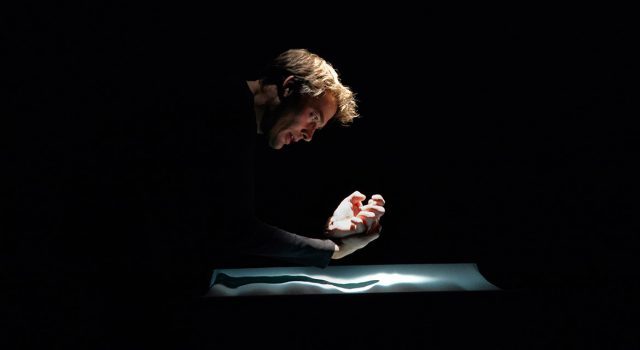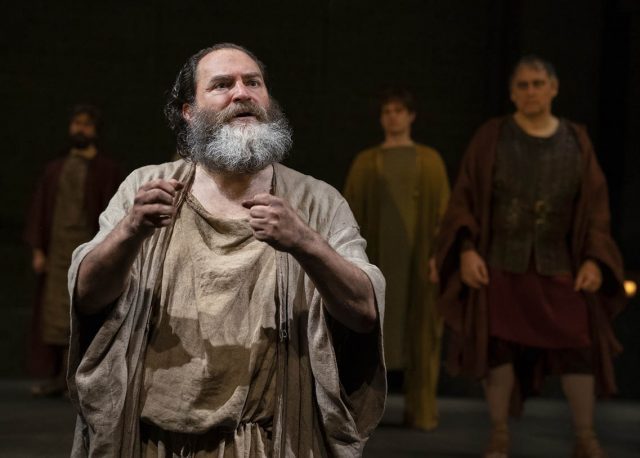
Michael Stuhlbarg is riveting as the title character in Tim Blake Nelson’s Socrates at the Public (photo by Joan Marcus)
Martinson Hall, the Public Theater
425 Lafayette St. at Astor Pl.
Tuesday through Sunday through June 2, $85-$150
212-539-8500
www.publictheater.org
Michael Stuhlbarg is rousingly gallant and stout as the title character in Tim Blake Nelson’s cogent but irritatingly long Socrates, which has been extended at the Public Theater’s Martinson Hall through June 2. The tale of the fate of one of the world’s most famous philosophers — who never wrote anything down, so all we know about him has come from the writings of others — is told in flashback via a pedantic, unnecessary frame story in which Plato (Teagle F. Bougere), a student of Socrates’s, is deciding whether he should become a boy’s (Niall Cunningham) teacher. The tall, blond boy is angry at Plato and what has been done to Socrates. “You’re an Athenian. The Athenians killed him. My question therefore implicates you, especially in the context of a democracy where leaders and their actions are promulgated as representing the people’s will,” the boy says. Plato acknowledges his responsibility, explaining, “In a sense I betrayed him more profoundly and lastingly than Athens did.”
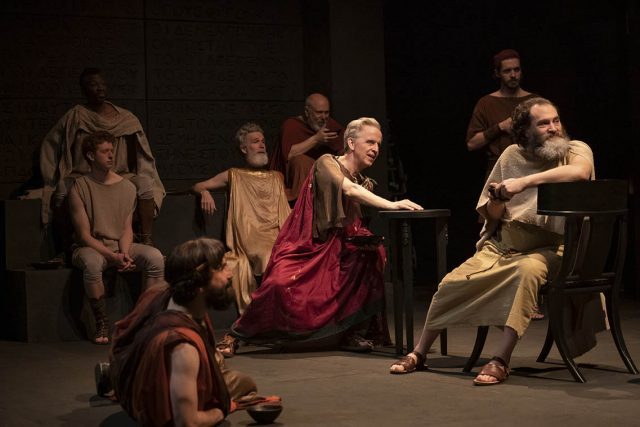
Crito (Robert Joy, center) is one of the writers whose dialogues form the basis of Socrates (photo by Joan Marcus)
Forget the bookended nonsense and instead revel in the bulk of the play, which really begins with a gathering in which Socrates, war hero Alcibiades (Austin Smith), playwright Aristophanes (Tom Nelis), doctor Eryximachus (David Aaron Baker), poet Agathon (Joe Tapper), writer Crito (Robert Joy), and others, dressed in period togas and robes designed by Catherine Zuber, are drinking heavily and regaling one another with tales of Socrates’s supposed love of good-looking boys and his general brilliance, both of which he adamantly denies. “You’ve taught an entire generation how to think!” Alcibiades exclaims, to which Socrates responds, “That’s simply not true!” Nelson soon jumps ahead to Socrates’s final days, as he’s arrested, facing a trial that could result in his execution. Like Sir Thomas More in A Man for All Seasons, Socrates refuses to bend his principles, spouting philosophy even as he denies his intelligence and ignores the pleas of his friends, colleagues, wife, Xanthippe (Miriam A. Hyman), and son to avoid the death penalty. “It would hardly become a man my age to resent his own end, don’t you think?” he says, arguing that there is only one outcome.

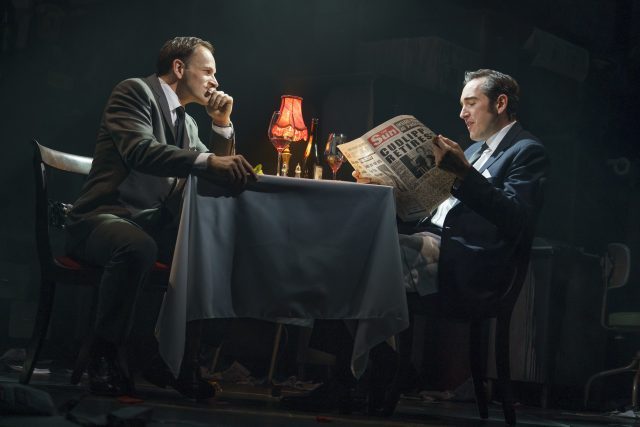
The Athenians make their case against Socrates in Tim Blake Nelson world premiere at the Public Theater (photo by Joan Marcus)
His fellow philosophers attempt to convince him otherwise, resulting in fascinating debates about happiness, equality, knowledge, memory, and truth in which the Tony- and Obie-winning, bushy-bearded Stuhlbarg (A Serious Man, The Pillowman), looking like a cross between Mandy Patinkin and the hirsute David Letterman, expounds on democracy with an intense fury that relates to the current situation in America and around the globe. After one particularly astute declaration, an audience member, a well-regarded thespian himself, shouted out, “Right on!”
Nelson, an actor (The Ballad of Buster Scruggs; O Brother, Where Art Thou?), filmmaker (The Grey Zone, O), and playwright (Eye of God, Anadarko), and Tony-winning director Doug Hughes (Doubt, The Father) let things go on way too long; the play runs a mind-boggling 160 minutes (with intermission), and you might find yourself groaning during the coda as Plato and the boy can’t stop evaluating what we’ve just seen. But when Stuhlbarg is onstage, it is electrifying. Scott Pask’s immersive set features walls that extend throughout the theater covered in the hand-carved text of Pericles’s Funeral Oration in Ancient Greek: “We are unique in the way we regard anyone who takes no part in public affairs: We do not call that a quiet life, we call it a useless life.” (Pericles was the uncle of Alcibiades.) Socrates did not live a quiet, useless life, his legacy as relevant today as ever.
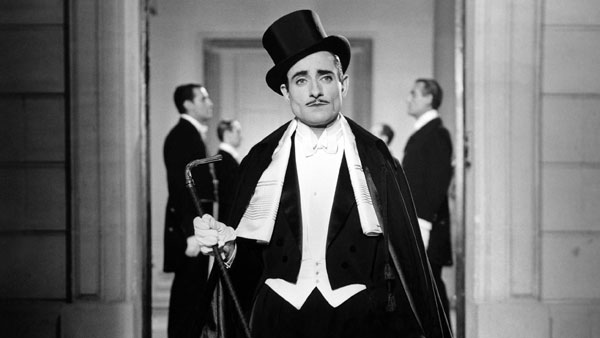
 French auteur Pierre Étaix’s strange and beautiful films were long inaccessible, the subject of nearly two decades of legal wrangling, but on May 9 and 15, MoMA will be presenting his 1965 bittersweet black-and-white slapstick charmer, Yoyo, as part of its “Jean-Claude Carrière” series, celebrating the screenwriter and master collaborator who worked with such legends as Luis Buñuel, Louis Malle, Miloš Forman, Jean-Luc Godard, Andrzej Wajda, Nagisa Oshima, and Peter Brook; the eighty-seven-year-old Carrière will introduce the May 9 screening. (In April 2010, Étaix was finally able to once again bring his films to the public, his entire output restored and making their New York debut at a festival at Film Forum in October 2012.) Étaix, who wrote Yoyo with Carrière, stars as a ridiculously wealthy but extremely bored man who lives alone in an ornately decorated, absurdly large chateau. It’s 1925, and he has servants for absolutely everything, as well as his own private band and flappers, but he pines for his lost love, Isolina (Claudine Auger). One day she arrives with a traveling circus, along with a young boy (Philippe Dionnet) who turns out to be his son. She at first rejects the multimillionaire, but when he loses it all on Black Tuesday, the three of them form their own traveling circus, with the boy ultimately turning into a popular clown named Yoyo (played as an adult by Étaix) and seeking to restore the chateau and his family.