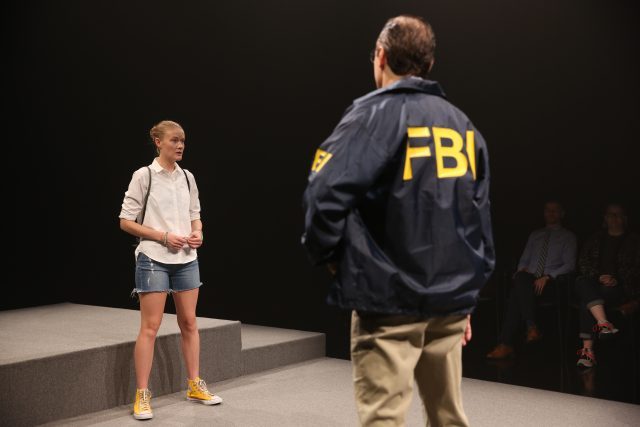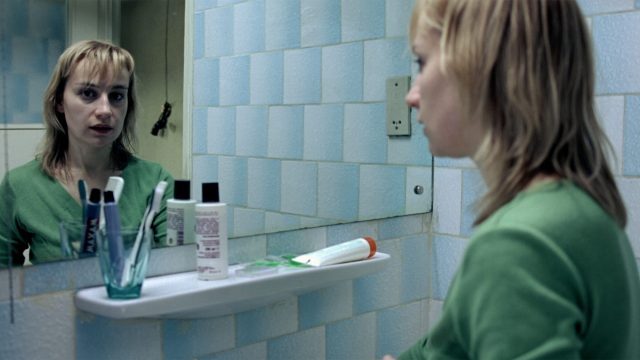
Anamaria Marinca stars in Cristian Mungiu’s harrowing 4 Months, 3 Weeks and 2 Days,, part of Film Forum celebration of the last three decades of Romanian cinema
Film Forum
209 West Houston St.
Through November 26
212-727-8110
filmforum.org
 On December 25, 1989, Romanian dictator Nicolae Ceaușescu and his wife, Elena, were executed by a firing squad after being found guilty of corruption and genocide. In the wake of his death, the Romanian film industry reinvented itself, and Film Forum pays tribute to that change with “The Romanians: 30 Years of Cinema Revolution,” consisting of thirty films screening over twelve days through November 26. Several shows will be followed by Q&As with the director and/or actor. In addition to the below four recommendations, the series includes Nae Caranfil’s Do Not Lean Out the Window, Radu Mihaileanu’s Train of Life, Alexandru Solomon’s The Great Communist Bank Robbery, and Constantin Popescu’s Pororoca.
4 MONTHS, 3 WEEKS AND 2 DAYS (Cristian Mungiu, 2007)
Friday, November 22, 3:30, 7:45
filmforum.org
Winner of the Palme D’Or at the 2007 Cannes Film Festival, Cristian Mungiu’s 4 Months, 3 Weeks and 2 Days is a harrowing look at personal freedom at the end of the Ceaușescu regime in late-’80s Romania. Anamaria Marinca gives a powerful performance as Otilia, a young woman risking her own safety to help her best friend, Gabita (Laura Vasiliu), out of a difficult, dangerous situation. Their lives get even more complicated when they turn to Bebe (Vlad Ivanov) to take care of things. Cinematographer Oleg Mutu, who shot Cristi Puiu’s brilliant The Death of Mr. Lazarescu, keeps the camera relatively steady for long scenes, without cuts, pans, dollies, or zooms, as the actors walk in and out of view, giving the film a heightened level of believability without looking like a documentary. Set in a restrictive era with a burgeoning black market, 4 Months goes from mystery to psychological drama to thriller with remarkable ease — and the less you know about the plot, the better.
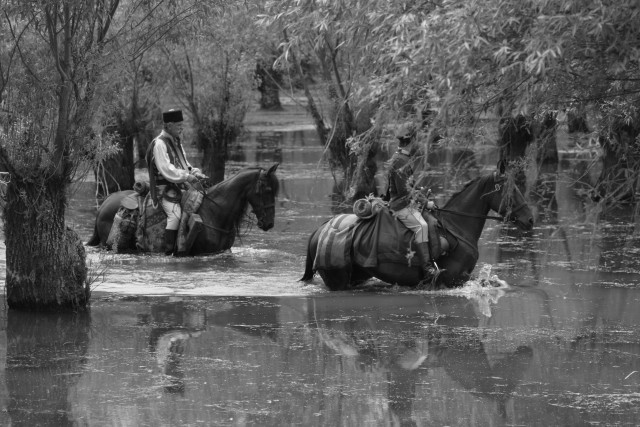
Father (Teodor Corban) and son (Mihai Comānoiu) hunt for a runaway slave in wickedly funny Aferim!
AFERIM! (Radu Jude, 2015)
Saturday, November 23, 3:30
bigworldpictures.org
filmforum.org
Romanian director Radu Jude won the Silver Bear as Best Director at the 2015 Berlin International Film Festival for Aferim!, his savagely funny blacker-than-black comic Western about bigotry, infidelity, and frontier justice in 1835 Wallachia. Lawkeeper Costandin (Teodor Corban) and his son, Ionitā (Mihai Comānoiu), are galloping through the local countryside, searching for runaway Gypsy slave Carfin (Cuzin Toma), who Boyar Iordache Cindescu (Alexandru Dabija) has accused of having an affair with his wife, Sultana (Mihaela Sîrbu). The surly Costandin leads the hunt, verbally cutting down everyone he meets, from random old women to abbots to fellow lawmen, with wicked barbs, calling them filthy whores, crows, and other foul names while spouting ridiculous theories about honor and religion; he even batters his son, saying he’s “a waste of bread” and that “if you slap him, he’ll die of grief.” It’s a cruel, cholera-filled time in which even the monks beat the poor, where Costandin regales a priest with the telling riddle, “Lifeless out of life, life out of lifeless,” which the priest thinks refers to the coming doomsday.
Cowritten by Jude (The Happiest Girl in the World, Everybody in Our Family) and novelist Florin Lăzărescu (Our Special Envoy, Numbness), who previously collaborated on the short film The Tube with a Hat, and shot in gloriously stark black-and-white by Marius Panduru (12:08 East of Bucharest; Police, Adjective), the Romanian / Bulgarian / Czech coproduction is an absurdist combination of Monty Python and the Holy Grail, Andrei Tarkovsky’s Andrei Rublev, Hal Ashby’s The Last Detail, and John Ford’s The Searchers, skewering everything in its path, either overtly or under its wide-reaching breath. Even Dana Pāpāruz’s costumes are a genuine riot, especially the boyar’s majestically ridiculous hat. But Aferim! is more than just a clever parody of period films and nineteenth-century Eastern European culture and social mores; it is also a brilliant exploration of the nature of racism, discrimination, misogyny, and the aristocracy that directly relates to what’s going on around the world today as well as how Romania has dealt with its own sorry past of enslaving the Romani people. Jude was inspired by real events and historical documents, setting the film immediately after the 1834 Russian occupation, which adds to its razor-sharp observations. “Aferim! is an attempt to gaze into the past, to take a journey inside the mentalities of the beginning of the nineteenth century — all epistemological imperfections inherent to such an enterprise included,” Jude says in his director’s statement. “It is obvious that such an effort would be pointless should we not believe that this hazy past holds the explanation for certain present issues.” Don’t miss this absolute gem of a film, which was Romania’s submission for the Academy Awards.
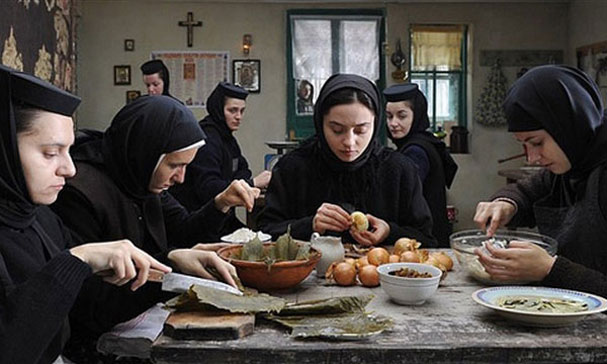
Voichita (Cosmina Stratan) must choose between her faith and her best friend in Cristian Mungiu’s Beyond the Hills
BEYOND THE HILLS (DUPA DEALURI) (Cristian Mungiu, 2012)
Sunday, November 24, 7:30
Monday, November 25, 12:40
filmforum.org
 Inspired by a true story detailed in a pair of nonfiction novels by Romanian journalist Tatiana Niculescu Bran, Cristian Mungiu’s Beyond the Hills is a powerful, emotional study of love, friendship, dedication, devotion, and sexual repression. In a barren section of modern-day Romania, Alina (Cristina Flutur) arrives at a poverty-stricken Orthodox monastery, where her childhood friend Voichita (Cosmina Stratan) has become a nun. Both young women grew up in a poor orphanage, and both still have no real place in society. Alina has come to try to convince Voichita — possibly her former lover — to leave the flock and go with her to Germany, where they can live and work together freely. Early on, Voichita rubs a tired Alina’s bare back; when Alina turns over, Voichita just stops short of massaging her friend’s chest, the sexual tension nearly exploding in a scene of quiet beauty that speaks volumes about their relationship. Despite Alina’s pleading, Voichita, apparently filled with deep inner guilt, refuses to turn her back on the priest (Valeriu Andriuţă), whom all the nuns refer to as Pa, and her newfound vocation. Unable to accept her friend’s decision, Alina begins acting out in threatening ways to both herself and the true believers, leading to shocking, tragic consequences.
Mungiu’s feature-film follow-up to the 2007 Palme d’Or winner 4 Months, 3 Weeks and 2 Days is another harrowing examination of characters trapped in a devastating situation. The two-and-a-half-hour film seems to take place in a different era, far away from contemporary towns and cities, cell phones and even electricity. Mungiu, who won the Best Screenplay award at Cannes for the film, is careful not to condemn or belittle Pa, Ma (Dana Tapalagă), and their faith, but he doesn’t praise them either, leaving it up to viewers to decide for themselves. In their feature-film debuts, Flutur and Stratan, who are both from Mungiu’s hometown of Iasi and shared the Best Actress award at Cannes, are exceptional, their eyes filled with fear and longing as Alina and Voichita try to find a balance in their opposing worlds.
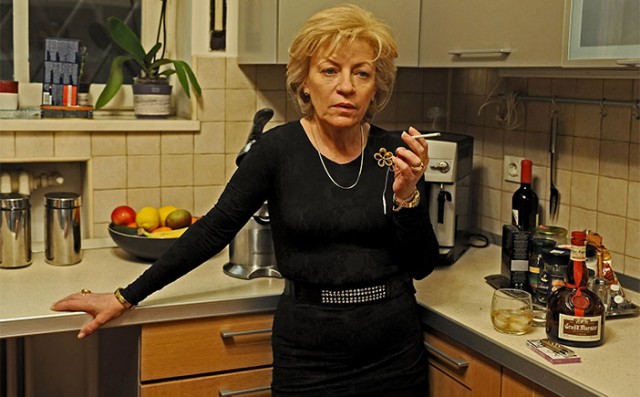
Luminița Gheorghiu plays a controlling, domineering mother in Călin Peter Netzer’s award-winning Child’s Pose
CHILD’S POSE (POZITIA COPILULUI) (Călin Peter Netzer, 2013)
Monday, November 25, 8:40
filmforum.org
www.zeitgeistfilms.com
Luminita Gheorghiu, grand dame of the Romanian New Wave, was nominated for Best Actress at the European Film Awards for her devastating portrayal of a domineering mother in Călin Peter Netzer’s Child’s Pose. Gheorghiu (The Death of Mister Lazarescu; 4 Months, 3 Weeks and 2 Days) stars as Cornelia Kerenes, an elegant, cigarette-smoking architect who immediately jumps into action when her son, Barbu (Bogdan Dumitrache), is involved in a terrible car accident, killing a child. Despite their recent estrangement — Cornelia and Barbu have rarely spoken since he married Carmen (Ilinca Goia) — Cornelia starts constructing a scenario, like designing one of her buildings, to keep Barbu out of jail. She and her surgeon husband, Reli (Florin Zamfirescu), along with her sister, Olga (Nataşa Raab), start calling in favors and doling out bribes while showing a stunning lack of concern for the family of the boy who Barbu killed. As the child’s funeral approaches, relationships come together and fall apart as parents try to deal with what has happened to their children. Winner of the Golden Bear at the Berlinale, Child’s Pose is a searing examination of class, corruption, and power.
Reminiscent of Lucrecia Martel’s The Headless Woman, in which María Onetto gives a mesmerizing performance as an Argentine upper-class wife and mother who looks the other way when it appears that she might have run over a local boy, Child’s Pose is a penetrating character study that centers around the wide gap between the rich and the poor. Early on in the film, Cornelia, who her husband at one point calls “Controlia,” sits down with her dour cleaning woman and offers her a pair of used shoes, expecting her to rejoice in such wonderful charity. The scene sets the stage for what occurs later, as Cornelia believes money is the primary route to Barbu’s freedom, but it’s a path littered with more than just one young child’s body. The taut, razor-sharp script was written by Netzer (Maria, Medal of Honor) and Răzvan Rădulescu, who has worked on such other Romanian New Wave films as The Death of Mister Lazarescu, Stuff and Dough, and Tuesday, After Christmas. In Cornelia, they have created a woman worthy of joining the pantheon of classic domineering cinematic mothers.

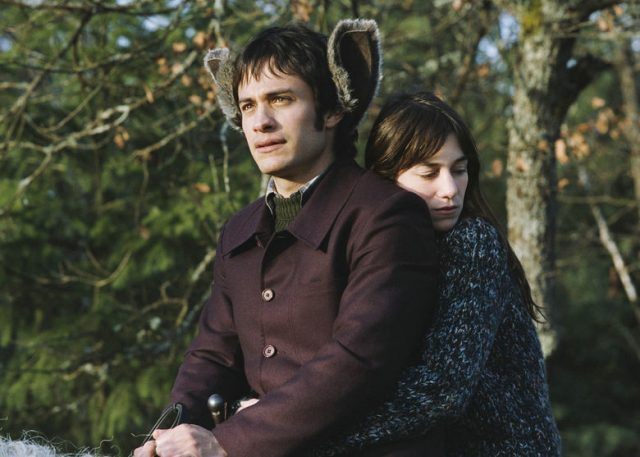
 The FIAF CinéSalon series “Charlotte Forever: Gainsbourg on Film,” an eight-movie tribute to the ever-charming and captivating Charlotte Gainsbourg, continues November 19 with eclectic auteur Michel Gondry’s feature-length debut as both writer and director. The Science of Sleep is a complex, confusing, kaleidoscopic stew that is as charming as it is frustrating. Gael García Bernal (The Motorcycle Diaries, Mozart in the Jungle) stars as the juvenile but endearing Stéphane, a young man in a silly hat who has trouble differentiating dreams from reality. The childlike Stéphane becomes friends with his new neighbor, Stephanie (Gainsbourg), who still has plenty of the child left inside her as well. Stéphane has a job his mother (Miou-Miou) got him, toiling for a small company that makes calendars, alongside the hysterical Guy (Alain Chabat), who can’t help constantly poking fun at coworkers Serge (Sacha Bourdo) and Martine (Aurélia Petit).