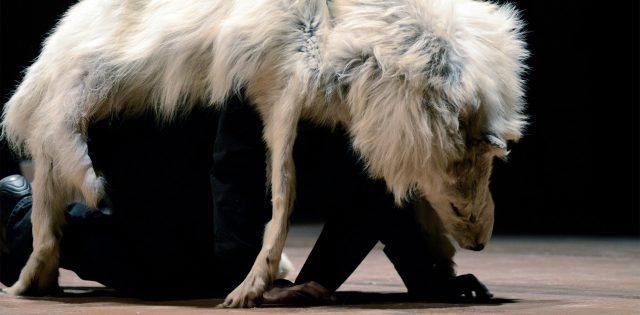
Who:Red Bull Theater What: Live unrehearsed online Zoom reading Where:Red Bull Theater website and Facebook and Vimeo When: Monday, May 4, free, 7:30 Why: In 2011, Red Bull Theater staged Thomas Dekker, John Ford, and William Rowley’s 1621 Jacobean tragedy, The Witch of Edmonton, at the Theater at St. Clement’s. The New York-based company, which on April 20 brought back the cast of its 2015 revival of Ford’s ’Tis Pity She’s a Whore for a free, online, live unrehearsed reading, is now doing the same with The Witch of Edmonton, assembling most of the original cast for a virtual presentation on May 4 at 7:30. Performing from wherever they’re sheltering in place will be Charlayne Woodard as Elizabeth Sawyer, Craig Baldwin as Warbeck and Countryman, Justin Blanchard as Frank Thorney, Christopher Innvar as Sir Arthur Clarington, Carman Lacivita as Somerton and Countryman, Christopher McCann as Thorney, Amanda Quaid as Katherine, Everett Quinton as Old Ratcliffe and Anne Ratcliffe, Miriam Silverman as Winifred, Derek Smith as Dog, Raphael Nash Thompson as Justice, Sam Tsoutsouvas as Carter, and newcomers Antoinette Robinson, David Manis, and Carson Elrod, with music by Daniel Levy. In a statement, company founder Jesse Berger, who directed the 2011 production, explained, “We want to engage you and our entire community with something stimulating and of genuine value. We’re not promising a finished performance but rather a unique way to experience the rarely seen The Witch of Edmonton.” It’s free to watch, although donations are accepted. Next up in this program are live, unrehearsed readings of Red Bull’s bloody good 2016 adaptation of Shakespeare’s Coriolanus on May 18, its 2005-6 version of Thomas Middleton’s The Revenger’s Tragedy on June 1, and Jeffrey Hatcher’s fab 2017 adaptation of Gogol’s The Government Inspector on June 15.
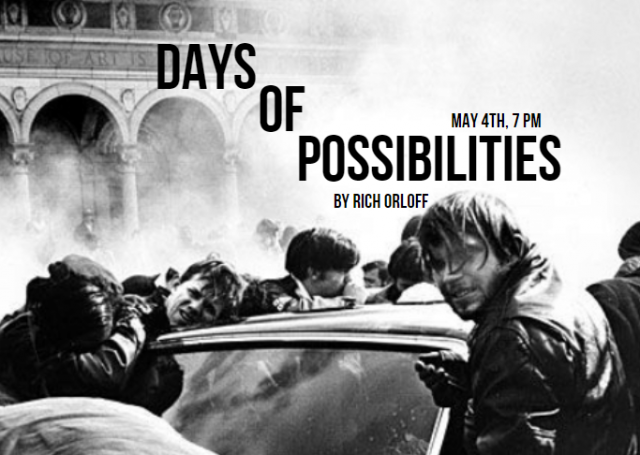
Who: New Circle Theatre Company What: Live Zoom performance of Days of Possibilities Where:Facebook Live When: Monday, May 4, free, 7:00 Why: On May 4, 1970, the Ohio National Guard shot and killed four unarmed college students at Kent State University during a protest against the US bombing of Cambodia. New Circle Theatre Company in New York City will commemorate that tragic event, which shook America to its core, with a live performance of Rich Orloff’s Days of Possibilities, an online adaptation of his 1989 documentary theater piece Vietnam 101: The War on Campus, for which he interviewed more than one hundred alumni of Oberlin College. Created specifically for Zoom, the new play will feature twenty actors performing from their homes; it is directed by David Kronick. In a statement, Orloff, whose other plays include Advanced Chemistry, Someone’s Knocking, Big Boys, and Chatting with the Tea Party, said in a statement, “I think the events of that era need to be remembered, not just for their historical importance, but for lessons we can use today. Days of Possibilities offers stories of hope and courage during a time of great uncertainty. To fight for what they believed in, students risked being expelled, jailed, tear-gassed, and even shot. I think we can be inspired by the idealism of that time, especially if we don’t want to accept today’s social and political problems as inevitable and instead choose to find ways to fight for a better world. The technological tools we can use today were undreamed of fifty years ago, but I like to think that dreaming and working for a better future is timeless.” On Monday night at the same time, the play will also be performed by theater companies in Tennessee, Massachusetts, Maryland, and California as well as a high school in Arizona. (If you miss the livestream, you can catch the recorded show later.)
Last week, the Professional Bull Riders hosted the first sports event in America since the Covid-19 shutdown postponed or ended stadium sports, including basketball, baseball, hockey, and others, as well as the Olympics. On April 25-26, PBR, whose latest motto is “Be Cowboy,” held its Las Vegas Invitational in Guthrie, Oklahoma, with competitors maintaining social distancing guidelines and riding in an arena with no fans. It was such a success that PBR will return to the Lazy E in Guthrie for “Unleash the Beast” tournaments May 9-10 and 16-17. You can now go behind the scenes of bull riding in Annie Silverstein’s deeply affecting debut feature film, Bull, but you will have to stream it at home rather than watching in a theater with other people.
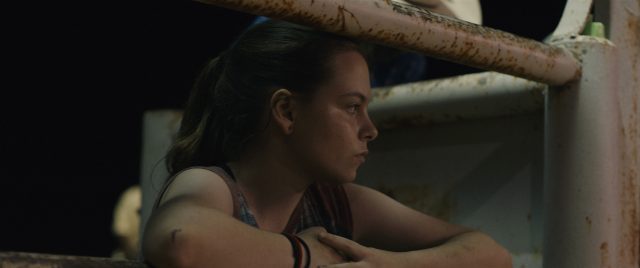
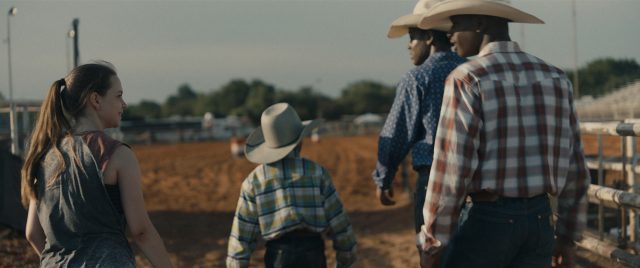
An Un Certain Regard selection at the 2019 Cannes Film Festival, Bull is a gently told coming-of-age story involving fourteen-year-old Kris (first-timer Amber Havard) and the middle-aged Abe Turner (Rob Morgan), a former professional bull rider who now works as a bullfighter, the men who protect the riders as they try to stay on the bull for the toughest eight seconds in sports. It’s the fighter’s responsibility to make sure the bull doesn’t gore or trample the rider after he dismounts or is ejected, as the fighters put their own lives in danger over and over again in the course of one event.
Kris is a quiet white girl who lives with her grandmother (Keeli Wheeler) and little sister (Keira Bennett); Kris’s mother (Sara Albright) is in prison but is nearing parole. Abe is a dour black man living alone down the street from Kris. Abe chastises Kris when her pitbull kills one of his chickens. Kris doesn’t seem to care about it — she doesn’t appear to care about much of anything, walking around with a sullen look, saying little. When Abe is away at a tourney, Kris breaks into Abe’s house and invites her friends to a wild party there during which they trash the place. When Abe gets back and catches Kris there, he calls the cops. Kris’s mother begs Abe and Officer Diaz (Karla Garbelotto) to let her go. Offered the chance to make things right, she mumbles to the officer, “Can’t you just take me to juvie?” Her eyes are distant, resigned to a life she has already given up on. Meanwhile, despite the beating his body is taking, Abe is determined to keep on fighting, either with PBR or the regional black cowboy rodeo circuit. Kris starts working for Abe, doing laborious chores while also becoming interested in bull riding herself. Abe has no intention of turning into a mentor to her, but soon they are forming an unusual bond, two lonely souls in desperate need of real human connection.
Expanding on her award-winning short Skunk, Silverstein has created a tender, moving tale that subtly reveals such issues as race, opioid abuse, the prison system, and parental neglect in rural America. Silverstein wrote the script with her husband, Johnny McAllister, after more than five years of research, including getting to know the men, women, and children living in such communities as Acres Homes outside of Houston and the athletes participating in local rodeos. She had previously spent ten years working with children in her native Seattle, which helped her define the character of Kris. Cinematographer Shabier Kirchner glides between intimate, handheld shots and the explosive excitement of bull riding, filming in such locations as the Old William Johnson Arena in Egypt, Texas, and the Roy LeBlanc Okmulgee Invitational Rodeo in Oklahoma.
Professional bullfighters Demetrius “Teaspoon” Mitchell and JW Rogers served as consultants and appear in the film, along with pros Devonte Toler, Tyler Travis, Cody Tesch, Nate Justice, and Lucas Teodoro; most of the cast are nonprofessionals in their first film, including Havard, who was discovered in a school cafeteria and beat out a thousand other girls for the part. She has an extraordinary screen presence, so modest and genuine that you will want to reach into the screen and shake her out of her character’s malaise. Morgan, who has appeared in such television series as Stranger Things and Daredevil and such films as The Last Black Man in San Francisco and Just Mercy, is edgy and boldly sensitive as the uneasy, unsettled Abe; the two actors avoid cliché as their lives become unexpectedly entangled.
On May 3 at 4:00, Silverstein, Havard, Morgan, and producer Monique Walton will participate in a live Q&A moderated by Gamechanger CEO Effie Brown, focusing on the film itself as well as the history of black rodeo communities; you can register in advance for free here. To find out more about bull riding and bullfighting, please check out the annual twi-ny talks I’ve conducted with PBR stars over the last five years.
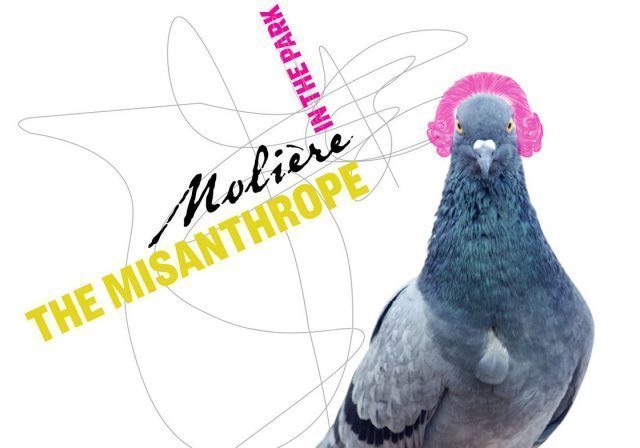
Who:Molière in the Park theater company What: Livestreamed performance and Q&A Where: FIAF Facebook and Molière in the Park YouTube When: Saturday, May 2, free with RSVP, 7:00 (show will be available for viewing through May 6) Why: Molière in the Park was scheduled to present two-time Pulitzer Prize winner Richard Wilbur’s English-language translation of Molière’s The Misanthrope in Prospect Park May 13-23, but the coronavirus shut it down. Instead, FIAF is bringing the world premiere of this contemporary take on Molière’s seventeenth-century comedy of manners to social media, streaming live on Facebook and YouTube on May 2 at 7:00. (A recording of the show will remain available on YouTube through May 6.) Heidi Armbruster, Kaliswa Brewster, Chris Henry Coffey, Naomi Lorrain, Jared McNeill, Jennifer Mudge, Postell Pringle, and Tamara Sevunts will be performing such roles as Alceste, Célimène, Philinte, Acaste, Oronte, Arsinoé, Éliante, Clitandre, Basque, and Du Bois from their homes in New York City, Milwaukee, and Perugia. Company founder Lucie Tiberghien will direct the production, which features guest appearances by Samira Wiley and Stew. Admission to the ninety-minute show, which will be followed by a Q&A, is free, but advance RSVP is required.
Lone Wolf Recital Corps will present live musical meditation on works composed by Terry Adkins on Performa Radical Broadcast (Performance view of Facets: A Recital Compilation by Terry Adkins, November 8, 2012, at the Arthur Zankel Music Center, Skidmore College presented as part of the exhibition Recital at the Tang Teaching Museum and Art Gallery. Photograph by Patrick O’Rourke)
Who: Blanche Bruce, Clifford Owens, Kamau Amu Patton What: Livestream performance Where:Performa’s Radical Broadcast website channel When: Friday, May 1, free, 4:00 Why: In 2017, MoMA hosted a series of performances and talks in conjunction with the exhibition “Projects 107: Lone Wolf Recital Corps,” one of which I was fortunate enough to see. The exhibit focused on the work of artist and musician Terry Adkins (1953-2014), the founder of the performance collective Lone Wolf Recital Corps. This spring the Pulitzer Arts Foundation was scheduled to open “Terry Adkins: Resounding,” consisting of sculptures, instruments, digital videos, and various personal ephemera. Along with the postponement of the show, several live performances were canceled, but on May 1 at 4:00, the Pulitzer, in conjunction with Performa and organized by corps members Clifford Owens and Kamau Amu Patton, will be presenting “Radical Broadcast: Lone Wolf Recital Corps,” a livestream performance featuring Adkins alter ego Blanche Bruce (named after former slave and US senator Blanche Kelso Bruce) revisiting the early scores “Second Mind” and “Alto Age,” with Owens joining from his New York City apartment and Patton working from his Chicago studio. (Owens participated in the 2005 Performa Biennial and Adkins in the 2013 edition.) Adkins once said, “My quest has been to find a way to make music as physical as sculpture might be, and sculpture as ethereal as music is. It’s kind of challenging to make both of those pursuits do what they are normally not able to do.” That is especially true of playing live music in the age of coronavirus.
Who: Trip Cullman, Diep Tran, Jeremy Tiang, Catherine Coray, more What:PlayClub live discussion Where: Zoom meeting (link sent to participants) When: Thursdays at 5:00, free but RSVP required (space is very limited) Why: During the coronavirus crisis and shutdown, Obie-winning, New York City-based Play Company, aka PlayCo, has started #Playfrom6FeetAway, a super-cool initiative in which a limited number of participants read a play in advance, then have a live online discussion hosted by a special guest. It might not be a replacement for the experience of live theater, but it is a great way to keep creators and play lovers connected. The series kicked off on April 23 with Nina Raine’s Consent, hosted by director Trip Cullman. On April 30, journalist Diep Tran will lead an examination of Young Jean Lee’s We’re Gonna Die, a play that I’ve seen twice, most recently in a rousing production at Second Stage. The program continues May 7 with Wei Yu-Chia’s A Fable for Now, hosted by the play’s translator, Jeremy Tiang, and May 14 with Sylvia Khoury’s Selling Kabul (the New York premiere was scheduled to begin previews March 27 at Playwrights Horizons), moderated by NYU Arts professor Catherine Coray of the Lark Play Development Center US/Middle East Playwright Exchange. The Zoom rooms are limited to a mere ten people, so keep watching PlayCo for further announcements and to snatch a coveted spot.
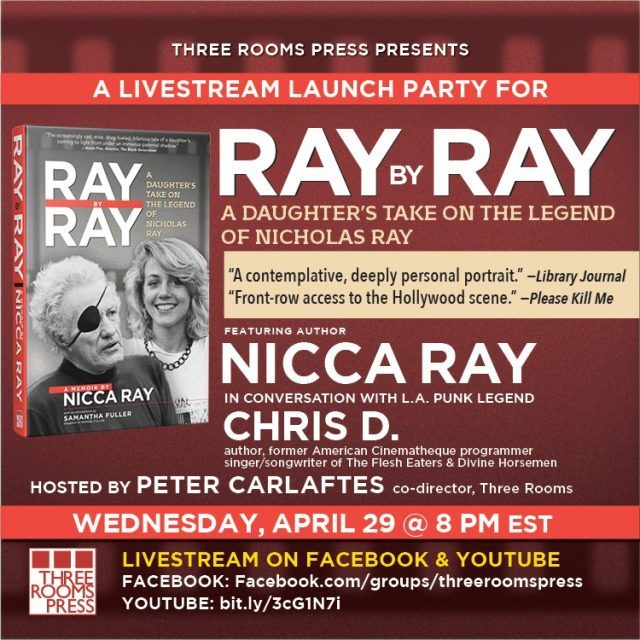
Who:Nicca Ray,Chris Desjardins,Peter Carlaftes What: Virtual book launch with reading and conversation Where:Three Rooms PressFacebook and YouTube When: Wednesday, April 29, free, 8:00 Why: Born in Wisconsin in 1911, Raymond Nicholas Kienzle Jr. would go on to change Hollywood as Nicholas Ray, a genre-redefining auteur who directed such films as They Live by Night, In a Lonely Place, Johnny Guitar, Rebel without a Cause, Bigger Than Life, and King of Kings. A controversial figure who had drug and alcohol problems and was married four times, including a short-lived, tempestuous union with Gloria Grahame, Ray had four children, including Nicca Ray, who was born in 1964; her mother was dancer Betty Utley, who divorced Ray that same year. Ray would not play a part in Nicca’s life for another decade before passing away in 1979. Nicca takes a unique look at who her father was, especially during those missing ten years, in her thoroughly researched memoir/biography, Ray by Ray: A Daughter’s Take on the Legend of Nicholas Ray (Three Rooms Press, April 2020, $20). On April 29 at 8:00, Three Rooms Press cofounder Peter Carlaftes will host a live virtual book launch on Three Rooms Press’s Facebook and YouTube pages, featuring a reading by Nicca, followed by a conversation between Nicca and punk rocker, poet, actor, director, Upsetter Records cofounder, and Flesh Eaters and Divine Horsemen band member Chris (Chris D.) Desjardins, discussing Nicholas Ray’s films, punk rock, creativity without drugs, and more.