twi-ny recommended events

LET FREEDOM RING VOL. 2

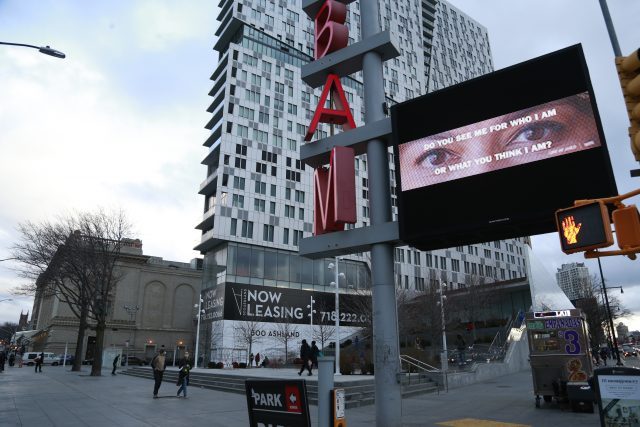
Jasmine Wahi’s On Visibility was part of first iteration of BAM’s “Let Freedom Ring” project (photo © Terrence Jennings 2020)

LET FREEDOM RING VOL. 2
BAM sign screen
Flatbush Ave. at Lafayette Ave.
February 12-15, free
www.bam.org/let-freedom-ring

Last month, as part of its thirty-fifth annual Brooklyn Tribute to Dr. Martin Luther King Jr., BAM hosted “Let Freedom Ring,” a weeklong public art display on its sign screen at the corner of Flatbush and Lafayette Aves., featuring visual meditations on what freedom means by Derrick Adams, Alvin Armstrong, Laylah Amatullah Barrayn, Lizania Cruz, Kameelah Janan Rasheed, Hank Willis Thomas, and Jasmine Wahi. Armstrong’s We Don’t Die We Multiply depicted two silhouetted bare-chested men bumping bodies. Adams offered MLK’s Tropic Interlude. Thomas asked, “Who Taught You to Love_?” Wahi’s On Visibility posits, “Do you see me for who I am or what you think I am” over an image of two large eyes. And Barrayn expllored beauty in Self-Portrait (Extension of a Woman) and Water Spirit (March on Washington 2020). The second iteration of “Let Freedom Ring” takes place February 12-15, with electronic billboard contributions from Jordan Casteel, Kevin Claiborne, Amy Sherald, Deborah Roberts, Cruz, Barrayn, and Wahi.

In a statement, BAM curator-at-large Larry Ossei-Mensah said, “After the first project’s success, I felt it necessary to continue the conversation and reflect on freedom as the nation observes Presidents Day and celebrates Black History Month. Working on ‘Let Freedom Ring’ has been a cathartic experience growing from a desire to ponder and imagine what freedom could look like in 2021 and beyond. It’s imperative that we share this thought-provoking work with the public and not relegate it to just a gallery exhibition. These are fundamental questions and concerns we all share as Americans, as human beings.” Commenting on the participants, he noted, “Naturally, as a curator, I look to artists who create work that inspires hope, proposes deep philosophical questions, and reminds us of our humanity for guidance on what is possible. I’m honored that these seven artists accepted my invitation and responded in a variety of ways. I was thrilled to see each artists’ perspective on freedom — from self-reflection, joy, and a reintroduction to Dr. King’s fight for economic justice with the Freedom Budget document.” BAM is one of the institutions I am missing the most during this pandemic lockdown, but this is a little taste of the kind of work it has been doing for decades.
THEATRE FOR ONE: HERE WE ARE — CHICAGO EDITION

THEATRE FOR ONE: HERE WE ARE
Court Theatre, Chicago
Free tickets for first week available Thursday, February 11, 11:00 am EST
Wednesday – Sunday, February 18 – March 14, free with advance RSVP
www.courttheatre.org

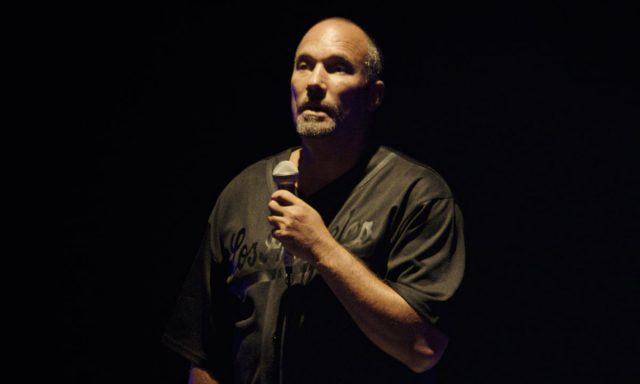
In my review of the inaugural iteration of Theatre for One’s “Here We Are,” I wrote that it “comes the closest to conjuring the feeling [of experiencing live theater], that swell of emotion between audience and performer. It is not only a brief, temporary panacea for what ails you; it fills a deep need for those desperate for live theater to return, taking advantage of current technology to make that exhilarating connection again.” The presentation, created by Christine Jones, consists of eight solo works between five and eight minutes apiece, written by some of today’s most exciting BIPOC women playwrights, performed live for one person at a time; the performers (seven women and one man) can see and hear you, and you can see and hear them, resulting in a unique atmosphere that is utterly thrilling. Chicago’s Court Theatre is bringing “Here We Are” back February 18 through March 4, with a cast and crew from the Windy City. You have to reserve your one free ticket in advance, and you won’t know which play you are going to see until it starts. I went back week after week last fall till I eventually saw them all, and it was well worth the time and effort. Below is the full roster of the Chicago edition; you can find out more about each play and the show as a whole here.

Thank You for Coming. Take Care., by Stacey Rose, directed by Miranda Gonzalez, featuring Sydney Charles
What Are the Things I Need to Remember, by Lynn Nottage, directed by Chris Anthony, featuring TayLar
Pandemic Fight, by Carmelita Tropicana, directed by Miranda Gonzalez, featuring Melissa DuPrey
Here We Are, by Nikkole Salter, directed by Monet Felton, featuring Xavier Edward King
Thank You Letter, by Jaclyn Backhaus, directed by Lavina Jadhwani, featuring Adithi Chandrashekar
Before America Was America, by DeLanna Studi, directed by Chris Anthony, featuring Elizabeth Laidlaw
whiterly negotiations, by Lydia R. Diamond, directed by Monet Felton, featuring Deanna Reed-Foster
Vote! (the black album), written and directed by Regina Taylor, featuring Cheryl Lynn Bruce

SUMMERSTAGE ANYWHERE: RODNEY KING FILM CONVERSATION WITH ROGER GUENVEUR SMITH AND DR. STEPHANIE LEIGH BATISTE

Roger Guenveur Smith will discuss his role as Rodney King in Spike Lee film as part of SummerStage Anywhere series

Who: Roger Guenveur Smith, Dr. Stephanie Leigh Batiste
What: Live discussion and Q&A
Where: SummerStage Anywhere
When: Thursday, February 11, free, 7:00
Why: “So whatcha wanna do, Rodney King? Reminisce?” Roger Guenveur Smith asks in Rodney King. “It goes a little bit something like this. . . .” Directed by Spike Lee, the 2017 film is a document of Smith’s one-man multimedia stage show exploring who Rodney King is as a human being and not just a controversial figure who became the symbol of the 1992 LA riots. On February 11 at 7:00, Smith, who has appeared in numerous Lee movies and has also portrayed Booker T. Washington, Huey P. Newton, and basebrawlers Juan Marichal and John Roseboro, will discuss the film with Dr. Stephanie Leigh Batiste, associate professor of Black studies and English at the University of California, Santa Barbara, offering new perspectives given the BLM protests that began last May following the murder of George Floyd at the hands of police. The film is available on Netflix or can be watched for free here in advance. The event is part of SummerStage Anywhere, an online initiative of the City Parks Foundation that also includes last week’s “Lift Every Voice: Celebrating 150 Years of James Weldon Johnson’s Legacy,” with Desmond Richardson, Khalia Campbell, Angie Swan, Laila Jeter, Donovan Canales, Elizabeth Alexander, and Phylicia Rashad, and continues February 18 with “The Rewind: A Celebration of Black Culture,” introduced by Greg Tate, and February 25 with “Michael Mwenso: Hope, Resist, and Heal,” a performance and conversation with Michael Mwenso and Shannon Effinger.

REEL PIECES WITH ANNETTE INSDORF: SPECIAL ONLINE CONVERSATION WITH RAMIN BAHRANI

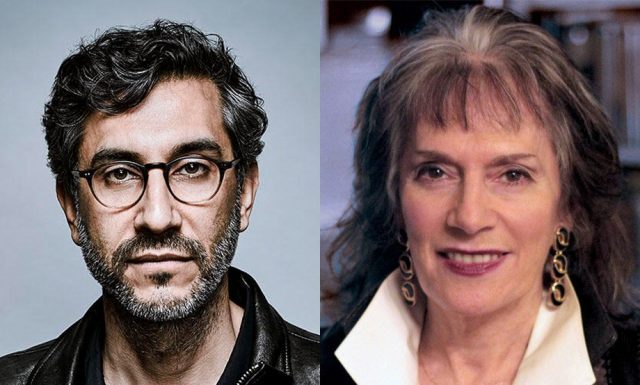
Ramin Bahrani and Annette Insdorf will discuss The White Tiger and more in 92Y talk and Q&A

Who: Annette Insdorf, Ramin Bahrani
What: Special online conversation about The White Tiger
Where: 92Y
When: Monday, February 8, free with RSVP. 8:00
Why: Iranian-American writer, director, and producer Ramin Bahrani burst onto the indie scene in 2005 with his brilliant Man Push Cart, followed by the charming Chop Shop and Goodbye Solo. He was nominated for the Golden Lion for 2013’s At Any Price and 2015’s 99 Homes but slipped a bit with his 2018 HBO adaptation of Ray Bradbury’s Fahrenheit 451. Bahrani is now back with the Netflix original The White Tiger, based on the Booker Prize–winning novel by his friend Aravind Adiga. The film stars Adarsh Gourav as a young boy who sees his future out of poverty by working for wealthy masters (Rajkummar Rao and Priyanka Chopra Jonas) who will help him climb the ladder of success, at an ever-increasing price. On February 8 at 8:00, Bahrani, a Columbia graduate and film professor, will join film historian, Columbia professor, and author Annette Insdorf for her 92nd St. Y series “Reel Pieces,” a livestreamed conversation and audience Q&A; admission is free with RSVP. You can also check out previous episodes of the show, online during the pandemic (Aaron Sorkin, Sofia Coppola) and from the before time in person (Greta Gerwig, Glenda Jackson, Nick Nolte), here.

THE ORCHESTRA NOW: SCHOENBERG & BACH / NEW & CLASSIC WORKS FOR STRINGS

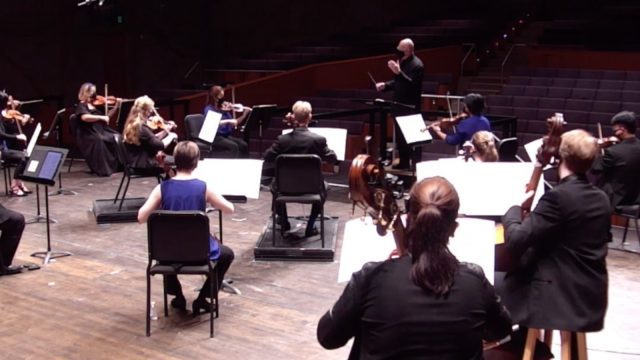
The Orchestra Now (TŌN) will present livestreamed concerts from the Fisher Center this month (photo courtesy the Orchestra Now)

Who: The Orchestra Now (TŌN)
What: Two livestreamed concerts
Where: Fisher Center for the Performing Arts at Bard
When: Sunday, February 7, free – $35, 2:00, and Sunday, February 21, free – $35, 2:00
Why: The Orchestra Now (TŌN), which features young musicians handpicked from around the world, will be presenting two live programs this month, broadcast from the Fisher Center at Bard in Annandale-on-Hudson. On February 7 at 2:00, “Schoenberg & Bach” features Bach’s Brandenburg Concerto No. 3, Lutosławski’s Funeral Music, Teresa Carreño’s Serenade for Strings, and Schoenberg’s Verklärte Nacht (Transfigured Night), conducted by Leon Botstein. On February 21 at 2:00, “New & Classic Works for Strings” consists of a timely world premiere by Sarah Hennies, Jonny Greenwood’s Popcorn Superhet Receiver, Vaughan Williams’s Fantasia on a Theme by Thomas Tallis, and Grieg’s Holberg Suite, conducted by James Bagwell. Tickets to each concert are free to $35 depending on what you can afford, and each will be available on demand on the STAY TŌNED digital platform beginning the Thursday following the live performance.

KIRSTEN JOHNSON CARTE BLANCHE: HAROLD AND MAUDE (AND MORE)

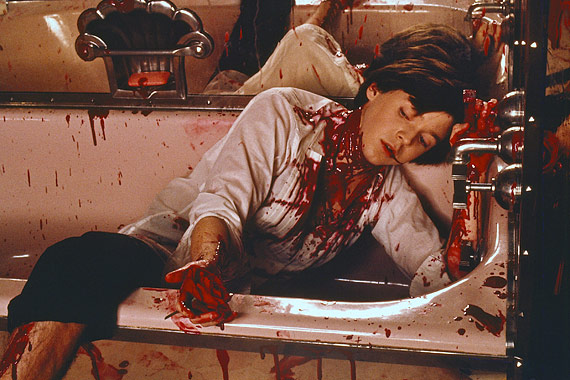
Harold (Bud Cort) has a little bit of an obsession with death in very different kind of romantic comedy that is part of Metrograph series

HAROLD AND MAUDE (Hal Ashby, 1971)
Metrograph Digital
Sunday, February 7, 8:00
Series continues through February 18
metrograph.com/screenings

New York City–based cinematographer and documentarian Kirsten Johnson has jumped into the spotlight with her latest nonfiction film, Dick Johnson Is Dead, which is garnering Oscar buzz; the film imagines multiple deaths for her father, who is suffering from dementia. The film was a follow-up to her 2016 autobiographical cinematic memoir, Cameraperson, which put her on the map after years of serving as director of photography for Laura Poitras (The Oath, Citizenfour), Michael Moore (Fahrenheit 9/11), and others. She is currently hosting “Kirsten Johnson Carte Blanche,” five specially selected films for Metrograph Digital, each uniquely dealing with life and death, including Elia Suleiman’s Divine Intervention, Yuval Hameiri’s I Think This Is the Closest to How the Footage Looked, Souleymane Cissé’s Yeelen, and Keisha Rae Witherspoon’s T.

On February 7 at 8:00, she will introduce a one-time-only live fiftieth anniversary screening of the existential cult fave Harold and Maude. Bud Cort (Harold) and Ruth Gordon (Maude) are magnificent in this glorious black comedy from director Hal Ashby (The Last Detail, Shampoo, Being There) and writer Colin Higgins (Foul Play, 9 to 5). Harold is an eighteen-year-old rich kid obsessed with death, regularly flirting with suicide. Maude is a fun-loving, free-spirited senior citizen approaching her eightieth birthday. Ashby throws in just the right amount of post-1960s social commentary, including a very funny antiwar scene, without becoming overbearing, as this could have been a maudlin piece of sentimental claptrap, but instead it’s far from it. Even the Cat Stevens soundtrack (“If You Want to Sing Out, Sing Out,” “Tea for the Tillerman,” “Where Do the Children Play?”) works beautifully. Harold and Maude is a tender, uproarious, bittersweet tale that is one of the best of its kind, completely unforgettable, enlightening, and, ultimately, life-affirming in its own odd way. While H&M will screen only on Sunday night, offering a respite from the Super Bowl frenzy, all the other films in “Kirsten Johnson Carte Blanche” will be available for several days after their initial livestream.

M. C. ESCHER: JOURNEY TO INFINITY

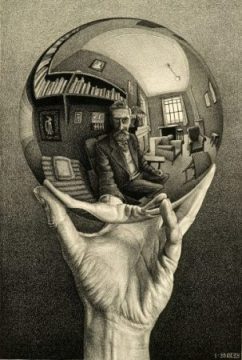
Documentary gazes into the complex world of M. C. Escher

M. C. ESCHER: JOURNEY TO INFINITY (Robin Lutz, 2019)
New Plaza Cinema
Opens virtually February 5
kinomarquee.com
newplazacinema.org

Maurits Cornelis Escher, better known as M. C. Escher, is one of the most popular graphic artists of the twentieth century, even though he considered himself a mathematician, not an artist. His fantastical works, often of impossible architectural configurations, are imbedded with a scientific surrealism that has made them favorites on T-shirts, posters, placemats, puzzles, album covers, ads, and tattooed body parts. In 2019, the traveling show “Escher: The Exhibition & Experience” came to Industry City in Brooklyn; the Italian-sponsored presentation included lots of Instagram-friendly installations that invited visitors to put themselves inside some of Escher’s most famous pieces. But who was the Dutch artist?

At the beginning of Robin Lutz’s documentary, M. C. Escher: Journey to Infinity, there’s a shot of fingers typing out the following: “I’m afraid there is only one person in the world who could make a good film about my prints; me.” And so it is; the movie is structured around Escher’s own words, compiled from his notes, journals, lectures, calendars, and letters, elegantly narrated by British actor Stephen Fry. The only talking heads who share their thoughts are two of Escher’s children, George and Jan Escher, and one of Escher’s daughters-in-law, along with, curiously enough, superfan Graham Nash. “I cannot understand why the out-of-control youths of today appreciate my works so much,” Escher says of late-1960s psychedelic re-creations of his butterflies and geometric space objects. Of course, it’s easy to tell what drew, and continues to draw, so many to his artistry.

Supplemented by archival photographs and film footage, Lutz traces Escher’s life and career from his love of drawing as a child and his studies at the Haarlem School of Architecture and Decorative Artists to his falling in love with Jetta Umiker, a romance he explains in rather unique language. His description of a picture of a seemingly endless winding road of trees is particularly revealing, accompanied by the sounds of an echoing church organ, played at St. Bartholomew’s in Haarlem, where Escher honed his craft. The camera focuses on a pair of feet treading the same paths that Escher took, as if he himself is leading us on this journey, focusing on rocks, flowers, birds, leaves, chameleons, and other elements that became his subject matter.

At the age of forty, he writes about his evolving process, involving systematism, recognizability, and the importance of background: “I have things of my own that had to come out, that I could express something others don’t have. . . For me, this is the richest of times.” The film grows richer as well as Escher shares insight behind the creation of some of his most famous works while also discussing isolation, human contact, and the horrors of Fascism and WWII. In addition, Lutz, who also served as producer and cinematographer, has plenty of fun with animation, bringing works to life, from a skull floating through the clouds to moving chess pieces to figures going up and down impossible staircases.

Breathlessly edited by Moek de Groot, M. C. Escher: Journey to Infinity is a pure joy because Lutz lets Escher, who passed away in 1972 at the age of seventy-three, run the show, his words poetic and passionate, the images captivating and mind-bending, infused with an infectious, futuristic energy that transcends the now. It’s an exciting trip deep into one man’s relationship with a complex world that he captured in extraordinary artworks that are likely to dazzle and confound viewers for a long time to come.