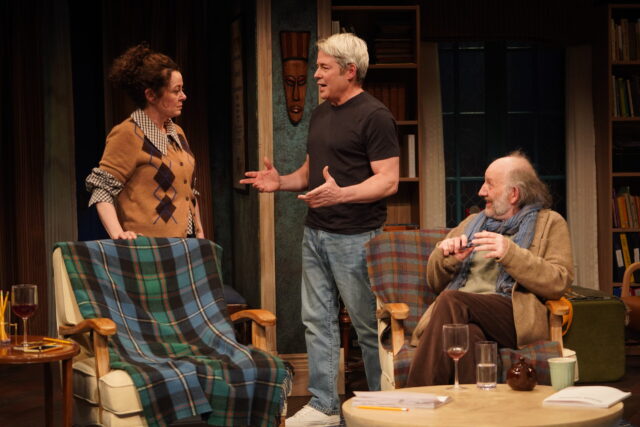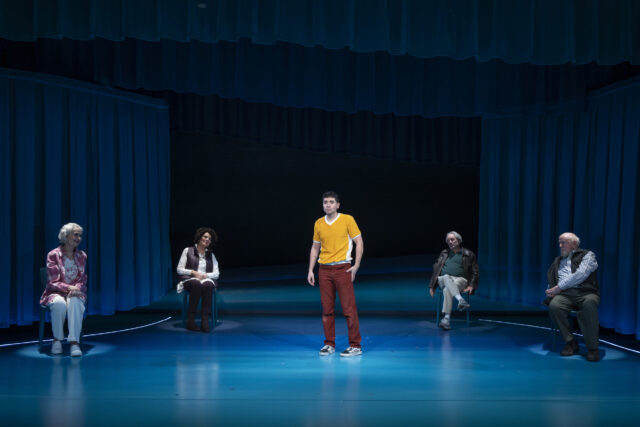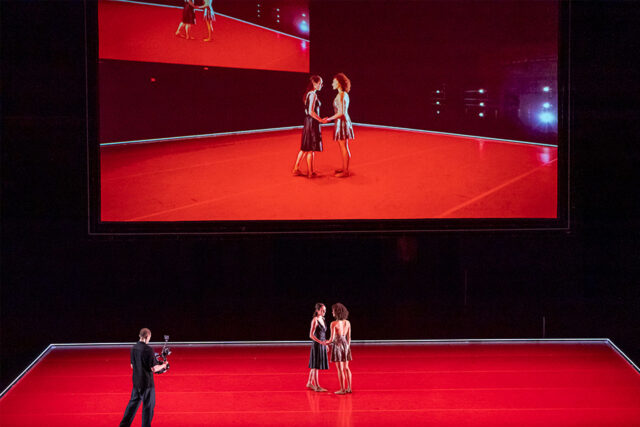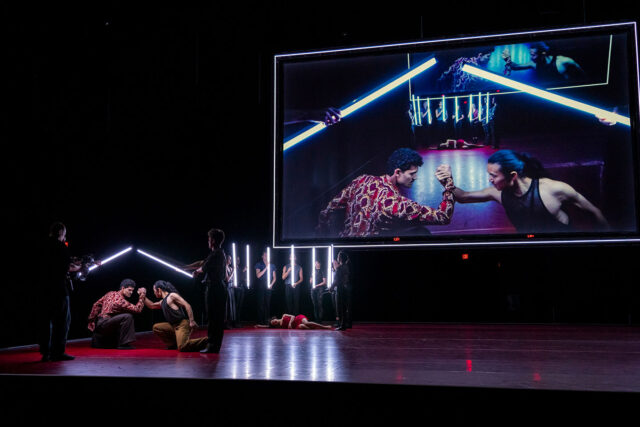
twi-ny recommended events

IDOLATROUS PROCESSIONS, PROVOCATIONS, DEMIURGIC NERVATURES, AND DISTANT PRESENCES: THE QUAY BROTHERS RETURN WITH SANATORIUM

The Quay Brothers return to Film Forum with their first feature-length film in twenty years, another foray into the unknown and unseen

SANATORIUM UNDER THE SIGN OF THE HOURGLASS (the Quay Brothers, 2024)
Film Forum
209 West Houston St.
Opens Friday, August 29
212-727-8110
www.filmforum.org

As if a new film from the Quay Brothers is not already reason enough to celebrate, the rejoicing can escalate because their latest, Sanatorium under the Sign of the Hourglass, is another masterful addition to their forty-year career.

Philadelphia-born, England-based identical twins Stephen and Timothy Quay make unique, complex stop-motion animated works that incorporate elements of German expressionism, silent film tropes, noir, and psychoanalysis, creating dark, heavily atmospheric tales that push the boundaries of storytelling conventions, using eerie, fragile dolls and puppets along with mysterious live action and spectral experimental music. They started out in 1985 with the eleven-minute Little Songs of the Chief Officer of Hunar Louse, or This Unnameable Little Broom, Being a Largely Disguised Reduction of the Epic of Gilgamesh, Tableau II, a dreamlike fantasia involving a creepy, clownlike figure surrounded by doors and drawers that open and close by themselves and windows that offer views into other worlds. They followed that up with the 1986 classic Street of Crocodiles, based on Bruno Schulz’s 1934 short story collection and inspired by the work of Czech filmmaker, artist, and playwright Jan Švankmajer; the twenty-minute opus revolutionized the genre, focusing on a man, dressed like a magician, who looks into a strange contraption that leads him into a portentous alternate universe where inanimate objects move and clocks have no hands.

Only their third feature-length film — after 1994’s Institute Benjamenta and 2004’s The Piano Tuner of EarthquakesSanatorium under the Sign of the Hourglass, based on the 1937 novel and other writings by Schulz, is a natural progression from those early days, a kind of summation of everything that came before it. The narrative is set at Sanatorium Karpaty in the foothills of the Karpathian Mountains, where patient J (Zenaida Yanowsky) is convalescing. We first meet Adela I (Allison Bell), a young woman peering around suspiciously, her knee blocking part of her face as we listen to a scratchy 1936 Radio Archive recording of a voice explaining, “Sometimes, at the opening . . . of a street someone turned to the sky half a face, with one frightened and shining eye, and listened to the rumble of space.” Next we see, through the pupil in a large, disembodied eye, three men in top hats, two chimneysweeps (Andrzej Kłak and Leszek Bzdyl) and an auctioneer (Tadeusz Janiszewski). The auctioneer is selling such unusual items as “Twin Quail eggs of supernatural size, laid during the Solar Eclipse . . . of 12 May 1706? Or three petrified ribs of a Siren . . . together with her hands found in the Royal Menagerie of Fredensborg . . . in the year 27 September 1674. Or an Iron Harpoon . . . struck by lightning! Or the Warm Blood of Bees! Or the Hour of your Death!”

Sanatorium under the Sign of the Hourglass is another audiovisual marvel by the Brothers Quay

The auctioneer, who also refers to himself as a flogger and a pedlar, returns to his sparse office, where his assistant (Wioletta Kopańska) shows him a new item that has been delivered for him to sell; in his booming thespian voice, he reads: “Forbiddingly called Maquette for the Sepulchre of a Dead Retina, it is a singularly decrepit but ornate wooden box having the appearance of a miniature funerary cabinet with a skilfully hidden secret drawer allegedly containing the deceased retina of its original owner. Penetrating the exterior skin of this box are seven randomly placed lenses with tiny adjustable screws. Each lens holds a glimpse of one of the seven final images that the said eye beheld. And when positioned correctly, once a year, on the 19th of November, the sun’s rays are aligned to strike the dead retina — thereby liquefying it, anointing each of the seven images and setting them in motion.”

The box suddenly comes to life, and the auctioneer peers into one of the lenses and sees Józef, a doll in a top hat who wanders through an old, ghostly train, going from coach to coach as doors and secret entrances swing open and closed and ghastly figures appear and disappear. In voiceover, the auctioneer narrates the proceedings as Józef meets the multiarmed Dr. Gotard, who is caring for Józef’s ailing father. Józef encounters a broken hourglass, a dilapidated bridge, a buzzing neon sign in red and blue, used chalk for hire, and old mirrors as he makes his way through netherworld vestibules.

The story occasionally cuts back to live action with real actors, where Józef (Kłak) is told by the chambermaid (Kopańska) that it is always night there. He peers through a keyhole and watches what might be some kind of S&M encounter, bathed in a golden light. A horde of men (Bzdyl, Robert Martyniak, Łukasz Łucjan, Marek Jasek) are tantalized by Adela II (Kopańska). Back in his doll form, Józef is led to a crumbling theater for one person; his seat is Loge 7A, which is restricted view.

It all combines for a storytelling tour de force, zeroing in on the voyeuristic nature of humanity, from how we watch movies and theater to how we interact with one another in real life and fantasy.

Sanatorium under the Sign of the Hourglass unfolds in seven sections, including “Provocations Found in Evening Corridors: Hosanna!,” “Distant Presences Traced Around the Circumference of a Knee,” “The Idolatrous Procession,” and “Travels in the Last World.” It’s a Victorian steampunk dark nightmare that is like an ASMR fan’s dream. The attention to detail in every shot, every sound is remarkable, resulting in a hypnotic audiovisual experience. The Quays are credited with the puppets, décors, animation, and cinematography; the spectacular production design is by Agata Trojak, with sets by Anna Podhajny, props by Mateusz Niedzielak, costumes by Dorothée Roqueplo, live-action cinematography by Bartosz Bieniek, and sound by Joakim Sundström and the Quays.

Timothy Nelson’s original score features electronic noise, propulsive drumming, and spectral tones, accompanied by additional music by Alfred Schnittke performed by the Berlin Radio Symphony Orchestra. The methods employed by the Brothers Quay are so dazzling that their mind-blowing sets were on display in the fall 2009 exhibit “Dormitorium: Film Décors by the Quay Brothers” at Parsons the New School for Design, and they were honored with the wide-ranging 2012–13 MoMA retrospective “Quay Brothers: On Deciphering the Pharmacist’s Prescription for Lip-Reading Puppets.”

Not even the most serious students of Freud and Jung will make sense of everything as the film investigates concepts of time and space, of life and death in ways that both chill and thrill. (In their director comments, the Quays call Sanatorium “an exploration of motifs and themes taken from the mytho-poetic writings of Bruno Schulz integrating both puppets and live-action to score the demiurgic nervature of Schulz’s 13th apocryphal month in the Regions of the Great Heresy.”) As they have done in This Unnameable Little Broom, Street of Crocodiles, and such other shorts as The Comb, The Phantom Museum: Random Forays into the Vaults of Sir Henry Wellcome’s Medical Collection, Metamorphosis, Through the Weeping Glass: On the Consolations of Life Everlasting (Limbos & Afterbreezes in the Mütter Museum), and The Doll’s Breath — some of which are documentaries — they invite viewers into fantastical, unimaginable realms and dimensions that are as confounding as they are beautiful, as unnerving as they are intensely involving and satisfying.

Sanatorium under the Sign of the Hourglass opens August 29 at Film Forum; each screening will be preceded by a specially recorded introduction by the Quay Brothers. The 6:10 show on Friday will be introduced by Literary Hub editor Olivia Rutigliano.

[Mark Rifkin is a Brooklyn-born, Manhattan-based writer and editor; you can follow him on Substack here.]
NOT AS YOU LIKE IT: TWELFTH NIGHT AT THE DELACORTE

Duke Orsino (Khris Davis) and his minions get ready for action in Twelfth Night (photo by Joan Marcus)

TWELFTH NIGHT
Delacorte Theater, Central Park
Tuesday – Sunday through September 14, free with advance RSVP, 8:00
shakespeareinthepark.org

The confusion begins early in Saheem Ali’s inconsistent adaptation of William Shakespeare’s 1601–02 romantic comedy, Twelfth Night, which opens the newly revitalized Delacorte Theater in Central Park. As the audience enters the space — the majority of the $85 million upgrade went to technical operations, dressing rooms, bathrooms, accessibility, and signage, along with improvements to the facade and seats — a string quartet is playing on a red stage that features swirling patterns and, in giant, bold letters around the back, the subtitle of the play: What You Will. (The renovation did not rid the Delacorte of its famous raccoons, one of which ambled along atop the back wall moments before the play began, eliciting the adoring attention of the crowd.)

Then Ghanaian American singer-songwriter Moses Sumney, portraying the fool, Feste, walks onto the stage with a guitar and sings, “All the world’s a stage, / And all the men and women merely players. / They have their exits and their entrances, / And one man — or woman — in their time plays many parts.”

The line actually comes from the second act of As You Like It and seems like a cliché here taken out of context, even with its addition of “or woman.” Meanwhile, the musical shift from classical to Sumney’s alternative/indie R&B is jarring, and the character feels more like a demonic troubadour than one of Shakespeare’s fools.

Maria (Daphne Rubin-Vega) offers some intriguing news to Malvolio (Peter Dinklage) in Shakespeare production at revitalized Delacorte (photo by Joan Marcus)

Next, a sea captain (Joe Tapper) and Viola (Lupita Nyong’o) rise in a small boat from one of the Delacorte’s new modular trap doors. Emphasizing that they are strangers to this land, the first words they say to each other are in Swahili, although most of their conversation in in English. (Nyong’o was born in Mexico and raised in Kenya and speaks fluent English, Spanish, Luo, and Swahili.) The explicatory scene lets us know that there has been a shipwreck that has led the captain and Viola to Illyria, which is ruled by the duke Orsino (Khris Davis), who is in love with Olivia (Sandra Oh), a count’s daughter who is mourning the recent deaths of her father and brother and currently uninterested in suitors. Viola’s brother, Sebastian (Junior Nyong’o), was also on the ship, and Viola holds out hope that he has survived as well. She decides to disguise herself as a man named Cesario and serve the duke. (Sebastian has indeed survived and is on the island, with Antonio [b], an enemy of the duke’s, as his servant.) Only then do we meet Orsino as he declares to court gentleman Curio (Ariyan Kassam) and Feste, “If music be the food of love, play on,” which usually starts the play.

Thus, this Twelfth Night has a completely different atmosphere, which is not in itself a bad thing. I am not a Bard purist who insists that Shakespeare plays should not be messed with. Among the endless beauties of his work are the myriad possibilities it offers for reinterpretation. Over the last dozen years, I have seen three memorable productions of Twelfth Night: one on Broadway starring Mark Rylance as an Olivia who is light on her feet and a wickedly funny and towering Stephen Fry as her steward, the much-maligned Malvolio, in a delightful version that harkened back to the seventeenth century in form and style; one off Broadway by Axis that was dark and foreboding and utterly involving; and one at the Delacorte in 2018, an engaging musical comedy by Shaina Taub, who also portrayed Feste. (Twelfth Night is a favorite of the Public Theater’s Shakespeare in the Park presentations, having been staged six times previously, going back to 1969.)

In 2021, I was disappointed in Jocelyn Bioh and Ali’s Merry Wives, which moved the location of the story from Windsor to South Harlem and felt too caught up in shtick, and the same is true here. Scenes move by too quickly as actors enter and leave down the aisles, via the traps, and through the “What You Will” wall like a one-ring circus, not allowing enough time for character development or actor chemistry. Attempts at amusement abound: Olivia’s uncle, the Falstaffian Sir Toby Belch (John Ellison Conlee), and his sidekick, the cheeky Sir Andrew Aguecheek (Jesse Tyler Ferguson), hang out in a hot tub doing lines of coke and whippets when they’re not plotting with Olivia’s chambermaid, Maria (Daphne Rubin-Vega), to publicly embarrass Malvolio (Peter Dinklage) in front of Olivia, whom he secretly pines for. Orsino asserts his strength and power by working out barechested at a gym and ordering his minions to drop and do pushups for punishment. Sir Toby, Sir Andrew, and Fabian (Kapil Talwalkar) hide from Malvolio behind four handheld letters, T, R, E, and E, instead of a tree, which is cute at first but goes on too long. A duel is transformed into a comic boxing match, with Sir Andrew in full boxing regalia.

Olivia (Sandra Oh) and her minions get ready for action in Twelfth Night (photo by Joan Marcus)

Real-life siblings Lupita and Junior Nyong’o are dapper in their double-breasted suits. The inspired casting of Dinklage as Malvolio tails off when he is left doing too much voguing, particularly when trying to put a smile on his face. Davis has impressive abs. The actor known as b seems out of place whenever they’re onstage, although the part of Antonio can be a challenge to integrate in even the best of productions. Rubin-Vega looks fabulous, but it’s hard to remember she’s playing a maid. Conlee has fun as Sir Toby, but it’s Oh who steals the show as Olivia, wonderfully balancing comedy and pathos as her lust builds up, subduing her mourning with an elegant wit and grace, best capturing the spirit of Ali’s intentions.

The director has excelled in such non-Shakespeare plays as James Ijames’s Fat Ham, Bioh’s Nollywood Dreams, and Donja R. Love’s Fireflies, but I’ve found both Merry Wives and now Twelfth Night overwrought and scattershot, with too many scenes and characters appearing to come from different plays, lacking continuity despite individual moments that shine. It’s perhaps best exemplified by the Twelfth Night finale, a showcase for costume designer Oana Botez and set designer Maruti Evans; it looks fabulous, but it comes out of nowhere. It elicits wild applause from the audience, but it feels like a preening peacock that has arrived onstage, perhaps watching out for that raccoon.

[Mark Rifkin is a Brooklyn-born, Manhattan-based writer and editor; you can follow him on Substack here.]
LOVE AND JEALOUSY: SEVEN SCENES AT LITTLE ISLAND

Miriam Gittens, Doug Letheren, and Alexander Bozinoff form a trio as Mikael Darmanie plays the piano and Danni Lee Parpan watches in Seven Scenes at Little Island (photo by Matthew Placek)

SEVEN SCENES
The Amph at Little Island
Pier 55, Hudson River Park at West Thirteenth St.
August 22-28, $10 standing room, $25 seats, 8:30
littleisland.org

A pair of real-life and professional partners bring an infectious passion to Seven Scenes, a lovely hourlong work continuing at the simultaneously spacious yet cozy outdoor Amph at Little Island through August 28.

The dance theater piece was conceived, choreographed, and directed by the Iowa-born Bobbi Jene Smith and Jerusalem native Or Schraiber, who met while dancing for Ohad Naharin’s Batsheva Dance Company, became founding members of the American Modern Opera Company in 2017, got married in 2018, and have a child together. The score, ranging from classical to country, is performed live by the electro-pop duo Ringdown, consisting of real-life couple Caroline Shaw and Danni Lee Parpan on vocals, keys, and synths, accompanied by Mikael Darmanie on keyboards and electronics, Keir GoGwilt on violin, and Coleman Itzkoff on cello. Smith and Schraiber are joined by dancers Alexander Bozinoff, Jonathan Frederickson, Payton Johnson, Doug Letheren, and Ophelia Young.

Seven Scenes comprises a series of interconnected vignettes about love, jealousy, and sexual exploration. Victoria Bek’s costumes feature the men in black or gray dress pants, black or white shirts, and shiny black shoes while the women, each with long hair, wear dark, low-cut outfits. The instruments are at the Hudson River end of the bare wood stage, which remains otherwise empty save for a few moments when the cast brings out a table and chairs. Shaw, Parpan, GoGwilt, and Itzkoff occasionally wander around the dancers, singing and playing their instruments before taking seats in the first row in between audience members. Whenever someone is not performing, they are closely watching what is going on, as if they are voyeurs waiting for their moment to participate.

Payton Johnson, Miriam Gittens, and Bobbi Jean Smith line up in Seven Scenes at Little Island (photo by Matthew Placek)

The evening is highlighted by solos, pas de deux, and trios in which the performers enact primarily romantic scenarios to a score that begins with Jean-Louis Duport’s Étude No.7 and then ranges from Brahms’s Piano Trio No. 2 in C major, op.87: andante con moto, Bach’s Violin Sonata in E minor P. 85: I. Allegro, Schubert’s Piano Trio No. 2 in E-Flat Major, D. 929: II. Andante con moto, and Handel’s Keyboard Suite No. 1 (Set II) in B-Flat Major HWV 434 IV. Minuet to Willie Nelson’s “Crazy” and Ringdown’s “Hocket,” “Fantasia,” and “Thirst,” highlighted by guttural sounds.

Smith and Schraiber’s movement language is inspired by Naharin’s Gaga, focusing on the full body, from fingers to toes, interspersed with just a few runs, jumps, and throws; dancers often remain in place as they interact with one another, but the relationships are always powerfully dynamic. (You can find out more about Smith and Schraiber in the films Bobbi Jene and Aviva.) A man and a woman converge, then are interrupted by a second man, the first man interested in both of them. The three women form a line, moving in unison before breaking free.

Classical ballet and ballroom meld with contemporary dance as the men sit around a table, put on and take off jackets, and one of the men stretches across the table. The men later form a row before sitting in chairs, evoking Naharin’s Minus 16 and Jerome Robbins’s bottle dance from Fiddler on the Roof. Individuals fall to the floor and remain there, as if having been rejected, or exhausted by the chase. Johnson excels in a solo to “Thirst” as Ringdown sings, “Clenched jaw and furrowed brow / If you are the rain, then I am the ground / Don’t know what to do with this thirst for a time and place where I found you first / Where I found you first.”

The men shake hands with audience members. Near the end, Fredrickson thrills with a yearning solo to Darmanie’s gorgeous piano.

There’s a beautiful intimacy to Seven Scenes and how it tells its stories, weaving in sound and motion, dancers and musicians, both physically and emotionally, as bodies come together and are ripped apart, all under a glowing night sky.

Following select performances, the audience is invited to the nearby Glade for a free concert at 10:00, with GoGwilt and pianist Conor Hanick on August 27 and pianist Jeremy Denk on August 28.

[Mark Rifkin is a Brooklyn-born, Manhattan-based writer and editor; you can follow him on Substack here.]
YO-HO-HO! A PYRATE MUSICAL ON A RED HOOK BARGE

Black Sam Bellamy (Danny Hayward) and Paulsgrave Williams (Lauren Molina) anticipate trouble ahead in The Royal Pyrate (photo by Geve Penaflor)

THE ROYAL PYRATE
Lehigh Valley Railroad Barge No. 79
Waterfront Museum, 290 Conover St., Red Hook
Saturday & Sunday through August 31, $35-$65
www.theroyalpyrate.com

“Ahoy there, maties! I know we all be feelin’ the weight o’ the world crushin’ down on us of late: a system which only seems to serve thems already on top, where ye’re afraid that if ye get hurt, or sick, ye’ll never find o’ way o’ diggin’ yer way outta the grave,” Paulsgrave Williams (Lauren Molina) says at the beginning of The Royal Pyrate. “There always be gold for wars, but never for our strugglin’ families. Life sure is difficult in 1715! But . . . that ain’t no reason we can’t have a bit o’ fun together tonight, eh?”

There’s more than a bit o’ fun to be had aboard Lehigh Valley Railroad Barge No. 79 in Red Hook, where the world premiere musical, featuring music and lyrics by Jason Landon Marcus and a book by Chas LiBretto, continues Saturday and Sunday nights through August 31.

Home to the Waterfront Museum owned and operated by Captain David Sharps, the barge has presented such previous shows as the Drama Desk–nominated The Wind and the Rain: A story about Sunny’s Bar, which related the true tale of the next-door Red Hook institution Sunny’s Bar, and Port Cities NY, which explored the sociocultural and –economic impact of the seventeenth-century Dutch trade routes via a game called “The Settlers of Manahatta.”

The rousing opening number, “Roll the Bones,” sets the tone for the hundred-minute show, which starts out in Wellfleet, Massachusetts, in 1715. Paulsgrave, Tommy Toothacher (accordionist Charley Layton), Ferguson (bassist Charlie Bennett), and Crabby Conrad (guitarist Marcus) are gambling when they are joined by their former colleague, master smuggler Black Sam Bellamy (Danny Hayward). Sam has returned because his girlfriend, Mary Hallet (Maggie Likcani), is pregnant and he needs fast money. Luck is not going his way, so he reveals a treasure map he has obtained that gives the location of where sixteen Spanish trips carrying riches have sunk.

Mary enters, disappointed that instead of getting a real job, Sam has opted to go back to his merry band of pirates, a word that offends Paulsgrave. “Pirates . . . attack ships. Kill the captain. Steal the cargo,” she explains. “Smugglers . . . selflessly distribute that cargo to the poor folks that needs ’em.” Tommy adds, “For a price.”

After Mary delivers the didactic song “New World,” which includes such lyrics as “If you really want a new world / Make sure you’re fighting the right fights. / We need inalienable rights. / Monetary compensation / Breeds corruption in a nation. / Citizens will need to have an independent core / And stop wasting time fighting a rich man’s war,” Simone Van Vorst (flutist Tais Szilagi) announces that Rev. Treat (Korie Lee Blossey) is looking for Sam, claiming he stole a corpse from the harbor; Treat is also upset with Mary because of her determination to change the status quo and expand the rights of the common people.

On their search for the treasure, they are accosted by a pirate ship captained by Edward Teach, better known as Blackbeard (Blossey), an imposing figure who deliciously declares, “Who’s got the beard that be most feared? Who to the mouth of the devil hath steered? . . . Pipe ye down then, shake a leg! / Seek me the captain and roll out a keg / Drop anchor, cut out the sails, I say / Stir not ye rascals or it’s hell ye’ll pay!” In addition, Sam and his ship, the Whydah, have made another enemy in Captain Beer (Layton) and his god-fearing crew, who want to see Sam hanged.

Meanwhile, Treat, Henrietta Hinkley (Marcus), Deidre Dimmock (Layton), Gilda Gilpen (Bennett), and the rest of the villagers in Wellfleet have accused Mary of witchcraft, wanting to see her hanged as well.

Thus, treasure might await some, a noose others.

Blackbeard (Korie Lee Blossey) is not about to back away from sunken treasure in musical aboard Red Hook barge (photo by Geve Penaflor)

The Royal Pyrate is based on the true story of Black Sam Bellamy, Mary “Goody” Hallet, Edward “Blackbeard” Teach, Paulsgrave Williams, the Rev. Samuel Treat, and the sunken Spanish treasure ships. In 1980, lifelong Cape Codder Barry Clifford discovered the Whydah and began salvaging it. However, far more is known about Bellamy, for example, than Hallet, so LiBretto (Melville on the Shore, Cyclops: A Rock Opera) and director Emily Abrams (Eeeeeeeee, Superfeats) try to fill in the gaps, although the pacing can sometimes be as choppy as the water outside. The night I went, it was windy and raining, so the barge occasionally lurched this way and that, which actually enhanced the overall immersive experience.

The audience, some of whom are asked to participate in small ways, is seated in two rows on three sides of the center space, the band occupying the fourth. Among the playful props are barrels, oars, swords, guns, playing cards, a small telescope, doubloons, and skeletons. Juli Abene and Alex Abene’s period costumes depict scalawags, rapscallions, buccaneers, and sea wolves — which are also the four levels of ticket prices — and are highlighted by Hallet’s petticoats, several cool pirate hats, and numerous vests. Marcus’s (Sally May, Cyclops: A Rock Opera) score melds English ballads, Irish folk, sea shanties, and West African and Caribbean melodies, with such standouts as “Roll the Bones,” “The Beard,” belted out by Blossey with operatic grandeur, and the rollicking finale, “Tell No Tales.”

The band crafts a jaunty sound while some members double as minor characters. Molina is an engaging host, and Blossey’s booming baritone and large physical presence can barely be contained by the rocking barge. Likcani is understated as Hallet, complementing the more boisterous Hayward as Bellamy.

And yes, there are plenty of Aaarrrr!s throughout, along with a healthy dose of self-referential humor.

Also, be sure to get there early — taking the ferry is highly recommended — and soak in the barge itself, as Sharps has lovingly preserved it, with fascinating details galore.

[Mark Rifkin is a Brooklyn-born, Manhattan-based writer and editor; you can follow him on Substack here.]
HOLLYWOOD BABBLE-ON: CHANNELING AVA GARDNER, GENE WILDER, AND GILDA RADNER OFF-BROADWAY

Elizabeth McGovern wrote and stars in off-Broadway premiere of Ava: The Secret Conversations (photo by Jeff Lorch)

AVA: THE SECRET CONVERSATIONS
New York City Center Stage I
131 West 55th St. between Sixth & Seventh Aves.
Tuesday – Sunday through September 14, $63-$219
avagardnerplay.com
nycitycenter.org

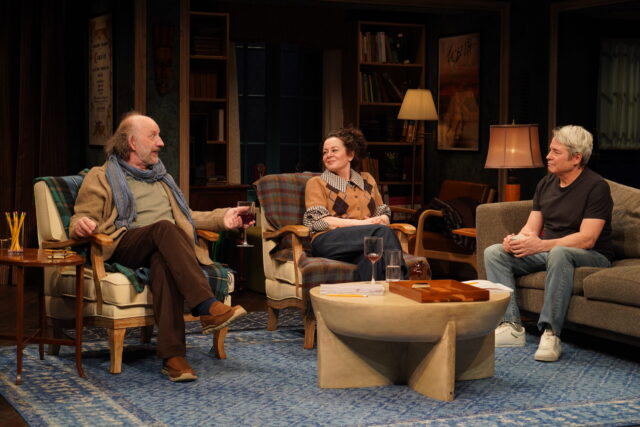
There are currently two off-Broadway premieres that feature fine performances by actors portraying film and television royalty, but each play struggles to get past frame stories that detract from the overall production.

Oscar-nominated actress Elizabeth McGovern wrote and stars in Ava: The Secret Conversations, a touring show running through September 14 at New York City Center Stage I. It’s based on the 2013 biography Ava: The Secret Conversations by British journalist Peter Evans and Oscar-nominated Hollywood legend Ava Gardner, compiled from interview sessions between the two in Gardner’s lavish London apartment initiated in 1988. Gardner had suffered a stroke in 1986 and had not appeared on camera since.

The play opens with Gardner (McGovern) in silhouette, calling Evans (Aaron Costa Gani) on the phone, talking about possibly ending her life. The narrative then cuts back to the first time they spoke; Gardner had chosen Evans to ghostwrite her memoir for Dick Snyder at Simon and Schuster. Evans, who wants to move away from celebrity gossip and instead work on his novel, thought it was a gag and insults her, but he soon realizes from his agent, Ed Victor (John Tufts), that the project is the real deal. While Evans gets excited about the prospect of exploring the Golden Age of Hollywood, Gardner just wants to barrel through it without making it a kiss-and-tell.

“I gotta write a book, or sell the jewels. I’m kinda sentimental about the jewels,” she admits to him.

He wants to start the memoir with her childhood on a farm in North Carolina, but she wants to talk about her recent stroke. Meanwhile, Victor, in voice-over, advises him, “Dick Snyder says he wants you to ask her about it. Frank’s penis. . . . I can get close to 800K if she talks Sinatra.”

Evans and Gardner quickly get down to business; she reveals the details of meeting and marrying Mickey Rooney, Artie Shaw, and Sinatra and enjoying a lot of sex. They touch on such films as The Killers, Mogambo, The Sun Also Rises, and The Barefoot Contessa and such key figures as Marlon Brando, John Ford, Howard Hughes, and Omar Sharif. Alex Basco Koch’s projections range from archival news footage to clips from Gardner’s films, immersing the audience in her glamorous world.

As she recounts her past relationships, Gani morphs into Rooney, Shaw, and Sinatra, re-creating scenes from Gardner’s past, focusing on her three husbands; none of whom were saints. Evans, who was married with two kids, spends a lot of time with Gardner, who does not hide her flirtatious nature from him. Although she doesn’t have full use of her left arm because of the stroke, she smokes and drinks and curls up seductively on the couch, which initially bothers Evans — until it doesn’t.

Just as Gardner is really opening up, outside forces suddenly stop the interviews and put the kibosh on the book. Gardner went on to publish the 1990 memoir Ava: My Story without Evans’s input; it took more than twenty years for Evans to acquire the rights to the interviews and release them in the 2012 book Ava: The Secret Conversations, which is credited to him and Gardner.

“When you get blown up so big, Peter, you end up paper thin,” she tells him late in the play, summarizing her life as well as her attempts to tell her story her way.

British journalist Peter Evans’s (Aaron Costa Gani) life is turned inside out when he is hired to ghostwrite Ava Gardner’s memoir (photo by Jeff Lorch)

McGovern (Time and the Conways, Downton Abbey) is lovely as Gardner; her accent may waver in and out, but her facial gestures, hair (by Matthew Armentrout), and costumes (by Toni-Leslie James) help her transform into the glamorous silver screen star in a mesmerizing performance. Ganis (Bernhardt/Hamlet, Homos or Everyone in America) does not fare as well, primarily because his characters — Evans, Rooney, Shaw, Sinatra — basically steal time away from Gardner, who merits all the attention.

McGovern the writer and Tony-nominated director Moritz von Stuelpnagel (Hand to God, The Thanksgiving Play) are exploring the creative process, but we learn only so much about Evans and instead want to know everything about Gardner. The pace comes to a screeching halt whenever Peter is not speaking with Ava and is instead talking to Ed or someone else; it’s a shame it couldn’t have been a one-woman show, but that would have been a different play.

In addition, there are bothersome plot holes; for example, Evans has a tiny notebook and only occasionally jots down notes, so it seems impossible for him to have gotten so many direct quotes; in actuality, he used a tape recorder, which would have been useful to point out so we don’t wonder about it.

Ava: The Secret Conversations might not be The Killers, Mogambo, or The Night of the Iguana, but it’s also not Ghosts on the Loose, The Sentinel, or The Naked Maja, falling somewhere in the middle of Gardner’s diverse oeuvre.

The whirlwind romance between Gilda Radner (Jordan Kai Burnett) and Gene Wilder (Jonathan Randell Silver) comes to life in off-Broadway premiere (photo by Carol Rosegg)

GENE & GILDA
59E59 Theaters
59 East 59th St. between Park & Madison Aves.
Tuesday – Sunday through September 7, $66-$86
212-279-4200
www.59e59.org

Cary Gitter’s Gene & Gilda, a Penguin Rep production running through September 7 at 59E59, details the whirlwind romance between Saturday Night Live superstar Gilda Radner (Jordan Kai Burnett) and comedy legend Gene Wilder (Jonathan Randell Silver). The show opens as Wilder is sitting down for his first interview since Radner’s tragic death. He’s hesitant to discuss his personal life with talk show host Dick Cavett, who appears here only in voice-over.

“I thought we agreed we wouldn’t discuss that,” Wilder says, but Cavett pushes him. “I’d rather keep that off limits,” Wilder answers, but is then interrupted by the sudden apparition of Radner, who declares, “Off limits? You wanna keep me off limits? . . . We can tell our story together. The good, the bad, and the ugly. The whole megillah.” The rest of the eighty-five-minute show flashes between the interview and reenacted scenes from Radner and Wilder’s relationship.

The two met on August 13, 1981, on the set of Hanky Panky, a 1982 comic thriller directed by Sidney Poitier that did not fare very well. At the time, Radner, who was born in 1946 in Detroit, was married to future SNL bandleader G. E. Smith, who had worked on her 1979 one-woman Broadway show, Gilda Radner — Live from New York. Wilder, who was born in 1933 in Milwaukee, had been divorced twice and was coming off the huge success of Stir Crazy, the second of his four collaborations with Richard Pryor. Although Radner knew in advance that she was going to fall in love with Wilder, he took a bit of convincing before being swept away by the gale force that was Gilda Radner. “But — but what about my vertigo, and the comfort handkerchief, and the praying?” he says to her, referring to some of his neuroses. She replies, “I love all of it. We complement each other’s craziness. A match made in meshugas.

They both suffer creative crises but find solace in each other and their home away from home, the south of France, where they wed in 1984. At one point, Wilder complains that he is only being offered parts in “Crap! Trash! Garbage!,” telling Radner, “I’m seeing clearly for the first time in years! I wanted to be a thespian. When I was a kid, I saw Death of a Salesman on Broadway, and it changed my life. That was art. I studied at the Actors Studio. I wanted to impact people. And now I’m nothing but a, a cheap Hollywood commodity, making stupid comedies like Hanky Panky! No offense.”

Radner reassures him that making people laugh is his gift. “What do you think people would rather do on a Saturday night — watch me give a speech about the hardships of life, or crack up over Roseanne
Roseannadanna? What we do is a — it’s a public service.”

But their idyllic life is turned upside down when Radner falls ill, experiencing mysterious symptoms that doctors cannot diagnose — until it’s too late.

Gene Wilder (Jonathan Randell Silver) looks back at his life with Gilda Radner (Jordan Kai Burnett) in Gene & Gilda (photo by Carol Rosegg)

Christian Fleming’s set features all-white furniture, from a two-section couch and a desk with a typewriter to luggage and a big box (perhaps to make the room seem ghostly or to keep the spotlight more on the couple — except at least twice, the night I went, when the spotlight loses Wilder). Wilder occasionally sits in a black director chair when being interviewed by Cavett; those segments slow down the pace dramatically.

The backdrop is a wall of television monitors where Brian Pacelli’s projections range from hearts and flowers to a shot of the south of France and live video of Wilder answering Cavett’s questions; at the center is a door marked “On the Air,” a constant reminder that we’re watching a TV show. Gregory Gale’s costumes put Wilder in relatively conservative suits and Radner in frumpy yet wacky outfits, while Bobbie Zlotnik’s hair and wigs hit their mark. Sound designer Max Silverman’s treacly score evokes telephone hold music.

In the script, Gitter (The Steel Man, The Sabbath Girl) explains that Gene & Gilda “is a work of fiction, based freely on fact.” Among his sources were Wilder’s 2005 memoir, Kiss Me Like a Stranger, Radner’s posthumous 1989 autobiography, It’s Always Something, and Lisa Dapolito’s 2018 documentary, Love, Gilda, as well as archival footage; although Wilder did sit down with Cavett for an interview in 1991, they did not delve into detail about Radner, instead talking about how ovarian cancer could and should be diagnosed earlier. Director Joe Brancato (The Devil’s Music, The Sabbath Girl) can’t quite find the balance between fact and fiction, fantasy and reality. There is too much telling, describing what happened, and not enough showing.

Burnett (Found, Romy & Michele the Musical), who previously portrayed Radner in a December 2023 workshop reading of Not Ready for Prime Time, a play about SNL’s first five years that is scheduled to debut in New York City in October, is adorable as the determined star, who is not afraid to say what she wants and go after it, although a brief skit in which she channels Roseanne Roseannadanna, Emily Litella, Baba Wawa, Judy Miller, and Candy Slice is a tough challenge.

Silver (Please Continue, Shear Madness!), who portrayed Richard Dreyfuss in regional productions of The Shark Is Broken for the fiftieth anniversary of Jaws, captures the essence of the mild-mannered, tentative Wilder. A scene in which they re-create one of the funniest bits from The Producers — when Max Bialystock (Zero Mostel) attempts to calm down a hysterical Leo Bloom (Wilder) — is another challenge, but there are several lovely moments between them, especially when they dance together.

Gene & Gilda is reminiscent of an episode of Saturday Night Live, with some good sketches, some okay ones, and some, well, not so memorable. It might not be Willy Wonka & the Chocolate Factory, Young Frankenstein, or Silver Streak, but it’s also not Hanky Panky, Haunted Honeymoon, or Rhinoceros. It’s more like The Frisco Kid, The Woman in Red, and Quackser Fortune Has a Cousin in the Bronx. And no need to worry; you won’t need your comfort hankie.

[Mark Rifkin is a Brooklyn-born, Manhattan-based writer and editor; you can follow him on Substack here.]
THE SITE WHERE IT HAPPENED: HAMILTON SING-A-LONG AT THE OLD STONE HOUSE

Fans can sing along to the Hamilton movie at the place where the Battle of Brooklyn happened

HAMILTON SING-A-LONG
Old Stone House & Washington Park
336 Third St., Brooklyn
Thursday, August 14, free with RSVP, 7:30
theoldstonehouse.org

Every summer, the Old Stone House commemorates the August 27, 1776, Battle of Brooklyn, the first military engagement following the signing of the Declaration of Independence on August 2 at the Second Continental Congress in Philadelphia. This year the historic site will be hosting “Revolutionary Brooklyn,” including walking tours, a short theatrical farce, a remembrance ceremony, a Constitution handwriting session, and a screening of the 2020 film Hamilton, a live stage recording of the smash 2015 Broadway musical that won eleven Tony Awards and is still running at the Richard Rodgers Theatre.

Directed by Thomas Kail and written by Lin-Manuel Miranda, the film features Miranda as Alexander Hamilton, Leslie Odom Jr. as Aaron Burr, Phillipa Soo as Eliza Hamilton, Renée Elise Goldsberry as Angelica Schuyler, Christopher Jackson as George Washington, Daveed Diggs as Marquis de Lafayette and Thomas Jefferson, Anthony Ramos as John Laurens and Philip Hamilton, Okieriete Onaodowan as Hercules Mulligan and James Madison, and Jonathan Groff as King George III. On August 14 at 7:30, fans can come to Washington Park and sing along to such favorite numbers as “My Shot,” “Non-Stop,” and “The Room Where It Happens.” Attendees can bring their own lawn chair or blanket and party on the exact place where the Battle of Brooklyn happened 249 years ago; admission is free with advance RSVP.

[Mark Rifkin is a Brooklyn-born, Manhattan-based writer and editor; you can follow him on Substack here.]
TIME IS ON HIS SIDE: CELEBRATING OLIVIER ASSAYAS AT METROGRAPH

OLIVIER ASSAYAS: OUT OF TIME
Metrograph
7 Ludlow St. between Canal & Hester Sts.
Series begins August 8
metrograph.com

In conjunction with the theatrical release of his latest film, the semiautobiographical Suspended Time, Metrograph will be screening a half-dozen of French writer-director Olivier Assayas’s works, which range from ultracool flicks to boring dramas, but they’re almost always visually stunning, filled with cinematic references and hip music — as well as such stars as Juliette Binoche, Kristen Stewart, Mathieu Amalric, Maggie Cheung, and future director Mia Hansen-Løve, who was Assayas’s partner for fifteen years. The series kicks off August 8 with a sneak preview of the new film in addition to 2018’s Non-Fiction and continues with such other tales as 1998’s Late August, Early September and 2000’s Les Destinées sentimentales.

Metrograph is celebrating the work of Olivier Assayas in retrospective including Summer Hours

SUMMER HOURS (L’HEURE D’ÉTÉ) (Olivier Assayas, 2008)
Friday, August 15, 6:15
Sunday, August 17, 5:35
metrograph.com
www.summerhours.com.au

At their annual family gathering, Frédéric (Charles Berling), Adrienne (Juliette Binoche), and Jérémie (Jérémie Renier) are celebrating their mother’s seventy-fifth birthday. But Hélène (Edith Scob) does not care about the present; instead, she is more concerned with preserving the past and preparing for the future. She pulls aside her oldest, Frédéric (Assayas’s on-screen alter ego), to tell him what to do with her belongings after she’s gone, but he is not ready to think about that. Her house is more like a museum, filled with valuable works of art and furniture that were collected by her uncle, a famous painter who died thirty years before. Frédéric would prefer to keep the house intact, donating a few items to the Musee d’Orsay and saving the rest for the next generation, but Adrienne and Jérémie don’t necessarily feel the same way, and Frédéric’s and Jérémie’s kids fail to see any value in the pieces, including two oil paintings by Camille Corot, begrudgingly noting that they’re from a different era. While Frédéric, a professor who has written a controversial book about the state of the economy, attaches personal memories to each object, Adrienne, a successful designer in New York, is more interested in the functionality of things, and Jérémie, who manages a company that profits from cheap labor in China, sees only monetary value. As the three siblings discuss what to do with their mother’s estate, relationships come into focus, and a long-held secret emerges.

Written and directed by Olivier Assayas (Clean, Demonlover), Summer Hours, which was selected for the 2008 New York Film Festival, is a thoughtful, intelligent slice-of-life story that avoids overbearing cliches and melodramatic moments; there are no blow-ups or overemotional scenes. Instead, the family deals with its situation directly and matter-of-factly, a sort of French Cherry Orchard for the twenty-first century. However, Assayas does include far too many red herrings, little flourishes of cinematic language that seem to set something up that never comes full circle. The project was initiated by the Musee d’Orsay, which had commissioned a group of international directors to make short films related to the institution’s holdings. Assayas’s friend and colleague Hou Hsiao Hsien ended up making the full-length Flight of the Red Balloon, which also starred Binoche. Although the project later fell apart, Assayas combined the idea with the worsening condition of his mother, resulting in a bittersweet and very personal work.

CLOUDS OF SILS MARIA

Juliette Binoche and Kristen Stewart mix fact and fiction in Olivier Assayas’s Clouds of Sils Maria

CLOUDS OF SILS MARIA (Olivier Assayas, 2014)
Friday, August 15, 8:15
Saturday, August 16, 5:25
metrograph.com

The related concepts of time and reality wind through Olivier Assayas’s beautifully poetic, melancholy Clouds of Sils Maria much like actual snakelike clouds slither through the twisting Maloja Pass in the Swiss Alps, as life imitates art and vice versa. Juliette Binoche stars as Maria Enders, a famous French actress who is on her way to Zurich to accept an award for her mentor, playwright Wilhelm Melchior, who eschews such mundane ceremonies. But while en route, Maria and her personal assistant, the extremely attentive and capable Valentine (Kristen Stewart), learn that Wilhelm has suddenly and unexpectedly passed away, and Maria considers turning back, especially when she later finds out that Henryk Wald (Hanns Zischler), an old nemesis, will be there to pay homage to Wilhelm as well, but she decides to go ahead after all. At a cocktail party, Maria meets with hot director Klaus Diesterweg (Lars Eidinger), who is preparing a new stage production of Wilhelm and Maria’s first big hit, The Maloja Snake, but this time Maria would play Helena, an older woman obsessed with ambitious eighteen-year-old Sigrid, the role she originally performed twenty years earlier, to great acclaim. Klaus is planning to cast Lindsay Lohan-like troublemaking star and walking tabloid headline Jo-Ann Ellis (Chloë Grace Moretz) as Sigrid, which does not thrill Maria as her past and present meld together in an almost dreamlike narrative punctuated by the music of Handel and cinematographer Yorick Le Saux’s gorgeous shots of vast mountain landscapes.

CLOUDS OF SILS MARIA

Valentine (Kristen Stewart) and Maria (Juliette Binoche) go in search of the Maloja Snake in the Swiss Alps

Clouds of Sils Maria resonates on many levels, both inside and outside of the main plot and the film itself. Assayas (Boarding Gate, Something in the Air) cowrote André Téchiné’s 1983 film, Rendez-Vous, which was Binoche’s breakthrough; Assayas and Binoche wouldn’t work together again until his 2008 film Summer Hours, similar to the relationship between Wilhelm and Maria. Meanwhile, the story of the play-within-the-film is echoed by the relationship between Maria and Valentine, who are having trouble separating the personal from the professional. It is often difficult to know when the two women are practicing lines and when they are talking about their “real” lives. Binoche (Blue, Caché) is simply extraordinary as Maria, a distressed and anxious woman who is suddenly facing getting older somewhat sooner than expected, while Stewart (The Twilight Saga, On the Road) became the first American woman to win a French César, for Best Supporting Actress, for her sensitive portrayal of Valentine, a strong-willed young woman who might or might not be holding something back. The scenes between the two are riveting as they venture in and out of the reality of the film, their onscreen chemistry building and building till it’s at last ready to ignite. Art, life, cinema, theater, fiction, and reality all come together in Clouds of Sils Maria, as Maria, Assayas, and Binoche take stock of where they’ve been, where they are, and where they’re going.

[Mark Rifkin is a Brooklyn-born, Manhattan-based writer and editor; you can follow him on Substack here.]