twi-ny recommended events

CLYDE’S

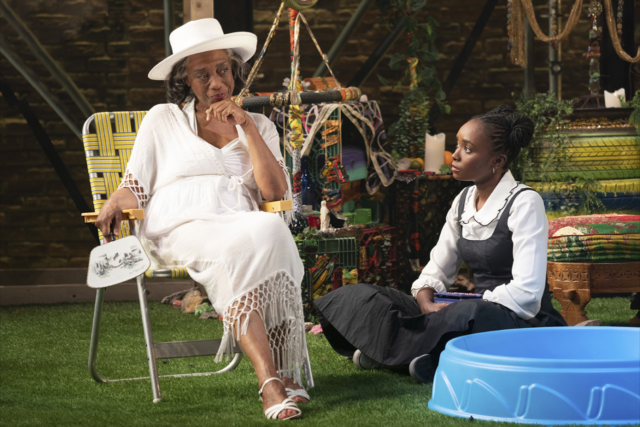
Clyde (Uzo Aduba) keeps a close watch on her employees in new Lynn Nottage play (photo by Joan Marcus)

CLYDE’S
Helen Hayes Theater
240 West 44th St.
Through January 16, $49-$149 (livestream January 4-16, $59)
2st.com/shows/clydes

If there’s a better living American playwright working today than Lynn Nottage, you’ll have to convince me.

The Brooklyn-born two-time Pulitzer Prize winner is back on Broadway with the delectable comedy Clyde’s, continuing at Second Stage’s Helen Hayes Theater through January 16. The ninety-minute play is set in the kitchen of a roadside diner in Berks County, Pennsylvania, run by the fierce and dominating Clyde (Uzo Aduba), who spent time in jail and exclusively hires ex-cons. But Clyde is no saint, helping the downtrodden out of the goodness of her heart; instead, she abuses her staff with vicious delight, insulting them with zinging barbs, threatening their employment, and sexually harassing them.

The kitchen crew consists of Tish (Kara Young), a single mother with an unreliable ex; Rafael (Reza Salazar), a twentysomething who is enamored with Tish; and the wise sage Montrellous (Ron Cephas Jones), a sandwich guru who avoids talking about his personal life. They are joined by Jason (Edmund Donovan), who is fresh out of the big house, complete with white supremacist gang tattoos on his face, neck, and arms.

“He tell you what happens if I catch any of you morons stealing? Breaking my rules?” Clyde tells Jason, referring to Rafael. “I don’t go to the police. I deal with it my way. Understand?” Later, Rafael warns Jason, “Bro, it’s real. Do not cross her. She’ll make you suffer.”

Montrellous is the Obi-Wan Kenobi, the Yoda, the Zen master of the kitchen. He raises sandwich making to an art. “You know why I love the sandwich?” Montrellous says. “’Cuz it’s a complete meal that you can hold between your fingers. It’s the most democratic of all foods. Two pieces of bread, and between, you can put anything you want. It invites invention and collaboration.” Rafael responds, “Jesus, I make a sandwich every day, but somehow your shit always tastes like the truth.” Montrellous adds, “It’s about order, baby. I’m interested in the composition, it’s not merely about flavor. Dig? I think about the balance of ingredients and the journey I want the consumer to take with each bite. Then finally how I can achieve oneness with the sandwich.” It’s also a metaphor for (re)building one’s life.

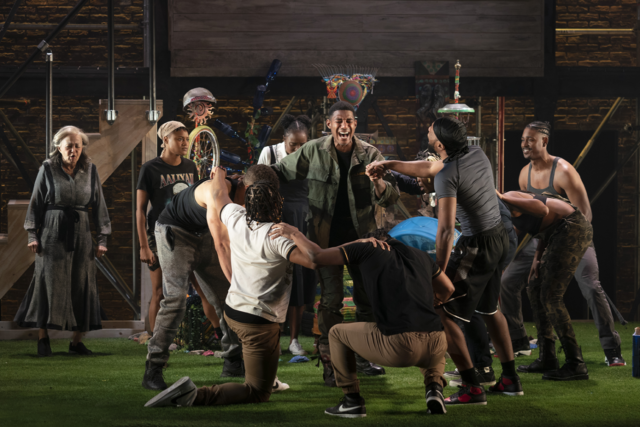
Rafael (Reza Salazar), Tish (Kara Young), Montrellous (Ron Cephas Jones), and Jason (Edmund Donovan) search for the perfect sandwich in Clyde’s (photo by Joan Marcus)

Whenever Montrellous begins to wax poetic about potential combinations, the lights take on a sepia tone, as if sacred word is descending from the heavens. (The expert lighting is by Christopher Akerlind.) Tish and Rafael make offerings of their own unique flavor profiles, looking to Montrellous for his approval like students trying to please their teacher (or father). Jason, who at first doesn’t care about kitchen hygiene or carefully developed recipes, soon takes part as well, learning that the sandwich is much more than just a bunch of stuff between two slices of bread.

But no matter how hard they try to make the perfect sandwich, Clyde continually shoots them down, not giving a damn about quality but only that they fill orders as fast as they can. In one hysterical scene, she pops up over and over again in the cut-out window, from multiple angles, leaving order slip after order slip as Tish, Rafael, Jason, and Montrellous hustle to keep pace. She also occasionally brings in questionable ingredients that probably fell off a truck somewhere, insisting the staff use them no matter the expiration date or the stench. It all comes to a head when investors are scheduled to meet with Clyde to help her out of some financial problems.

Takeshi Kata’s functional kitchen set serves as a kind of way station, a limbo or purgatory where the characters exist between their prior incarceration and the freedom of the real world. Clyde is like the judge, jury, and executioner over what Nottage calls in a program note a “liminal space,” as she constantly reminds them where they’ve been while disparaging any hope they might have for a better future. As Montrellous says, “And you know what they say, ’cuz you left prison don’t mean you outta prison. But, remember everything we do here is to escape that mentality. This kitchen, these ingredients, these are our tools. We have what we need. So, let’s cook.” He later explains, “This sandwich is my strength. This sandwich is my victory. This sandwich is my freedom.”

As the fiery Clyde, three-time Emmy winner Aduba (Orange Is the New Black, Mrs. America), who has appeared in such stage works as Coram Boy, Godspell, and The Maids, might refuse to taste any of Montrellous’s sandwiches, but she devours the scenery. She storms into each scene in a different outrageously jaw-dropping costume by Jennifer Moeller, with dazzling colors and remarkable shoes. Aduba and Emmy winner Cephas Jones (This Is Us, Hurt Village) complement each other beautifully, Montrellous’s calmness balancing her fiery fury.

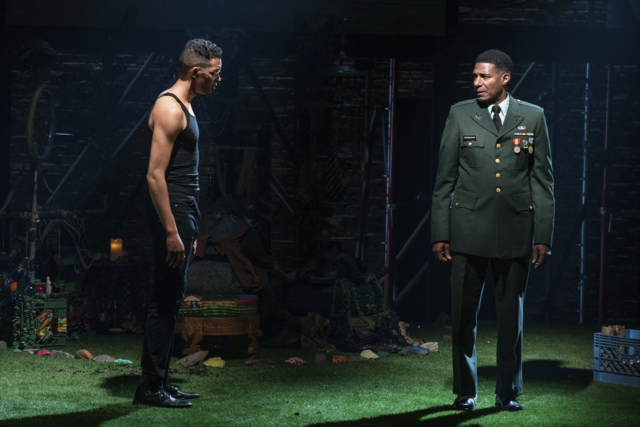
Clyde (Uzo Aduba) and Montrellous (Ron Cephas Jones) have different ideas about the future in new Broadway play (photo by Joan Marcus)

Salazar (Richard II, Oedipus El Rey) and Young (All the Natalie Portmans, Halfway Bitches Go Straight to Heaven) form a delicate but poignant duo, facing their own demons and dependencies. Donovan (Greater Clements, Lewiston/Clarkston) ably fits well right in the middle of it all, lending an intriguing unpredictability to Jason, who’s struggling to get through every day and avoid going back to prison.

Kate Whoriskey, who previously directed Nottage’s Pulitzer Prize–winning Sweat and Ruined, knows just what to do with Nottage’s words, bringing them to life with a scintillating intelligence, capturing the rhythm of her language and the depth of her characters. Clyde’s might be hilariously funny, but it is serious about the revolving door of the prison system, immigration, income inequality, sexism, racism, greed, and power, its own seven deadly sins.

In just the last dozen years or so, Nottage has given us Sweat, Ruined, Mlima’s Tale, The Secret Life of Bees, and revivals of By the Way, Meet Vera Stark and Fabulation, or The Re-Education of Undine, with the Michael Jackson musical MJ and an opera adaptation of her 2003 play, Intimate Apparel, up next. That’s quite a banquet. And as a bonus dessert, performances from the Hayes Theater will be simulcast live online January 4-16 ($59), filmed by five to seven cameras.

In his final appearance on The David Letterman Show in October 2002, musician Warren Zevon, discussing his terminal cancer, said about life, “Enjoy every sandwich.” With Lynn Nottage, that’s an easy order to fill.

CAROLINE, OR CHANGE

Caroline, or Change returns to Broadway in marvelous revival at Studio 54 (photo by Joan Marcus)

CAROLINE, OR CHANGE
Studio 54
254 West 54th St. between Eighth & Ninth Aves.
Tuesday – Sunday through January 9, $49-$250
212-719-1300
www.roundabouttheatre.org

A few days before seeing Michael Longhurst’s Broadway revival of Caroline, or Change at Studio 54, I was at another theater waiting for a play to begin when the two men next to me started talking about the show, saying that friends of theirs considered it the best musical of the young century. Who am I to disagree?

I was sucked in from the opening moments, when Black maid Caroline Thibodeaux, spectacularly portrayed by Sharon D Clarke, is downstairs in the basement of the Gellman home in Lake Charles, Louisiana, in late 1963. She’s doing the laundry and listening to the radio, explaining, “Nothing ever happen under ground in Louisiana / Cause they ain’t no under ground in Louisiana / There is only under water.” She is joined by the Washing Machine (Arica Jackson, in a bubbly costume), who tells her, “Consequences unforeseen. / Consequences unforeseen. / Put your faith and clothes in me, / a brand-new nineteen-sixty-three / seven-cycle wash machine,” and the Radio (a 1960s-style girl group consisting of Nasia Thomas, Nya, and Harper Miles in matching sparkling outfits and antennae), who agree, “Tough and dreary and all dishevel, / sixteen feet below sea level.” The demonic Dryer (a devilish Kevin S. McAllister) declares, “Laundry mine now! / You know the story: / Let’s make this basement a purgatory. / Time has come / Time has come / Time has come to suffer heat!”

Caroline is an unhappy single mother raising four kids on the thirty dollars a week she makes working tirelessly for the Gellmans, who are Jewish: The recently widowed Stuart Gellman (John Cariani), who prefers to play the clarinet rather than to say much or face reality; his new wife, Rose Stopnick Gellman (Caissie Levy), who can’t help feeling like an unloved replacement for the deceased, beloved Betty and who misses her old Upper West Side neighborhood; and Stuart’s eight-year-old son, Noah (alternately played by Gabriel Amoroso, Adam Makké, or Jaden Myles Waldman), who has developed a secret relationship with Caroline. He goes down to the basement to hang out with her, lighting her cigarettes and watching her work, even though, as she tells him, “I got no use for you. This basement too darn hot for two.”

Maid Caroline Thibodeaux (Sharon D Clarke) has some sharp words for Noah Gellman (Adam Makké) in poignant, prescient show (photo by Joan Marcus)

When Rose catches Noah leaving change in his pocket yet again, she chastises him and decides to let Caroline keep whatever she finds, to both punish Noah and supplement Caroline’s meager wages. But Caroline does not want any charity, instead collecting the money in a bleach cup and returning it to the boy — until she doesn’t, and things take a sharp turn.

Pulitzer and Tony-winning book writer Tony Kushner (Angels in America, Homebody / Kabul) references change in many ways throughout the show’s one hundred and fifty minutes (with intermission). As Caroline, three-time Olivier winner Clarke (Death of a Salesman, The Amen Corner) carries the weight of 1960s racism and inequality on her shoulders; Caroline is thirty-nine, while Clarke is fifty-five, and it’s easy to believe that the constant wear and tear on Caroline’s daily existence has aged her unfairly.

She is deeply unsatisfied with her position in life but also feels that there is no way out, that she has no choice but to play the role of the lowly black maid. While waiting for the bus (McAllister) with fellow maid Dotty Moffett (Tamika Lawrence), who is going to night school to better herself, Caroline says, “I don’t like the way you do. You change.” Dotty responds, “You the one that change! . . . Sorry you is sick and shame. Sorry you drinking misery tea. Sorry your life ain’t what it should be.”

As they continue to talk, the Moon (N’Kenge, in a dazzling round seat dangling from the rafters), a celestial presence watching from above, finally appears, promising, “Change come fast and change come slow / but change come, Caroline Thibodeaux.” Caroline replies, “Nothing ever changes under ground in Louisiana.”

At the Gellmans’ Chanukah party where Caroline, her sixteen-year-old daughter, Emmie (Samantha Williams), and Dotty are preparing dinner, Rose’s father, the progressive Mr. Stopnick (a scene-stealing Chip Zien), shouts, “The old world’s ending! Negroes marching! Change is coming! Down with the filthy capitalist chazzerim!” But Stuart’s parents (Joy Hermalyn and Stuart Zagnit) are having none of that, pleading, “Let’s not dwell on ugly things! Let’s thank God for the joys He brings! Watch the colored candles melt! Spin the dreidel for Chanukah gelt!”

During Chanukah, children often receive chocolate gelt, shaped like change: nickels, dimes, quarters, and half-dollars. Earlier, when Caroline is considering keeping the money Noah has been leaving in his pocket, she opines that her ten-year-old son, Jackie (Alexander Bello or Richard Alexander Phillips), has to see the dentist, her eight-year-old son, Joe (Jayden Theophile), wants candy, and her oldest son, Larry, who is fighting in Vietnam, needs a care package with cookies. Chanukah gelt, both real and confectionary, is not going to solve their problems.

A Chanukah party leads to trouble in Caroline, or Change (photo by Joan Marcus)

The outstanding score by Tony-winning composer Jeanine Tesori (Fun Home, Thoroughly Modern Millie), who previously teamed up with Kushner on the opera A Blizzard on Marblehead Neck for Glimmerglass, ranges from R&B, soul, and gospel to blues, klezmer, and folk, with orchestrations by Rick Bassett and Buryl Red that avoid treacly sentimentality. The multilevel set, by Fly Davis, who also designed the costumes, sometimes separates into two parts, creating a gap between Noah’s upstairs bedroom and the other half of the house, but the space it creates is often confusing and uncomfortable. However, the depiction of the washer/dryer and radio is hilarious, their playful movement choreographed by Ann Yee.

Longhurst (Constellations, Europe) keeps the action proceeding at an exciting pace that does not allow pauses for applause after songs, which works beautifully, although the audience can’t help but shower praise on Clarke after a showstopping solo in which Caroline finally asserts herself, proclaiming, “Ya’ll can’t do what I can do / ya’ll strong but you ain’t strong like me.”

Seventeen years after its debut, the semiautobiographical Caroline, or Change is both prescient and timely. Kushner — who grew up in a Jewish family in Lake Charles, with a father who played the clarinet, a mother who had cancer (but did not pass away when he was a child), and a Black maid named Maudie Lee Davis to whom the show is dedicated — makes references to the Spanish flu and a Confederate statue being torn down, and the repeated refrains about being underwater came just before Katrina struck Louisiana in 2005. The Covid-19 crisis and murder of George Floyd brought racial injustice and inequity to the forefront of America yet again, recalling the 1960s civil rights movement.

Caroline, or Change doesn’t provide any easy answers or celebrate any heroes; it is instead a potent reminder that while things have changed over the last sixty years, a whole lot more still needs to change. The best new musical of the twenty-first century? Who am I to disagree?

THE LEHMAN TRILOGY

The Lehman Trilogy takes place on Es Devlin’s stunning stage (photo by Julieta Cervantes)

THE LEHMAN TRILOGY
Nederlander Theatre
208 West 41st St. between Seventh & Eighth Aves.
Tuesday – Sunday through January 2, $59-$209
877-250-2929
thelehmantrilogy.com

“The prospect of sitting through a nearly three-and-a-half-hour play about the history of Lehman Brothers performed by a mere three actors might not necessarily be your idea of fun,” I wrote about the American premiere of The Lehman Trilogy at Park Avenue Armory in the spring of 2019. But it turned out to be what I called “an epic masterpiece, must-see theater at its finest.”

Still, the prospect of watching it two and a half years later, at the Nederlander Theatre on Broadway with two of the same actors amid a continuing pandemic, was not necessarily my idea of fun. But it turned out to once again be must-see theater at its finest.

Adapted by writer Ben Power and director Sam Mendes from Stefano Massini’s five-hour Italian original, the dazzling play relates the history of the men behind the business, siblings Henry (Simon Russell Beale), Mayer (Adam Godley), and Emanuel Lehman (Adrian Lester), who were born and raised in the small town of Rimpar in Bavaria and arrived, individually, in the United States between 1844 and 1850, operating a fabric store in Montgomery, Alabama. Over the years, they change with the times and the needs of the market, selling raw cotton, coffee, and coal and, eventually, trading money, building a vast empire that came crashing down in the 2008 financial crisis. Henry is considered the head, with the most business sense; Emanuel the arm, able to forcibly get things done; and Mayer the potato, an unequal partner who serves as the mediator. As the firm develops, the evolving name of the company is written and rewritten on glass walls, a constant reminder of where they were and where they are going.

Adam Godley, Simon Russell Beale, and Adrian Lester play multiple roles in The Lehman Trilogy (photo by Julieta Cervantes)

The story is told primarily in the third person, an ingenious decision that adds an extra dimension to the characters, giving them each a unique perspective on themselves and their family.

Henry: Every morning, like this morning, they get up at five in their three-room home.
Mayer: They light the lamps with whale oil and wash with one pail of water between them.
Emanuel: This is worse than Germany! Emanuel said on his third day in America.
Mayer: After the slap that Henry laid on his face he never said it again.
Henry: Every morning, like this morning, while Montgomery sleeps, they pray together before leaving.
Emanuel: Just as they did in Bavaria. They put on their hats and go out.
Mayer: Another day.

The narrative is divided into three chapters, “Three Brothers,” “Fathers & Sons,” and “The Immortal,” as their fame and fortune rises through the next generations, which include Emanuel’s ruthless son, Philip (Beale); Mayer’s son, Herbert (Lester), who believes in fairness, stability, and security, not the Lehman tradition of risk taking; and Philip’s son, “Bobby” (Godley), who loves the limelight and becomes the very public face of the company. “No one outside this family can ever truly understand. What we’ve done. Why we did it. What we plan to do next,” Philip says. Bobby answers, “At Yale they teach us that nothing is more outdated as betting on industry. The times are changing, Father. The new century will wipe everything away.” He doesn’t know how right he is.

The play takes place on Es Devlin’s gorgeous set, a large, revolving transparent cube with several office-like rooms. Video designer Luke Halls projects geographic scenes onto the huge semicircle at the back of the stage and onto the floor around the cube, from the vast sea and plantation estates to cotton fields and the New York City skyline. As good as it all looks, the set lacks the magic and power it had in the armory’s massive Wade Thompson Drill Hall; it feels too cramped on the Nederlander stage, where, depending on where you’re sitting, you’re unlikely to get its full impact.

The history of the Lehman brothers is told by three actors in sensational production (photo by Julieta Cervantes)

Beale (Candide, Uncle Vanya), Godley (Rain Man, Anything Goes), and Olivier winner Lester (Red Velvet, Company), who replaces Ben Miles as Emanuel, are majestic, an absolute marvel. The three men have a commanding presence, balancing humor and gravitas as they move about the cube, using office packing boxes as furniture, arranging them into steps, furniture, and even a piano. (A real piano is played offstage by Candida Caldicot.)

Oscar, Tony, and Olivier winner Mendes (The Ferryman, American Beauty) and Power (Emperor and Galiean, Husbands and Sons) have made a few tweaks to the show in the wake of the Covid-19 crisis and the George Floyd protests. When Mayer discusses how the company benefits from plantations and slaves, Henry notes, “Doctor Beauchamp, who once treated the children of those slaves for chickenpox, now shakes his head the way he once did about yellow fever: ‘Surely you knew it could not last, Mr. Mayer? Everything that was built here was built on a crime. The roots run so deep you cannot see them but the ground beneath our feet is poisoned. It had to end this way.’” But “Mayer doesn’t want to hear. So day and night, he tries to convince himself that, although the war is lost, the South if you look hard enough still stands, is not dead.”

Later, in a Greek diner in Nebraska, Henry relates the story of its owner, Georgios Petropoulos: “He crossed the country in 1918 when the soldiers brought the influenza back from Europe and half a million Americans died. He saw the priests collecting the bodies off the street in Philadelphia, and the protests in San Francisco, against the wearing of masks.” At the Nederlander, employees walk up and down the aisles, making sure all audience members are wearing their masks correctly, over their mouth and nose.

Despite running more than three hours with two intermissions, The Lehman Trilogy flies by, moving faster than the Dow Jones stock ticker. It’s also a whole lot more satisfying, with Power, Mendes, and the outstanding cast taking all the risks and leaving all the rewards for the audience.

JENNIFER NETTLES: BROADWAY UNDER THE MISTLETOE

Who: Jennifer Nettles
What: Broadway Under the Mistletoe tour
Where: The Town Hall, 123 West Forty-Third St. between Fifth & Sixth Aves.
When: Wednesday, December 15, $69 – $129, 7:30
Why: Fresh off her turn in the lead role of Jenna in Waitress on Broadway, Georgia-born singer-songwriter and actress Jennifer Nettles returns to New York City with her holiday show “Broadway Under the Mistletoe,” which comes to the Town Hall on December 15. Nettles, a three-time Grammy winner who formed the country-pop group Sugarland in 2003 with Kristen Hall and Kristian Bush, has also starred on Broadway as Roxie Hart in Chicago, has appeared in the television series The Righteous Gemstones and the film Harriet, and has released such solo albums as That Girl, Always Like New, and To Celebrate Christmas, which includes seasonal favorites by Kenny Loggins, Dolly Parton, Irving Berlin, and others. The concert will feature Christmas songs and Broadway classics as well as tunes from Sugarland and Nettles’s solo career.

PROJECT SHAW: VILLAGE WOOING

Who: Maryann Plunkett, Jay O. Sanders
What: Project Shaw reading of Village Wooing
Where: Leonard Nimoy Thalia Theatre, Symphony Space, 2537 Broadway at Ninety-Fifth St.
When: Monday, December 13, $40, 7:00
Why: Gingold Theatrical Group’s long-running Project Shaw, which began in 2009 with the goal of eventually presenting every one of George Bernard Shaw’s sixty-two works, returns to live performances with a concert reading of 1933’s two-character comedy Village Wooing. Real-life husband and wife Jay O. Sanders (Girl from the North Country, Uncle Vanya) and Maryann Plunkett (Me and My Girl, Sweet and Sad) star as A and Z, respectively, who meet on board a cruise liner; he is a writer, while she is the daughter of a postman. They have three conversations, the first on the cruise, the latter two at a village shop where she works. Plunkett and Sanders work together often, most famously in Richard Nelson’s Rhinebeck Panorama, about three upstate families, the Apples, the Gabriels, and the Michaels. Shaw wrote the play after going on his first cruise.

“Though we kept these play readings going online during the last year and a half, and we’ll continue with an online presence, reconnecting with our in-person community is what we’ve most missed,” founding artistic director David A. Staller said in a statement. ”[We’ve just finished] the in-person off-Broadway production of Shaw’s Mrs. Warren’s Profession and decided to celebrate the end of this challenging year with a party, of sorts, with two of my favorite humans: Maryann and Jay. Just being with them is a party.” The party takes place December 13 at 7:00 at the Leonard Nimoy Thalia Theatre; tickets are $40.

REVOLUTION OF OUR TIMES: A FILM BY HONGKONGERS

Kiwi Chow’s Revolution of Our Times goes behind the scenes of Hong Kong protest

REVOLUTION OF OUR TIMES (Kiwi Chow, 2021)
Stuart Cinema
79 West St., Brooklyn
Opens Friday, December 10
www.stuartcinema.com

Kiwi Chow’s Revolution of Our Times is a fearless, unrelenting, unapologetic documentary that takes viewers into the maelstrom of Hongkongers’ impassioned fight for justice against the strong arm of Mainland China.

The January 25 Revolution in Egypt was harrowingly captured on film in Stefano Savona’s 2011 Tahrir: Liberation Square and Jehane Noujaim’s 2013 The Square. The 2014 Revolution of Dignity in Kyiv was memorably re-created in Mark and Marichka Marczyk’s immersive production Counting Sheep. In 2020, people around the world marched to protest the police killing of George Floyd in Minneapolis. And on January 6, 2021, Americans were glued to their screens as violent insurrectionists stormed the US Capitol. Chow takes the documenting of public protest to a new level in his film, opening December 10 at Stuart Cinema in Brooklyn.

In 1997, the transfer of sovereignty over Hong Kong passed from the British to China, but twenty years later, Hongkongers still hadn’t received the self-rule they had been promised. In 2019, they began marching against the Fugitive Offenders and Mutual Legal Assistance in Criminal Matters Legislation (Amendment) Bill, which called for extradition to Mainland China, giving legal authority to Beijing over Hong Kong citizens. A grassroots campaign soon turned into two million protesters taking to the streets, marching for freedom.

Chow puts viewers right in the middle of the ferocious action, following seven teams as they organize resistance against the heavily armed police amid brutal beatings, rubber and real bullets, tear gas, armored vehicles, and water cannons blasting liquid allegedly infused with a toxic blue substance. Told in such chapters as “The Beginning of the End,” “The United Front,” “Powerlessness,” “One Body,” and “The End of the Beginning,” the 150-minute film features remarkable on-the-ground footage combined with news reports and interviews with some of those on the front lines, including fourteen-year-old student Conscience, sixteen-year-old V Boy, twenty-year-old social work student Snake, twenty-three-year-old Sentinel Station coordinators Logic and Marx, twenty-seven-year-old salesperson Runner, voluntary first aider Morning, twenty-five-year-old administrative executive Mom, thirty-two-year-old business manager Dad, and others, their faces obscured to hide their identities. Chow was unable to locate some subjects for new interviews, as they had disappeared. “Everyone is a nobody. Nobody is everyone,” twenty-two-year-old parent-cars coordinator Nobody says.

Providing perspective are social worker Jackie Chen, Causeway Bay Bookstore founder Lam Wing-kee, legal scholar and Occupy Central leader Benny Tai, and heroic reporter Gwyneth Ho, who bravely broadcast what was happening live.

Evoking the 2014 Umbrella Revolution in Hong Kong, many of the protesters carry umbrellas as both shield and statement; they wear hardhats, gas masks, goggles, and, in some cases, bulletproof vests. As protesters start dying — Chow shows a few being dropped from buildings and one getting shot point blank in the chest — the resistance arms itself with Molotov cocktails while pushing the concept “Be Water” to slip away from the police and change strategy on the fly.

The fight for freedom continues as Hongkongers battle Mainland China

Calling out, “Liberate Hong Kong! Revolution of Our Times!” the protesters are organized into such groups as the Valiants, the Shield Men, the Smoke Controllers, the Map Team, and the Driving Team, incorporating gaming techniques while communicating via the Telegram messaging app. They challenge LegCo chief executive Carrie Lam and university presidents, who they see as loyal to Beijing. “I don’t want this to become the next 6/4 Tiananmen Square!” a woman yells at police in riot gear. Seventy-three-year-old farmer Uncle Chan becomes a savior, risking his life as a guardian of the children.

Chow (Ten Years: Self Immolator, A Complicated Story, Beyond the Dream) keeps coming back to one young man who in many ways is the prime example of how peaceful protest can quickly turn into something else at the hands of the police and a totalitarian regime. “I never thought I would get shot,” he says over footage of protesters being dragged through the burning streets and being fired at. “I got shot above my eye the first time. I was lucky; I was most scared of not being able to walk out of there. Can’t go back to the front line. Actually, I did these things because I wanted to tell the government that Hongkongers will not be silenced because of money or oppression. I will not let anyone rob me of my freedom. I will not let anyone take away my freedom of thought. I will not let anyone take away my free will.”

Watching Revolution of Our Times is a brutal experience that underlines the fear the world has of Xi Jinping’s China, as no nation helps the protesters. They are left in an impossible situation, especially as they are barricaded inside Poly U for a final, chilling confrontation. The score is unnecessarily sentimental and the ending is overly zealous, but the words and images tell an unforgettable story that, in 2021, is not improving, not in Hong Kong and not anywhere else. But as current affairs commentator Lee Yee says about the revolution, “There is no turning back.” And as several activists assert, despite all the setbacks, the movement is far from over.

PIONEERS GO EAST COLLECTIVE: CROSSROADS

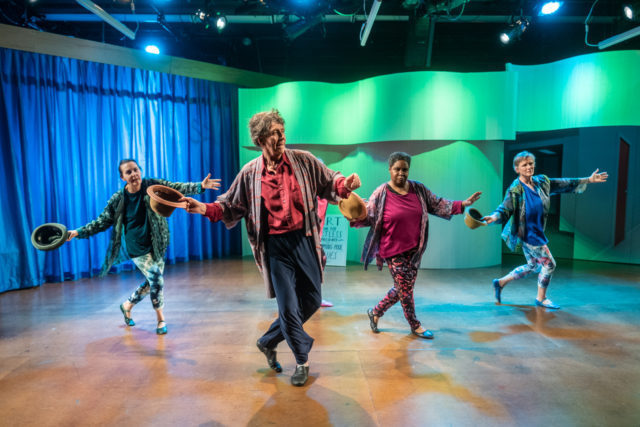
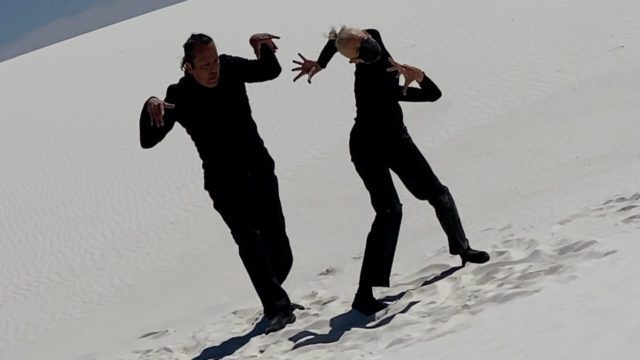
The next edition of gorno’s Yonsei f*ck f*ck is part of Pioneers Go East Collective “Crossroads” series at Judson Memorial Church

Who: Pioneers Go East Collective
What: Performance series
Where: Judson Memorial Church, 55 Washington Square South between Thompson & Sullivan Sts.
When: Thursday, December 9 & 16, free – $50 (sliding scale), 8:00
Why: Pioneers Go East Collective was founded in 2010 as “an arts and cultural organization inspiring a lively exchange of queer art and culture by connecting people to ideas and experiences.” Focusing on social engagement, collaboration, accessibility, and relevance, the Manhattan-based group has put on such multimedia performances as My name’sound, Virgo Star, and American Mill No. 2 at such venues as La MaMa, Ars Nova, A.R.T/ New York Theatre, and Triskelion Arts. On December 9 and 16, PGEC returns to Judson Memorial Church for the performance and video series “Crossroads,” building a community of art, poetry, music, dance, film, and more around the work of multigenerational queer, BIPOC, and feminist artists.

On December 9 at 8:00, curator Hilary Brown-Istrefi brings together ALEXA GRÆ’s eve’s witness. 2 soliloquies to the night, created by GRÆ, Jon Wes, and Matthew Ozawa with text by Connie Edgemon; Arien Wilkerson’s climate change performance installation Equators, made in collaboration with David Borawski, Jon-Paul LaRocco, and Domenic Pellegrini; and gorno’s (Glenn Potter-Takata) Yonsei f*ck f*ck pt. 12, a collaboration with evan ray suzuki and Kimiko Tanabe. The program on December 16 consists of dancer Lydia Mokdessi and musician Jason Bartell’s Devotion Devotion IV, joined by vocalist Syd Island; Marija Krtolica’s Infinite Subjectivity, a dance-theater piece performed by Michael Mangieri and Krtolica, with live music and reading by Jason Ciaccio and text by Søren Kierkegaard; and Janessa Clark’s film Future Becomes Past, with dancer Courtney Drasner revisiting a 2003 solo, photographed by Kathleen Kelley with music by Ben Lukas Boysen and Sebastian Plano, along with an untitled work in progress by Clark.