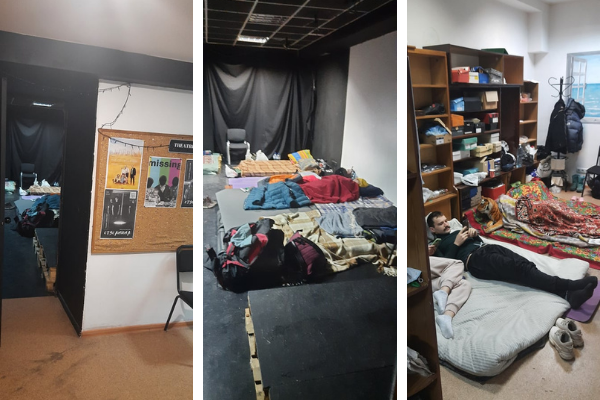
Who:ProEnglish Theatre of Ukraine What: Livestreamed fundraiser Where: ProEnglish Theatre of Ukraine Facebook Live When: Sunday, March 27, free with RSVP (donations encouraged), 11:00 am Why: Shortly after the Russians began their invasion of Ukraine on February 24, 2022, the ProEnglish Theatre of Ukraine converted its black box space into a shelter for members of the theatrical profession and neighbors, creating a safe area where actors, directors, technicians, and others could gather together. The company, which is based in Kyiv, has been collecting food and medicine for the elderly while continuing to make art. It is also supporting an effort to train actors as medical personnel to make videos to show people how to care for injured citizens. As part of Boston-based Arlekin Players Theatre’s #Artists4Ukraine project, “a campaign of hope,” ProEnglish Theatre is presenting a livestreamed version of British playwright Harold Pinter’s 1991 drama The New World Order, which deals with imperialism, totalitarianism, and hegemony. The three-character, ten-minute play involves a blindfolded man about to be tortured for unknown reasons.
ProEnglish Theatre of Ukraine has converted its space into a shelter for the cast, crew, and community in Kyiv
Des: Do you want to know something about this man? Lionel: What? Des: He hasn’t got any idea at all of what we’re going to do to him. Lionel: He hasn’t, no. Des: He hasn’t, no. He hasn’t got any idea at all about any one of the number of things that we might do to him. Lionel: That we will do to him. Des: That we will.
After finding out about what ProEnglish Theatre was doing, Arlekin founding artistic director Igor Golyak, who was born in Kyiv, made a video in which he declared, “This could be us. This is us.” The play will be performed live over Facebook on March 27 at 11:00 in the morning; if you can give anything, donations will be accepted to help the cause of ProEnglish Theatre in these dire times, as the people of Ukraine demonstrate a profound resilience to protect their freedom.
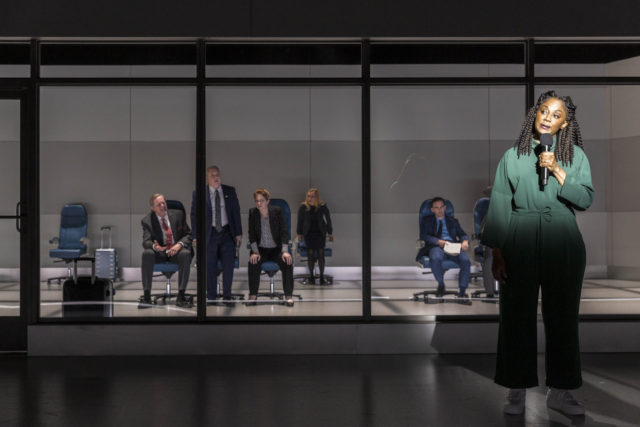
April Matthis is fabulous as the only person of color in Claudia Rankine’s Help (photo by Kate Glicksberg for the Shed)
HELP
The Griffin Theater at the Shed
The Bloomberg Building at Hudson Yards
545 West 30th St. at Eleventh Ave.
Tuesday – Sunday through April 10, $29-$77
646-455-3494 theshed.org
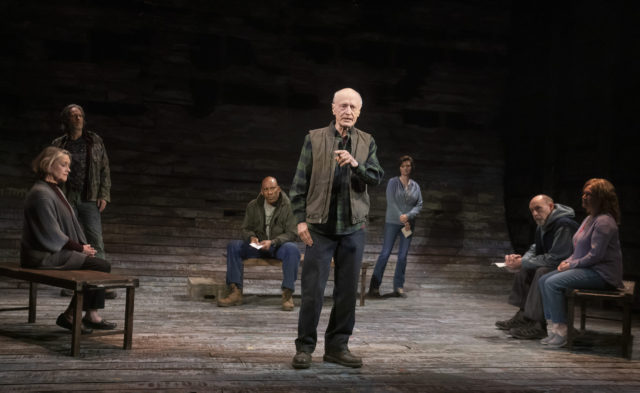
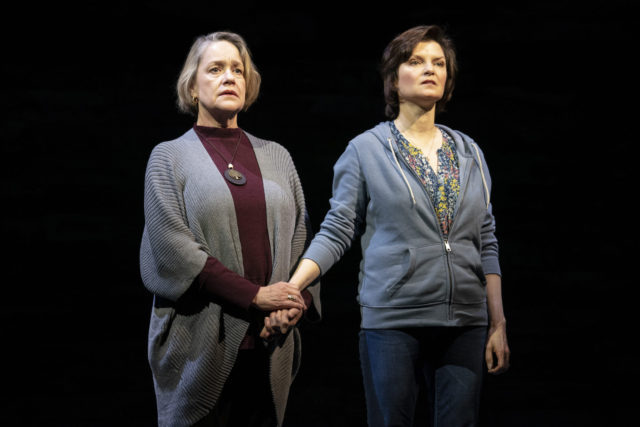
Poet, playwright, and professor Claudia Rankine wanted to know what white people were thinking, so she asked them. The results can be seen in the blistering new show Help, which opened last night at the Shed’s Griffin Theater.
Several recent plays by Black playwrights, including David Harris’s Tambo & Bones, Jordan E. Cooper’s Ain’t No Mo’, and Jackie Sibblies Drury’s Fairview, have used fictional narratives to address systemic racism, breaking the fourth wall and directly confronting the predominantly white audience.
But Rankine goes right to the facts in Help, which consists of verbatim dialogue from interviews with white men and white women conducted separately by Rankine, who is Black, filmmaker Whitney Dow, who is white, and civil rights activist and theologian Ruby Nell Sales, who is Black; responses to Rankine’s 2019 New York Times article “I Wanted to Know What White Men Thought About Their Privilege. So I Asked”; and quotes from such politicians, writers, and other public figures as James Baldwin, Elon Musk, Marjorie Taylor Greene, Audre Lord, Donald Trump, Eddie Murphy, Bill Gates, Dr. Martin Luther King Jr., Dr. Richard Sackler, Mitch McConnell, Toshi Reagon, and Fred Moten.
Obie winner April Matthis hosts the evening as the Narrator, portraying a version of Rankine, speaking straight to the audience. “I am here — not as I — but as we — a representative of my category,” she says at the start. “The approximately eight percent of the U.S. population known as Black women.” After listing a few real names and epithets of Black women, she declares, “Ultimately, whatever name you use, all of them, begin with the letter N.”
She walks back and forth across the front of the long, horizontal stage, either holding a microphone or stopping at the stand near the middle, like a comedian performing a semiautobiographical one-person show. Although the ninety-minute play has plenty of laughs, it is also deadly serious when it comes to racism, white supremacy, reverse racism, and white privilege. And she’s not about to let the mostly white theatergoers off the hook because they have bought a ticket to see such a progressive show and clap at all the politically correct moments.
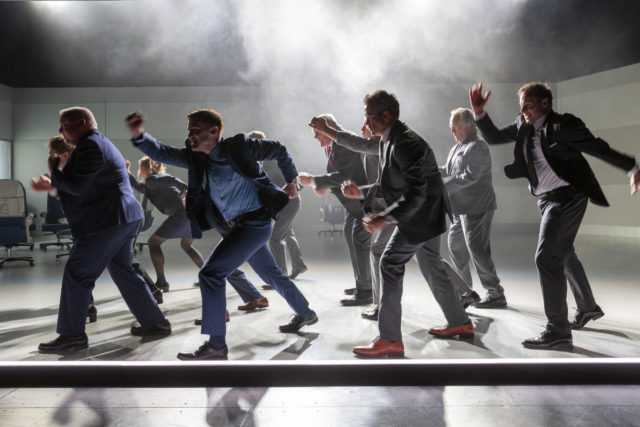
White men and women display their privilege through dance in Help (photo by Kate Glicksberg for the Shed)
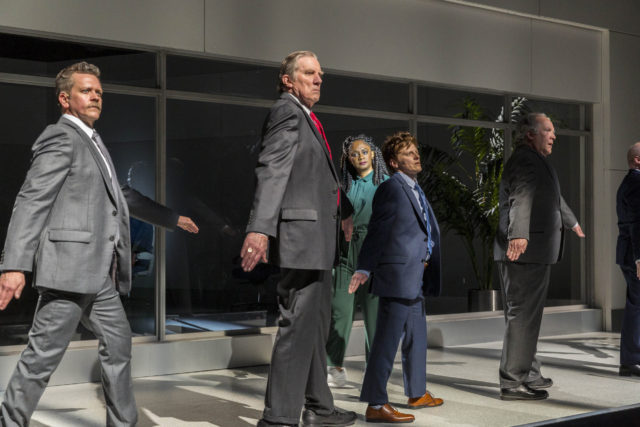
Behind the Narrator is a glassed-in airport waiting room populated by nine white men and two white women in business attire, a stark contrast to the Narrator’s green jumpsuit. They often interact with her, either joining her at the front or welcoming her into their space. Actually, “welcoming” might not be the best word, because they usually don’t like what she has to say, even though she attempts to be neutral, not responding the way she wants to as they refuse to acknowledge the advantages their whiteness automatically brings them and turning it back on her.
In an early vignette, people are lining up to board a plane, in number order according to their ticket. The Narrator wants to make sure she is in the right spot but is not thrilled when one man (Jeremy Webb) says to another (Tom O’Keefe), “You never know who they’re letting into first class these days.” In a sidebar, her therapist (Tina Benko) tells her, “You didn’t matter to him. That’s why he could step in front of you in the first place. His embarrassment, if it was embarrassment, had everything to do with how he was seen by the person who did matter: his male companion. He made a mistake in front of his companion. You are allowing yourself to have too much presence in his imagination.”
The Narrator responds, “I want a new narrative, one that doesn’t demand, or require, or want . . . one that doesn’t accept my invisibility. I need a narrative that includes your whiteness as part of the diagnosis. . . . The limits of his world are the limits of your world too.” She’s not speaking to just the therapist but to everyone in the theater.
A few moments later, the Narrator assumes the man (Nick Wyman) in front of her voted for Trump, and he snidely replies, “You can stand in this line with me, but you’ll never be in line with me. That’s why I’ll vote for him again. And again.” And another (Rory Scholl) doesn’t hesitate to admit to her, “If the cost of my way of life is your life — that’s not my concern.”
It’s a war of words, interpretations, meanings, and intent that makes for an uneasy flight as she leads us through barrages of racist statements made by familiar names (identified specifically in the play’s online resources page) as well as a few brief chats in which the other person wants to be an ally but doesn’t know how to deal with their inherent privilege. She won’t even give her husband (O’Keefe), who is white, a break. “I’m not demonizing, I’m historicizing,” she tells us. “To stay alive, forget thriving, I need to negotiate whiteness.”
The white cast, which also includes Jess Barbagallo, David Beach, Charlotte Bydwell, Zach McNally, Joseph Medeiros, John Selya, and Charlette Speigner, occasionally breaks into group social dances, choreographed by Shamel Pitts, that sometimes involve the rolling waiting room chairs as the men and women put their whiteness on further display. The original music is by JJJJJerome Ellis and James Harrison Monaco, with sound by Lee Kinney, lighting by John Torres and costumes by Dede Ayite; Nicole Brewer is the antiracist coordinator.
The Narrator (April Matthis) navigates through a white world in Claudia Rankine play (photo by Kate Glicksberg for the Shed)
Over the last two years, Rankine (Just Us: An American Conversation,Citizen: An American Lyric) and Obie-winning director Taibi Magar (Twilight: Los Angeles, 1992,Is God Is) reshaped and updated the play, which had to shut down during previews in March 2020 because of the pandemic, working in the January 6 insurrection, the murder of George Floyd, the Covid-19 crisis, and other recent events, although there is, unfortunately, a timeless quality to everything, as racism doesn’t look like it’s going away soon. They’re not teaching or preaching, but they steadily navigate so the audience doesn’t feel backed into a corner.
At the center of it all is Matthis (Toni Stone,Fairview), who is brilliant as the Narrator, guiding the interactions while making sure the audience remains uncomfortable even when laughing, since Rankine pulls no punches. “Imagine if my fellow travelers were to wrestle with their own privilege, instead of with my presence. For once,” she says. Once again, she’s not just referring to the characters in the play; we’re all in the waiting room together.
Tony winner Mimi Lien’s fab set matches the Narrator’s description of it as a “liminal space, a space neither here nor there, a space we move through on our way to other places, a space full of imaginative possibilities.” Clearly, it’s white people who are doing most of the moving as minorities face more of a stasis. “There’s no outrunning the kingdom, the power, and the glory,” the Narrator reminds us. Meanwhile, another white man (Beach) insists, “The dominant culture is colorless,” later adding that classic phrase, “I don’t see color.”
The program features several excellent essays, by Rankine, Dow, Simone White, and Sales, who, in “Can We Just Get Down to the Conversation About Whiteness?,” writes, “We must ask, is it a privilege to inherit a death driven system that predicates itself on the decimation of the potential and possibility of white men to reach the fullness of their humanities? Contrary to calling out the worst in them as the system does, we must see the good in them that they do not see in themselves. Our work must enable them to find new meaning in their lives and provide relief from their brokenness and fragmentation.” Help is no mere attack on whiteness but a declaration that things can and must change, with help from everyone.
The Narrator sums it up best when she says, “There is, after all, no racism without racists.” At its heart, the show is about the fear that pervades white people who are desperately trying to hold on to the past, and their power, as the world changes right before their eyes. They’re afraid they and their kids won’t get into the right schools, won’t get the good jobs, won’t have the same opportunities they’ve had for more than two hundred years since the birth of the nation.
At the end of her writer’s note, Rankine points out, “As Ruby Sales has said, ‘There’s nothing wrong with being European American; that’s not the problem. It’s how you actualize that history and how you actualize that reality.’” And that’s what Help is about.
Del (Del Walker) takes Irene (Anne Gooding) on a ride to nowhere in Bronco Bullfrog
BRONCO BULLFROG (Barney Platts-Mills, 1969)
Film Forum
209 West Houston St.
March 25-31
212-727-8110 filmforum.org
It’s a shame that writer-director Barney Platts-Mills won’t be around for the US theatrical premiere of the 2K restoration of his remarkable, long-forgotten 1970 underground black-and-white cult favorite, Bronco Bullfrog. But the British auteur, who passed away in October at the age of seventy-six, did supervise the restoration, and the film’s cinematographer, Adam Barker-Mill, will be at the 7:00 show at Film Forum on opening night, March 25, to talk about the making of the kitchen sink drama, the British neorealist subgenre that included such works as Tony Richardson’s Look Back in Anger, Ken Loach’s Kes, and Jack Clayton’s Room at the Top.
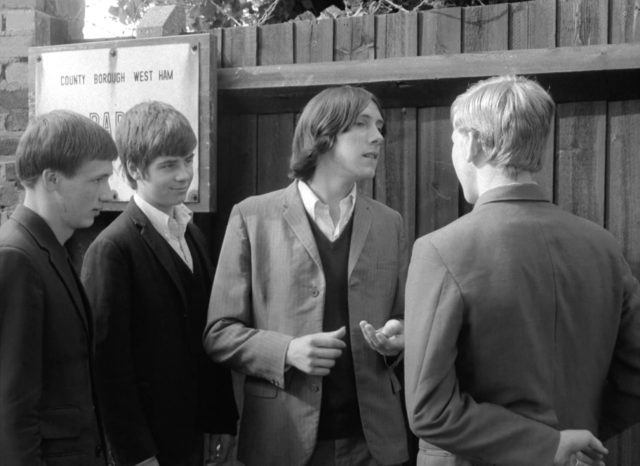
The story takes place in the shabby East End of London, where a group of boys battle malaise and boredom by sneaking into the movies, pulling off petty robberies, and fighting a gang of well-dressed, better-educated guys led by Parker (J. Hughes Jr.). Del Quant (Del Walker) is a seventeen-year-old welding apprentice who hangs around with his ne’er-do-well buddies, Roy (Roy Haywood), Chris (Chris Shepherd), and Geoff (Geoffrey Wincott). When Del meets Chris’s cousin, Tina (Tina Syer), and her fifteen-year-old friend, Irene Richardson (Anne Gooding), Del and Irene start seeing each other, but with little money they don’t exactly go out on the town; sometimes they merely head to the group’s hideout, a ramshackle space with dirty words and magazine pictures of naked women on the walls.
When local legend Jo Saville (Sam Shepherd), also known as Bronco Bullfrog, gets out of reform school, he offers Del a chance to make some fast cash, but they’re not exactly a crackerjack bunch of thieves; Jo, Del, Roy, and Chris are not even the droogs from Stanley Kubrick’s A Clockwork Orange, which came out the following year. In fact, the films have several elements in common; perhaps Platts-Mills was familiar with Anthony Burgess’s 1962 novel. Like Clockwork,Bronco Bullfrog has its own language and features heavy accents, so subtitles are often used, which has also been the case with many of Loach’s films. (In Platts-Mills’s second film, the more free-wheeling Private Road, the protagonists go to see Kubrick’s Spartacus.)
Neither Del’s father (Dick Philpott) nor Irene’s mother (Freda Shepherd) is happy about the kids’ relationship, especially when Sergeant Johnson (Stuart Stones) shows an interest in Del. But Del and Irene keep doing their thing, not talking or doing much as they try to figure out if there’s anything out there in the world for them; they know what they don’t want but not what they do, their lives devoid of the promise of a happy future while they seek out instant, temporary kicks.
Bronco Bullfrog is a wonderfully drawn study of teen angst and ennui. The characters wander aimlessly through empty, decrepit streets and alleys, every turn leading nowhere. Much of the poetic and deeply romantic film is improvised and shot on location where the nonprofessional actors live; it was made for a mere eighteen thousand pounds. Platts-Mills himself ran away from his expensive public school when he was fifteen; his father, John Platts-Mills, was a prominent barrister and member of Parliament.
The idea for the film came from Walker and his friends, who had participated in theater director Joan Littlewood’s workshop at the Play Barn, which was depicted in Platts-Mills’s 1969 documentary, Everybody’s an Actor, Shakespeare Said. They needed something to do, so Walker asked the director to make a movie with them.
Four East End teens battle malaise in Barney Platts-Mills’s Bronco Bullfrog
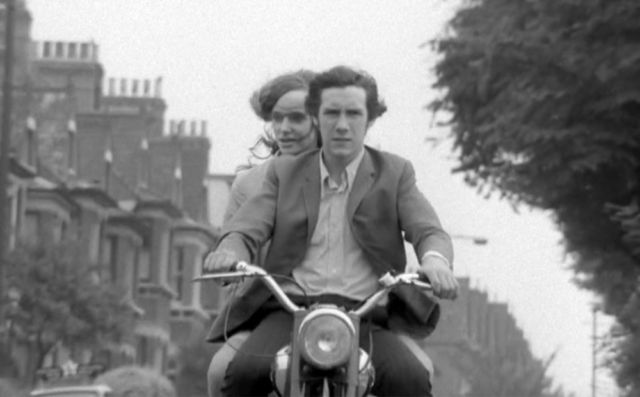
Although there was a script, the disenfranchised youth, neither mods nor rockers, just go about a fictionalized version of their lives, making it up on the fly as Platts-Mills and Barker-Mill — who became a successful installation artist — keep the cameras rolling. The charmless Del fancies himself a ladies’ man, but the scene in which he meets Irene is hysterical. He and Chris sit opposite Irene and Tina in a small tea shop, with nothing to say; Roy, playing pinball, looks over as if he’s jealous that his pals are talking to girls, but he’s not ready for that either and goes back to his game. On another date, Del, who recently bought a used motorbike, sits with Irene outside the fence of a motocross race, watching the kind of excitement that never comes his way.
Meanwhile, Bronco Bullfrog is no tough gang leader; he’s a bit of a doofus and maybe even just a nice guy who’s lost, which is perhaps why Platts-Mills named the film after him, because he’s a relatively minor character. He’s so thoughtful and gentle with his landlady (E. E. Blundell) that it’s easy to see through his supposed tough exterior. And the battles with Parker and his friends are pathetic; after Del and his group lamely push one of them to the ground, they later brag about how they beat him up.
The 2K restoration, made from the original 35mm print that was saved out of the garbage, is stark and sharp, capturing the feel of the teens’ mundane existence in this downtrodden corner of British society. The soundtrack is by drummer Tony Connor, saxophonist Keith Gemmell, bassist Trevor Williams, and guitarist Howard Werth of the British art-rock band Audience, adding to the late-1960s vibe. The multi-award-winning Platts-Mills went on to make the 1982 sword and sorcery film Hero and the 2010 drama Zohra: A Moroccan Fairy Tale, also about teen lovers. But it all started with Bronco Bullfrog, a landmark of British cinema that is finally getting its due here in America.
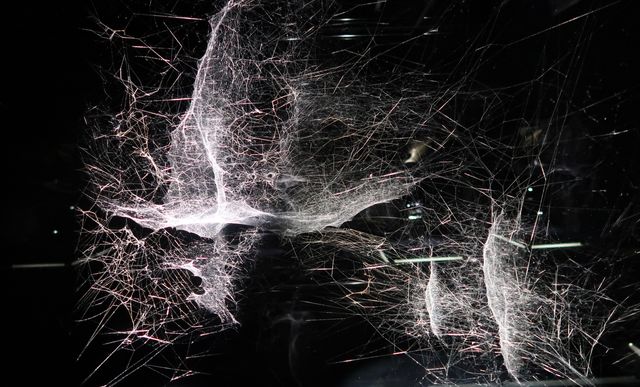
Spiders and their webs are at the center of Tomás Saraceno’s immersive, multimedia exhibitions at the Shed and Tanya Bonakdar Gallery (photo by twi-ny/mdr)
TOMÁS SARACENO: PARTICULAR MATTER(S)
The Shed
545 West 30th St. at Eleventh Ave.
Tuesday – Sunday through April 17
Upper level + gallery: $42; lower level + gallery: $35; gallery exhibition only: $12
646-455-3494 theshed.org studiotomassaraceno.org
The integration of art, technology, nature, and the environment is central to Argentina-born artist Tomás Saraceno’s discipline, currently on display in a pair of complex immersive exhibitions in the city. In “Silent Autumn” at Tanya Bonakdar in Chelsea and “Particular Matter(s)” at the Shed in Hudson Yards, Saraceno investigates toxic air and water, the reuse of plastic bags, rampant consumerism, and, most of all, spiders though collaborations with MIT and NASA, among others, attempting to find ways to fix a broken planet in this out-of-control Capitalocene era.
In a 2014 lecture he gave at MIT, Saraceno discussed the “sociability” of spiders. “It’s very similar to humans,” he said. “Spiders are social because they have enough space and food. But if you put a lot of social spiders in a very tiny space, they are not social. They eat each other. They’re pretty much like humans. There are forty-three thousand species of spider and only twenty are social. Knowing that sociability is a big trend for the survival of the planet, no one really understands this. What we do is try to make [the spiders] operate and work, one with the other, the solitary and the social.” It sounds all too close as humanity emerges from a global pandemic.
Continuing through April 17, “Particular Matter(s)” leads visitors on an audiovisual journey through the kingdom of the spiders. Webs of At-tent(s)ion consists of seven encased hybrid spider webs, hanging in midair and lit so it appears that they’re glowing in the dark. Each case is like its own universe, with different species of spider building on what others started, resulting in magical architectural structures made of spider silk and carbon fibers.
Radio Galena turns a crystal into a wireless radio receptor. Printed Matter(s) reproduces cosmic dust from 1982 in a series of ten photos printed using black carbon PM2.5 pollution extracted from the air in Mumbai; they are arranged loosely on a wall, as if they might blow away and break up into shreds, like the atmosphere being destroyed by pollution. Particular Matter(s) is a light beam that reveals how much dust is in the air that we breathe, poisoned by the burning of fossil fuels.
Arachnomancy features a deck of thirty-three tarot-like meteorological “oracle” cards, printed on carbon-footprint-neutral paper, spread out across a table, based on the beliefs of the spider diviners of Somié, Cameroon, who make cards out of leaves, forecasting weather events. The cards include images of maps, plants, human figures, and webs, with such titles as “Bad News,” “Planetary Drift,” “Invertebrate Rights,” “Entanglement,” and “Fortunate Webbing.” Dangling above the table is a web built by two Cyrtophora citricola spiders that looks like you could rip it apart with a soft breath.
Inspired by the writings of science journalist Harriet A. Washington,We Do Not All Breathe the Same Air uses black carbon, soot, and PM2.5 and PM10 to reveal how pollution impacts air quality in different parts of the country, adversely affecting BIPOC and poorer areas. A red sliding sheet laser brings spider webs to life in a long horizontal window in How to entangle the universe in a spider/web,? which resembles a trip through the human circulatory system or into a far-off galaxy. The concept of spider ballooning and visitors’ movement combine to create music in Sounding the Air, an installation in which five threads of spider silk form an aeolian instrument that emits sonic frequencies when it encounters heat, wind, body movement, and other elements.
A Thermodynamic Imaginary is a room filled with many wonders of Saraceno’s oeuvre, a fantasy world comprising sculpture, projected video (Tata Inti and Living at the bottom of the ocean of air), shadows, reflections, large bubbles, and more, like its own galaxy in what the artist calls the Aerocene: “a stateless state, both tethered and free floating; a community, an open source initiative; a name for change, and an era to live and breathe in.”
On the fourth floor, you have to remove your shoes to walk into Museo Aero Solar, devised by Saraceno and Alberto Pesavento in 2007, an ecological balloon composed of plastic bags sewn together, their brands and trademarks visible, seeking to eventually eliminate the use of fossil fuels by providing sustainable, free-floating options. The gallery also includes documentation of the project and such items as an Aerocene Backpack and flight starter kits.
The centerpiece of “Particular Matter(s)” is Free the Air: How to hear the universe in a spider/web, a live eight-minute concert held in an almost blindingly white two-level, ninety-five-foot diameter floating sculpture, commissioned by the Shed for this exhibition. The limited audience gets misted as they enter the foggy space, which contains 450,000 cubic feet of air and features a large-scale net made of steel and thick wire that evokes a giant spider web on which people lie down; it’s a rather tenuous trampoline with gaps in it, so if you jump, it will affect not only your balance but others’ as well, so don’t play around too much. If you’re on the lower level, you can look up to see the people above you, almost walking on air.
Darkness ensues and the concert in four movements begins, prerecorded sound waves and vibrations of spiders interacting with their webs that are impacted by the audience’s presence, incorporating Sounding the Air,Webs of At-tent(s)ion, and other items in “Particular Matter(s).” It’s a welcoming atmosphere of interspecies communion and coexistence that plots a course for ways to save our increasingly fragile planet using our innate spider-sense and expanding our idea of what home is.
Advance tickets are necessary for the special experience and sell out quickly, so act fast. As part of the Shed program “Matter(s) for Conversation and Action,” on March 30 at 6:00 there will be a free Zoom panel discussion, “Invention, Experimentation, and Radical Imagination,” with MIT professor Caroline A. Jones, climate scientist Dr. Kate Marvel, and Vassar professor Molly Nesbit, moderated by designer, teacher, and entrepreneur Sandra Goldmark, followed on April 13 at noon by “Rights of Nature, Activism, and Change” with lawyer Alicia Chalabe, Dartmouth professor N. Bruce Duthu, and sociologist and writer Maristella Svampa, moderated by Columbia Law School professor Michael B. Gerrard.
Tomás Saraceno gallery show at Tanya Bonakdar complements Shed exhibition (photo courtesy Tanya Bonakdar Gallery)
TOMÁS SARACENO: SILENT AUTUMN
Tanya Bonakdar Gallery
521 West 21st St. between Tenth & Eleventh Aves.
Tuesday – Saturday through March 26, free, 10:00 am – 6:00 pm www.tanyabonakdargallery.com
In conjunction with the Shed show, Tanya Bonakdar is presenting “Silent Autumn” through March 26. The title plays off Rachel Carson’s seminal 1962 book, Silent Spring, a “fable for tomorrow” that called for the elimination of such chemicals as DDT in order to maintain a living, breathing Earth. The exhibit begins with An Open Letter for Invertebrate Rights, in which Spider/Webs explain, “Do not be afraid. Let us move from arachnophobia to arachnophilia by sensing new threads of connectivity, or else face the eternal silence of extinction.”
Visitors must put booties over their shoes in order to enter Algo-r(h)i(y)thms, a musical instrument comprising a vast network of webs, the strings of which make warming sounds when plucked. You can either create your own solo or work in tandem with others for a more ornate score. Surrounding the instrument are Arachne’s handwoven Spider/Web Map of Andrómeda, with a duet of Nephila inaurata — four weeks and ensemble of Cyrtophora citricola — three weeks and Cosmic Filaments, intricate black-and-white architectural drawings of web universes.
The title diptychs (and one triptych) pair framed leaves glued to inkjet paper next to framed photographs of the leaves; the two works initially look identical, but over time the real leaves will fade and disintegrate while the picture endures. Silent Spring comprises four panels of pressed poppy flowers from contaminated soil near Saraceno’s Berlin-Rummelsburg studio, with shutters that protect them from the sun, although they too will fade; the dirt was polluted by a photographic film and dye manufacturer, so the piece is very much part of Saraceno’s personalized mission of recycling and sustainability.
In the same room, three stainless-steel and wood sculptures hang from the ceiling at different heights, evoking the much larger structures Saraceno installed on the Met roof for “Cloud City” in 2012 as well as the Silent Autumn framed leaves. In a smaller room, the blown glass pieces Pneuma,Aeolus,Aeroscale, and Aerosolar Serpens probe breathing, physical presence, and the brittleness of existence. Other works continue Saraceno’s exploration of overconsumption, pollution, climate change, and the future of life on the planet — and throughout the universe.
Saraceno is a genius at bringing us into his world by creating fascinating objects that are ravishing to look at, then hitting us with the heavily researched science behind it all as he attempts to save the world. But he can only do it with our help.
Coal Country is a damning portrait of much that’s wrong in America today, a tale of corporate greed, corruption, union busting, an unequal justice system, and a lack of compassion for one’s fellow human beings. And it’s all true.
On April 5, 2010, more than two dozen men died in the Upper Big Branch Mine disaster in Raleigh County, West Virginia. Jessica Blank and Erik Jensen’s documentary play is set at the end of the trial of Massey Energy CEO Don Blankenship, who ran the mine. The action begins as Judge Berger (Kym Gomes) has opened the floor for relatives and colleagues to share their stories of what happened before, during, and after the horrific event, the worst mining disaster in the United States in forty years. The audience serves as a kind of jury as the characters speak verbatim dialogue, word for word what the real men and women of Raleigh County said.
Patti Stover (Mary Bacon) talks about her chance at second love with Gregory Steven Brock, who went to the mine that day even though he wasn’t feeling well because he couldn’t afford to take time off. Tommy Davis (Michael Laurence) worked in the mines with his brother Timmy and nephews Cory and Josh; like many people who lived in the company town, mining went back generations.
Roosevelt Lynch Jr. (Ezra Knight) would pass by his father every morning, one having just finished a shift, the other about to start one. Dr. Judy Petersen’s (Deirdre Madigan) brother Dean did everything with his twin brother, Gene, but shortly after they both began in the mine, Gene quit while Dean stayed on.
Gary Quarles (Thomas Kopache) shares the story of his son in Coal Country (photo by Joan Marcus)
Gary Quarles’s (Thomas Kopache) son was tired of working off the dangerous longwall. “I’d say Massey ran outlaw from the day Blankenship brought ’em in,” Gary says about the hiring of nonunion employees. “We always said that Massey Energy was his third world country, and Don was the dictator.”
The de-facto leader of the group is Stanley Stewart, known as Goose (Carl Palmer), a third-generation miner whose grandfather was killed on the job. Goose told his wife, Mindi (Amelia Campbell), about how he could see trouble was brewing because of how the new ownership was dealing with basic health and safety issues. “My first twenty years was union. This was the strongest union place in the world before Massey came in,” Goose says. Gary adds, “And I’ll tell you what, you didn’t worry ’bout gettin’ fired by speakin’ up.”
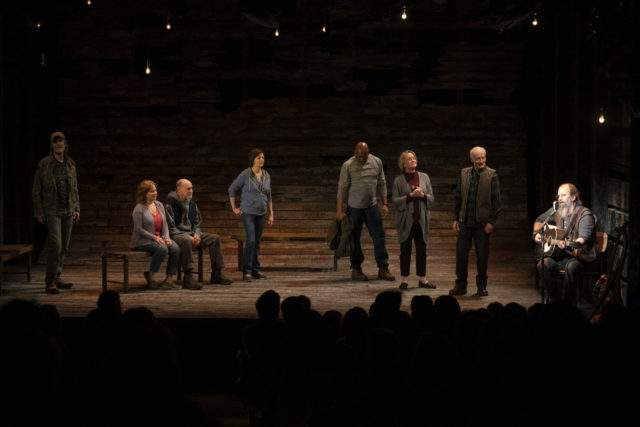
Throughout the play, Grammy-winning folk-country-rock troubadour and activist Steve Earle plays related songs from his chair in the front right corner of the stage, switching between acoustic guitar and banjo. He sometimes gets up and joins the cast, who occasionally sing lines and choruses with him. Earle’s score ranges from the traditional folk song “John Henry,” about an African American “steel drivin’ man” battling a steam drill in the Big Bend Tunnel in West Virginia in the nineteenth century, to “Heaven Ain’t Goin Nowhere,” “The Devil Put the Coal in the Ground,” and “It’s About Blood.”
In “Union, God, and Country,” Earle asks the audience to sing along to these key lines: “Union, god, and country / West Virginia gold and blue / Union, god, and country / was all we ever knew.” Earle also performs his 2013 bluegrass song “The Mountain,” in which he explains, “I was born on this mountain / This mountain’s my home / And she holds me and keeps me from worry and woe / Well, they took everything that she gave / Now they’re gone / But I’ll die on this mountain / This mountain’s my home.” I’ve seen Earle numerous times over the years, from the Ritz and the Bottom Line to the Blue Note, the Lone Star Roadhouse, and Judson Church, and he is an inspired choice for Coal Country; he also served as composer and onstage narrator in Richard Maxwell’s existential Western Samara for Soho Rep. in 2017. On April 5, 2020, Earle played the songs of Coal Country in a free Facebook Live concert and has recorded them for the album Ghosts of West Virginia. (Wednesday night shows will be followed by a discussion with Earle on March 16 and 30 and Blank and members of the cast on March 23 and April 6.)
Dr. Judy Petersen (Deirdre Madigan) and Mindi Stewart (Amelia Campbell) wait for word of their relatives in Coal Country (photo by Joan Marcus)
An Audible production that had to cut short its premiere run at the Public in March 2020 because of the pandemic lockdown, the ninety-minute Coal Country has made a successful transition to the Cherry Lane. Richard Hoover’s wood-based set at times places the audience inside the mine, with David Lander’s lighting signaling trouble behind the slats of broken wood in the back. Movement director Adesola Osakalumi guides the actors on- and offstage as they rearrange various benches, providing much-needed breaks between emotional moments.
Married partners Blank and Jensen previously collaborated on such projects as The Exonerated, in which an ensemble reads the words of innocent men and women on death row, and The Line, a virtual Public Theater presentation from July 2020 in which an all-star cast told the verbatim stories of health-care workers and first responders in the early days of the Covid-19 crisis.
In Coal Country, Blank and Jensen do a magnificent job of integrating the individual stories, weaving them together to form a compelling narrative that will have you at the edge of your seat, even if you know exactly what happened. The scenes in which the characters are waiting on news of the fate of their loved ones are unforgettable, especially seen now, after two years of a global health crisis that has killed nearly a million Americans, many of whom died alone, their relatives forbidden to be with them. It’s a uniquely American tale, one that comes amid extreme partisanship, polarization, and divisiveness, but it doesn’t matter where you fall on the political spectrum to be deeply moved and infuriated by its overarching message.
As Earle sings, “It’s about fathers / It’s about sons / It’s about lovers / Wakin’ up in the middle of the night alone / It’s about muscle / It’s about bone / It’s about a river running thicker than water ’cause / It’s about blood.”
Talene Monahon’s Jane Anger is a frenetic farce that believes if you hit the audience with a nonstop, relentless barrage of jokes, enough are going to stick to make the experience worthwhile. The laughs actually begin with the full title, which is: Jane Anger or The Lamentable Comedie of Jane Anger, that Cunning Woman, and also of Willy Shakefpeare and his Peasant Companion, Francis, Yes and Also of Anne Hathaway (also a Woman) Who Tried Very Hard. And I’m happy to say that more than enough jokes hit their target to make this a very funny evening.
It’s 1606, and London is in the midst of yet another plague. Addressing the audience directly at the start of the play, Jane Anger (Amelia Workman) immediately equates that time with recent global affairs. “It’s back, baby!” she announces. “The death carts are out, the plague screecher is running around screeching, the playhouses have closed, fleas are swarming the streets, people are freaking out.”
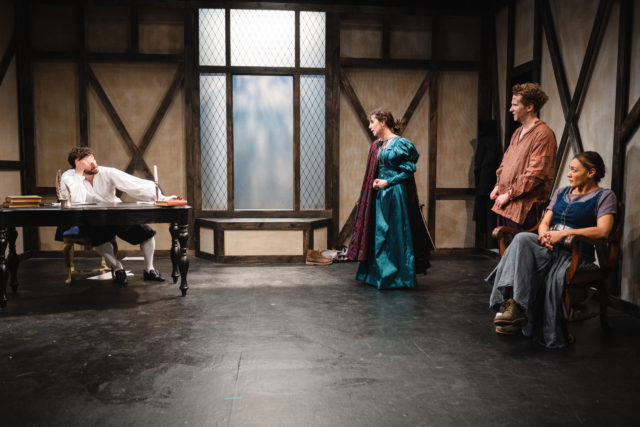
With the city in lockdown, including the theater, William Shakespeare (Michael Urie) is stuck in his home, suffering an extreme case of writer’s block. With no place to go, Francis Sir (Ryan Spahn), an apprentice actor with the King’s Men — who appears to be much older than the nearly sixteen years he claims to be — asks for shelter from the Bard, who agrees to let him live on the floor in his writing room. The quaint Elizabethan set, by Joey Mendoza, features a large window in the back that functions as an entrance, above where Francis sleeps.
“Sixteen? This seems most improbable to me,” the Bard says. “You seem somewhat older and uglier and more weathered in the face.” Francis replies, “The poverty, sir. It has coarsened me. I assure you I am a mere youth. A boy, a stripling, a youngker!”
Real-life partners Michael Urie and Ryan Spahn star in new play by Talene Monahon (photo by Valerie Terranova)
Feeling a ton of pressure — during the 1593 plague, Shakespeare wrote the poems Venus and Adonis and The Rape of Lucrece and worries that now he will be outpaced by the prolific Ben Jonson and even Thomas Middleton — the Bard ultimately decides to pen King Lear, even though there is already another play about the same monarch, purportedly written by Thomas Kyd, called King Leir. But to make the story his own, Shakespeare is going to change Leir to Lear and Cordella to Cordelia.
Soon the Dark Lady of Shakespeare’s sonnets, Jane, his muse, pays a surprise visit on her former lover. “You’re alive. You came!” the Bard declares. “Aw! Not any time that you would remember,” Jane ribaldly answers.
Jane has a favor to ask of Shakespeare: She needs him to sign a document endorsing a pamphlet she is trying to get published by William Jaggard. (In fact, a woman going by the name Jane Anger did publish a highly influential 1589 pamphlet entitled “her Protection for Women. To defend them against the SCANDALOUS REPORTES OF a late Surfeiting Lover, and all other like Venerians that complaine so to bee overcloyed with womens kindnesse.”) But Will wants to finish his new play before helping Jane — and he’s not exactly sure about woman writers, as an earlier exchange with Francis revealed.
Francis: Sir. You need not fret. This shall all pass. Your genius is surely not imperiled by the plague-writing of other men or women or anyone — Will: Men or who? Francis: . . . Women, sir . . . ? Will: Frankie! Was that your sarcasm again? A woman writing? What, sitting at a little desk with her quill? Scribbling away in her skirt?? “Look at me! I’m a woman writing!” Francis: “Look at me! I’m a woman forming words out of my mind and then making sentences out of them.” Will: “Look at me! I’m a woman who can spell!” HA HA. Will and Francis: HA HA HA HA HA HA HA HA HA.
When Francis asks, “What is a Cunning Woman? Is that like a physician? Or a Barber-Surgeon?” Shakespeare replies, “Yes, Frankie, it’s similar but the differences are the person has breasts and makes less money.”
Next to join in the fray is Shakespeare’s detested wife, Anne Hathaway (Monahon). He purposely hasn’t seen her in seven years and seemingly refuses to acknowledge the prior existence of their son, Hamnet, who died a decade before, most likely from the plague. Anne Hathaway is always referred to by her full name, Anne Hathaway, and yes, there are inside references to the current actress, Anne Hathaway, who portrayed Viola in Twelfth Night at the Delacorte in 2009.
“Simply put, Anne Hathaway is Death to a writer’s process,” Shakespeare declares, adding a moment later, “For whatever reason, people don’t seem to like Anne Hathaway. It’s a bit of a thing, actually.”
The high jinks speed up with four characters onstage as egos clash, revelations are made, and the silliness only increases, with Monty Python-esque humor.
Amelia Workman stars as the title character in Talene Monahon’s Jane Anger (photo by Valerie Terranova)
An earlier, shorter iteration of Jane Anger, called Frankie and Will, was streamed during the pandemic, with the action taking place in Urie (Angels in America,Buyer & Cellar) and Spahn’s (Moscow Moscow Moscow Moscow Moscow Moscow,How to Load a Musket) Manhattan apartment; the real-life partners did numerous virtual presentations over the last two years, and they both starred in Michael Kahn’s eccentric production of Hamlet for Shakespeare Theater Company in 2018, with Urie as the title character and Spahn as his old friend Rosencrantz. Having acted together so often — in addition to cohabitating — the pair has an instant chemistry, in this case reminiscent of Abbott & Costello.
Director Jess Chayes (HOME/SICK,The Antelope Party) holds nothing back, letting the characters fire away at will, pun intended. Plenty of jokes miss their target — repeated references to the Pony Rule, the equivalent of social distancing, fall flat — but plenty nail the bull’s-eye.
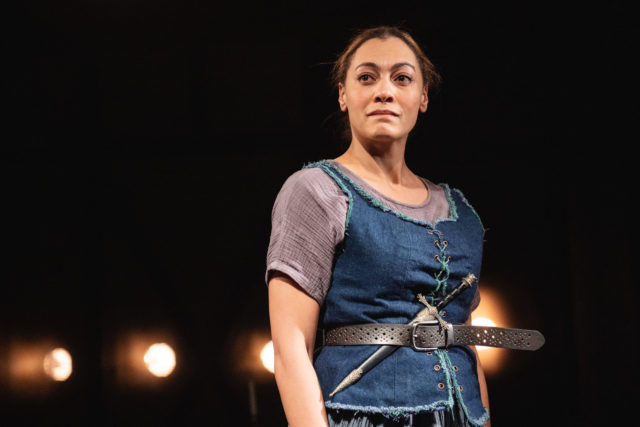
Monahon, who previously wrote How to Load a Musket and starred in Widower’s Houses for TACT, is lithe and demure as the somewhat simpleminded, self-deprecating Anne Hathaway, while the ever-dependable Workman (Fefu and Her Friends,Tender Napalm) is bold and fierce as the unabashed, forward-thinking Jane.
In her pamphlet, Anger wrote, “At the end of men’s fair promises there is a Labyrinth, and therefore ever hereafter stop your ears when they protest friendship, lest they come to an end before you are aware whereby you fall without redemption. The path which leads thereunto, is Mans wit, and the mile’s ends are marked with these trees, Folly, Vice, Mischief, Lust, Deceit, and Pride. These to deceive you shall be clothed in the raiments of Fancy, Virtue, Modesty, Love, True meaning, and Handsomness. . . .” Monahon and Chayes capture that spirit in this madcap comedy.
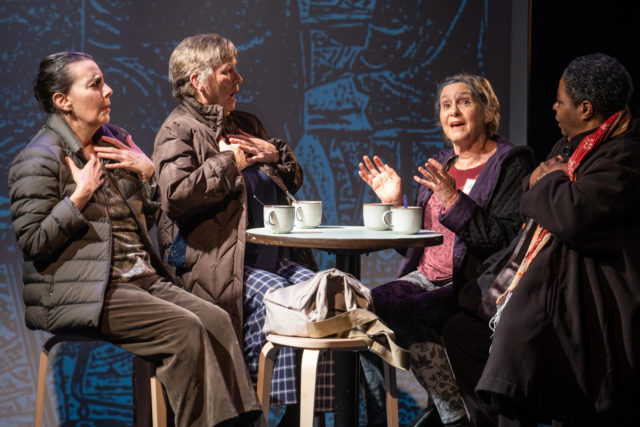
A quartet of senior women gets more than they bargained for in Lemon Girls or Art for Artless (photo by Andrew Bisdale)
LEMON GIRLS OR ART FOR THE ARTLESS
La MaMa Experimental Theatre Club, the Downstairs
66 East Fourth St. between Second Ave. & Bowery
Thursday – Sunday through March 27, $25-$30
212-475-7710 www.lamama.org talkingband.org
Lemon Girls or Art for the Artless is a small show in a small space, but it’s one of the most exhilarating and inspiring shows I’ve seen since the pandemic interrupted in-person entertainment in March 2020. It’s an uproarious and touching celebration of aging and coming to terms with who you are and what you’ve accomplished, a kind of alternative to the wickedly fun Six on Broadway, where the six wives of Henry VIII battle it out to see who had it worst with the monarch.
Continuing in the Downstairs theater at La MaMa through March 27, Lemon Girls is about four senior women whose connection to life changes when they meet a stranger in their local café, appropriately called Solo, where the quartet, friends since attending the progressive Lemon Elementary school together, meet for coffee every Tuesday at 3:30. They sit at the same table each week, but they are surprised one afternoon to not only find a line to get in — the new pencil latte has become a thing — but also see that a stranger has taken their spot.
Urban historian Nivea (Patrena Murray), social worker Topo (Lizzie Olesker), retired civil servant Pinny (Louise Smith), and cookbook writer Lorca (Ellen Maddow) assume that the man, Sid Spitz (Jack Wetherall), will cede them the table, but instead he cheekily asks them to join him, in some ways becoming their fifth friend, painter Fran (Tina Shepard), who is not there. They recognize instantly that he’s not like the other males they know, who call themselves the Romeos: Retired Old Men Eating Out. (“They enjoy the turkey chili. It gives them gas,” Pinny points out.) An FIT librarian and performance artist, Sid invites the women to become part of a music theater workshop he leads in the basement of a rec center.
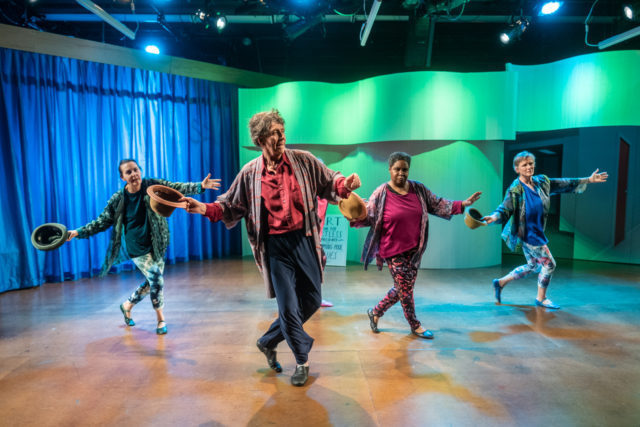
After some waffling, they do actually show up. Their skepticism of Sid’s earnest direction gives the rehearsal scenes brilliant, low-key comedy. “Keep on walking, fill in the spaces, curve through the people, use your arms. And STOP. And float. And STOP and float,” he advises, adding, “The floor is sand, your feet are hands, they squeeze the sand. They caress, they sink, they caress, they squeeze.”
Lorca says to Nivea, “What does he mean our feet are hands? Like monkeys? Does he mean monkeys? Is this the beach? Are we supposed to be at the beach, or the zoo?”
When Sid tells them to move underwater and “fill the empty spaces,” Lorca wonders, “Underwater? How do we breathe? People can’t breathe underwater.” And when he prompts them to glide like their hands are knives and the air is bread, slicing away, Lorca argues, “Suddenly it’s the kitchen?”
Sid Spitz (Jack Wetherall) leads rehearsals for upcoming show in charmer at La MaMa (photo by Andrew Bisdale)
But the four women are superb actors, able to play their characters, older women who are learning to perform, with skill and nuance as the quartet eventually enjoys adapting to Sid’s unique choreographic methods and come up with songs that share intimate details of their lives. As they prepare to put on a public show for an organization called Art for the Artless, there’s conflict: In order to keep the workshop funded, they need a fifth participant, and Nivea promises to bring Fran.
In addition, Sid needs to get paid so he can afford his rent to his landlord and best friend, Marvin; the unseen Marvin is about to turn ninety and is close with artist David Hockney, which excites the group, who rave about how Hockney’s recent show at the Met changed their lives.
At one point, Topo opines, “What I think I look like and what I look like don’t match. That gives me the creeps,” to which Lorca replies, “But it doesn’t matter. It doesn’t matter anymore.” Before the rehearsals, the women had resigned themselves to a plain existence, exemplified by some of Lorca’s bitter songs. Sitting outside the café, Lorca and Pinny remember one of Lorca’s schoolgirl ditties: “I sit on a bee because I am dumb / I scream at my teacher cuz she isn’t fair / I kick the doctor because he hurt me / I drown in the river because it is there.” But hope is on the way.
Lemon Girls or Art for the Artless is the latest from avant-garde mainstays Talking Band, which has staged more than fifty new works since 1974. The show is directed by four-time Obie winner Paul Zimet (The City of No Illusions,The Walk Across America for Mother Earth), who cofounded the troupe with Maddow (Fusiform Gyrus — A Septet for Two Scientists and Five Horns,Fat Skirt Big Nozzle), who wrote Lemon Girls and composed the wonderful songs, and Shepard. Sean Donovan (Cabin,The Reception) did the marvelous, often hysterical choreography, which is a character unto itself, helping define the four women and how they view the world. The fab costumes are by Kiki Smith.
Anna Kiraly’s set is anchored by the slightly raised Café Solo at the corner of stage right, covered by a blue curtain when the action is taking place in the central makeshift workshop space, where a door leads beyond. The characters open and close the curtain as scenes there begin and end; on the back wall of the café, Kiraly projects pixelated, abstracted black-and-white footage of younger people hanging out in the shop, which the four women ignore.
As we emerge from the coronavirus crisis, which hit senior citizens particularly hard, it is an absolute joy to watch Nivea, Topo, Pinny, Lorca, and Sid, portrayed by a supremely talented cast, meeting new people, trying new things, and finding renewed meaning in their everyday existence.
“That’s what’s changed!” Nivea suddenly declares. “That’s what I’ve gone back to, I mean. I’ve stopped watching myself. I used to always be watching myself watching myself. Did you ever do that?”
Lorca replies, “Oh yeah. Everything was such a ridiculous complication of layers. And finally I just got tired of it, really, really tired of it. I would watch myself reflected in store windows looking like a hobbling old hag. It was so sad and exhausting! So I just stopped looking. It’s like I went back to when I was eight or something. Whatever I feel like doing, I do it.”
Talking Band has been around for nearly a half century; if you haven’t seen them before, you’ll be thrilled that you’ve met them now and have finally been introduced to their intoxicating philosophy.