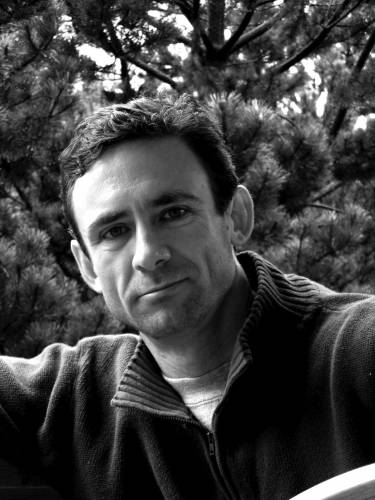
- Chuck Palahniuk will be celebrating the release of TELL-ALL at the Great Hall at the Cooper Union on May 6 (photo by Shawn Grant)
CHUCK PALAHNIUK: TELL-ALL (Doubleday, May 4, 2010, $24.95)
The Great Hall at the Cooper Union
7 East Seventh St. at Third Ave.
Thursday, May 6, $30, 6:00
www.chuckpalahniuk.net
www.strandbooks.com
www.randomhouse.com
There’s a critical moment in every Chuck Palahniuk book when readers have to decide whether to forge ahead or return it disgustedly to the shelf, perhaps never to be opened again. In such bestselling novels as FIGHT CLUB, CHOKE, HAUNTED, RANT, and PYGMY, Palahniuk describes, in great detail, gut-twisting (literally) scenes of intense, brutal sex and/or violence, often told in a complex narrative style that takes some getting used to. Stick with it and you’re rewarded with some of the most intelligent, darkest satirical writing of the last fifteen years that’s as fun as it is challenging.
His latest work, TELL-ALL, is told from the point of view of Hazie Coogan, the longtime caretaker and protector of former Hollywood starlet Katherine Kenton. It’s a wry mash-up of SUNSET BOULEVARD and THE BAD AND THE BEAUTIFUL, with Palahniuk bold-facing a vast array of celebrity characters centered around Lillian Hellman, from George Cukor and Adolph Zukor to Christian Dior and Coco Chanel, from Rita Hayworth and Lucille Ball to Peter Lorre and Clifton Webb, and, perhaps most appropriately, famous gossip columnists Walter Winchell, Hedda Hopper, and Louella Parsons.
Palahniuk, a journalism major and former movie projectionist who splits his time between his home state of Washington and Oregon, will be making his sole New York City appearance in support of TELL-ALL on May 6 at the Great Hall at the Cooper Union, a much-anticipated event that will include Julie Halson performing selections from the book as Katherine Kenton and Hazie Coogan; tickets are $30, and all attendees get a poster and a signed hardcover. Palahniuk took a break from his schedule, which will also take him to Portsmouth, Boston, Asheville, Chicago, and other cities, to answer a few questions we had for him over e-mail.

twi-ny: Your rabid fan base, known as the Cult, has a habit of coming to your readings and signings dressed up as characters from your books, tying Christmas trees to the tops of their cars, and mimicking other elements from you stories. What do you think it is about you and your books that attract this kind of worship? When we attend readings by the likes of Paul Auster, Haruki Murakami, and Tom Robbins, things tend to be a bit more subdued, which in no way are we implying is preferable, of course.
Chuck Palahniuk: After twenty years as part of the Cacophony Society, I see that people love events which allow them to act out and participate in consensual ways. No one wants to be the lone fool, but if everyone is dressed as Santa Claus it’s safe and communal and still fun. As the person onstage I’m especially aware of being a lonely idiot so I stage book events to include games and costumes and prizes and activities, each linked to either the book I’m pimping or to the piece I’ve written specifically to read at that event. Yes, this extra effort takes me all winter to orchestrate — even at this moment, my props and prizes are already shipped to each venue, including the Cooper Union — but this structure and preparation also allows me to relax and have a good time. Once I’m traveling and bone-tired and starving I still have the assurance of my structured insanity to keep me sane.
twi-ny: Your new book, TELL-ALL, deals with Hollywood celebrity. Who are some of your favorite old-timers? Bette Davis or Joan Crawford? Clara Bow or Theda Bara? Marilyn, Mamie, or Mansfield?
CP: No one will ever be as bitter and lovely as Geraldine Fitzgerald — I’ll sit through all of WUTHERING HEIGHTS just to hear her say, “Ïf Cathy dies . . . perhaps then I might live.” That’s a guesstimate of the quote. However, I burn a perpetual candle beside a shrine to Gloria Grahame; nobody played more or better floozies and bitches. You know she was polishing Jim Stewart’s apple in IT’S A WONDERFUL LIFE or why else would he give her all that money?
twi-ny: Your only New York City appearance will be on May 6 at the Great Hall of the Cooper Union, where presidential candidate Abraham Lincoln gave one of his most memorable speeches, 150 years ago this past February. How do you think Lincoln would do if he were to run in 2012? How do you think he might respond to TELL-ALL and Julie Halston?


 Jean-Pierre Léaud gives a bravura performance in Jean Eustache’s New Wave classic about love and sex in Paris following the May 1968 cultural revolution. Léaud stars as Alexandre, a jobless, dour flaneur who rambles on endlessly about politics, cinema, music, literature, sex, women’s lib, and lemonade while living with current lover Marie (Bernadette Lafont), obsessing over former lover Gilberte (Isabelle Weingarten), and starting an affair with new lover Veronika (Françoise Lebrun), a quiet nurse with a rather open sexual nature. The film’s three-and-a-half-hour length will actually fly by as you become immersed in the complex characters, the fascinating dialogue, and the excellent acting. Much of the movie consists of long takes in which Alexandre shares his warped view of life and art in small, enclosed spaces, the static camera focusing either on him or his companion. The film is screening on May 3 as part of the Neue Galerie’s Battlefields film series, featuring works involving soldiers in WWI, in conjunction with the current exhibit focusing on World War I veteran Otto Dix. The series concludes May 10 with Albert and Allen Hughes’s FROM HELL, starring Johnny Depp.
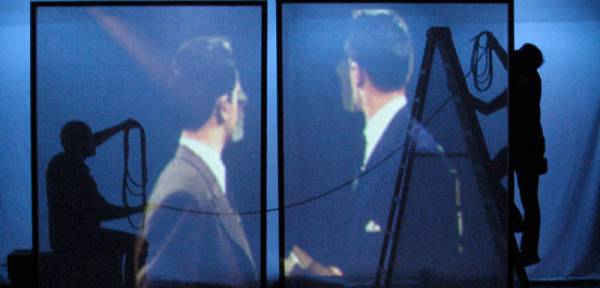
 In 1948, Alfred Hitchcock released his first Technicolor film, a psychological thriller loosely based on the Leopold & Loeb murders, starring Farley Granger and John Dall as a pair of Nietzschean “superior intellects” who throw a dinner party in their New York City apartment immediately after killing a former classmate and stuffing him into a chest they leave in the middle of the living room as guests start arriving. Reid Farrington, who previously reimagined Carl Th. Dreyer’s THE PASSION OF JOAN OF ARC in THE PASSION PROJECT, deconstructs and reconstructs Hitchcock’s film in GIN & “IT,” a multimedia whirlwind in which Farrington digitally removes ROPE’s characters and projects them individually onto screens that four actors move around the set, creating a three-dimensional effect that mixes live theater with film. (“It” was Hitchcock and screenwriter Arthur Laurents’s code word for the underlying homosexuality between Granger and Dall’s characters, which they subtly hid from the censors.)