Apichatpong Weerasethakul’s Palme d’Or winner is a subtly beautiful meditation on death and rebirth, memory and transformation
UNCLE BOONMEE WHO CAN RECALL HIS PAST LIVES (LUNG BOONMEE RALUEK CHAT) (Apichatpong Weerasethakul, 2010)
Alice Tully Hall
1941 Broadway at 65th St.
Saturday, September 25, 3:00
Sunday, September 26, 9:00
212-875-5601
www.filmlinc.com
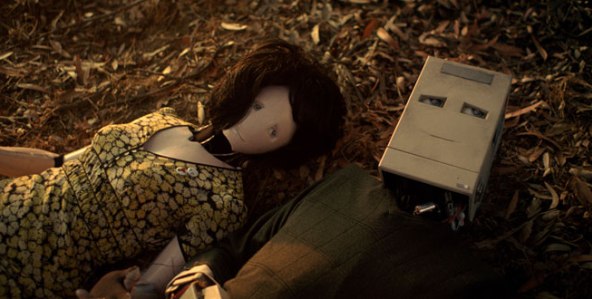
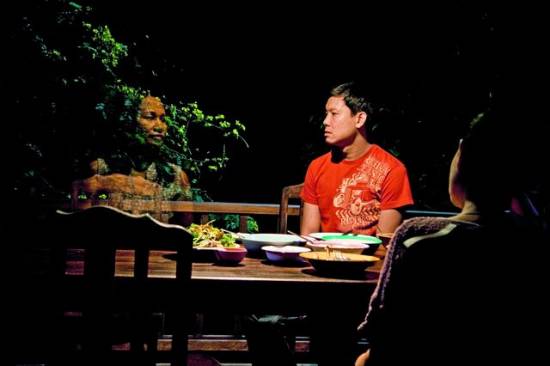
 Winner of this year’s Palme d’Or at Cannes, Thai writer-director Apichatpong Weerasethakul’s UNCLE BOONMEE WHO CAN RECALL HIS PAST LIVES is an elegiac meditation on memory, transformation, death, and rebirth, a fascinating integration of the human, animal, and spirit worlds. Uncle Boonmee (Thanapat Saisaymar) is dying of kidney failure, being tended to by his Laotian helper, Jaai (Samud Kugasang). Boonmee is joined by his dead wife’s sister, Jen (Jenjira Pongpas), in his house in the middle of the jungle. Boonmee and Jen have nearly impossibly slow conversations that seem to go nowhere, just a couple of very simple people not expecting much excitement out of what’s left of their lives. Even when Boonmee’s long-dead wife, Huay (Natthakarn Aphaiwonk), and his long-missing son, Boonsong (Geerasak Kulhong), now a hairy ghost monkey covered in black fur and with two laserlike red eyes, suddenly show up, Boonmee and Jen pretty much just go with the flow. Weerasethakul maintains the beautifully evocative pace whether Jaai is draining Boonmee’s kidney, the characters discuss Communism, Tong (Sakda Kaewbuadee) questions his monkhood, a princess (Wallapa Mongkolprasert) has sex with a catfish, or they all journey to a cave in search of another of Boonmee’s past lives. The film, which was shot in 16mm and was inspired by a 1983 book called A MAN WHO CAN RECALL HIS PAST LIVES, is part of the Primitive Project, Weerasethakul’s multimedia installation that also includes the short films A LETTER TO UNCLE BOONMEE and PHANTOMS OF NABUA. Weerasethakul, who gained a growing international reputation with such previous works as BLISSFULLY YOURS (2002), TROPICAL MALADY (2004), and SYNDROME AND A CENTURY (2006) and has a bachelor’s degree in architecture from Khon Kaen University and an MFA in filmmaking from the Art Institute of Chicago, is a master storyteller who continues to challenge viewers with his unique visual language and subtly effective narrative techniques.

 British filmmaker Patrick Keiller’s follow-up to 1994’s LONDON and 1997’s ROBINSON IN SPACE is another staggering achievement, a gorgeous pairing of word and image resulting in something fresh, challenging, and unlike anything you’ve ever seen before. The conceit behind ROBINSON IN RUINS is that it consists of found footage taken by a man named Robinson, with text from his rather eclectic notebook; in fact, every shot is carefully planned by writer, director, and editor Keiller, with the narrative added later, intoned by Vanessa Redgrave. The camera barely moves throughout the film’s one hundred and one minutes; instead, it remains still as it depicts a construction site, rapeseed fields, nuclear power plants, a mail slot, and a street corner, the only signs of movement the wind blowing through the trees, a passing car, or industrial smoke. People are virtually nonexistent as Redgrave reads Robinson’s complex treatise on agriculture, architecture, the economic crisis, history, politics, and opium, all centered around, as Keiller said at the film’s press preview, “the problem of dwelling.” ROBINSON IN RUINS is like a tour through a thrilling art exhibition, each piece beautifully composed, coupled with fiercely intellectual poetry that is wonderful to listen to, even if much of it is impossible to understand. The New York Film Festival screening on September 26 will be preceded by Alan Berliner’s short film TRANSLATING EDWIN HONIG: A POET’S ALZHEIMER’S (2010).