Hiroshi Teshigahara drama is an existential masterpiece
WOMAN IN THE DUNES (SUNNA NO ONNA) (Hiroshi Teshigahara, 1964)
Rabbitholestudio
33 Washington St., Brooklyn
Wednesday, November 10, free, 8:00
718-852-1500
www.rabbitholestudio.com
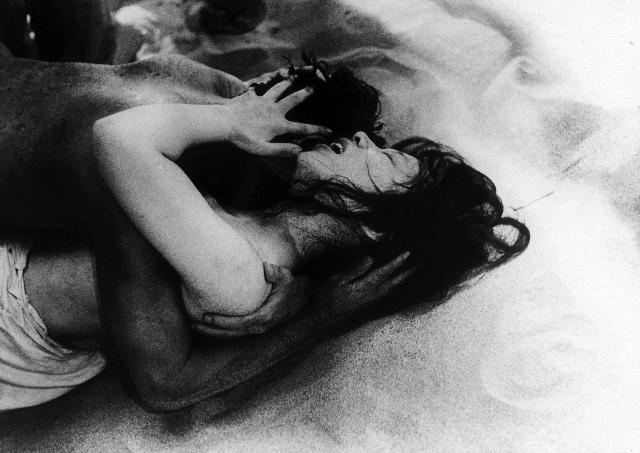
 Hiroshi Teshigahara’s Sisyphean tale, based on Kobo Abe’s marvelous novel, tells the story of an entomologist (Eiji Okada) out in the desert looking for insects when he comes upon a village of people living in the sand dunes — and he is unknowingly sucked into their world. Kyōko Kishida stars as the title character. See the movie — just wait till you get to the psychedelic head trip scene — but be sure to read the book as well; the scenes of the man trying to escape by climbing up the sand will feel oddly familiar to anyone who has ever been trapped in a seemingly inescapable situation. Teshigahara, who died in April 2001, adds surreal visual elements that make the film an unusually compelling though basically simple story. Abe also collaborated with Teshigahara on PITFALL (OTOSHIANA), THE FACE OF ANOTHER (TANIN NO KAO), and THE MAN WITHOUT A MAP (MOETSUKITA CHIZU). WOMAN IN THE DUNES is screening as part of Rabbitholestudio’s weekly Wednesday night film series, which features free admission and is now BYOB.


 Screening as part of Asia Society’s Japanese Cinema 1960s series, THREE OUTLAW SAMURAI stars Testsoro Tamba as Shiba, a wandering samurai who comes upon a town mired in chaos. The peasants have kidnapped the magistrate’s daughter (Miyuki Kuwano) to protest unfair taxation, but the magistrate has little time for them. Shiba is soon joined by Sakura (Isamu Nagato) and Kikyo (Mikihiro Hira) as they fight for what’s right. Director Hideo Gosha’s debut film, a classic Eastern Spaghetti Western, is more cerebral than many of its contemporaries, as it often opts for mental battles rather than swordfighting action. Sakura’s transition from a brash killer to a concerned potential lover is inspiring and heartbreaking, while Kikyo learns there’s more to being a samurai than wine and women. But don’t worry; Gosha makes sure we don’t get too bogged down in life lessons and sentimentalism. Tadashi Tsushima’s jazzy score is awesome. The series continues December 3 with Mikio Naruse’s YEARNING (1964) and December 10 with Kihachi Okamoto’s AGE OF ASSASSINS (1967) and Eiichi Kudo’s THE FORT OF DEATH (1969).