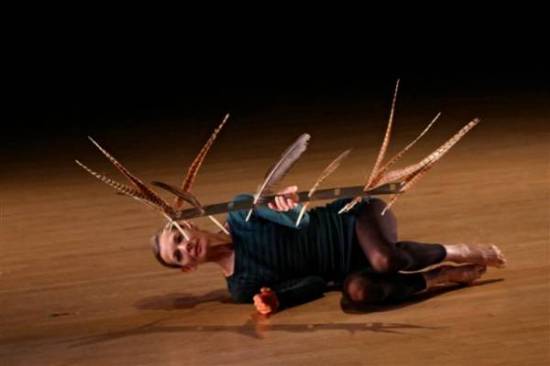
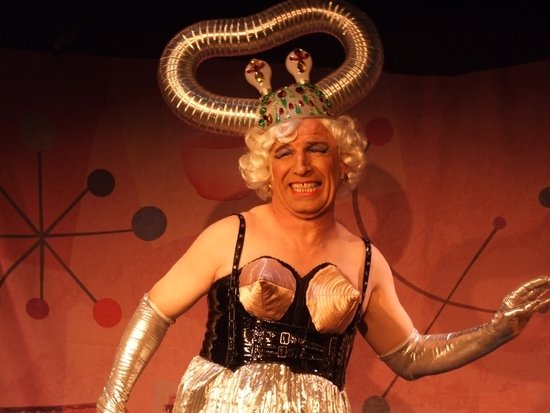
Molissa Fenley turns unusual props into extensions of the human body this week at the Joyce SoHo (photo by Julie Lemberger)
Joyce SoHo
155 Mercer St. between Houston & Prince Sts.
Through November 7, $22
212-242-0800
www.joyce.org
www.molissafenley.com
Molissa Fenley had to know she was asking for trouble when she approached five visual artists and asked each of them to create props for a new performance piece. Presented with some very, um, unusual objects, Fenley and her two collaborators, Katie McGreevy and Cassie Mey, are able to incorporate them into a series of beautiful moves that come together wonderfully in THE PROP DANCES, which runs through November 7 at the Joyce SoHo as part of the American Masterpieces series. The evening gets off to a fascinating start with “Pieces of Land,” in which Jene Highstein supplies white cardboard “gloves” for the dancers—oversized rectangles for Mey, squares for McGreevy, and circles for Fenley—that limit use of their hands; they can’t touch, hold, grab, or lift one another. Wearing black tights and loose-fitting tank tops, the dancers move elegantly to Jason Hoopes’s dissonant percussion-based score, the clunky props seamlessly becoming extensions of their bodies. The evening continues with Merrill Wagner’s “94 Feathers,” in which the dancers trade off flat horizontal metal “planters” pierced with feathers and crouch under a small chicken-wire coop, followed by “Planes in Air,” in which they use Roy Fowler’s cream-colored fans that resemble the large shell in Botticelli’s “Birth of Venus” and evoke erotic fan dances. Fenley performs the solo piece “Mass Balance,” moving with Todd Richmond’s long, narrow wooden pole on a floor lit like a bamboo forest. The finale, “Prop Dance #5,” has the three dancers sharing a pair of ugly plastic tarps and two blocks of white Styrofoam insulation board, supplied by Keith Sonnier and reminiscent of Miranda July’s “Eleven Heavy Things”; the dancers hide under the tarps, place their extremities through the holes, and gracefully slide around the objects. Although it could have been gimmicky, THE PROP DANCES instead feels like an organic work, with Fenley viewing the odd props not as impediments or handicaps but instead as natural parts of her choreography. After a short intermission, the dancers return to revive Fenley’s 1995 piece, REGIONS, a trio of solos that begins with “Chair,” in which the choreographer sits on a somewhat shaky wooden chair, using her arms and legs to shift her body, and continues with “Ocean Walk,” which on opening night featured Mey gliding gorgeously up and down the stage, like a beautiful wave, and “Mesa,” a lovely piece danced by McGreevy on Thursday. (Fenley will perform “Ocean Walk” and “Mesa,” in addition to “Chair,” on November 6.) An After Hours Q&A will take place after the November 5 performance, moderated by choreographer Elizabeth Streb, who recently performed Trisha Brown’s “Man Walking Down the Side of a Building” on the Whitney facade. Fenley will also be choreographing and dancing in Leslie Scalapino’s play FLOW-WINGED CROCODILE on November 16 at Dixon Place.
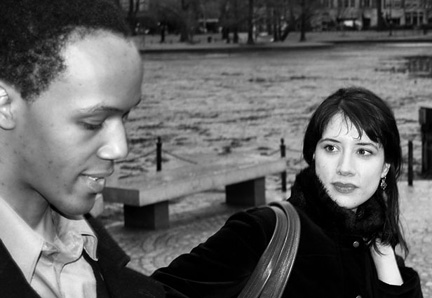
 Twenty-three-year-old writer-director Damien Chazelle expanded his senior thesis at Harvard into an unusual black-and-white musical that mixes John Cassavetes’s SHADOWS and FACES with Jacques Demy’s THE UMBRELLAS OF CHERBOURG (and a little French Nouvelle Vague) as seen through the modern lens of mumblecore. An accomplished jazz drummer, Chazelle (who makes a cameo in the film behind the kits) casts real-life jazz trumpeter and first-time actor Jason Palmer as Guy, a jazz trumpeter in a relationship with Madeline (Desiree Garcia), whom he met on a Boston park bench. But when Guy strays following a chance encounter on a train with a stranger named Elena (Sandha Khin) — an electrifying scene filled with heat and passion — Madeline leaves him, instead dreaming of making a new life for herself in New York. But as the two of them go their separate ways, they still imagine what could have been. The film features such actual musicians and dancers as Andre Hayward of the Jazz at Lincoln Center Orchestra, tap-dancer Kelly Kaleta, and teenage saxophone prodigy Grace Kelly. (Look for Chazelle’s father, Benard, as Paul.) Justin Hurwitz wrote the music for five of the original songs, with Chazelle supplying the lyrics. A slow-paced, heartfelt drama, GUY AND MADELINE ON A PARK BENCH has the improvisational feel of a quiet jazz solo, a soft, tender film about love and loss and how fragile meaningful relationships can be.