Bert Allenberry (Tom Hanks) meets Virginia (Kayli Carter) and Carmen (Kelli O’Hara) at the 1939–40 World’s Fair in This World of Tomorrow (photo by Marc J. Franklin)
THIS WORLD OF TOMORROW
The Shed’s Griffin Theater
545 West 30th St. at Eleventh Ave.
Tuesday – Sunday through December 21, $169-$299 theshed.org
The 1939–40 World’s Fair was an extraordinary moment in New York City history, as people from around the globe descended on Flushing Meadows to see such attractions as the Trylon and Perisphere, Elektro the Moto Man, the Fountains of Light at the Lagoon of Nations, General Motors’ Futurama, the Life Savers Parachute Jump, the Helicline, the Aquacade, and a Rembrandt self-portrait. It’s been memorialized in books, movies, and museum exhibits, and now it’s the setting of a new play cowritten by and starring Tom Hanks, running at the Shed through December 21.
This World of Tomorrow gets off to a rousing start, with jazzy entrance music by Louis Armstrong, the Dorsey Brothers, Lionel Hampton, Benny Goodman — and Nina Simone, who is from the next generation. In the opening scene, two people from the future, Bert Allenberry (Hanks) and Cyndee (Kerry Bishé), have traveled back in time to the World’s Fair, to June 8, 1939; while Bert is fascinated by everything he is experiencing, Cyndee is less enthusiastic. When looking at four sculptures by Leo Friedlander, Bert reverentially reads to Cyndee, “All citizens of the world are entitled to these four Freedoms: Of Religion, Speech, Assembly, and that one there. The Press. . . . Never has the world held a brighter promise of things to come. The Present is but an instant between an Infinite Past and a Hurrying Future.”
They then meet Carmen Perry (Kelli O’Hara) and her teenage niece, Virginia (Kayli Carter), who are playing hooky from work and school, respectively. Bert is instantly smitten with Carmen as much as he is excited by the fair. When he offers them his VIP pass and pin that says, “I have seen the future,” Virginia turns him down, explaining that she is learning to approach life with patience and so will wait in line like most everyone else. “Enjoy the anticipation,” Bert says, surprised.
Bert and Cyndee return to 2089, where they work at SKAEL, the Salina Kansas Alternating Enterprise Lab, which he runs with M-Dash (Ruben Santiago-Hudson). While Bert gleefully talks about hot dogs, cake, and coffee, which apparently aren’t available in 2089, M-Dash wonders why he didn’t kill Adolf Hitler and reminds him about the racism that was prevalent 150 years before, two classic time-traveling genre tropes. (Other tropes, like how Bert has to avoid changing anything that could impact the space-time continuum, are either ignored or given short shrift.) Bert and M-Dash get caught up in a discussion filled with techno-jargon — Finite Atomic Structure, DODEKA, VOX-PAC, Impulse coding, Inner-Structurals — and seek answers from ELMA (Jamie Ann Romero), an External Learning Machine Associate, a sort of AI robot who speaks without emotion.
The narrative shifts back to the morning of June 8, 1939, as Carmen, a divorced bookkeeper, gets ready to take Virginia to the fair. Carmen lives in the Bronx with her brother, Max (Jay O. Sanders), Max’s wife, Sylvia (Romero), and Virginia in a cramped apartment. Max is a tough-talking butcher, and Sylvia is a nurse who works the late shift at Bellevue. Max plays pinochle with his buddies. Carmen has lunch every day at a Greek diner off Sheridan Square owned by an immigrant named Costas (Sanders), a larger-than-life figure who promises his food is “number one the best.”
After several trips to the past, Bert is warned by Honoria (Michelle Wilson) and Dr. Tanner (Paul Murphy) of Chronometric Adventures that his portal-related Trillic Acid numbers are at dangerous levels and that he should not go on another journey, but his fondness for Carmen makes him consider risking it all.
This World of Tomorrow is like an hourlong episode of The New Twilight Zone (without commercials), except it’s two hours and fifteen minutes (with intermission), along with a dash of the 1980 romantasy Somewhere in Time, more than a hint of Back to the Future, and a touch of the 1985 anthology series Amazing Stories thrown in. (In fact, the 1939 New York World’s Fair is a key plot point in the time-traveling TZ episode “The Odyssey of Flight 33.”) There’s a lot of repetition and explication; it could benefit from being trimmed down to a leaner ninety minutes or so.
The Salina Kansas Alternating Enterprise Lab has an important meeting in 2089 (photo by Marc J. Franklin)
The play is based on two short stories from Hanks’s 2017 collection Uncommon Type, “The Past Is Important to Us” and “Go See Costas,” but Tony-winning director Kenny Leon (Topdog/Underdog,Home) can’t quite merge them on Derek McLane’s ever-shifting set, which switches from a Bronx kitchen and a Greek diner to a conference room and the fair and features archival projections on more than two dozen pillars. Dede Ayite’s costumes help differentiate the various time periods, but it still feels like multiple stories unsuccessfully merged into one.
Oscar and Emmy winner and Tony nominee Hanks is most well known as a television and film star, but he cut his teeth with the Riverside Shakespeare Company in New York and the Great Lakes Shakespeare Festival in Cleveland in the late 1970s; he made his Broadway debut in Lucky Guy in 2013, and he played Falstaff in the Shakespeare Center of Los Angeles’ Henry IV in 2018. Clearly comfortable on the stage, he is as appealing as ever as Bert, an eminently likable man who doesn’t have a bad thing to say about anyone. He has instant chemistry with Tony winner and Emmy and Grammy nominee O’Hara (The Light in the Piazza,The King and I), who mostly appears in musicals but is at home here, lending a working-class elegance to Carmen. You desperately want them to fall in love and be together, but not all the obstacles they face make sense.
The rest of the cast is trapped in thankless roles that only get in the way of the central story. And the dialogue is overladen with scientific concepts that weigh down the narrative with confusing verbiage — it lacks the fun charm of, say, Star Trek’s invented technological language — and Hanks and cowriter James Glossman preach too much about peace and love.
“Let’s leave tomorrow to tomorrow,” Carmen suggests. That’s not necessarily a bad idea.
And as Lee (Lee Aaron Rosen), one of Bert’s colleagues at SKAEL, emphasizes, “Learning that ‘The Past Is Important to Us’ don’t come cheap.”
Neither does learning about the future.
[Mark Rifkin is a Brooklyn-born, Manhattan-based writer and editor; you can follow him on Substack here.]
David Henson (Michael Hayden) shares his story — but not his motives — with Emily (Molly Ranson) in The Honey Trap (photo by Carol Rosegg)
THE HONEY TRAP
Irish Repertory Theatre, Francis J. Greenburger Mainstage
132 West Twenty-Second St. between Sixth & Seventh Aves.
Wednesday – Sunday through November 23, $60-$125 irishrep.org
Inspired by Ed Moloney’s Belfast Project at Boston College, in which audio interviews were conducted with approximately fifty former paramilitaries involved in the Troubles in Northern Ireland in the 1970s and ’80s, Leo McGann’s The Honey Trap is a gripping thriller that explores the Troubles in a unique and compelling way.
The play begins in the dark, with snippets of dialogue heard in voiceover from former members of the IRA, the UDR, and a Scottish soldier talking about the thirty-year conflict. “They act holier than thou but they were rotten to the core. They couldn’t kill us themselves so they got their death squads to do it for them,” a Republican woman says. A former Ulster Defence Regiment man states, “I see them rarely enough but I do now and then. The post office. The big supermarket. Petrol station sometimes. I look them straight in the eye. They know what they did.”
As the voiceovers fade out, we see Emily (Molly Ranson), a twentysomething American PhD candidate and researcher, sitting at a table preparing to interview David Henson (Michael Hayden), a former British soldier. He is suspicious of Emily’s possible biases, as the vast majority of her previous subjects were on the side of the IRA, but he sees this as an opportunity to set the record straight. “Okay. I mean, I know you’re more interested in talking to IRA types, but here we are. I’m glad I’m going to get a chance to tell you the truth. Because you won’t get that from them,” he says. She responds, “We’re thrilled that you’re telling your truth.” To which he shoots back, “My truth? No. The truth.”
For the next two hours (with intermission), the play shifts between the present and 1979, when the young Dave (Daniel Marconi) and his friend and fellow soldier, Bobby (Harrison Tipping), had a night out that ended up with Bobby’s murder, a case that was never solved. We gradually disover that Dave is not speaking with Emily merely to share his story but also to find out who killed Bobby — and perhaps exact revenge.
In 1979, Dave and Bobby, who are both married, are at a pub after a tough day working riot control in West Belfast. As part of a game meant to embarrass Bobby, Dave forces his mate to approach two young women, Kirsty (Doireann Mac Mahon) and Lisa (Annabelle Zasowski), despite Bobby’s initial reluctance. Soon the four of them are flirting.
The action occurs in flashback around the table where Emily is interviewing Dave, who carefully watches his memories unfold as Emily continues to probe. Dave insists that he and Bobby were at the bar just to relax and have a few pints. “Did you have any idea anything was amiss?” she asks. He replies, “Not a clue.”
Dave eventually takes off, leaving Bobby with the two women. “And that was it. Last I ever saw of him,” Dave explains. “They took him to some flat just outside Belfast. We don’t know if they interrogated him first or what. Then someone shot him twice in the head. His own mum wouldn’t have recognised him. But they left his army ID in his pocket. So that made it a bit easier. Thoughtful of them, eh?”
In the second act, the modern-day Dave travels to South Belfast to meet Sonia (Samantha Mathis), who he believes knows exactly what happened to Bobby that night.
Leo McGann’s The Honey Trap at Irish Rep travels between the present and 1979 (photo by Carol Rosegg)
Every character gets more than they bargained for in The Honey Trap. McGann (Friends Like These,In the Moment) and director Matt Torney (The White Chip,Stop the Tempo), both of whom grew up in Belfast, maintain a simmering tension all the way to an explosive conclusion, with plenty of shocks and surprises, overcoming a few awkward moments. At the center of it all is the older Dave, who is onstage the entire show, either in the present day meeting with Emily and Sonia or watching his younger self on the night his life changed forever.
Tony and Olivier nominee Hayden (Judgment at Nuremberg,Carousel) is riveting as Dave, a private man on a quest while fighting off his demons; it will make you wonder what you would do if given the opportunity to watch scenes from your past unfurl before your very eyes. The rest of the cast is strong, led by a tender performance by Mathis (33 Variations,Make Believe) as a woman who thought she had escaped her past.
Master set designer Charlie Corcoran expertly integrates the different time periods and locations, from the unionist pub to a coffee shop to a bedroom, enhanced by Sarita Fellows’s casual and military costumes and Michael Gottlieb’s sharp lighting, switching between brightness and dark, shadowy interiors. James Garver’s sound ranges from the voiceovers to a loud pub and a quiet café.
The Honey Trap — which takes its name from the form of covert deception in which an operative uses seduction to lure someone into a manipulative situation — is another winner from the Irish Rep, a complex play that explores issues of guilt, responsibility, trauma, and vengeance that might be about a specific fictional event but feels all too relevant in today’s world.
[Mark Rifkin is a Brooklyn-born, Manhattan-based writer and editor; you can follow him on Substack here.]
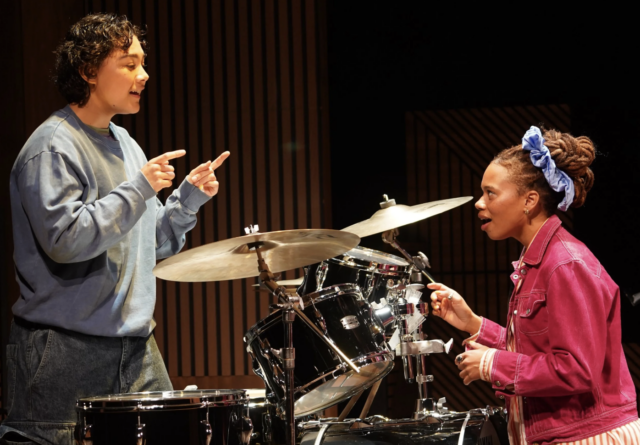
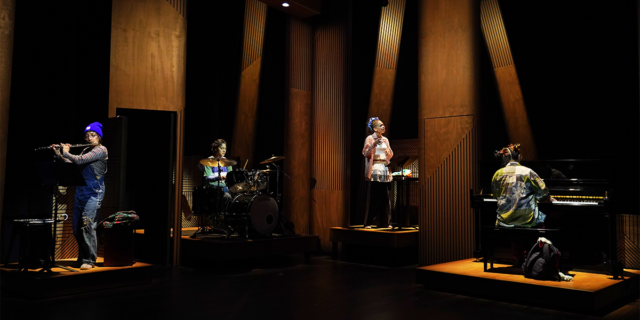
Heather Christian’s Oratorio for Living Things is an exhilarating journey through time, space, and shared human experience (photo by Ben Arons)
HEATHER CHRISTIAN’S ORATORIO FOR LIVING THINGS
The Pershing Square Signature Center
The Romulus Linney Courtyard Theatre
480 West 42nd St. between Tenth & Eleventh Aves.
Through November 23, $181-$197 signaturetheatre.org
Below is my original review of Heather Christian’s Oratorio for Living Things when Ars Nova presented it at Greenwich House in the spring of 2022. The show at the Signature is just as compelling and rewarding; I have made only small adjustments to the review to note just a few changes, including updating the cast. For a more personal take on it, please visit my Substack here.
——————————————-
Heather Christian’s Oratorio for Living Things is a gloriously exhilarating ninety-minute celebration of life, art, and nature, an immersive journey through the complex quantum, human, and cosmic time and space of our daily existence.
Oratorio is Obie winner Christian’s follow-up to Animal Wisdom, a confessional of music and storytelling dealing with the personal and communal aspects of ritual and superstition, grief and loss, ghosts and the fear of death, and I Am Sending You the Sacred Face, a solo virtual musical about Mother Teresa, performed in drag in a closet by Theater in Quarantine’s Joshua William Gelb.
Originally premiered by Ars Nova at Greenwich House, the Signature production takes place in a reconfigured, in-the-round Romulus Linney Courtyard Theatre, where the audience sits in a few steeped rows of rafters, each section separated by a dozen steps; it’s such a small group that you feel specially privileged to be there. Twelve lovely performers (Kirstyn Cae Ballard, Jonathan Christopher, Carla Duren, Ashley Pérez Flanagan, Brian Flores, Jonny-James Kajoba, Barrie Lobo McLain, Ángel Lozada, Divya Maus, Ben Moss, Onyie Nwachukwu, and Dito Van Reigersberg) in casual, carefully considered dress move up and down the stairs and through the tiny center stage area, over which dangles a glowing orb that evokes an unstructured, abstract globe or meteor. At the top of either side is the outstanding band: Fraser A Campbell on woodwinds, Jane Cardona on piano, Jules Biber on cello, Odetta Hartman on violin, John Murchison on upright and electric bass, and Peter Wise on percussion.
Twelve singers and six musicians envelop the audience in Heather Christian’s glorious Oratorio for Living Things (photo by Ben Arons)
Throughout, the singers make warm, intimate direct eye contact with the audience, signaling we are all on this planet together and need to live in unison with one another and nature. Christian’s libretto, which is handed out to each audience member as they’re seated, is in English and Latin; the lights are usually dimmed just enough to still allow you to follow along, but you certainly don’t have to.
As Christian notes in a program letter, “Don’t worry! You do not need a degree in astrophysics, antique languages, or microbiology to ‘get’ this piece. In fact, one would argue that Oratorio for Living Things could function as a Rorschach test. It’s made to engage with you at whatever level you’d like to do so.”
However, it can become a bit distracting when a lot of heads are buried in the white libretto instead of watching the performers, particularly when they’re right in front of them. But this is a judgment-free zone. (The comforting set is by Krit Robinson, with costumes by Márion Talán de la Rosa, lighting by Jeanette Oi-Suk Yew, and sound by Nick Kourtides.)
The score morphs from classical oratorio to jazz, gospel, blues, and a burst of Godspell-like musical theater as Christian guides us through canticles, hymns, choruses, and poems with such titles as “Beginning (Infinite Fractal),” “Alligatum (membranes),” “Dust to Dust (water),” “Hydrogen and Helium: History of Violence,” and “Vesuvius,” which contains the warning: “Now we have arrived at something truly Frightening.”
In “Memory Harvest,” individual singers recall major and minor moments from their past, one example of which is: “I’m five years old and my cousin is seven years old and we jump from one foot to the other standing on the side of the road across from the train tracks. Our excitement builds as the train approaches, our arms flailing, pump up and down, we want the engineer to pull the chain to blow the train whistle. And he does.”
In “Carbon/DNA Iteration 4: Building DNA via Ticker Tape on Time Spent,” the performers use numbers to quantify life, including such observations as “Three and a half hours throwing away unopened mail / Forty minutes putting lids on Tupperware / Eighteen days looking for a bathroom / One year in the ‘Bag Drop’ line / Eleven days trying to remember why you came into the room / Four hours changing pants / Two and a half years being too cold / Four years and eleven days being too hot.” It’s a gorgeous, often very funny look at the little things that add up, equating a wide range of items that we all have in common and which feel particularly meaningful as we emerge from a pandemic lockdown that severely limited our presence in society and has led to so much grief and loss.
Obie-winning director Lee Sunday Evans (Dance Nation,Intractable Woman: A Theatrical Memo on Anna Politkovskaya) has just the right touch to make it all flow seemingly effortlessly, like a babbling brook where you rest and casually reflect on the beauty of everything. Evans also makes sure we don’t feel like we’re trapped in science class amid mentions of entropy, energy, evolution, chloroplasts, mitochondria, diatoms, and covalent bonds. (However, in the hallway leading into the theater are posters detailing the nucleus of a cell, a human heart, the core of the earth, the solar system, and a nebula.)
Inspired by Italian physicist Carlo Rovelli’s The Order of Time, American astronomer Carl Sagan’s Cosmos, and German composer Carl Orff’s cantata “Carmina Burana,” Christian imbues Oratorio with an existential hope that fuels who we are as individuals and as a harmonic unit. In the libretto, she describes “Fields” as “a brief indulgence in an environment (now established). A reminder that because something is devoid of human consciousness or observation does not mean that it is empty.” In “Vesuvius: Dormancy,” we are told, “Do not mistake dying for stopping,” and in “Vesuvius: Eruption” that “we are in the middle / we aren’t at the end / of a loop.” (After the show, in the lobby, attendees can write down a memory on seed paper and pin it to a board, then take someone else’s memory home.)
Do whatever you can to see Oratorio for Living Things, which has been extended through November 23; several of the last performances of this extraordinary shared pilgrimage are sold out, but a few tickets are left. As Christian writes in the libretto, “A very smart person once said that given the choice between living in a universe where only some things are known and knowable and living in a universe where either everything or nothing was known, they’d take the former. Because out of mystery evolves curiosity, and out of confoundment evolves wonder.”
And that is exactly what Oratorio delivers.
[Mark Rifkin is a Brooklyn-born, Manhattan-based writer and editor; you can follow him on Substack here.]

Nelson (John Leguizamo) and Patti Castro (Luna Lauren Velez) go for a spin in em>The Other Americans (photo by Joan Marcus)
THE OTHER AMERICANS
The Anspacher Theater at the Public Theater
425 Lafayette St.
Tuesday – Sunday through November 23, $60-$125 publictheater.org
The Other Americans is John Leguizamo’s first foray into writing a play with an ensemble cast. He is most well known for such solo autobiographical shows as Latin History for Morons and Freak, in which he portrays all the characters, and he stars in this one as well.
The show starts out impressively. As ticket holders take their seats at the Public’s Anspacher Theater, Latin songs such as Héctor Lavoe’s “Rompe Saraguey” and Larry Harlow, Frankie Dante, and Orquesta Flamboyan’s “Atájala: Se acaba la guerra” set the mood, while Arnulfo Maldonado’s stage design, featuring a detailed open house set within a community, the windows and some furniture practically reaching into the audience, invites everyone into what promises to be an intimate family drama.
It’s 1998 in Forest Hills, and Nelson Castro (Leguizamo) is desperately trying to save his laundromat business after having moved from the less-ritzy Jackson Heights — a socioeconomic step up that is proving to be a big strain.
“I stand to lose everything,” he tells someone over the phone. “C’mon, man. I’ma have the payment to ya by the end of the week. On my mother.”
When he greets his wife, Patti (Luna Lauren Velez), he doesn’t admit to the depth of the financial problems he is experiencing but does say to her, “I just can’t understand, I just don’t understand . . . how everybody gets to fail up but us. Cause how does some white guy walk into the same bank but with no business experience, ask for a loan, and he gets it. Over me. Me, who’s got decades of professional expertise and savvy and I end up with nada, culo, dick, cero!”
Patti is busily preparing for the return of their twenty-year-old son, Nick (Trey Santiago-Hudson), who is coming home after a ten-month stint in rehab. They are having a small party for Nick, with Toni (Rebecca Jimenez), his older sister, who is getting married to Eddie (Bradley James Tejeda), who works for Norma (Rosa Evangelina Arredondo), Nelson’s younger half sister, a successful, fashionable businesswoman, and Veronica (Sarah Nina Hayon), Patti’s no-filter, fast-talking best friend who is nine months pregnant.
Soon, as Nelson keeps trying to raise money by legal and perhaps not-so-legal means, he fails to see how his life is falling apart all around him.
A Latino family faces serious challenges in John Leguizamo play (photo by Joan Marcus)
The Other Americans is like a modern Latino update of such classic 1970s social-issue television series as All in the Family,The Jeffersons, and Good Times. Tony- and Obie-winning director Ruben Santiago-Hudson (Jitney,Lackawanna Blues) does a strong job of navigating the cast through the set, and there are several tender moments, like when Nelson and Patti dance a duet, but there are not enough of them, as the balance between comedy and tragedy falters.
The show eventually gets bogged down by genre clichés and clearly targeted plot twists, and it takes 135 minutes (including intermission) instead of a half hour (including commercials). Leguizamo is too one-note as Nelson; while we understand the challenges he is facing, the character’s stubbornness gets to be too much. Velez is wonderful as Patti, who tries to find the positive in everything while not becoming a pollyanna. However, although the climax is obvious, the play ends with a powerful coda that packs a gut punch. If only there were more of that.
[Mark Rifkin is a Brooklyn-born, Manhattan-based writer and editor; you can follow him on Substack here.]
The French village of Concorde rejoices when a new baker comes to town (photo by Matthew Murphy and Evan Zimmerman)
THE BAKER’S WIFE
Classic Stage Company, Lynn F. Angelson Theater
136 East Thirteenth St. between Third & Fourth Aves.
Tuesday – Sunday through December 21, $66-$206 www.classicstage.org
Why did it take nearly half a century for The Baker’s Wife to at last get a major New York City production? That’s a question you’ll likely be asking yourself after seeing this delightful musical at Classic Stage, marveling at what you’ve just experienced.
The show — based on Marcel Pagnol’s 1938 classic film La Femme du Boulanger, which was adapted from Jean Giono’s 1935 semiautobiographical novel Jean le Bleu — was on a pre-Broadway national tour in 1976 when it was abruptly pulled by producer David Merrick. It was reworked for a 2005 run at the Paper Mill Playhouse in New Jersey and was presented by the Gallery Players in Brooklyn for sixteen performances in 2015 and by J2 Spotlight for a ten-day showcase in 2022. Thus, this revival has been a long time coming.
The fun begins as you enter the theater, which has been transformed by Jason Sherwood into the 1935 village of Concorde in Provence, bedecked on all four sides with wandering plants, old-fashioned signage, a bakery (Boulangerie), balconies above the shop and in a far corner, double windows that open up, and small tables that seat characters at a café as well as a handful of audience members. Several men are already onstage, two playing a guitar and an accordion, the others engaged in a game of pétanque. The play proper begins as husband-and-wife café owners Claude (Robert Cuccioli) and Denise (Judy Kuhn) set the tables; Denise then turns to the audience and explains that nothing much ever changes in their town — except that their baker died and they are anxiously awaiting their new pâtissier, as they have been without bread and pastries for seven weeks, which is unconscionable.
“He could have arranged for another baker. He knew he was going to die,” Antoine (Kevin Del Aguila), the local lush, complains about the previous dough expert. The teacher, Martine (Arnie Burton), replies, “How did he know? He was drunk, he fell in a pit, and broke his neck.”
As calm and peaceful as everything appears at first, the rousing song “If It Wasn’t for You” establishes that all is not so well in Concorde, which in French means “harmony.” The priest (Will Roland) is not happy that the mayor, le Marquis (Nathan Lee Graham), is cavorting like a pimp with his “nieces,” the sexy trio of Simone (Savannah Lee Birdsong), Inez (Samantha Gershman), and Nicole (Hailey Thomas). The priest is also at odds with Martine and his recent teaching. Claude bosses around Denise, while Barnaby (Manu Narayan) suppresses his wife, Hortense (Sally Murphy). The hunky Dominique (Kevin William Paul) is not about to tie himself down with one woman, assisted by his friend Philippe (Mason Olshavsky). And the stern spinster Therese (Alma Cuervo) just wants to be left alone. “Ooh, life is hard enough for me / With all my cares and labors / Why must I be burdened with / Such irritating neighbors?!,” they sing.
When the baker, Aimable Castagnet (Scott Bakula), finally arrives, the villagers assume that the stunning young woman with him is his daughter, but it is actually his wife, Geneviève (Ariana DeBose). While the amiable Aimable is excited about this new opportunity, Geneviève seems a bit tentative, as if moving to this far-off location might be a little overwhelming. He asks her if she really likes it, and she says that she does, but it isn’t long before she is considering the attention heaped on her by Dominique, who wants to show her around the area and take her to the waterfall. She reminds him that she is married, and he wonders if Aimable would be jealous. “Jealous? Why should he be jealous?” she says. He answers like a rapscallion, “Because someone like you . . . If you were mine, I wouldn’t leave you alone for a second.”
Geneviève asks Aimable if he ever gets jealous, and he responds, “Jealous? Because other men find you beautiful? Why should I be jealous? I have a diamond and it’s shining in their eyes. Let them be jealous of me. . . . I’m going up to take a little nap.” When he tells her he loves her and she does not say the same in kind, it’s clear he might have something to worry about, but he is too wrapped up in his own world to figure out what is happening. And after something does, it affects his baking skills to the point that the villagers have to take extreme action to get their beloved bread every day.
Geneviève (Ariana DeBose) takes stock of her life in The Baker’s Wife at Classic Stage (photo by Matthew Murphy and Evan Zimmerman)
There’s a central flaw in the casting of the show — even though Geneviève is young and gorgeous and Aimable is a clueless, boring man more than twice her age, one can still imagine why she would be attracted to him because he is played by Bakula, who might be a senior citizen but is a handsome and virile guy in his later years. In the film, the baker, portrayed by Raimu, is a shlubby, silly, clownlike figure, and it’s easy to imagine him being potentially cuckolded. With Bakula in the husband role, Geneviève’s attraction to Dominique seems to happen far too quickly. But the quality of the performances makes that a minor quibble that is skillfully overcome.
Seductively directed by Gordon Greenberg (The Heart of Rock and Roll; Dracula, a Comedy of Terrors), who has been associated with the show since 2002, The Baker’s Wife features lovely music and lyrics by Oscar and Grammy winner and five-time Tony nominee Stephen Schwartz (Pippin,Wicked) and a thoughtful if straightforward book by Tony winner Joseph Stein (Fiddler on the Roof,Zorba). The enchanting music direction by conductor Charlie Alterman and orchestrations by David Cullen range from the villagers’ delicious “Bread,” expressing their glee at Aimable’s first morning as their baker (“What is there like fresh, warm bread?”), and Geneviève’s “Meadowlark,” the show’s breakout hit (“Who does he think he is?” she declares about Dominique), to “Romance,” in which the women surprisingly find themselves not surrounded by men (“How quickly the bloom is off the rose”), and Denise’s exquisite “Chanson,” which opens the first and second acts (“And then one day, suddenly / Something can happen / It might be quite simple / It may be quite small / But all of a sudden / Your world seems different”). The nine-piece band is highlighted by Alterman’s keyboards and Jacob Yates’s accordion, which help maintain the charming French feel, as does Stephanie Klemons’s fun and playful choreography.
DeBose (Pippin,Hamilton) and Bakula (Guys and Dolls,The Connector) — who played Dominique forty years ago — are wonderful together, the former capturing Geneviève’s youthful fascination, the latter embodying Aimable’s inability to see reality. Among the other standouts are Tony nominees Kuhn (Fun Home,Chess) and Cuccioli (Jekyll & Hyde,Les Misérables) as the café owners who eventually reach an important understanding, Murphy (The Minutes,Downstate) as the meek Hortense, and Tony nominee Del Aguila (Some Like It Hot,Frozen) as Antoine, who is in a way the conscience of the community.
The musical is also a celebration of women and the freedom to make their own choices. “Men! Pigs! Thank God I never married,” Therese declares. To which the marquis adds, “You know what’s wrong with the marriage vows? . . . Till death do us part. . . . That’s too long . . . much too long.”
Just as there are many types of bread, bread serves as a metaphor about life’s ups and downs. “Man does not live by bread alone,” it says in the Bible, which also states, “Give us this day our daily bread.” Mother Teresa explained, “There is more hunger for love and appreciation in this world than for bread.” The phrase “breaking bread” means that people have united over food. In most cultures it is the man who is responsible for “putting bread on the table.” And when someone is in prison, it is said that they will have to exist on “bread and water.”
In The Baker’s Wife, bread brings people together, in friendship, in romance, and in community, although it can also tear them apart, as when Barnaby refuses to allow Hortense to have a strawberry tart because he hates them, or when Aimable burns the bread one morning. But as Omar Khayyam once said, “A loaf of bread, a jug of wine, and thou.”
And a delectable musical.
[Mark Rifkin is a Brooklyn-born, Manhattan-based writer and editor; you can follow him on Substack here.]
Rhea (Amy Landecker) is suspicious when Maddie (Chloë Grace Moretz) and Caroline (River Lipe-Smith) show up at her door (photo by Emilio Madrid)
CAROLINE
MCC Theater
Susan & Ronald Frankel Theater
511 West Fifty-Second St. between Tenth & Eleventh Aves.
Through November 16, $137 mcctheater.org
“Hi there, what can I get for you?” a diner waitress asks a mother and daughter at the beginning of Preston Max Allen’s deeply affecting Caroline.
It might seem like a harmless, standard question, but it gets right to the heart of the show, making its world premiere at MCC Theater. The waitress is portrayed by Amy Landecker, who later plays Rhea, mother to Maddie (Chloë Grace Moretz) and grandmother to nine-year-old Caroline (River Lipe-Smith). Maddie and Caroline, who has a broken arm, are on their way from West Virginia to Evanston, Illinois, fleeing Maddie’s abusive boyfriend and seeking help from Maddie’s parents, who have not seen her in a long time and don’t even know she has a daughter.
Maddie, who has been sober for eight years, had a troubled childhood: drinking at fifteen, doing drugs, sleeping around, stealing money from her parents, leaving home at seventeen, and getting pregnant. She hasn’t spoken to her mother and father in eleven years. When she shows up at the house she grew up in, her mother is surprised to see her and is cold and untrusting, especially when Maddie is demanding of what she wants, and doesn’t want, from her.
“Do you think I want to be here?” Maddie says. “If you don’t want us here, we’ll go. But I was hoping that maybe we could be mature about this.” Rhea, trying to suss out the situation, states, “Do you think we wanted this? Do you think we didn’t do every single thing in our power to help you? We fought for years for you. We hemorrhaged our savings trying to give you a recovery you didn’t want to have. . . . You have no idea what we went through. You can’t possibly remember what you went through, so don’t come into this house and try to tell me about my intentions.”
Rhea agrees to let them stay for one night until they agree on an acceptable plan going forward. She uses much of the time to get to know Caroline, who is trans, something that Maddie initially keeps from her mother. The three generations of women try to figure out what comes next as they argue about the past and prepare for a better future.
Caroline (River Lipe-Smith) and Maddie (Chloë Grace Moretz) try to figure out what’s next in potent world premiere at MCC (photo by Emilio Madrid)
Allen (We Are the Tigers,Storytime) writes compelling, honest dialogue that avoids the trappings of Hallmark movie-of-the-week melodrama, while the direction by Tony winner David Cromer (A Case for the Existence of God,Our Town) is swift, always in motion, on Lee Jellinek’s set, which is divided into three changing sections that include a diner table, motel bedroom, living room, and kitchen, expertly lit by Tyler Micoleau.
Landecker (Bug,Transparent) and Moretz (The Library,Kick-Ass) are terrific as Rhea and Maddie, who have work to do if they are going to reestablish their family; it takes a while to adjust to Lipe-Smith’s delivery (A Christmas Carol,Kinky Boots) but it smooths out significantly as the play goes on.
There are no men in the play; Caroline’s father is dead, Maddie’s father is away on business, and her ex-boyfriend is out of the picture. For ninety minutes, three women discuss responsibility, individuality, and what it means to be a mother and a daughter. Allen and Cromer provide no easy answers as the characters face difficult decisions that are not about to result in facile conclusions wrapped up in a neat bow.
[Mark Rifkin is a Brooklyn-born, Manhattan-based writer and editor; you can follow him on Substack here.]

Christopher Nelius’s Whistle is the opening-night selection of the 2025 DOC NYC festival
DOC NYC 2025 IFC Center
323 Sixth Ave. at West Third St. Village East by Angelika
181-189 Second Ave. at 12th St. SVA Theatre
333 West Twenty-Third St. between Eighth & Ninth Aves.
November 12-21, $13-$30 per screening, ten-ticket package $170 www.docnyc.net
The 2025 iteration of the annual DOC NYC festival, ten days of documentary shorts, features, and animated works at IFC Center, the Village East, the SVA Theatre, and online, gets underway November 12 with the opening-night selection, Christopher Nelius’s Whistle, about Carole Anne Kaufman, the Whistling Diva, and other mouth musicians at the Masters of Musical Whistling festival in Hollywood. Kaufman will participate in a postscreening Q&A with fellow whistlers Jay Winston, Lauren Elder, Molly Lewis, Anya Ziordia Botella, and Davitt Felder. There are two centerpiece films: Carl Deal and Tia Lessin’s Steal This Story, Please! follows around activist journalist and Democracy Now! host Amy Goodman, who will appear with the directors at two shows, November 13 and 14, while Celia Aniskovich’s The Merchants of Joy delves into the New York City Christmas tree trade. The closing night film is Ivy Meeropol’s Ask E. Jean, which tells the story of E. Jean Carroll, who successfully sued Donald Trump twice.
The festival is divided into such sections as “Resilience,” “Fight the Power,” “Investigations,” and “Sonic Cinema” in addition to several competitions; among the many highlights are Raoul Peck’s Orwell: 2+2=5, Alan Berliner’s Benita, Ian Bell’s WTO/99, Joe Beshenkovsky and James A. Smith’s Mata Hari, Isa Willinger’s No Mercy, Tyler Measom and Craig A. Williams’s If These Walls Could Rock, and Amy Berg’s It’s Never Over, Jeff Buckley.
Below is a closer look at some of the standouts; keep watching this space for more reviews as DOC NYC continues.
Elizabeth Lo is given remarkable access to a love triangle in award-winning documentary Mistress Dispeller
MISTRESS DISPELLER (Elizabeth Lo, 2024)
Village East
Thursday, November 13, 9:20 www.docnyc.net
In her debut feature-length documentary, 2020’s Stray, Elizabeth Lo tracked a remarkable homeless canine named Keytin as the golden mutt lived a dog’s life on the streets of Istanbul, allowing Lo to capture his every move, telling the dog’s story from his perspective.
Lo has followed that up with Mistress Dispeller, in which the participants in a love triangle allow Lo to capture their every move, telling their story from each of their unique perspectives.
Taking inspiration from Chantal Akerman’s Jeanne Dielman, 23 Quai due Commerce, 1080 Bruxelles and Akira Kurosawa’s Rashomon, Lo’s film explores a relatively new “love industry” in China, mistress dispellers, who, for fees of tens of thousands of dollars and more, are hired by women who believe their husbands are having an affair; over the course of two or three months, the dispeller, using a false identity, ultimately convinces the mistress to end the illicit romance through a structured technique. They do so in a calm, unobtrusive way, treating all three parties with dignity and respect.
It took three years for Lo to find mistress dispeller Wang Zhenxi, then get permission to document one of her cases, in which Mrs. Li wants to end her husband’s affair with the younger Fei Fei. Wang poses as a cousin of Mr. Li’s who is interested in learning the married couple’s favorite pastime, badminton. Wang carefully orchestrates various meetings in which she spends time alone with the mistress, studies her motivations and emotions, and comes up with a plan. Lo’s mounted, still camera is in every room, every car — but not necessarily Lo, who sometimes leaves the camera recording as she exits the space, permitting her subjects to talk more openly without her watching. “I am just a vessel in their lives,” Wang says, and so is Lo. (Lo had previously interviewed Mrs. Li’s younger brother, who was a dispelled male mistress and recommends Wang in the film.)
Although it is made clear from the start that this is not some kind of game, there are winners and losers. “It’s just like a war. You either win or lose everything,” Wang explains. Fei Fei admits, “Winning or losing isn’t the question. Actually, neither is important to me anymore. Because there are many more important things than winning.” But later she states, “I can’t keep losing though, right? Everyone wants to win. Why can’t the winner be me?”
Lo directed, produced, and photographed the film in addition to writing and editing it with Charlotte Munch Bengtsen. She gives equal weight to Mr. Li, Mrs. Li, and Fei Fei while delving into Wang’s methods. Time and money is never discussed; instead, Lo focuses on the care Wang employs in her business, determined to achieve a satisfying result for all involved. The access Lo is supplied is astounding; of course, only Mrs. Li knows what’s happening at first, but soon Mr. Li understands as well, while Fei Fei discovers the deception only at the conclusion.
Lo does not seek to elicit any judgments, but she includes several scenes in which Mrs. Li and Fei Fei carefully tend to their personal style, taking care to dress well and get their hair done, while Mr. Li, the object of each woman’s affection, is not exactly a fashion plate or a great conversationalist. However, the film does not ask us to question the love — and we know from the start that Wang’s goal is to restore the marriage, with the mistress out of the picture.
In a program note, Fei Fei says, “I am willing to participate in filming because, considering the long river of life, this is a small part of it. But it’s also something that’s significant to me right now. I see this as a documentary of my life. It is also a portrait of love. From the beginning of our encounter, to the middle of the relationship, and the end, it’s all part of this process of love. . . . Love doesn’t disappear, it just diverts. It’s just a process of love moving around. It’s quite meaningful to make time to recall and witness the process for yourself — whether the path you take is right or not. . . . When others see this film, they might gain some insights from it.”
Meanwhile, Mrs. Li explains, “Teacher Wang taught me a lot. About love, and other things. She said, ‘Look, you are going through this, this difficulty, and we should film it, so more women, more people, can face their families and learn how to handle a situation like this. . . .’ I want more people to know that love doesn’t come easy, especially for people at our age. Don’t give up so easily.”
The film also touches on aspects of contemporary Chinese dating, from matchmaking seminars and fairs to online channels. Lo occasionally cuts away for drone shots of cities and mountainous landscapes, incorporating all of China into the narrative, merging the inner and outer worlds of the people and the country.
Mistress Dispeller screens November 13 at the Village East, with Lo and producer Emma D. Miller on hand for a Q&A.
Award-winning filmmaker explores the life and career of Benita Raphan in new documentary
BENITA (Alan Berliner, 2025)
IFC Center
Friday, November 14, 7:00
Village East
Sunday, November 16, 11:30 am www.docnyc.net
Shortly after learning of his friend and longtime collaborator Benita Raphan’s suicide on June 10, 2021, documentarian Alan Berliner was asked by her family if he would complete the film she was working on when she died, at the age of fifty-eight. They gave him full access to her extensive archives, comprising notebooks, outtakes, drawings, photographs, and other ephemera. Berliner spent a year doing research and ultimately decided instead to make a film about her, in an attempt to better understand Betina as a person and filmmaker and, perhaps, why she hanged herself.
“Think of this film as an experiment in collaboration,” Berliner says at the start of the aptly titled Benita. “Benita left behind thousands of pieces; my job was to splice them together, to make a mash-up of our different filmmaking styles, to do whatever it takes to bring Benita’s creative spirit to life. But as much as anything, I also just wanted the joy of being able to work with Benita, one final time.”
Berliner conducted new interviews with more than a dozen people from Betina’s private life and professional career, including her mother, Roslyn Raphan; her friends Lucy Eldridge, Shari Spiegel, Miriam Kuznets, and Eric Latzky; her former boyfriend Eric Hoffert of the Speedies; composers Hayes Greenfield and Robert Miller, and SVA chair Richard Wilde. Together they paint a portrait of an eclectic, unusual, and caring avant-garde artist who was able to charm people into participating in the creation of her films — for free. Among the numerous words they use to describe her are “complex,” “serious,” “charismatic,” “a singular soul,” “a nonconformist,” “unpredictable,” “an irregular verb,” “nervous,” “anxious,” “intense,” “incredibly humble,” “fragile,” “vulnerable,” and “a scientist in an artist’s body.”
“I want to work on fun stuff, and her stuff is fun,” sound designer Marshall Grupp says.
“I wanted to help her, I wanted her to succeed,” notes postproduction facilitator Rosemary Quigley.
Producer, director, writer, editor, and narrator Berliner incorporates scenes from about half of Benita’s thirteen short films, focusing on ones that explore creativity, intelligence, and mental illness: 2002’s 2+2 (mathematician John Nash), 2004’s The Critical Path (architect Buckminster Fuller), 2008’s Great Genius and Profound Stupidity (author Helen Keller), and 2018’s Up to Astonishment (poet Emily Dickinson).
“Benita’s films aren’t really meant to be understood,” Berliner (First Cousin Once Removed,Intimate Stranger) explains. “She’s more interested in helping you make connections and stirring up feelings about her subjects using abstraction, layering, and rapid editing, sometimes all at once, to express things that can’t always be put into words, things like dreams, stream of consciousness, or visual metaphors. When Benita takes us inside the complicated minds of her subjects, she’s also trying to show us what it’s like inside her own.”
The film excerpts reminded me of the work of experimentalists Hollis Frampton, Stan Brakhage, and Maya Deren and such surrealists as Luis Buñuel and Salvador Dalí yet wholly original. Clips in which Benita is filming her shadow as she walks down the sidewalk or crunching on ice are poetically beautiful and memorable.
A 2019 Guggenheim fellow, Benita wrote down such thoughts as “Don’t be afraid to have bad ideas,” “Mistakes are an opportunity to start again & do it right,” and “Celebrate the confusion.” However, her more recent words ranged from “afraid” and “lost” to “I’m not myself” and “falling apart.”
She spent more time by herself near the end, dedicating many of her days to her dogs, including one who had severe psychological issues and another she named Rothko, after abstract painter Mark Rothko, who committed suicide in 1970 at the age of sixty-six. “Dogs don’t repeat any of your secrets,” she wrote.
Berliner captures Benita’s inner strength and unique style, but it’s not always possible to figure out why someone chooses death over life; mental illness is too often too difficult to diagnose, especially among friends and relatives.
Benita is making its world premiere at DOC NYC, screening November 14 at IFC Center and November 16 at the Village East, with Berliner, the recipient of last year’s DOC NYC Lifetime Achievement Award, on hand for Q&As following each show.
Documentary explores Seattle protests against the WTO in 1999 (photo by Rustin Thompson)
WTO/99 (Ian Bell, 2025)
Village East
Friday, November 14, 9:00
IFC Center
Monday, November 17, 1:00
Online November 15-30 www.wto99doc.com www.docnyc.net
Young and old march through the streets, forming blockades and human chains. Signs denounce globalization and corporatization. Angry farmers and union workers demand they be heard. Cries of fascism ring out. Local police, state troopers, and the National Guard douse protesters with pepper spray and tear gas, toss flash-bang grenades, and shoot the crowd with rubber bullets. Mysterious agitators in all black smash store windows. Donald Trump and Roger Stone weigh in on free trade and tariffs.
A documentary about government intervention into blue cities in 2025? A “No Kings” rally gone bad? Clips from the Rodney King and George Floyd protests?
No, Ian Bell’s riveting WTO/99 is composed exclusively of archival footage of the Battle of Seattle, when, beginning on November 30, 1999, tens of thousands of local, national, and international men and women took to the streets to protest the WTO Ministerial Conference being held in the largest municipality in the State of Washington. Bell includes no talking heads, no experts, no eyewitnesses, only film and video taken by news organizations and individuals. No one is identified by name, and occasional interstitial text notes the time and day, with just little bits of information.
Two early exchanges set the tone. After buying a gas mask, a pair of twentysomethings are preparing to head into Seattle. “I know we are all hoping this is gonna be peaceful, but do you think that the police will use tear gas?” the man asks. The woman answers, “I’m gonna say that, no, they’re not going to use tear gas.” The man says, “What do you think would make them go to that extreme?” The woman responds, “They would go to those extremes if there was a need for it. That’s the positive attention that I want to set out there for them, that they would do it if there’s a need, and I don’t think that there will be.”
On the TV show Seattle Police: Beyond the Badge, a law enforcement official explains, “We’re not looking to provoke anything; in fact, Seattle has a long and well-deserved history of working well with demonstrators, regardless of their views.”
Both sides might have been hoping for peace, but violence escalates as the WTO has to rearrange its schedule. Mayor Paul Schell proclaims, “The city is safe,” despite evidence to the contrary.
Among the familiar faces getting in sound bites are Bernie Sanders, Bill Clinton, Al Gore, Roger Stone, Michael Moore, Amy Goodman, Tom Hayden, Ralph Nader, Howard Schultz, and Alan Keyes. At a club, a supergroup consisting of Dead Kennedys leader Jello Biafra, Soundgarden guitarist Kim Thayil, Nirvana bassist Krist Novoselic, and Sweet 75 drummer Gina Mainwal rock out for the cause.
In his feature documentary directorial debut, Seattle native Bell and co-editor Alex Megaro weave in events coming from both sides in a fury that matches what is happening on the ground; much of the footage is jerky and low-tech, adding to the chaos. “I think we all need to thank the inventor of video cameras,” one man says.
The film evokes such other poignant works about protests and rallies as Stefano Savona’s Tahrir: Liberation Square, David France’s How to Survive a Plague, and Daniel Lindsay and T. J. Martin’s LA 92, but WTO/99 feels particularly relevant now, given what is happening with ICE and the National Guard in cities all across the country.
“I’ve never seen the United States come to this,” another man says, but now it seems to be happening every week, available for everyone to watch on their smartphones as the discord unfolds in real time.
WTO/99 is screening November 14 at the Village East, followed by a Q&A with Bell, Megaro, producer Laura Tatham, and archival producer Debra McClutchy, and November 17 at IFC Center; it will be available online November 15– 30.
Meredith Monk looks at her past, present, and future in Billy Shebar’s celebratory and deeply affecting documentary
MONK IN PIECES: A CONCEPT ALBUM (Billy Shebar, 2025)
Village East
Wednesday, November 19, 3:45 www.docnyc.net monkinpieces.com
Near the beginning of Billy Shebar’s revelatory documentary, Monk in Pieces, composer Philip Glass explains that Meredith Monk “was a self-contained theater company. She, amongst all of us, I think, was the uniquely gifted one — is the uniquely gifted one.” It’s an important correction because Monk, at eighty-three, is still hard at work, creating live performances and films that defy categorization.
While several of her earliest projects were met with derision in critical circles, today she is revered for her remarkable output, although it is still impossible to put her into any kind of box. At one point in the documentary, a chorus of Monk scholars sings her praises; one says, “She’s achieved so much, has received so many accolades, and yet she’s this unknown,” a second notes, “She kind of falls through the cracks of music history,” and a third admits, “We don’t know how to talk about her.”
Written, directed, and produced by Shebar — whose wife, coproducer Katie Geissinger, has been performing with Monk since 1990 — and David Roberts, Monk in Pieces does a wonderful job of righting those wrongs, celebrating her artistic legacy while she shares private elements of her personal and professional life. Born and raised in Manhattan, Monk details her vision problem, known as strabismus, in which she is unable to see out of both eyes simultaneously in three dimensions, which led her to concentrate on vocals and the movement of her physical self. She studied Dalcroze Eurhythmics: “All musical ideas come from the body; I think that’s where I’m coming from,” she says. All these decades later, her distinctive choreography and wordless tunes are still like nothing anyone else does.
Meredith Monk shares a special moment with her beloved turtle, Neutron
Unfolding at a Monk-like unhurried pace, the ninety-five-minute documentary is divided into thematic chapters based on her songs, including “Dolmen Music,” “Double Fiesta,” “Memory Song,” “Turtle Dreams,” and “Teeth Song,” while exploring such presentations as Juice (1969), the first theatrical event to be held at the Guggenheim; Education of the Girlchild (1973), in which a woman ages in reverse; Quarry (1976), a three-part opera about an American child sick in bed during WWII; Impermanence (2006), inspired by the sudden death of her partner, Mieke von Hook; and her masterwork, Atlas (1991), in which the Houston Grand Opera worries about her numerous requests and production costs, whether the piece will be ready in time, and if it even can be considered opera. There are also clips from Ellis Island,Book of Days,Facing North, and Indra’s Net, her latest show, which was staged at Park Ave. Armory last fall. In addition, Monk reads from her journals in scenes with playful animation by Paul Barritt.
Monk opened up her archives for the filmmakers, so Shebar, Roberts, and editor Sabine Krayenbühl incorporate marvelous photos and video from throughout Monk’s career, along with old and new interviews. “It was her voice that was so extraordinary, not only the different kind of sounds she could make, but the imagination she was using in producing the sound . . . totally individual,” Merce Cunningham says. WNYC New Sounds host John Schaefer gushes, “I don’t know when words like multimedia and interdisciplinary began to become in vogue, but Meredith was all of those things.” Her longtime friend and collaborator Ping Chong offers, “She had to fight to be acknowledged in the performing arts world because critics were saying that what she was doing was nonsensical, was crazy, was not serious; in a way, it’s a fight to survive. Pain is where art comes from. . . . Art has to come out of need. And now she’s an old master.”
And Björk, who recorded Monk’s “Gotham Lullaby,” touts, “Meredith’s melody making is like a timeless door that’s opened, like a gateway to the ancient is found. It definitely affected my DNA. . . . Her loft that she has lived in for half a century is an oasis in a toxic environment.” Among the other collaborators who chime in are longtime company member Lanny Harrison; composer Julia Wolfe; and David Byrne, for whom she created the opening scene of his 1986 film, True Stories, and who says he learned from Monk that “you can do things without words and it still has meaning, it still has an emotional connection.”
Some of the most beautiful moments of the film transpire in Monk’s loft, where she tends to her beloved forty-two-year-old turtle named Neutron, puts stuffed animals on her bed, meditates while staring at windows lined with Tibetan prayer flags, composes a new song, looks into a mirror as she braids her trademark pigtails, and sits at her small kitchen table, eating by herself. Surrounded by plants and personal photographs, she moves about slowly, profoundly alone, comfortable in who she is and what she has accomplished, contemplating what comes next.
“What happens when I’m not here anymore?” Monk, who received the 2014 National Medal of Arts from President Barack Obama, asks while working with director Yuval Sharon, conductor Francisco J. Núñez, and performer Joanna Lynn Jacobs on a remounting of Atlas for the LA Philharmonic in 2019. “It’s very rare that anybody gets it.”
Monk in Pieces goes a long way toward rectifying that, filling in the cracks, helping define her place in music history.
Monk in Pieces screens November 19 at 3:45 at the Village East; followed by a Q&A with Monk, Shebar, Krayenbühl, and producer Susan Margolin.
[Mark Rifkin is a Brooklyn-born, Manhattan-based writer and editor; you can follow him on Substack here.]