twi-ny recommended events

THE CONTENDERS 2010: THE SOCIAL NETWORK

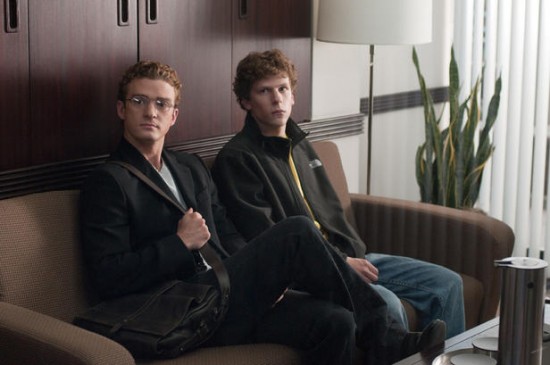
Justin Timberlake and Jesse Eisenberg are a couple of high-profile whiz kids in David Fincher’s THE SOCIAL NETWORK

THE SOCIAL NETWORK (David Fincher, 2010)
MoMA Film
Museum of Modern Art
11 West 53rd St. between Fifth & Sixth Aves.
Tuesday, December 14, 8:30
Series continues through January 22
Tickets: $10, in person only, may be applied to museum admission within thirty days, same-day screenings free with museum admission, available at Film and Media Desk
212-708-9400
www.moma.org
www.thesocialnetwork-movie.com

One of the most widely praised films of 2010, THE SOCIAL NETWORK is being screened at the Museum of Modern Art on Tuesday night as part of the series “The Contenders 2010,” a collection of influential and innovative international movies the institution believes will stand the test of time. MoMA has already shown such works as Luca Guadagnino’s I AM LOVE, Christopher Nolan’s INCEPTION, Roman Polanski’s THE GHOST WRITER, and Mads Brügger’s THE RED CHAPEL, and upcoming films include Yael Hersonski’s A FILM UNFINISHED, Mark Romanek’s NEVER LET ME GO, and Banksy’s EXIT THROUGH THE GIFT SHOP. In THE SOCIAL NETWORK, Jesse Eisenberg stars as computer whiz kid Mark Zuckerberg as he develops what became Facebook while attending Harvard. The film is told primarily in flashback as Zuckerberg is being sued for having allegedly stolen the idea from the Winklevoss twins (both played by Arnie Hammer). Zuckerberg is depicted as a spiteful, mean-spirited, self-indulgent person trying to prove to his ex-girlfriend (Erica Albright) that he will amount to something. Justin Timberlake is outstanding as the fast-moving, smooth-talking Sean Parker, the founder of Napster who loves living the high life. For a young man who created a social media platform where people collect friends, Zuckerberg made a lot of enemies on his way to the top. The film was written by Aaron Sorkin (A FEW GOOD MEN, THE WEST WING), who makes an appearance as an ad executive meeting with Zuckerberg, and directed by David Fincher, who has made such other terrific films as FIGHT CLUB, ZODIAC, and THE CURIOUS CASE OF BENJAMIN BUTTON. Eisenberg (THE SQUID AND THE WHALE, ADVENTURELAND) will participate in a Q&A following the MoMA screening.
MERRY TUBACHRISTMAS 2010

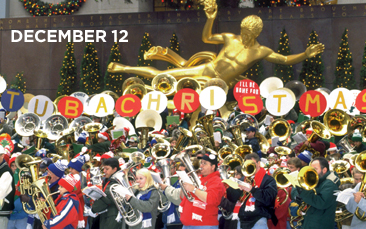
The thirty-seventh annual MERRY TUBACHRISTMAS concert will take place Sunday at Rockefeller Center

Ice Skating Rink at Rockefeller Center
50th St. between Fifth & Sixth Aves.
Sunday, December 12, 11:30 am registration
Admission: free
Participation: $5
www.tubachristmas.com
www.rockefellercenter.com/events

In 1835, the brass instrument known as the tuba was patented by Wilhelm Wieprecht and Johann Gottfried Moritz. Musical prodigy William J. Bell, who was born on Christmas Day, 1902, began playing the tuba when he was ten years old, later joined the Cincinnati Symphony Orchestra and the NBC Symphony Orchestra (under Arturo Toscanini) as principal tuba, and then taught music at Indiana University beginning in 1961, passing away shortly after his retirement in 1971. In 1974, as a tribute to his mentor, former student Harvey G. Phillips established the annual MERRY TUBACHRISTMAS concert, which celebrates Bell and his dedication to the tuba and the euphonium by playing Christmas carols arranged by Alec Wilder, who passed away in 1980 on Christmas Eve. The Harvey Phillips Foundation, a nonprofit group affiliated with Indiana University, now sponsors TUBACHRISTMAS all around the world, “honoring all great artists/teachers whose legacy has given us high performance standards, well structured pedagogy, professional integrity, personal values, and a camaraderie envied by all other instrumentalists.” And you thought it was just a whole bunch of people playing “Jingle Bells” on tubas at the Rockefeller Center ice rink. Well, on Sunday, December 12, a whole bunch of people will play “Jingle Bells” and other Christmas classics on tubas at the Rockefeller Center ice rink at 3:30, conducted by Chris Wilhjelm and hosted by Phillips himself. If you’d like to participate, just show up to register at 11:30 in “warm, bright, festive colors” with your tuba and a music stand or lyre and be ready to rehearse at 12:30.

THE SOUND OF ONE HAND: PAINTINGS AND CALLIGRAPHY BY ZEN MASTER HAKUIN

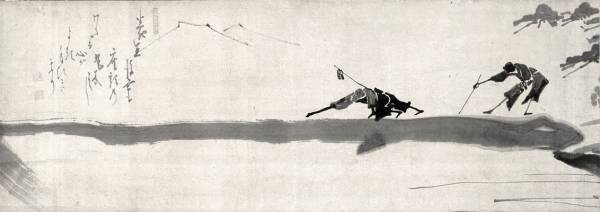
Hakuin Ekaku, “Two Blind Men on a Bridge,” ink on paper (Man’yo-an Collection)

Japan Society Gallery
333 East 47th St. at First Ave.
Through January 9, $10-$12, free Friday from 6:00 to 9:00
212-832-1155
www.japansociety.org

One of the current New York City exhibitions most deserving of applause is also one of the most contemplative ones, sparking a quiet awe and fascinaton from those who experience its subtle wonder. “The Sound of One Hand: Paintings and Calligraphy by Zen Master Hakuin,” at Japan Society thorugh January 9, features sixty-nine scroll paintings by artist and teacher Hakuin Ekaku (1685-1768), made primarily for his students, lay followers, and other monks as teaching tools, never for sale. Able to create marvelous scenes with an intuitive economy of line, Hakuin displays a sly sense of humor and a deep understanding of human behavior in his works. The centerpiece is “Hotei’s Sound of One Hand,” a depiction of Hakuin’s favorite subject, the wandering monk Hotei, sitting in a meditative position, one hand raised, asking what has since become one of the great existential questions, the famous koan, “What is the sound of one hand [clapping]?” Hotei, one of the Seven Gods of Good Fortune, is surrounded by such sayings as “Young shop-clerks, no matter what you say / if you don’t hear the sound of one hand, it’s all rubbish!” Hakuin also shows Hotei playing kickball, juggling while spinning a plate from his chin, watching sumo mice, and transformed into a kite. “Hakuin’s Hotei paintings demonstrate that Zen is not an unfathomable discipline restricted to a few determined monastics, but a lively force available to everyone in every daily activity,” writes cocurator Stephen Addiss in his essay “Hotei as Everyman” in the gorgeous exhibition catalog (Shambhala, $65), which also features such chapters as “Life in Art, Art in Life,” “Buddhist, Shinto, and Folk Deities,” and “Confucian Themes and Painting-Calligraphy Interactions.” Hakuin’s immense skill and humble nature are also evident in such works as “Monkey and Cuckoo,” “Sixth Patriarch’s Rice Mill,” “Ant on a Grindstone,” “Two Blind Men on a Bridge,” and “Daruma’s Shoe,” ink-on-paper scroll paintings imbued with both mystery and meaning but never overladen with heavy messages. As you make your way through “The Sound of One Hand,” you’ll continually want to stop and applaud — and break out into laughter — but instead, slowly breathe in its quiet splendor and unending charm in silence, evoking the sound of one hand. (On December 12 and January 8 at 11:00 am, Roshi Pat Enkyo O’Hara of Village Zendo will lead a discussion about Hakuin, followed by a meditation; tickets are $25 and include admission to the gallery. While at Japan Society, also be sure to go downstairs to see the free exhibition “oxherding,” an extraordinary collaboration between painter Max Gimblett and writer and translator Lewis Hyde.)

SHADOWS OF THE RISING SUN: CINEMA AND EMPIRE

Harrowing war drama kicks off weekend series at Japan Society

FIRES ON THE PLAIN (NOBI) (Kon Ichikawa, 1959)
Japan Society
333 East 47th St. at First Ave.
Friday, December 10, $12, 7:30
Series runs through December 12
212-715-1258
www.japansociety.org

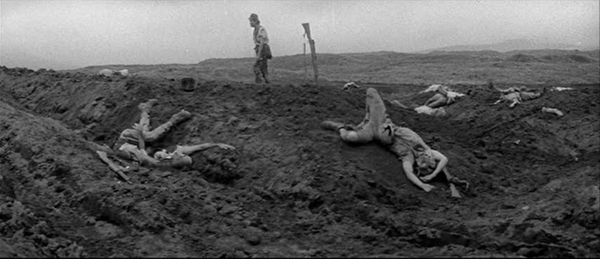
Kon Ichikawa’s FIRES ON THE PLAIN is one of the most searing, devastating war movies ever made. Loosely based on Shohei Ooka’s 1952 novel and adapted by Ichikawa’s wife, screenwriter Natto Wada, the controversial film stars Eiji Funakoshi as the sad sack Tamura, a somewhat pathetic tubercular soldier on the island of Leyte in the Philippines at the tail end of World War II. After being released from a military hospital, he returns to his platoon, only to be ordered to go back to the hospital so as not to infect the other men. He is also given a grenade and ordered to blow himself up if the hospital refuses him, which it does. But instead of killing himself, Tamura wanders the vast, empty spaces and dense forests, becoming involved in a series of vignettes that range from darkly comic to utterly horrifying. He encounters a romantic Filipino couple hiding salt under their floorboards, a quartet of soldiers stuffed with yams trying to make it alive to a supposed evacuation zone, and a strange duo selling tobacco and eating “monkey” meat. As Tamura grows weaker and weaker, he considers surrendering to U.S. troops, but even that is not a guarantee of safety, as the farther he travels, the more dead bodies he sees. FIRES ON THE PLAIN is a blistering attack on the nature of war and what it does to men, but amid all the bleakness and violence, tiny bits of humanity try desperately to seep through against all the odds. And the odds are not very good.
FIRES ON THE PLAIN begins Japan Society’s weekend-long Shadows of the Rising Sun: Cinema and Empire series, comprising a quartet of Chinese and Japanese films that examine Japan’s futile attempts at creating an empire through war. The impressive lineup includes the New York premiere of Koji Wakamatsu’s CATERPILLAR, being screened on Saturday night at 7:00; Jiang Wen’s 2000 Cannes Grand Prize winner, DEVILS ON THE DOORSTEP, scheduled for Sunday at 4:00; and Nagisa Oshima’s 1983 WWII drama MERRY CHRISTMAS, MR. LAWRENCE, starring David Bowie, Ryuichi Sakamoto, Tom Conti, and Takeshi Kitano, on Sunday at 7:00. FIRES ON THE PLAIN is also part of Japan Society’s Zen & Its Opposite: Essential (& Turbulent) Japanese Art House festival of monthly classics, which continues January 11 with Nobuo Nakagawa’s HELL and February 18 with Kihachi Okamoto’s SWORD OF DOOM.

WHAT IS THIS THING CALLED LOVE? A NIGHT WITH GENE WILDER

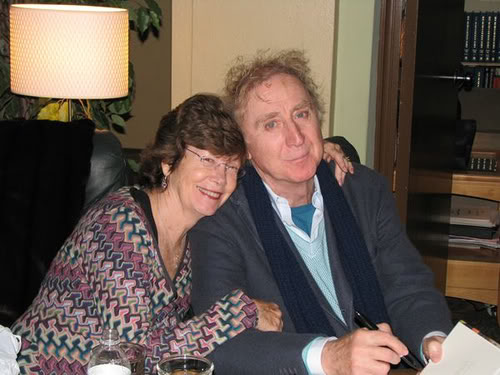
Gene Wilder will be interviewed by his wife, Karen, at special evening at the JCC

JCC in Manhattan
334 Amsterdam Ave. at 76th St.
Wednesday, December 15, $15, 8:00
646-505-4444
www.jccmanhattan.org

Comic actor Gene Wilder, who made his film debut in BONNIE AND CLYDE and went on to star in such hits as THE PRODUCERS, BLAZING SADDLES, and WILLY WONKA AND THE CHOCOLATE FACTORY, is also the author of such books as KISS ME LIKE A STRANGER: MY SEARCH FOR LOVE AND ART, THE WOMAN WHO WOULDN’T, and MY FRENCH WHORE. His latest, WHAT IS THIS THING CALLED LOVE? (St. Martin’s, March 2010, $19.99), features a dozen stories about love and romance, including “The Lady with the Red Hat,” “The Flirt,” and “My Old Flame.” In the prelude, Wilder admits, “Apart from the 1929 Cole Porter song, this is a ridiculous title and I know it; sounds a little like some egotistical guru telling the rest of the world about love and lovemaking and broken hearts.” Wilder’s goal, instead, is to give readers “a little pleasure and a laugh.” He’ll be looking to do all that and more on December 15 at the JCC in Manhattan, when he’ll be interviewed by his wife, Karen, about love and other topics in a special event held in conjunction with the Center for Hearing and Communication.

JACK FERVER: RUMBLE GHOST

Jack Ferver’s RUMBLE GHOST searches for the inner child within us all (photo by Liz Ligouri)

Performance Space 122
150 First Ave. at Ninth St.
Through December 12, $20
www.ps122.org

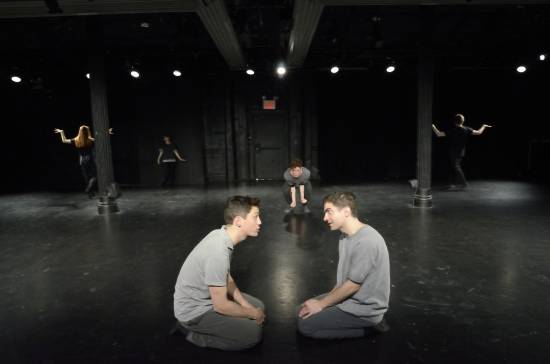
The 1982 frightfest POLTERGEIST has become part of the American zeitgeist, representing the death-in-life horror of suburban living, complete with child abduction by an evil creature from another dimension. That’s where writer-choreographer Jack Ferver, who has made critics and audiences uncomfortable in such works as DEATH IS CERTAIN, MEAT, and WHEN WE WERE YOUNG AND FILLED WITH FEAR, found his inspiration for the hour-long RUMBLE GHOST, as he once again makes viewers squirm for a whole range of reasons. Fortunately, he also leaves them vastly entertained. As the audience filters into P.S. 122’s second-floor theater, Ferver and Christian Coulson are conducting a barely audible conversation, walking around and around the dark stage, populated by five unmoving figures. As the two men keep repeating the scene, their voices rise, and their journey continually shrinks; it is soon apparent that they are acting out the scene from POLTERGEIST in which Steve (Coulson) shows off their new house to his wife, Diane (Ferver). After each repetition, Ferver approaches the audience and pauses, as if to say, yes, get ready, because we’re going to do it again, and the audience, shifting in their seats, can’t help but think that they might be in for a whole lot more of this. After eight or nine trips, each more spatially confined than the previous (a clever way to evoke people’s familiarity with a movie they may have watched over and over and over again), the piece moves on, as the dancers — Benjamin Asriel, Reid Bartelme, Carlye Eckert, Michelle Mola, and Breanna O’Mara in addition to Coulson and Ferver — break off into experimental solos and duets as Carol Anne is sucked into a television set and a psychic (Eckert) is called in to try to find her. Save for two mirrors and two fluorescent lights, there are no other props or special effects, but Ferver is able to create tense — and funny — action playing off the audience’s memory of the film. If you’ve seen POLTERGEIST, you’ll be visualizing what is only being referred to onstage.

Just as Steve and Diane are about to go in after Carol Anne, the production shifts abruptly, as the seven players bring out chairs and sit in a circle for an Inner Child Work therapy session in which they all use their real names, ostensibly no longer in character. Ferver has brilliantly turned the movie family’s search for their child into the dancers’ search for their own inner child (while also equating a house with the psyche). By allowing the audience to watch this psychodrama, which is based on his personal experiences, Ferver once again evokes strong emotions ranging from the uncomfortable to the exhilarating, regardless of how “true” any of it might be. We are used to seeing performers perform onstage; we are not, however, used to seeing how they interact with one another offstage, and Ferver has playfully let us inside a rarely seen part of the creative process. Throughout RUMBLE GHOST, he continually surprises with his ability to challenge us by defying expectations, getting both into our faces and into our heads.

AS THE EYES OF THE SEAHORSE

Live music and dance collide and intersect at HERE Arts Center

HERE Arts Center
145 Sixth Ave. at Dominick St.
December 9-11, $15-$20
212-352-3101
www.here.org

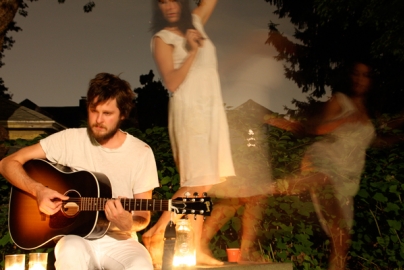
Two Philadelphia groups will create a unique performance piece in the round December 9-11 at HERE Arts Center, combining indie folk rock with experimental dance in AS THE EYES OF THE SEAHORSE. Music group the Mural and the Mint, consisting of Corey Duncan, Eliza Jones, Michael Kiley, Jebney Lewis, and Joshua Ramey, and the Nichole Canuso Dance Company, featuring Nichole Canuso, Niki Cousineau, Meg Foley, John Luna, Shannon Murphy, and Christina Zani, will collaborate on a stage surrounded by candlelit Mason jars and various odds and ends. The Mural and the Mint released their debut album, PRIVATE POCKETS, in 2008, and have just made the first single from their upcoming disc (also called AS THE EYES OF THE SEAHORSE), a light-hearted song called “Ripe,” available for free online. Canuso’s previous productions include TAKES, WANDERING ALICE, and THE ROYAL WE. The collaboration is part of HERE’s hemispHEREs initiative, which brings together visiting artists and the institution’s resident artists in a series of workshops, open rehearsals, discussions, and performances.