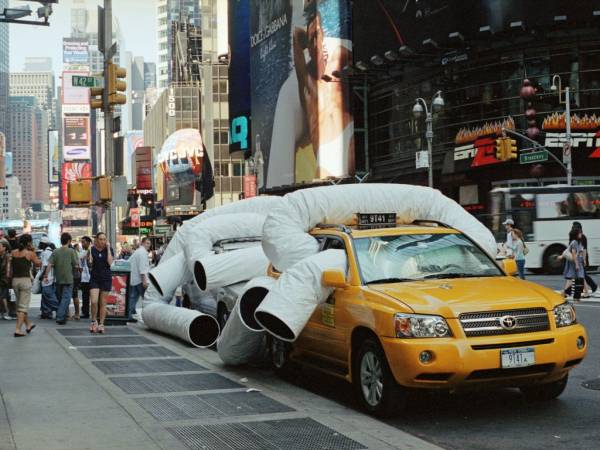
Flux Factory auction, which takes place online and at December 15 gala, includes Kathryne Hall’s digital C-print “Tubisms: Cars: Times Square” (© 2007 by Kathryne Hall)
Center 548
548 West 22nd St. between Tenth & Eleventh Aves.
Wednesday, December 15, $15-$1,000, 7:00
718-707-3362
www.fluxfactory.org
Long Island City’s Flux Factory, “a not for profit arts organization supporting innovation in things,” will be holding its annual auction Wednesday night in Chelsea, with live performances, light food and drink, and an impressive list of artists selling works to benefit the art collective. Among the participating artists are Andrea Dezsö, Dan Colen, Kathryne Hall, Marie Losier, Molly Surno, Peter Doig, Ryan McNamara, Stefany Anne Golberg, Swoon, and Ward Shelley, with Angela Washko, Daupo, Douglas Paulson, Elizabeth Larison, Gabriela Vainsencher, Sarah Glidden, and Will Harris serving as “knock-off” live artists, creating customized copies on demand. Guests of honor Elizabeth Dee and city councilmember Jimmy Van Bramer will also be feted by a performance by Alison Ward, video art by Jaime Iglehart, Matthew-Robin Nye’s creative seating, silkscreening by Bread and Butter Collective, and DJ Sondies leading a dance party. You don’t have to attend the festivities in order to bid on the works, which are all detailed online.


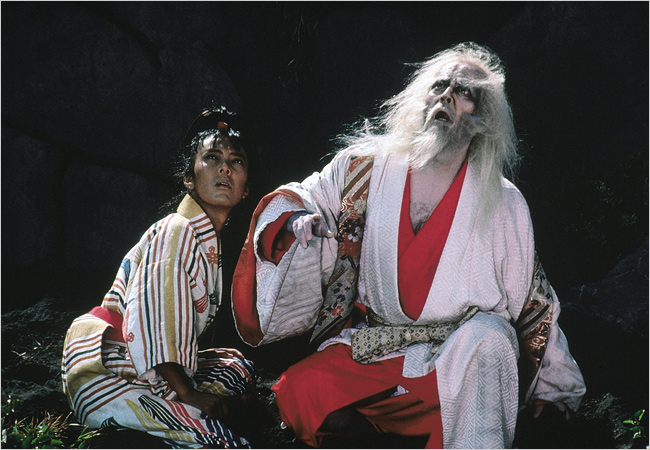
 Inspired by the story of feudal lord Mori Motonari and Shakespeare’s KING LEAR, Akira Kurosawa’s RAN is an epic masterpiece about the decline and fall of the Ichimonji clan. Aging Lord Hidetora (Tatsuya Nakadai) is ready to hand over his land and leadership to his three sons, Taro (Akira Terao), Jiro (Jinpachi Nezu), and Saburo (Daisuke Ryû). But jealousy, misunderstandings, and outright deceit and treachery result in Saburo’s banishment and a violent power struggle between the weak eldest, Taro, and the warrior Jiro. Hidetaro soon finds himself rejected by his children and wandering the vast, empty landscape with his wise, sarcastic fool, Kyoami (Peter), as the once-proud king descends into madness. Dressed in white robes and with wild white hair, Nakadai (THE HUMAN CONDITION), in his early fifties at the time, portrays Hidetaro, one of the great characters of cinema history, with an unforgettable, Noh-like precision. Kurosawa, cinematographers Asakazu Nakai, Takao Saitô, and Masaharu Ueda, and Oscar-winning costume designer Emi Wada bathe the film in lush greens, brash blues, and bold reds and yellows that marvelously offset the white Hidetaro. Kurosawa shoots the first dazzling battle scene in an elongated period of near silence, with only Tôru Takemitsu’s classically based score playing on the soundtrack, turning the film into a thrilling, blood-drenched opera. RAN is a spectacular achievement, the last great major work by one of the twentieth century’s most important and influential filmmakers. Film Forum is screening RAN as part of its two-week tribute to Takemitsu, which concludes this week with DODES’KA-DEN (Akira Kurosawa, 1970), EMPIRE OF PASSION (Nagisa Oshima, 1978), BALLAD OF ORIN (MELODY IN GREY) (Masahiro Shinoda, 1977), BAD BOYS (Susumu Hani, 1961), and SHE AND HE (Susumu Hani, 1963).