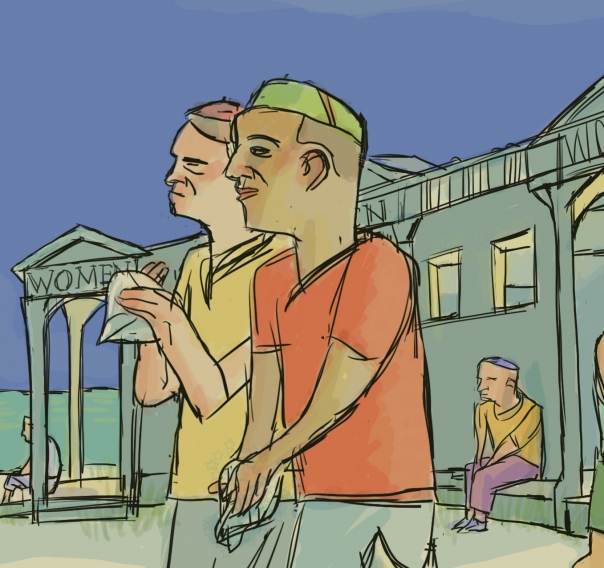
Ben Katchor, whose CARDBOARD VALISE will be released on March 15, is one of seven English-language authors taking part in French festival at NYU (artwork © 2011 by Ben Katchor)
NYU Hemmerdinger Hall, ground floor
Silver Center, 100 Washington Square East on Waverly Pl.
February 24-26, free
www.frenchwritingfestival.com
Earlier this month, Austrian, German, and Swiss authors came to town for Festival Neue Literatur; now it’s France’s turn to bring over some of its best young writers. The second annual Festival of French Writing, sponsored by the Center for French Civilization and Culture at NYU, the Cultural Services of the French Embassy, and Institut Français, will pair seven French-language authors with seven English-language authors in conversations about literature, each one moderated by a different cultural critic. Curated by Un livre un jour host Olivier Barrot and NYU professor Tom Bishop and held at NYU’s Hemmerdinger Hall, the free discussions begin on tonight at 7:15 with Geneviève Brisac (Une année avec mon père) and Rick Moody (The Four Fingers of Death), moderated by Open Letter Books director Chad W. Post, and will be followed at 8:30 by novelist Stéphane Audeguy (The Theory of Clouds) and New Yorker European correspondent Jane Kramer (The Politics of Memory: Looking for Germany in the New Germany). Friday kicks off at 2:30 with philosopher Pascal Bruckner (The Tyranny of Guilt) and essayist and humanities professor Mark Lilla (The Stillborn God: Religion, Politics, and the Modern West), moderated by Adam Gopnik; graphic novelists David B. (Nocturnal Conspiracies: Nineteen Dreams) and Ben Katchor (Julius Knipl, Real Estate Photographer) will get together at 4:00, moderated by New Yorker art director and RAW cofounder Françoise Mouly; and at 7:30, French-Afghan writer and filmmaker Atiq Rahimi (The Patience Stone) will team up with Russell Banks (The Sweet Hereafter), moderated by Le Monde journalist Lila Azam Zanganeh. Saturday’s duos start at 2:30 with Laurence Cossé (A Novel Bookstore) and Arthur Phillips (The Song Is You), moderated by NYU French professor Judith G. Miller, followed at 4:30 by writer-director Philipe Claudel (I’ve Loved You So Long) and A. M. Homes (This Book Will Save Your Life), moderated by Harper’s publisher John R. (Rick) MacArthur. It should all make for some interesting and enlightening examinations of form and style, method and methodology, and cross-cultural connectivity.
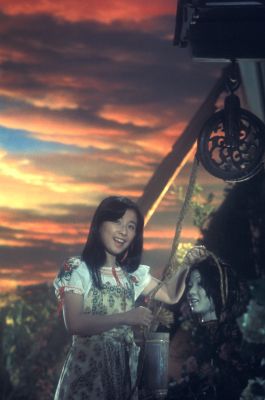
 One of the craziest movies ever made, Nobuhiko Obayashi’s 1977 cult classic, HOUSE (HAUSU), is finally getting its first-ever U.S. theatrical release, in a new 35mm print at the IFC Center. Truly one of those things that has to be seen to be believed, HOUSE is a psychedelic black horror comedy musical about Gorgeous (Kimiko Ikegami) and six of her high school friends who choose to spend part of their summer vacation at Gorgeous’s aunt’s (Yoko Minamida) very strange house. Gorgeous, whose mother died when she was little and whose father (Saho Sasazawa) is about to get married to Ryoko (Haruko Wanibuchi), brings along her playful friends Melody (Eriko Ikegami), Fantasy (Kumiko Oba), Prof (Ai Matsubara), Sweet (Masayo Miyako), Kung Fu (Miki Jinbo), and Mac (Mieko Sato), who quickly start disappearing like ten little Indians. HOUSE is a ceaselessly entertaining head trip of a movie, a tongue-in-chic celebration of genre with spectacular set designs by Kazuo Satsuya, beautiful cinematography by Yoshitaka Sakamoto, and a fab score by Asei Kobayashi and Mickie Yoshino. The original story actually came from the mind of Obayashi’s eleven-year-old daughter, Chigumi, who clearly has one heck of an imagination. Oh, and we can’t forget about the evil cat, a demonic feline to end all demonic felines. The film was released last year prior to its appearance on DVD from Janus, the same company that puts out such classic fare as Federico Fellini’s AMARCORD, Akira Kurosawa’s RASHOMON, Jacques Tati’s M. HULOT’S HOLIDAY, François Truffaut’s SHOOT THE PIANO PLAYER, Jean Renoir’s THE RULES OF THE GAME, and Jean-Luc Godard’s VIVRE SA VIE, so HOUSE has joined some very prestigious company. And who are we to say it doesn’t deserve it?

 Throughout his professional career, which began with the 1997 underground hit Pickpocket, Sixth Generation Chinese writer-director Jia Zhang-ke has shuttled easily between documentaries (Useless, 24 City) and narrative features (The World, Still Life) — and it’s not always obvious which is which, as his steady, poetic style is built on subtlety, slow rhythms, and an innate sense of realism (and he freely mixes fantasy and reality as well). His latest documentary, the Cannes Film Festival Un Certain Regard selection I Wish I Knew, adds elements of fiction to its compelling examination of the intimately personal side effects that resulted from the Chinese civil war and Cultural Revolution, as many people left Shanghai for Taipei and Hong Kong. Jia and interviewer Lin Xudong meet with elderly men and women who tell tragic stories of family and friends being murdered and executed by the government; an especially poignant scene is set at a community gathering where senior citizens dance to Dick Haymes’s version of the old standard “I Wish I Knew”; one of the interviewees sings into the camera, “I wish I knew someone like you could love me / I wish I knew you place no one above me / Did I mistake this for a real romance? / I wish I knew, but only you can answer,” which could be as much about a personal relationship as the revolution itself. Jia also talks with several filmmakers and actresses, from Hou Hsiao-hsien and Wang Toon to Huang Baomei, Rebecca Pan, and Wei Wei, illustrating how Shanghai has been depicted on film with clips from such movies as Hou’s Flowers of Shanghai, Xie Jin’s Huang Baomie, Wang’s Red Persimmon, Lou Ye’s Suzhou River, Wang Bing’s To Liberate Shanghai, Wong Kar-wai’s Days of Being Wild, and Michelangelo Antonioni’s Cina. As the nearly two-hour documentary reaches its conclusion, they interview younger people, including bestselling writer, blogger, and race-car champion Han Han, who don’t share the same conflicted memories of communism and the Cultural Revolution, instead praising an evolving modern-day capitalistic Shanghai that has brought them vast wealth, with no interest in the past of Deng Xiaoping, Mao Zedong, and Chiang Kai-shek. Throughout the film, Jia’s onscreen muse, Zhao Tao, who has appeared in six of his previous works, walks through contemporary Shanghai, pausing as she languidly looks out over the ever-changing city, where intensely poor neighborhoods are being torn down right around the corner from massive construction projects. Commissioned for the 2010 World Expo held in Shanghai, I Wish I Knew might not have been quite what the expo folk expected, but then again, they did give carte blanche to Jia, who never takes the easy way out, creating yet another complex, confusing, and controversial cinematic experience. I Wish I Knew, which is scheduled to open in New York on April 29, is screening as part of MoMA’s “Documentary Fortnight” series, which continues through February 28 with such international nonfiction films as Rick Goldsmith and Judith Ehrlich’s The Most Dangerous Man in America: Daniel Ellsberg and the Pentagon Papers, Linda Hoaglund’s ANPO: Art X War, Helena Trestíková’s Katka, Marcus Lindeen’s Regretters, and Clio Barnard’s The Arbor.