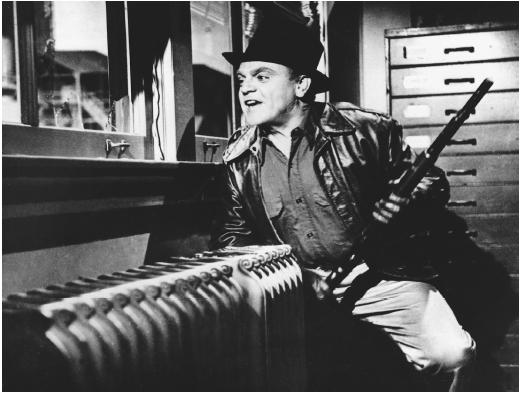
James Cagney isn’t about to let anything stop him from reaching the top of the world in film noir classic
WHITE HEAT (Raoul Walsh, 1949)
Academy Theater at Lighthouse
111 East 59th St.
Monday, March 7, $5, 7:00
www.oscars.org
 Raoul Walsh’s film noir classic White Heat might have been nominated for a mere single Oscar, losing for Best Motion Picture Story (losing to The Stratton Story), but it quickly came to be considered one of the greatest gangster pictures ever made. The 1949 film stars James Cagney as Cody Jarrett, a devout criminal married to the beautiful moll Verna (Viriginia Mayo) but still deeply (and unhealthily) attached to his mother (Margaret Wycherly). While doing time for a train robbery gone wrong, Jarrett finds out that his gang has been taken over by his former flunkie Big Ed Somers (Steve Cochran), who also seems to have taken over Verna as well. Jarrett decides he must break out of jail, setting the stage for an unforgettable climax. Walsh (High Sierra, They Died with Their Boots On) doesn’t concentrate just on the action, of which there is plenty, instead focusing on Jarrett’s troubled psyche as he blindly seeks revenge. White Heat will be showing March 7 as part of the Academy’s monthly Mondays with Oscar series, even though Oscar was not very kind to it; the nominees for Best Picture that year were All the King’s Men, Battleground, The Heiress, A Letter to Three Wives, and Twelve O’Clock High, while the Best Actor nominees were winner Broderick Crawford (All the King’s Men), Kirk Douglas (Champion), Gregory Peck (Twelve O’Clock High), Richard Todd (The Hasty Heart), and John Wayne (Sands of Iwo Jima). The screening will be introduced by screenwriter Richard LaGravenese (The Fisher King, The Horse Whisperer).
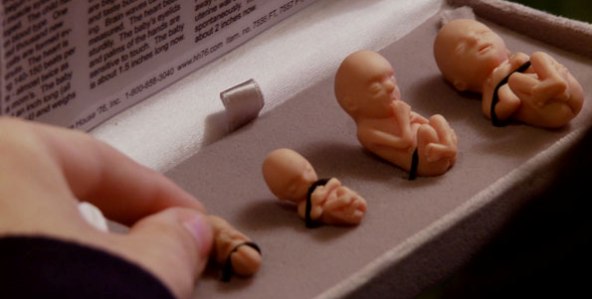
 Heidi Ewing and Rachel Grady, who have teamed up for such documentaries as The Boys of Baraka (2005), the Oscar-nominated Jesus Camp (2006), and one segment of Freakonomics (2010), spent a year on the rather indistinct corner of 12th St. & Delaware Ave. in the small community of Fort Pierce, Florida, where an intense battle is waging. On one side of the street sits an abortion clinic, while on the other side is the prolife Pregnancy Care Center. Ewing and Grady are able to get the primarily young, poor pregnant women considering abortion to open up and share their stories as they face one of the most difficult decisions anybody will ever have to make. The women are met by a constant handful of protesters outside the abortion clinic, who try to get them to change their mind and go across the street. Several of the women go to the Pregnancy Care Center by accident, believing it to be the abortion clinic — which is precisely why the center set up shop there — where they are not told of their mistake and are offered money and clothing to not go through with the termination of their pregnancies. They become pawns in a religious and moral battle that Ewing and Grady show can be as infuriating as it is heartbreaking, although the filmmakers do an excellent job of remaining neutral, not casting judgment. Interestingly, while the workers at the prolife center have a lot to say on the issue, the people at the abortion clinic are far more cautious and reserved, with the owner-doctor never being seen on camera but only pulling up in his car (perhaps at least partly for safety reasons, as Kansas abortion doctor George Tiller was murdered during the time the film was being made). This special screening of 12th & Delaware, which will be followed by a Q&A with one of the filmmakers, is part of the Maysles Institute’s monthly Doc Watchers Presents series, curated by Hellura Lyle.