Guy Maddin’s HAUNTINGS will be shown as part of the New School’s noir festival
Theresa Lang Student and Community Center (and other venues)
Arnhold Hall, 55 West 13th St.
Admission: free
www.newschool.edu/artsfestival/noir
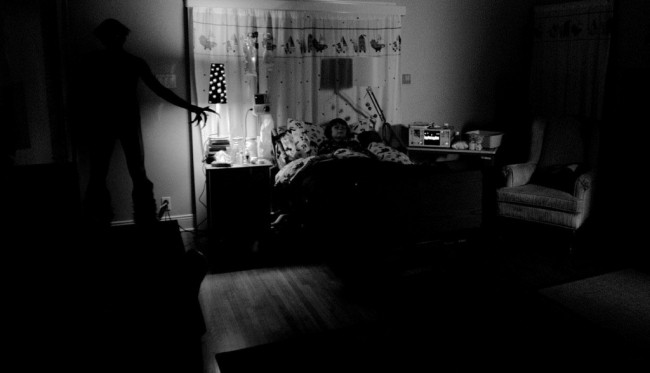
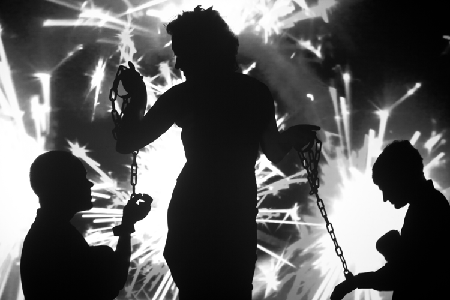
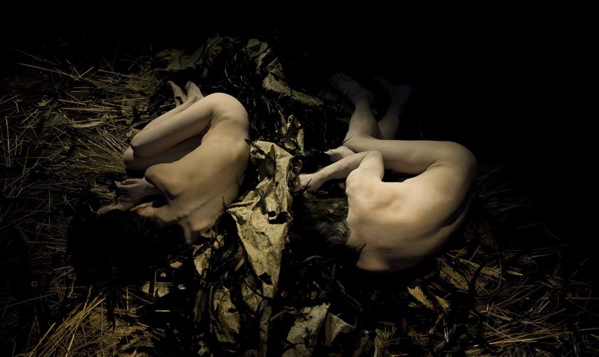
Dark, shadowy tales filled with double crosses, murder, heated sexuality, creepy corners and alleyways, mysterious characters, flippant dialogue, shootouts, and dangerous women — there’s nothing like a good noir story. The inaugural New School Arts Festival continues this week, using the institution’s resources for a thorough cultural examination of the theme of the noir genre in film, theater, literature, music, and art. All events are free but require advance reservations via the above website. Today at 6:00, author and professor James Naremore will deliver the keynote address, followed by a screening of the Coen brothers’ 1984 neonoir classic, Blood Simple, introduced by cultural writer Kim Morgan and Hirshon Festival Director-in-Residence Guy Maddin. Blood Simple star Frances McDormand will participate in a special conversation with Cecilia Rubino following a screening of the Coens’ Fargo on Friday at 2:00, with the reservation line opening today at noon. On Tuesday at 4:00, the 1913-14 silent crime serial Fantômas will be shown, followed by a panel discussion with Geoffrey O’Brien, Howard Rodman, Luc Sante, and David White; at 6:00, Molly Haskell will deliver a paper on the femme fatale that lies at the center of the noir genre, followed by a discussion with Morgan, Susie Linfield, and Laura Frost, moderated by Bill Goldstein; and at 8:00, Robet Polito, Mary Gaitskill, and Robert Pinsky will read poetry accompanied by live improvised jazz from Ben Allison, Frank Kimbrough, and Rudy Royston in the program “Noir — Poetry, Fiction and Jazz.” On Wednesday at 4:00, Eugene Lang College students and alumni will present John Webster’s 1612 play The White Devil; blues expert Michael Gray will discuss the life and career of Blind Willie McTell at 6:30; and Maddin will screen Hauntings, his short reimaginings of lost films by major directors, then take part in a talk with Polito. On Thursday night from 6:30 to 11:30, “Noir Now” will include creative writing students reading their winning noir-inspired work, video excerpts from composer Paul Moravec and librettist Terry Teachout’s noir opera The Letter, poetry reading by Frank Bidart, and Greil Marcus and Todd Haynes discussing Haynes’s fine miniseries adaptation of James M. Cain’s Mildred Pierce, currently being shown on HBO. On Friday at 11:00 am, New School students have curated an excellent noir double feature at the IFC Center, consisting of Billy Wilder’s Sunset Boulevard (1950) and David Lynch’s Mulholland Drive (2001), and the festivities conclude that night at 8:00 with the Dorothy H. Hirshon Film Festival: Original Script Reading Event, featuring multimedia excerpts from students finishing up their Screenwriting Certificates, followed by a public reception.

 Julie Delpy’s delightful debut, 2 Days in Paris, is a true DIY indie, with Delpy serving as writer, director, editor, star, composer, soundtrack performer, and one of the producers. Delpy plays Marion, a flitty Frenchwoman who decides to bring her boyfriend of two years, Jack (a heavily tattooed Adam Goldberg), to spend two days with in her hometown in Paris as a stopover on their way from Venice to their apartment in New York City. But spending forty-eight hours with Marion’s family (Delpy’s real-life parents, Albert Delpy and Marie Pillet, and sister, Alexia Landeau) and bumping into a seemingly endless stream of Marion’s former boyfriends while not understanding a word anyone is saying might be a bit much for Jack, an interior designer whose own insides are rife with stomach problems and migraines. 2 Days in Paris is Delpy’s Annie Hall, an engaging film filled with slapstick humor, inventive characters, and underlying truths about love and life. It is screening April 5 at 12:30 and 7:00 at Florence Gould Hall as part of the French Institute Alliance Française’s CinémaTuesdays: Paris Today series, with Tonie Marshall’s five-minute 1994 short, Before . . But After (Avant . . . Mais Après), starring Mathieu Kassovitz and Quentin Ogier.

 Based on the Russian novel Yama (The Pit) by Aleksandr Kuprin, protofeminist director Kenji Mizoguchi’s Sisters of the Gion offers a poignant look at the changing desires of women in twentieth-century Japan. In the Gion District, geisha have become one-man prostitutes, taking up with one wealthy patron at a time. When Furusawa (Benkei Shiganoya) loses his business, the bankrupt man turns away from his wife and instead goes to Umekichi (Yōko Umemura), who takes him in, believing that it is her responsibility. Her younger sister, Omocha (Isuzu Yamada), is furious, arguing that geisha, and women in general, should be more than just the playthings of men. She wants her sister instead to find a rich patron who can take care of her in style. Omocha is a manipulative woman, willing to lie to get what she thinks she and Umekichi deserve, but she is not doing it for evil reasons as much as she wants to change the plight of the geisha and give more power to women. But Umekichi cannot break free of the old-fashioned ways as Omocha plays games with successful businessman Jurakudo (Fumio Okura) and his assistant, Kimura (Taizō Fukami), devising a plot that threatens to tear everything apart. Mizoguchi fills Sisters of the Gion with long shots of narrow passageways as characters try to escape from their situations but are unable to. Made in 1936, just before a war that would change Japan’s views on houses of ill repute, the film is virtually timeless for most of its too-brief sixty-nine minutes, until one man decides to take actions into his own hands and suddenly cars and the nearby city shift the overall perspective. In the end, it’s about more than just money, although it’s definitely about that, but it’s also about respect, about common decency, and about humanity, as seen from all sides. Sisters of the Gion is screening April 4 with Yasujiro Ozu’s 1933 silent crime drama, Dragnet Girl, starring Kinuyo Tanaka, as part of Film Forum’s “5 Japanese Divas” series, featuring four weeks of films starring Yamada, Tanaka, Machiko Kyo, Setsuko Hara, and Hideko Takamine, who play strong, determined women in such classic works as Ozu’s Early Summer (1951) and Tokyo Story (1953), Hiroshi Teshigahara’s The Face of Another (1966), Mikio Naruse’s Okaasan (1952) and Flowing (1956), Akira Kurosawa’s The Idiot (1951) and Throne of Blood (1957), Keisuke Kinoshita’s Carmen Comes Home (1951) and Twenty-Four Eyes (1954), and Mizoguchi’s Ugetsu (1953), Sansho the Bailiff (1954), and Street of Shame (1956), among others.