twi-ny recommended events

TWI-NY TALK: BEN KATCHOR

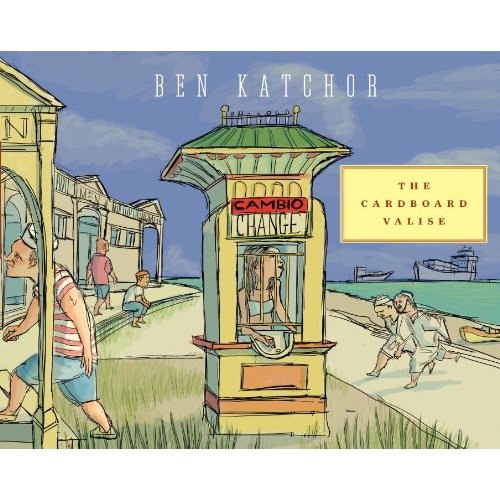
Since 1988, Brooklyn-born artist Ben Katchor has been exploring urban decay and disappearing aspects of culture and society in such comic strips as Hotel & Farm, The Jew of New York, and Julius Knipl, Real Estate Photographer as well as in such musical theater pieces as The Rosenbach Company and The Slug Bearers of Kayrol Island, or, The Friends of Dr. Rushower. He focuses on old-fashioned characters who wander through cities mumbling and grumbling about the way things were, seeking out blue-plate specials and marveling at old signage from a bygone era. Katchor has just released his latest book, The Cardboard Valise (Pantheon, March 2011, $25.95), a collection of “picture-stories” published in Metropolis magazine that detail eccentric xenophile Emile Delilah’s surreal existence, including his journey to the Tensint Islands, an exotic land known for its rest-room ruins and boardwalk ice-cream licker. The book comes with fold-out carrying flaps, mimicking Emile’s valise, which is filled with an array of things, as is Katchor’s book. On April 2 at 2:00, Katchor will present A Checkroom Romance at the New School Presents Noir festival; the free musical production features text and images by Katchor and music by Mark Mulcahy. On April 9, Katchor will be signing copies of his books at the Pantheon booth at the MoCCA Festival of Comic Art at the 69th Regiment Armory at Lexington Ave. and 26th St. Katchor recently discussed travel and the future of the book in our latest twi-ny talk.

Ben Katchor’s latest collection is another genius examination of eccentricity in a surreal, old-fashioned world (photo by Jeff Goodman)

twi-ny: Your previous book, The Beauty Supply District, came out more than ten years ago. Why such a long wait?

Ben Katchor: I got involved in working on music-theater productions over the past ten years. In collaboration with composer Mark Mulcahy, we produced four shows: The Slugbearers of Kayrol Island, The Rosenbach Company, A Checkroom Romance, Memorial City, and, premiering in October 2011, Up from the Stacks. All along, I continued my weekly and monthly picture-stories but didn’t feel the need to compile them into a book — until now.

twi-ny: In The Cardboard Valise, Emile Delilah packs a heavy suitcase and heads to the Tensint Islands. You’ve also taken readers on a journey to Kayrol Island. When you go on vacation, do you prefer bustling cities, dusty towns, or exotic islands? Are there certain items that you always pack that you don’t necessarily really need, as Emile does?

BK: I like cities and the countryside of Europe. I tend to bring along piles of research material that I rarely get to use.

twi-ny: One of the major themes of your work has always involved disappearing parts of culture — outdated factories, old-fashioned signage, and people lamenting the way daily life is changing, missing how things were. With the growing success of electronic books, there are some sounding the death knell for the physical book itself. What are your thoughts on ebooks, specifically as it relates to the kind of picture-stories that you tell? Are you afraid the physical book might be a disappearing part of American culture?

BK: The repurposing of physical books for electronic distribution is an awkward and limited activity, mainly for archival purposes. The possibilities of electronic storytelling go far beyond the confines of the printed book and I look forward to seeing what develops. Physical books will be around for a long time — I see them used as window and door props, and as structures to support laptop computers. I’m used to looking at picture-stories on large high-resolution screens; modern printed books seem to me like an unfortunate reduction of the information in the original digital file. The publishing industry began to dematerialize books with the introduction of the disposable paperback — the ebook is the logical expression of this impulse.
TAYLOR KUFFNER: TROMPONGAN GEDE / ANSAMBEL GENDER WAYANG

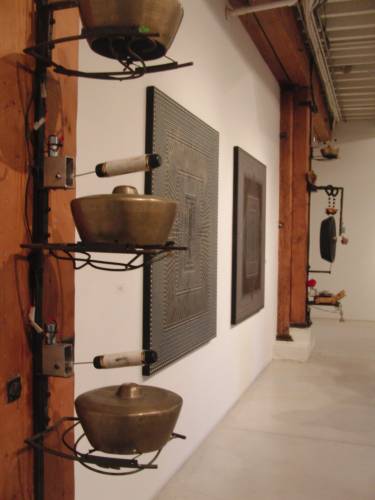
Zemi17’s GamelaTrons bring meditative music to Chelsea (photo by twi-ny/mdr)

FACING EAST
Sundaram Tagore Gallery
547 West 27th St. between Tenth & Eleventh Aves.
Tuesday – Saturday through April 2, 10:00 am – 6:00 pm
212-677-4520
www.sundaramtagore.com
www.zemi17.net
gamelatron slideshow

Since March 4, the northern edge of the Chelsea art district has been alive with the sound of an unusual kind of music, and this is the last week to be drawn in by its meditative mystery and magic. The rhythmic chiming is coming from both inside and outside the Sundaram Tagore Gallery on West 27th St., part of the “Facing East” group show focusing on works by contemporary artists from Japan, Korea, Vietnam, India, and Uzbekistan. Interspersed among such paintings as Hiroshi Senju’s “Waterfall” and Natvar Bhavsar’s “Truptya” is a pair of site-specific audiovisual installations by American artist, composer, and musician Aaron Taylor Kuffner, aka Zemi17, who spent several years in Indonesia studying traditional Balinese and Javanese music. In the back room is “Ansambel Gender Wayang,” what Kuffner refers to as “the world’s first fully robotic Gamelan Orchestra,” with a quartet of percussive GamelaTrons, as well as a sharp-toothed turtle, performing a series of computerized scores that allow visitors to watch the various hammers banging up and down. Meanwhile, “Trompongan Gede,” consisting of dozens of gongs, bells, hammers, mallets, and lights placed throughout the rest of the gallery, play numerous compositions that can be both cacophonous and soothing, restful and energizing. “The reactions vary widely,” Kuffner told twi-ny. “Some people are surprised or even frightened; others are elated and seem to turn into curious children just after hearing a couple gongs ring out.” The show continues through April 2.

Developed with the League of Electronic Musical Urban Robots (LEMUR), the GamelaTrons come with a spacey sci-fi back story that you don’t need to know about to enjoy the sounds, but in case you’re curious, here’s how Zemi17 describes it: “In the not too distant future, after massive climate change has transformed the earth and made human life as we know it impossible, our descendants — an ethereal synthesis of our human consciousness and highly advanced robot technology — discover a set of bronze percussive instruments buried in the earth. The sounds from striking these gongs and bells awaken memories and dreams from an era long past. These future beings develop a simple set of networked mechanical mallets that mimic the movements of the human musicians they have seen in their dreams. The songs this robot orchestra plays tell joyful, sad, bittersweet, wise, and wondering stories from the time of the human race’s great transformation.”

TICKET GIVEAWAY: LA CAGE AUX FOLLES

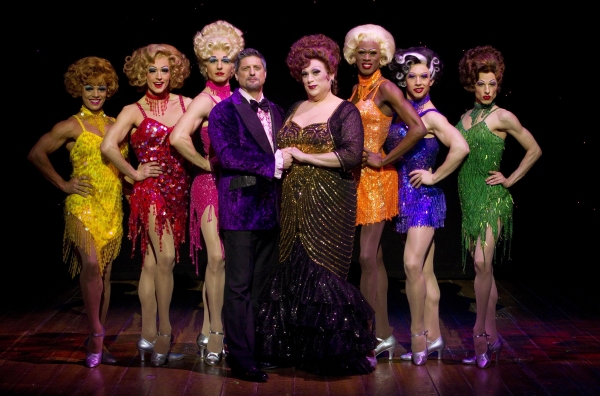
Christopher Sieber and Harvey Fierstein have taken over the lead roles in Tony-winning Broadway revival of LA CAGE AUX FOLLES (photo by Joan Marcus)

Longacre Theater
220 West 48th St. between Broadway & Eighth Ave.
Tickets: $47.50 – $79.50 with this special offer
www.lacage.com

La Cage Aux Folles began its life as a 1973 French play written by and starring Jean Poiret with Michel Serrault, about a young man who is introducing his fiancée’s conservative parents to his father and his father’s rather flamboyant drag-performing lover. Five years later it was turned into a film by Édouard Molinaro starring Ugo Tognazzi and Serrault, and in 1983 it became a hit Broadway musical, winning six Tonys, including Best Book of a Musical (Harvey Fierstein), Best Original Score (Jerry Herman), and Best Musical. In 1996, Mike Nichols remade the original film as The Birdcage, with Robin Williams, Nathan Lane, and Gene Hackman. And now the musical is back on Broadway, in a new production at the Longacre Theatre that earned 2010 Tonys for Best Musical Revival as well as Best Actor (Douglas Hodge) and Best Director (Terry Johnson).

The cast has just undergone a number of changes, the most exciting of which has Fierstein playing Albin/Zaza for the first time ever; in addition, Christopher Sieber is the new Georges, replacing Jeffrey Tambor, who lasted a mere nine days taking over for Tony nominee Kelsey Grammer; other current cast members include A. J. Shively as Jean-Michel, Mike McShane as M. Renaud/M. Dindon, Alyce Beasley as Mme. Dindon/Mme. Renaud, Wilson Jermaine Heredia as Jacob, and Elena Shaddow as Anne. La Cage Aux Folles, which features such songs as “We Are What We Are,” “I Am What I Am,” “Song on the Sand,” “Masculinity,” and “The Best of Times,” is currently running a special discount offer that saves you forty percent, but twi-ny also has two pairs of tickets to give away for free, good for Tuesdays at 8:00, Wednesdays at 2:30 and 8:00, Thursdays at 8:00, and Saturdays at 2:30 through May 1. To be eligible to win, just send your name and daytime phone number to contest@twi-ny.com by Monday, April 4, at 12 noon. All entrants must be twenty-one years of age or older; two winners will be selected at random.

DISTANT WORLDS: MUSIC FROM FINAL FANTASY

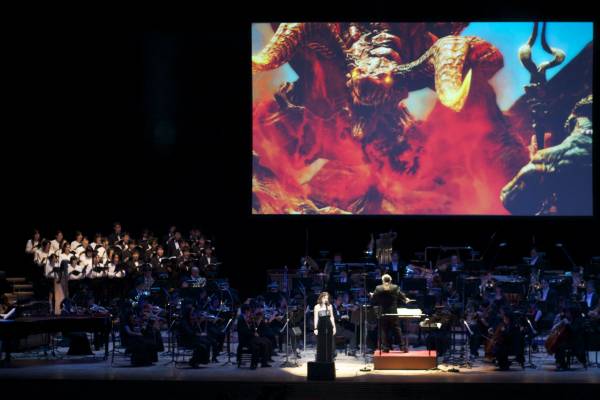
Final Fantasy multimedia concert experience comes to BAM April 1-2 (Final Fantasy XIV © 2010 Square Enix Co., Ltd. Final Fantasy is a registered trademark of Square Enix Holdings Co., Ltd. All material used under license.)

BAM Howard Gilman Opera House
Peter Jay Sharp Building
230 Lafayette Ave.
Friday, April 1, and Saturday April 2, $65-$175, 8:00
718-636-4100
www.ffdistantworlds.com
www.bam.org

Final Fantasy began as a role-playing video game in 1987 and has since expanded into manga, movies, television, and much more, emerging as an international phenomemon with a legion of dedicated fans. In addition to its amazing imagery using cutting-edge technology, Final Fantasy features symphonic scores composed by Nobuo Uematsu, who began making the music for the series shortly after accidentally bumping into creator Hironobu Sakaguchi. On April 1-2, Uematsu and conductor Arnie Roth will present “Distant Worlds: Music from Final Fantasy” at BAM’s Howard Gilman Opera House, performed by the Distant Worlds Philharmonic Orchestra, the Riverside Choral Society, and various soloists, accompanied by a screen showing memorable images and videos from the games. The April 1 program includes FF VII: Prelude, FFVIII: Liberi Fatali, FFXI: Memoro de la Stono — Distant Worlds, FF VII: J-E-N-O-V-A, FF VIII: Fisherman’s Horizon, the American premiere of FF XIV: Answers, FFX: To Zanarkand, FFVI: Terra’s Theme, FFXII: Kiss Me Goodbye, FFV: Clash on the Big Bridge, FFVII: Opening — Bombing Mission, and FFVIII: Don’t Be Afraid, while April 2 consists of FF VII: Aerith’s Theme, FF V: Dear Friends, FF IX: Vamo’ alla Flamenco, FF VI: Opera “Maria and Draco,” FF IX: A Place to Call Home — Melodies of Life, FFX: To Zanarkand, FFVI: Terra’s Theme, FFXII: Kiss Me Goodbye, FFV: Clash on the Big Bridge, FFVII: Opening — Bombing Mission, and FFVIII: Don’t Be Afraid. “Distant Worlds” has been touring the world, delivering its multimedia concert experience to fans who can’t get enough of Final Fantasy and its depiction of the ultimate battle between good and evil. Tickets start at $65, but if you splurge for the $175 package you get to meet Uematsu and Roth and attend an autograph and photo session. (If you use code 13999, you’ll save $10 on all tickets.)

DENEUVE: A CHRISTMAS TALE

A CHRISTMAS TALE concludes BAMcinématek’s “Deneuve” series in high style

A CHRISTMAS TALE (UN CONTE DE NOËL) (Arnaud Desplechin, 2008)
BAMcinématek
BAM Rose Cinemas
30 Lafayette Ave. between Ashland Pl. & St. Felix St.
Thursday, March 31, 6:30, 9:30
718-636-4100
www.bam.org

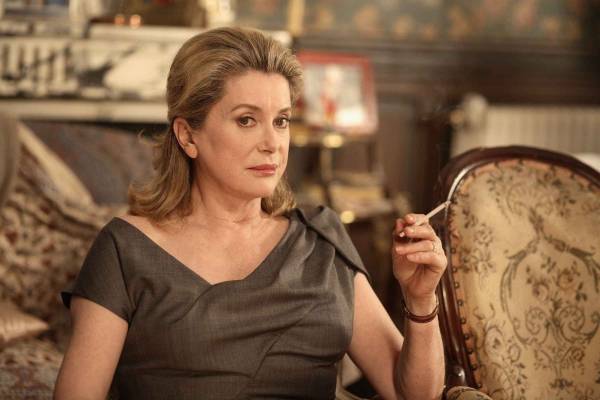
One of the best films of 2008, A Christmas Tale (Un Conte de Noël) is yet another extraordinary work from French filmmaker Arnaud Desplechin (La Sentinelle, Esther Kahn). Desplechin, who examined family dysfunction in the masterful Kings and Queen (one of the best films of 2006), brings back much of that film’s cast in A Christmas Tale. Catherine Deneuve stars as Junon, the family matriarch who has just discovered she has leukemia and is in need of a bone-marrow transplant. Although it is rare for children to donate bone marrow to their mother (or grandmother), Junon insists that they all take the test to see if they are compatible. Soon they gather at Junon and Abel’s (Jean-Paul Roussilon) house for the holidays: oldest daughter Elizabeth (Anne Consigny), a dark and depressed woman whose teenage son, Paul (Emile Berling), has been institutionalized with mental problems and whose husband, Claude (Hippolyte Girardot), is rarely home; Ivan (Melvil Poupaud), the youngest son, a carefree sort married to Sylvia (Chiara Mastroianni, Deneuve’s real-life daughter), whom Junon strongly distrusts; and black sheep Henri (Mathieu Almaric), the middle child who was initially conceived primarily to save Abel and Junon’s first son, Joseph, who ended up dying of the same leukemia that Junon has contracted. Henri, who shows up with a new girlfriend, the very direct Faunia (Emmanuelle Devos), is a philandering ne’er-do-well who is deeply estranged from Elizabeth and not close with his mother, leading to much strife as Christmas — and a possible transplant — nears. Desplechin, who wrote the script with Emmanuel Bourdieu, once again has created powerful, realistic characters portrayed marvelously by his extremely talented cast; despite the family’s massive dysfunction, you’ll feel that even spending more than two and a half hours with them is not enough. A Christmas Tale concludes BAMcinématek’s month-long “Deneuve” series in high style.


MIRU KIM: THE PIG THAT THEREFORE I AM

Miru Kim, “IA 1,” digital C-print, 2010 (© 2010 by Miru Kim)

Doosan Gallery
533 West 25th St. between Tenth & Eleventh Aves.
Tuesday – Saturday through April 23, free, 10:00 am – 6:00 pm
Artist Talk: Thursday, March 31, free, 6:00
212-242-6343
www.doosangallery.com
www.mirukim.com

For Miru Kim’s latest project, the performance artist and photographer took photos of herself naked on pig farms in Iowa and Missouri, posing with the animals. The work was inspired by Jacques Derrida’s “The Animal That Therefore I Am” — which starts, “In the beginning, I would like to entrust myself to words that, were it possible, would be naked” — and by iconoclastic French philosopher Michel Serres’s musings on the human skin, which she quotes from in her artist statement. Kim places her skin against the skin of the pigs, creating beautiful images that go beyond mere feminist metaphors and animal activism. “As I lay down next to a sow weighing five hundred pounds,” Kim writes on the walls of the gallery, “I felt the warmth travel from the soft underbelly of the animal into my bare right thigh. Two bodies mingled momentarily, in the skin on skin contact. I could no longer reason whether I was feeling the pig’s abdomen on my thigh, or the pig was feeling my thigh on her abdomen. The line between the subject and the object were obscured, and two souls mingled on the plane of contact.”

Miru Kim, “Compositions 1 and 5,” digital C-print, 2010 (© 2010 by Miru Kim)

Her five “Composition” pieces are hung together on one wall, unframed, extreme close-ups of her body pressed firmly against that of a pig, inviting visitors to get up close and personal, as if they were in the pen as well. In fact, at the March 24 opening, the gallery was so packed that it mimicked some of the photos, although in this case Kim was dressed. In “MO 1,” her right arm is reaching up, echoing the pigs’ water feeders, while in “MO 2,” Kim is standing, facing away from the camera, exposing her backside much like the pigs’ bottoms and tails that stick out of the gates. And in others, she lies down, bends over, and kneels in the mud, becoming one with the animals.

Raised in Seoul and based in New York City, Kim traveled the world for her previous series, “Naked City Spleen,” taking pictures of herself nude in abandoned buildings, on rooftops and bridges, and in underground tunnels, becoming part of the urban architecture in Istanbul, Detroit, Paris, Philadelphia, Seoul, and New York. The new series, “The Pig That Therefore I Am,” debuted at last fall’s Fokus Lódz Biennale 2010 and is now on view at the Doosan Gallery in Chelsea through April 23. Kim, who has given lectures at the 2010 Conflux Festival, the second World Culture Forum, and the Entertainment Gathering 2008, will give a free Artist Talk at Doosan on Thursday, March 31, at 6:00.

TENEMENT TALKS

Historian Jane Ziegelman will lead a pair of culinary tours with the Tenement Museum (photo by Andrew Coe)

Lower East Side Tenement Museum
108 Orchard St.
Tuesday, March 29, and Thursday, April 7, $25, 6:30
Wednesday, March 30, and Tuesday, April 5, free with RSVP
212-982-8420
www.tenement.org

The Lower East Side Tenement Museum will be hosting a series of interesting Tenement Talks over the course of the next ten days, beginning Tuesday night with “Free Lunch,” a tasting and tour with Jane Ziegelman and representatives of Edible Brooklyn and Brooklyn Brewery, looking back at the nineteenth-century staple of free food when you buy a beer. This twenty-first-century “free lunch” will cost you $25. On Wednesday, Paul Goldberger will discuss “Why Architecture Matters” with Kristen Richards, upon the release of the paperback edition of his book. On April 5, Joan Silber will host a panel on “Immigrant Daughters on Family & Literature,” with Myra Goldberg, Joanna Clapps Herman, and Kathleen Hill talking about classic books that influenced their work and life. And on April 7, Jane Ziegelman and James Beard Foundation vice president Mitchell Davis will lead ticket holders on the tour “97 Orchard: An Edible History” ($25).