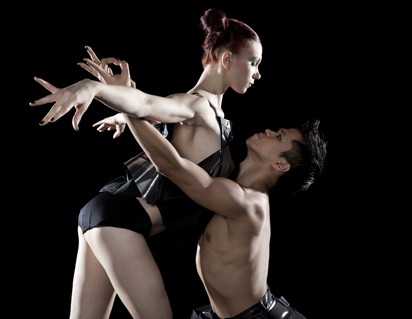
Karole Armitage’s GAGA-GAKU has its world premiere at the Joyce this week (photo by Julieta Cervantes)
The Joyce Theater
175 Eighth Ave. at 19th St.
Through May 8, $10-$39
212-691-9740
www.joyce.org
www.armitagegonedance.org
New York–based choreographer Karole Armitage describes her company’s current two-week run at the Joyce as “the culmination of ten years of intense work . . . the crescendo of a wild, exciting ride,” as Armitage Gone! Dance turns its attention more to multidisciplinary theatrical pursuits in the future. If that’s the case, they’re going out with quite a bang. Armitage is presenting two programs at the Joyce, the first of which consists of three very different works that combine to form a thrilling night of dance. The evening begins with the world premiere of GAGA-Gaku, which incorporates ancient Japanese court music, Cambodian court dance, Japanese Noh theater, and Balinese dance. AG!D members are joined by three guest dancers from the Dance Theatre of Harlem on a miniaturized dark stage, a red curtain cutting the space by more than half, the lights dangling just over their heads. Evoking Balinese puppet theater and Southeast Asian and Indonesian statuary, the dancers exhibit unusual poses emphasizing the long lines of arms and legs, traditional hand positions (mudras), and right-angled knees and ankles. Feet pound rhythmically on the floor, adding percussion to the mesmerizing guitar-heavy score by Lois V Vierk. Reflections from the silvery ground send shadowy patterns up their skin, adding another facet to Issey Miyake’s intriguing costumes for the women, three-dimensional sculptural origami camisoles made of recyclable fibers and developed through mathematical algorithms with the help of a computer scientist. Near the end of the piece, as Vierk’s “Red Shift” threatens to explode, Matthew Mottel, listed in the program as a character named Mushroom, comes out from behind the curtain and starts talking about zombies from Albuquerque; it’s utterly bewildering and infuriatingly out of place in a piece that otherwise was reaching a dazzling conclusion. The bizarre intrusion was the talk of intermission; we’re sure Armitage had her reasons, but two days later, we’re still scratching our head.
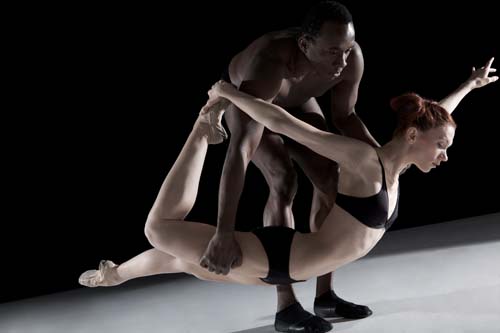
LIGETI ESSAYS is one of four pieces featured in Armitage Gone! Dance season at the Joyce (photo by Julia Cervantes)
GAGA-Gaku is followed by the beautiful Ligeti Essays, a 2005 work set to a trio of song cycles by twentieth-century Hungarian composer György Sándor Ligeti. On the full stage, icy white light falls from the ceiling, illuminating a Roxy Paine-like metallic tree with bare branches in the far left corner, shining against the black backdrop. The floor is illuminated by a large rectangle of fluorescent lights as dancers appear primarily in a series of solos and duets that range from silly and playful to sexy and serious. Marlon Taylor-Wiles and Masayo Yamaguchi are stand-outs as a couple that keeps returning to the alter-Edenesque site, designed by David Salle and Clifton Taylor (who designed the GAGA-Gaku set as well), to explore their relationship. Program A concludes with the all-out frenzy of Armitage’s 2009 revival of her 1981 breakthrough, Drastic-Classicism, in which all eleven members of the company cut loose on the open stage as if in a 1980s club, running and jumping around in Deanna Berg MacLean’s ripped, tight-fitting black costumes, hanging out in pseudo-cool poses against the exposed brick wall in the back, and interacting with the four guitarists and drummer powering away at Rhys Chatham’s commissioned punk score. It feels like an encore both for the audience and the dancers, who get to improvise within the piece, as well as a coda as Armitage looks to a changing future. (The three-part Program A is scheduled for April 29 & 30 and May 4, 5, and 7. Program B features Armitage’s 2010 work Three Theories, which the company performed last year at Cedar Lake as part of the World Science Festival. You can read our review of the sixty-five-minute piece, which delves into the Big Bang, the Theory of Relativity, Quantum Theory, and String Theory, here.)
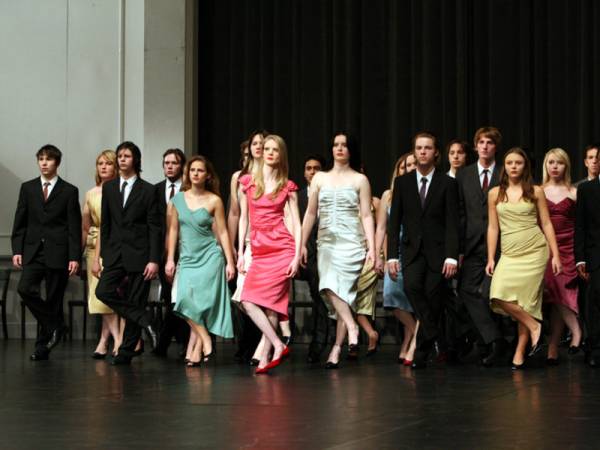
 From 1973 until her death in 2009, legendary dancer and choreographer Pina Bausch ran Tanztheater Wuppertal, the German company that changed the face of dance theater forever with such seminal productions as Rite of Spring, Café Müller, Danzón, Masurca Fogo, and so many more. In 1978 she staged Kontakthof, collaborating with Rolf Borzik, Marion Cito, and Hans Pop, set to music by Juan Llossas, Charlie Chaplin, Anton Karas, Sibelius, and other composers. In 2000, she revisited the piece with a cast of senior citizens, and eight years later she turned the roles over to a group of Wuppertal high schoolers, most of whom had never heard of her and had never danced before. Director Anne Linsel and cinematographer Rainer Hoffmann follow the development of this very different production in Dancing Dreams, speaking with the eager, nervous participants, who talk openly and honestly about their hopes and desires, as well as with rehearsal directors Jo-Ann Endicott and Benedicte Billet, who do not treat the teens with kid gloves but instead are trying to get them to reach deep inside of themselves and hold nothing back. When Bausch shows up to choose the final cast, telling the teenagers that she doesn’t bite, the tension mounts. Dancing Dreams is an intimate look at the creative process, about dedication and determination and what it takes to be an artist. It suffers at times from feeling too much like a reality television show, mixing American Idol and So You Think You Can Dance with the fictional Glee, but it also offers a last glimpse at Bausch, whose final interview is captured in the film. “You might think I’ve had enough of Kontakhtof,” she says at one point. “But every time it’s a new thing.” Dancing Dreams is screening May 1 & 2 as part of MoMA’s KINO 2011: New Cinema from Germany series, which runs April 27 – May 2 and also includes Gereon Wetzel and Jorg Adolph’s How to Make a Book with Steidl, Tom Tykwer’s Drei (Three), Friedmann Fromm’s Weissensee (The Weissensee Saga: A Berlin Love Story), Florian Cossen’s Das Lied in mir (The Day I Was Not Born), Philip Koch’s Picco, and a Next Generation presentation of short works.

 Based on a novel by Ma Shitu, Jiang Wen’s Let the Bullets Fly is a very funny action comedy set during the Warlord Era of the 1920s. After a train robbery doesn’t quite come off as planned, wanted gangster Pocky Zhang (Jiang) and his sidekicks team up with shady swindler Tang (Ge You) and a treasure-hunting woman (Carina Lau) to pose as the new county governor (Zhang) and his team, attempting to take over Goose Town and abscond with its money. But Goose Town already belongs to the crooked Huang Silang (Chow Yun-fat), who is not about to let Zhang take away what’s his. What follows is a goofy battle of wills that involves self-gutting, an idiot body double, some excellent gory violence, and lots of double entendres. A huge critical and commercial success in China, Let the Bullets Fly is way too long at 132 minutes, and the pacing often feels scattershot, perhaps the result of at least six screenwriters having poured out some thirty scripts before Jiang was ready to proceed. Jiang is wonderfully understated as Zhang, while Chow is a hoot as the local mobster whose domain is suddenly threatened. Filled with plenty of sly references and homages to Sergio Leone’s spaghetti Westerns, Let the Bullets Fly is a flawed but entertaining Chinese popcorner.